

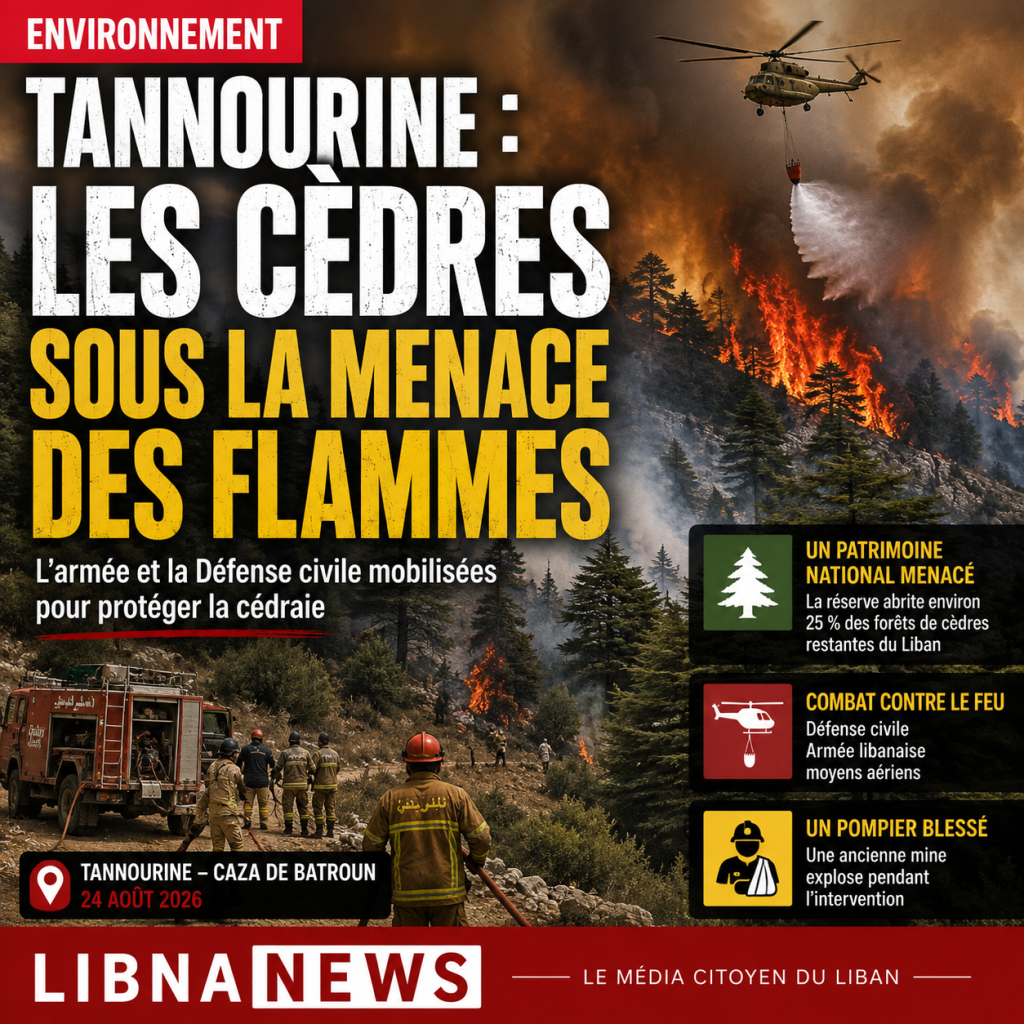
A major fire was declared on Monday 24 August 2026 in the vicinity of the Tannourine Cedar Nature Reserve in the Batroun Caza, fearing a spread to one of Lebanon’s most important cedars. The flames grew in a steep area near Arz al-Bilad, between Tannourine, Hadath al-Jebbe and Kfour al-Arabi. Civil Defence mobilized teams from about 10 centres, supported by a Lebanese Army helicopter. A firefighter was slightly injured by the explosion of an old mine during operations.
Fire developed in a particularly difficult terrain, making it difficult for ground crews to intervene. During the afternoon, local residents and officials called for a strengthening of air assets following difficulties encountered by the first arrangement. The immediate objective was to prevent flames from crossing the peripheral areas and reaching the heart of the cedar forest, whose ecological value far exceeds Tannourine limits.
The initial information available at the end of the day indicated that the fire threatened the reserve directly without a definitive assessment of the areas burned or the number of cedars affected. The extinguishing operations continued. The cause of the disaster had also not been determined, which required a distinction between the threat to the forest and speculation about the origin of the fire.
Fire at the door of Tannourine Cedar
The disaster was reported in the morning of Monday, 24 August, in the Arz al-Bilad area. The rugged terrain quickly constituted one of the main obstacles to operations. Fire spread into a steep valley where Civil Defence vehicles may not always have direct access to homes. This configuration increases the risk that a fire will progress under the influence of wind before teams can create shutdown lines or reach the flames.
Civil Defence has announced the engagement of teams from approximately ten centres. The Lebanese Army provided air support with a helicopter used to launch water. Tanks and an artificial water supply have also been mobilized to speed up the supply of fire-fighting equipment. During the afternoon, local officials reported that the teams were approaching disaster control, while maintaining operations to avoid recovery.
This mobilization reflects the sensitivity of the site. Fire not only threatens a local wooded space. The Tannourine Reserve protects one of the mainCedrus libanistill in the country. The Lebanese Ministry of the Environment estimates that the cedar community in this reserve accounts for about a quarter of the remaining cedar forests in Lebanon, giving each fire likely to penetrate a national dimension.
However, the situation remained evolving on Monday. The information gathered over the course of the day described a fire in the vicinity of the reserve, or a fire in its perimeter. In the absence of a full official assessment of the damage, it was not possible to say that the heart of the cedral had burned. The priority of relief remained precisely to avoid this progression.
An old mine hurts a firefighter
The operations were complicated by an additional incident. A member of the Civil Defence was slightly injured when an old mine, laid by a very active militia during the civil war, relict of past conflicts, exploded in the reserve. According to the Civil Defence, a stone fell on the machine caused the detonation. The firefighter was taken to the hospital for treatment.
This accident illustrates the particular risks that teams can face in certain Lebanese mountain areas. In addition to the immediate danger of fire, ammunition or old mines are sometimes added, the presence of which makes walking in difficult areas more dangerous. However, the teams must approach the outbreaks sufficiently to prevent the spread under the trees and treat the recovery after the aerial drop.
The injury did not interrupt operations. The Civil Defence indicated that its teams were continuing their work to encircle the disaster and limit its expansion, with the support of the army. No other injuries were officially reported in the information available at the end of the day.
An essential reserve for Lebanon’s natural heritage
The Tannourine Cedar Forest Nature Reserve was established by law in 1999 and is located in the mountains of northern Mount Lebanon. It protects a vast forest complex where Lebanon’s cedar dominates, along with juniper, oak and maple trees. Its topography, which has long been difficult to access, has helped to protect part of the forest from the logging and human exploitation that has reduced the ancient Lebanese cedars over the centuries.
The Ministry of Environment lists more than 600 plant species on the reserve, as well as about 20 species of mammals and over 40 species of butterflies and butterflies at night. The region is also recognized for its importance for birds, particularly on migratory routes. The loss of part of this forest cover would therefore have consequences that would not be limited to the cedars themselves.
The cedar also has a special place in Lebanese identity. Present on the national flag, it is both a historical symbol and a species whose natural stands are now fragmented. Large cedrals cover only a fraction of the massifs they once occupied. Tannourine, along with other northern and Chouf forests, is one of the essential cores of conservation.
This rarity increases the potential severity of fires. An adult tree may survive some limited damage, but intense fire can destroy young trees, damage trunks and alter the soil needed for regeneration. The loss of vegetation also further exposes slopes to erosion, particularly on rocky and steep terrains such as Tannourine.
Cedars already subjected to several pressures
The 24 August fire is not the only threat to the forest. Tannourine cedrals have already undergone a major plant protection crisis since the 1990s, when a previously unknown insect at the site caused repeated defoliation of trees. Species, baptizedCephalcia tannourinensis, required a monitoring and intervention programme involving the lebanese authorities and researchers.
This episode showed the vulnerability of an ecosystem that its apparent robustness can mask. Cedars are adapted to the difficult conditions of the Lebanese mountain, but temperature changes, drought, pests and fires can combine and weaken their regeneration capacity. Higher temperatures and longer dry periods increase the amount of vegetation that may ignite during the summer.
The risk of fire was precisely monitored nationally in recent days. The National Centre for Natural Hazards and Early Warning publishes daily risk levels for Lebanese communities. By 24 August, several areas of the Batroun District and surrounding areas had medium to very high levels, depending on the area. The maps do not allow a cause to be attributed to the Tannourine disaster, but they show that summer conditions remain favourable for rapid start and spread of fire.
The extent of damage still to be determined
The priority now remains to completely shut down the homes and prevent any night recovery. In mountain fires, embers may persist under vegetation or in rocky areas after large flames disappear. The wind can then reactivate these hot spots and fire again in a nearby area. Teams must therefore continue monitoring after the most spectacular phase of the intervention.
Environmental assessment will also be required once the disaster has been controlled. It should specify the area burned, identify the types of vegetation affected and determine whether cedars, including young trees, have been directly affected. At the end of Monday, no sufficiently consolidated official figures were yet available for this assessment.
The determination of the origin of the fire will be another step. No definite cause had been announced at the time of the operations. Forest fires may result from human activities, recklessness or other factors, but no hypothesis can be attributed to the Tannourine disaster without investigation.
For the teams mobilized on Monday, the urgency remained very concrete: to contain the flame front before it entered the densest areas of the cedral. As the night approached, the success of this operation had to determine whether Tannourine would emerge from the fire with limited damage to its periphery or whether any of the main shrines of the Lebanese cedar would suffer greater losses.




