

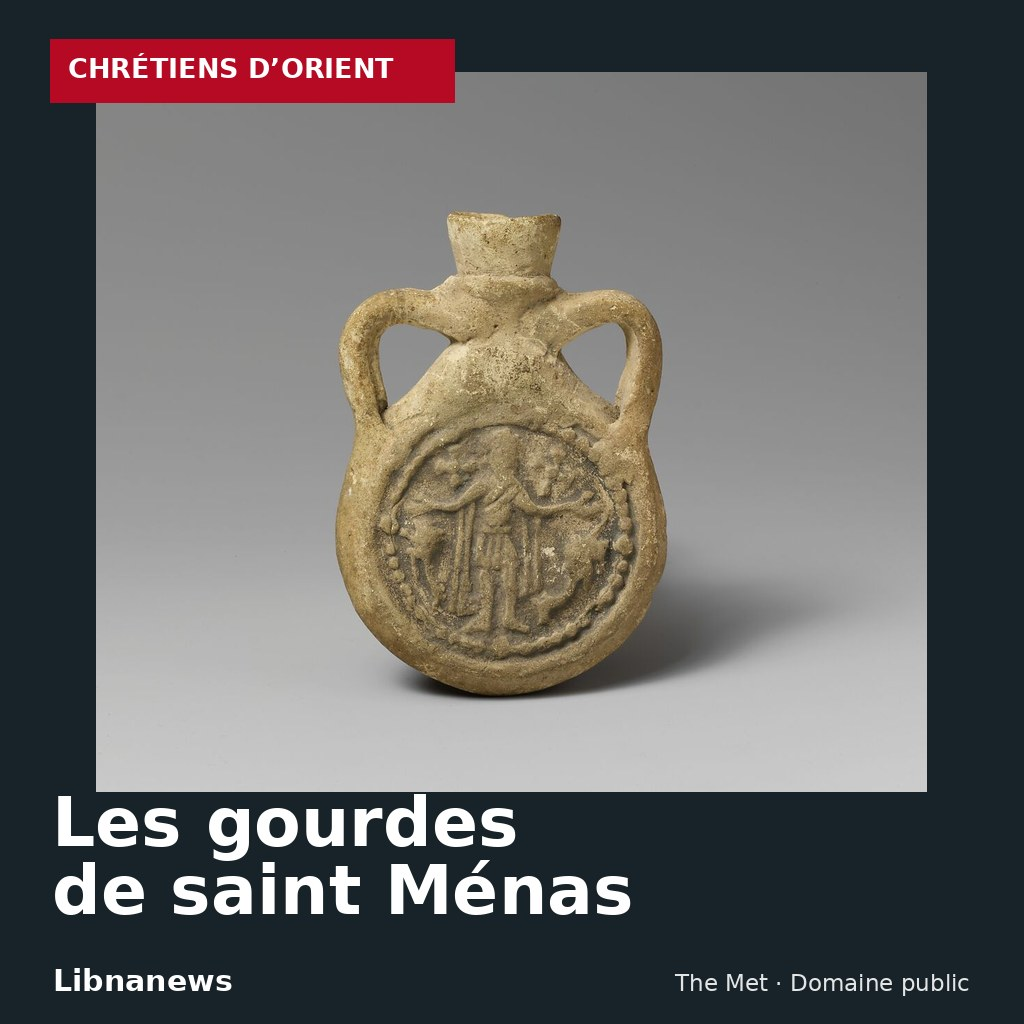
Up to ten centimetres high, a terracotta bottle preserved at the Metropolitan Museum of Art bears the image of Saint Menas between two camels. Pilgrims reported in these gourdes water or oil from the Egyptian sanctuary of Abu Mina. As the Coptic feast of November 24 approaches, this object tells how a place of pilgrimage circulated the image of the saint far beyond his tomb.
In the gourd, water or oil of the sanctuary
The Met dates from the 4th to the 7th century and is probably made in Abu Mina, southwest of Alexandria. The terracotta is not glazed. A short collar surmounts a flat stripe and two handles frame. The relief combines the central character with two camels. The museum notice does not present the object as proof of a specific journey: it explains the use of this type of light bulbs, which allowed to bring home water or oil from the holy place. The copy x.197 is not displayed, according to the museum.
The Louvre preserves several objects from the same family. On one of them, made of terracotta with a two-part mould, Menas is also associated with a dromedary. Another door to the Menas front between two lying dromedaries and, on the back, a decoration that the museum attributes to Saint Thecle. These differences remind us that not all gourdes capture exactly the same image. We can read practices and devotional figures, without presuming their content at the time each object entered a collection.
What the two camels represent
The synaxary, the liturgical collection that tells the life of the saints, commemorates the martyrdom of Mari Mina, says the Thaumaturge, the 15 Hathor. This date corresponds this year to Tuesday, November 24. In the account transmitted by Coptic tradition, Menas is a martyred Christian soldier; camels are linked to the return of his remains to Egypt. The terracotta attests that this scene was represented on devotional objects. It does not, on its own, allow to verify the episodes of the story.
Abu Mina, from the tomb to the city of pilgrimage
The remains give an idea of the extent of the gathering at the time. Around the tomb attributed to the martyr, the city of Abu Mina gathered churches, a Baptistery, streets, houses and workshops. The Egyptian Ministry of Tourism and Antiquities also describes a place for pilgrims. These are the remains of this ancient Christian centre, inscribed as a World Heritage Site in 1979, and not the Coptic Monastery, which UNESCO designates as Abu Mina.
The modern monastery of St. Mina adjoins the site. In May 2025, Pope Coptic Tawadros II visited the remains before going to the monastery, where he visited the cathedral and the sanctuary of Pope Kyrillos VI. The account of the Church distinguishes the two stages. On April 9, 2026, the patriarchate also documented a Holy Thursday liturgy in this monastery. This office attests that the place is always a place of worship; He does not say whether the faithful today carry the same gourdes as in ancient times. UNESCO also presents the monastic community as one of the partners in conservation work, without confusing it with the archaeological site.
Out of the list at risk, the site remains monitored
The rise of the water table, particularly linked to irrigation, has weakened the remains. After drainage and water control work, the World Heritage Committee removed Abu Mina from the World Heritage List at Risk in 2025. The site remains a World Heritage Site.
In 2026, the Committee welcomed the continued monitoring of the table level and the stabilization of structures. It encouraged the maintenance of a water-control rescue system and requested Egypt to report again by 1 December 2027. The release of the list at risk thus marks an improvement in conservation, not the end of the maintenance: the ruins always testify to the city that pilgrims left with their small gourdes.





Comments