





A dossier in the shadow of the offshore gas race
While the Lebanese energy debate has focused for years on the Mediterranean, the country’s ground floor remains almost absent from public discussion. However, historical and more recent geological studies and exploration campaigns have shown evidence of an oil and gas system in several parts of the territory. The information available does not indicate that Lebanon has commercially exploitable reserves. On the other hand, they establish a more precise reality: several areas have been considered promising enough to warrant further exploration, but the drilling required to verify this hypothesis has never been conducted at the depths now considered relevant.
The issue is all the more surprising as Lebanon is going through a deep economic crisis and is looking for investments that can generate new resources. The country has devoted considerable political energy to offshore exploration. It negotiated its maritime boundaries, allocated blocks, welcomed international companies and expected the results of offshore drilling. Meanwhile, the possibility of land exploration remained largely outside public priorities.
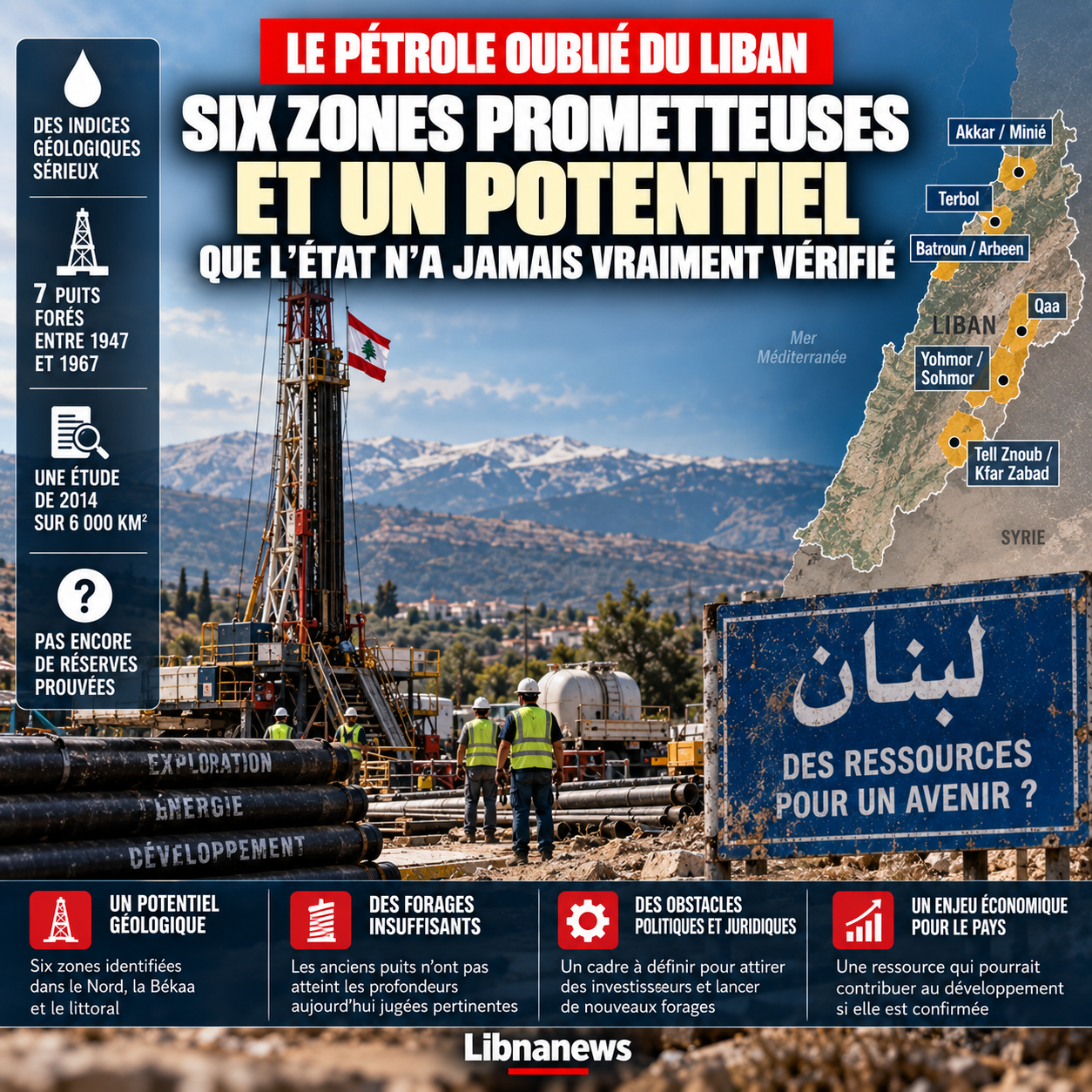
The data cited in the corpus are from a campaign conducted in 2014. An American company would then have conducted an aerial geophysical study covering approximately 6,000 square kilometres. The work would have covered the north of the country, the Bekaa and part of the coast. The information collected was then combined with two-dimensional seismic data already available from the State.
The results are presented as indicating the existence of an oil system and several structures that may merit exploration. But between « geological potential » and « commercial deposit », the distance is immense. Only deep enough drilling can determine whether hydrocarbons are actually present, in what quantities and under what technical conditions they could be produced.
This is precisely the stage Lebanon did not take.
Six areas appear in studies
The information collected identifies six geographical groupings considered promising. The first is in the Qaa depression, north of the Bekaa. The second concerns the areas of Yohmor and Sohmor in Western Bekaa. A third set is identified around Tell Znoub and Kfar Zabad, in the central part of the Bekaa.
The Terbol region, east of Tripoli, is a fourth area. A fifth is in total Batrun-Arbeen. Finally, the Akkar and the area of Minié appear as a sixth space, extending north of Mount Lebanon.
This distribution is interesting because it shows that the question does not concern an isolated point in the territory. The structures mentioned cross several geological regions of the country. The Bekaa occupies an important place, but the North is also concerned.
However, frequent confusion must be resisted. An area described as promising by a geological study does not necessarily contain an exploitable oil field. For an oil system to produce commercially attractive accumulation, several conditions must be met. This includes a parent rock capable of generating hydrocarbons, migration mechanisms, a sufficiently porous rock reservoir and a structure capable of retaining oil or gas.
A geophysical study can detect structures compatible with this model. It can’t replace drilling. As long as a probe has not reached the target and allows direct measurements, it is impossible to seriously talk about proven reserves.
The distinction is crucial for Lebanon. The Earth record deserves an exploration. It does not yet justify promises of wealth.
Seven wells had already been drilled between 1947 and 1967
Interest in the Lebanese basement is not new. Seven exploration wells were reported to have been drilled between 1947 and 1967. The sites mentioned include Yohmor, Sohmor, Terbol, Arbeen and Qaa.
These drillings are important because they are a direct observation of the basement. According to the available evidence, they provided evidence confirming the existence of an oil system and an oil-related activity. However, they did not lead to the discovery of a commercial deposit.
This lack of discovery could long be interpreted as a sign of weakness in the Earth’s potential. However, the specialized sources cited in the dossier offer another reading. The problem could come, at least in part, from the insufficient depth of old drilling.
Historical wells would have reached depths ranging from approximately 650 metres to 2,700 metres. More recent evaluations estimate that it would be necessary to go down to about 4,000 or 4,500 metres, or more, to properly test certain targets.
The gap is considerable. A well stopped at 2,700 metres does not indicate the absence of hydrocarbons in a structure with a target of 1,500 or 2,000 metres below.
This does not mean that the old drillings would have discovered oil had they been deeper. There is no element of the corpus that allows such an assertion. This only means that they have not tested all the targets that subsequent geological interpretations consider interesting.
Four kilometers underground before you know
This question of depth is the technical core of the case. To determine whether the identified structures contain commercially exploitable hydrocarbons, one or more exploration wells should be drilled to the horizons considered relevant.
A 4,000- or 4,500-metre drill is a complex industrial operation. It is necessary to identify precisely the location, prepare the site, mobilize a suitable drilling facility and cross several geological formations. Operators must then analyze the rocks, fluids and pressures encountered.
Even if oil or gas appears, the work does not stop. The size of the reservoir, its continuity, its pressure and the ease with which the hydrocarbons can be extracted must be determined. Additional assessment wells may be required prior to any development decision.
Only after this sequence can we start talking about technically recoverable resources and then commercially exploitable reserves.
Lebanon is now well ahead of this stage. Available information identifies targets. They do not provide sufficient figures on the volumes that could be recovered.
This lack of reliable figures must remain at the centre of any analysis. Land oil can be an economic path. It cannot be integrated into public accounts today as an acquired wealth.
Why didn’t the 2014 study trigger a drilling campaign?
It is here that the dossier becomes as institutional as well as geological. A 6,000-square-kilometre campaign identifying several promising areas could normally have led to the following step: completing the data, selecting targets and preparing calls to interested companies.
This did not occur at the scale necessary to test the structures.
Sources refer to a set of political, legal and technical obstacles. However, they do not allow the blockage to be attributed to a single decision or to a single person responsible. Rather, the problem appears to be the accumulation of several difficulties in a country where large energy projects are already subject to complex procedures.
The contrast with the offshore is striking. Lebanon has gradually developed an institutional and contractual framework for maritime exploration. Blocks have been defined. Allocation procedures have been organised. International companies have been able to enter the process.
The Earth did not have the same dynamics.
But an oil company does not engage in deep drilling simply because a study indicates potential. It must know the tax system, its rights to a possible discovery, the duration of its licence, environmental obligations, the rules of access to land and the procedures for building the facilities.
Legal uncertainty increases the risk. And the higher the risk, the more investors demand favourable conditions or choose another country.
The special problem of land
Land exploration has a difficulty that the offshore does not present in the same way: it is necessary to work on land occupied, cultivated or owned by different owners.
A geological structure does not respect cadastral boundaries. A potential reservoir may extend under several plots, villages or property types. The ideal site for drilling can be on private land or in an area used for agriculture.
This requires the State to have clear rules on access to land, compensation, easements and liability for damage.
There is also a need to distinguish between surface ownership and subsurface resource rights. These issues must be legally locked before major investors arrive. A company must know with which authority it negotiates and what procedures apply if an owner refuses access.
The elements of the corpus refer precisely to legal obstacles around the terrestrial sector. However, they do not provide sufficient details to reconstruct article by article throughout the applicable ownership regime. It would therefore be imprudent to invent a legal framework absent from the documents.
What sources make it possible to establish is simpler: the lack of a sufficiently successful legal and operational environment is one of the obstacles preventing the transition from geological studies to a real exploration campaign.
An exploration that could begin without promising a miracle
The first rational decision would not be to announce that Lebanon has oil. It would be to determine if he owns it.
This requires a step-by-step approach. Old data should be collected and reinterpreted. The results of the 2014 campaign should be confronted with the information available since then. Further studies could help refine structures before selecting priority targets.
The State could then define the legal and contractual conditions for operators to propose exploration campaigns. The six zones should not necessarily be opened simultaneously. One or more targets with the best relation between geological potential, accessibility and risk could be preferred.
The drilling would then become the trial judge.
If the first deep well does not encounter any commercial reservoir, the information would nevertheless have value. It would correct models and avoid building public policies on unrealistic expectations.
If he encounters hydrocarbons, a new phase would begin. Their volume and profitability should still be determined.
This method seems less spectacular than an announcement of discovery. However, it corresponds to the normal logic of oil exploration: gradually reduce uncertainty before investing more.
Land oil cannot become a new financial mirage
Lebanon’s recent economic history requires special caution. Any natural resource perspective can quickly be transformed into a promise of future revenue. However, the country cannot use hypothetical wealth to immediately settle its debt, repay depositors or finance reconstruction.
No land reserves are demonstrated by the available evidence. No future level of production can be calculated seriously from the only studies mentioned. No budgetary revenue can therefore be anticipated in a credible way.
This caution does not detract from the interest of the case. On the contrary, it allows the right question to be asked. The problem is not whether Lebanon should believe that it is rich. It is to understand why he did not make the necessary investments to really know his basement.
An exploration campaign can lead to failure. It’s inherent in the sector. But not to explore maintains the country in a situation where neither optimism nor pessimism can be verified.
An economic challenge that exceeds oil revenues alone
A commercial discovery would obviously have important consequences. But the economic interest of an exploration program begins before production.
Geophysical campaigns, drilling, environmental studies and associated services involve engineers, technicians, transportation companies and suppliers. Infrastructure must be created or adapted.
Land development could also have regional effects. Several identified areas are located in Bekaa and the North, two areas with significant investment needs.
These effects should not be exaggerated. The oil industry is highly capitalistic and does not automatically constitute a major provider of permanent jobs. But an organised programme could create a specialized activity and develop skills that could also be used in other energy sectors.
The key issue remains governance. A natural resource does not automatically produce development. Without transparent rules on licences, revenues, markets and environmental impacts, it can fuel new conflicts.
The environmental dimension cannot wait for the discovery
Land drilling directly brings the industry closer to the people. A platform located in Bekaa, Akkar or the North is not tens of kilometres away. It shares territory with villages, crops, water resources and existing infrastructure.
Environmental rules must therefore precede operations. They are responsible for managing drilling sludge, fluids, waste and pollution risks. Protection of groundwater is particularly important in a country already facing serious water management difficulties.
An impact assessment cannot be a formality performed after the site has been selected. She must be involved in selecting the target.
This dimension can also change the hierarchy of promising areas. A geologically interesting structure may be less attractive if its exploitation threatens an essential water resource or requires disproportionate interventions in a densely populated area.
The energy potential must therefore be assessed together with the environmental and territorial cost.
Comparison with offshore must remain measured
The land record returns to the moment when the hopes placed in marine exploration have already experienced expectations and disappointments. It would be tempting to present the earth’s basement as an alternative. The information available does not allow this conclusion.
Both fields respond to different geologies and constraints. A failure at sea does not prove anything about the Earth’s potential. Similarly, the evidence on land does not suggest that Lebanon has more hydrocarbons under its mountains and plains than under the Mediterranean.
The right approach is to diversify geological knowledge. Lebanon invested politically in the offshore because it had evidence to justify exploration. Terrestrial data also seem to be interesting enough to pose the question of modern exploration.
The difference is that the latter never reached the decisive stage of deep drilling.
The real scandal would be to confuse potential with certainty
The six identified areas, the seven former wells and the 2014 geophysical campaign form a sufficiently serious set to justify an exploration policy. They are not evidence of oil wealth.
It is this border that a credible public strategy should preserve. The state must not sell an oil dream or abandon a potential before it has been verified.
The former boreholes reached about 650 to 2,700 metres. Today’s targets may require depths of 4,000 to 4,500 metres or more. This difference alone explains why historical results do not permanently close the file.
Nearly 12 years after the 2014 geophysical campaign, the question remains almost the same: what is there really under Lebanese territory?
Lebanon has indices, data and areas to study. It does not yet have commercially proven land reserves on the basis of available evidence. Between the two is precisely what the state never led to the end: a modern drilling campaign capable of transforming a geological hypothesis into a response.