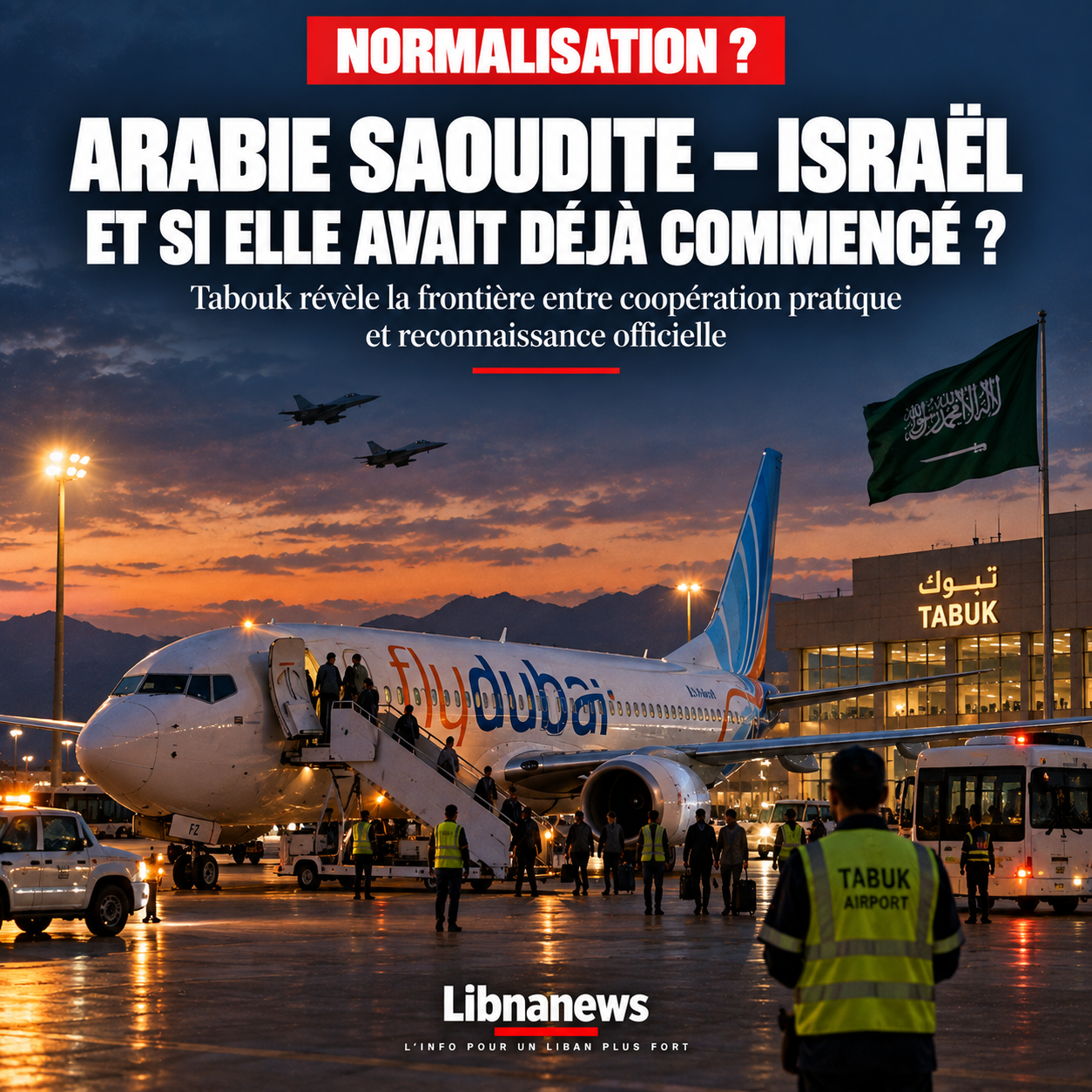
The incident on board the Flydubai flight between Dubai and Tel-Aviv could only be a rather spectacular occurrence. A problem erupted on board, the code 7500 indicating possible unlawful intervention was issued, Israel immediately took off fighter aircraft and eventually landed in Tabuk, Saudi Arabia, with a very large majority of Israeli passengers on board. But it is precisely the banality with which the situation was finally managed that deserves to be stopped. For a few hours, a country that does not officially recognize Israel welcomed a plane that went to Tel Aviv, took care of its Israeli passengers and actually participated in the resolution of a crisis that was followed directly by the Israeli authorities.
Taken separately, each of these elements can perfectly explain. A plane in difficulty must be able to land. Passengers must be protected regardless of their nationality. Israel had to react when an aircraft carrying its nationals issued a signal that might correspond to a hijacking. Saudi Arabia had to manage what was happening in its airspace. None of this proves the existence of a secret agreement between Riyadh and Israel. But the accumulation of these elements raises a much more interesting question: what if the normalization we have been talking about for years had already begun in practice, while only its formalization remained blocked?
The question deserves to be asked all the more because the episode does not start in Tabuk. As soon as code 7500 was issued, Israel took off combat aircraft to meet the Flydubai Boeing. At that time, Israeli pilots obviously could not know how the incident would end. The aircraft was finally heading towards Saudi Arabia. The Israeli fighters, to our knowledge, did not enter Saudi airspace, and it would be false to say otherwise. But what would have happened if the situation on board had remained uncontrolled as the Boeing crossed the border?
This is probably one of the most interesting issues in this whole case. Would the Israeli fighters have interrupted their mission on the Saudi border while an aircraft that might have been hijacked and carried more than a hundred Israelis was continuing its route? Would the Saudis have taken over immediately? Would an exceptional authorisation have been issued? Would the Americans have coordinated? It is perfectly possible that procedures exist for this kind of situation without the public knowing the details. And if they exist, they may say more about real relations between the States of the region than diplomatic communiqués.
Because this is not the first time the question has arisen. During the confrontations with Iran, the same questions had already arisen about the trajectories of Israeli aircraft, information provided by American and Arab radars, air defence systems and mechanisms to prevent an Israeli aircraft from being targeted by a country that, officially, is not its ally. Of course, some of this information remains secret, and many of the claims that circulate on the air corridors used by Israel have never been demonstrated. But there have long been a number of Polichinelle secrets in the region: States that do not recognize themselves officially can perfectly share certain interests and above all need to know what the other does when missiles, drones or combat aircraft cross the region.
Iran was probably the main accelerator of this discreet rapprochement. For years, Israel and several Gulf monarchies have watched with concern the development of Iranian ballistic capabilities, its nuclear programme and the extension of its regional influence. Their interests were not identical and they are still not. Saudi Arabia has also restored its diplomatic relations with Tehran and is now seeking to avoid a confrontation that could directly threaten its infrastructure and economic development. But the existence of differences does not erase the years during which Israelis and Saudis considered part of the same threats with the same concerns.
To this is added the role of the United States. Washington is both Israel’s main military ally and an essential security partner for Saudi Arabia. In the region, the Americans have surveillance capabilities, bases, radars and command capabilities that make it increasingly theoretical that everyone would operate in a completely separate system. It is not even necessary for an Israeli officer to call a Saudi officer directly to make a form of coordination exist. If the information goes back to an American system before being redistributed to the various partners, the operating result can be substantially the same without either government having to speak publicly about cooperation.
This is where the Flydubai incident becomes revealing. A plane from the Emirates to Israel faces a serious problem. Israel takes off its hunters. The aircraft is heading towards Saudi Arabia. The Saudis welcomed his Israeli passengers and the crisis was finally handled without incident between countries that did not even have diplomatic relations on paper. This obviously does not look like an alliance. But it doesn’t really look like two totally foreign states either.
The continuation is even more interesting because it shows precisely where the boundary is. Once the emergency had ended, Israel would have wished to send military aircraft to recover its nationals in Tabuk. Riyadh refused. The passengers therefore had to leave by other means, notably with Flydubai. The Saudi decision is not contradictory to the above. On the contrary, it allows us to understand Riyadh’s logic. Welcoming a civilian aircraft in difficulty and ensuring the safety of its passengers can be presented as a normal obligation. To see Israeli military aircraft landing on Saudi soil would have produced a much more politically difficult image.
We may be touching here on the real border of the current Israeli-Saudi relationship. Anything necessary, discreet, technical or justifiable by an emergency may become possible. What would turn this cooperation into a public symbol remains forbidden. Saudis can accommodate more than a hundred Israelis in Tabuk, but they do not want a photograph of an Israeli military aircraft on a Saudi tarmac. The difference seems small operationally. Politically, it is immense.
This leads us to wonder what the exact meaning of the word « standardisation » still means. If one speaks of embassies, ambassadors, official visits and diplomatic recognition, it obviously did not take place. Saudi Arabia continues to formally condition the establishment of relations with Israel for progress on the Palestinian question. But if normalization means that one country gradually accepts the existence of the other in its strategic environment, can communicate with it directly or indirectly when a crisis imposes and can manage common situations without immediately causing an incident, then the process seems much more advanced.
This may be the way standardization actually takes place. One often imagines a forward and one after: two countries would be enemies until the day their leaders sign an agreement in front of the cameras. In reality, things can be much more progressive. Secret contacts appear first, then interests converge, intermediaries transmit messages, the military learn not to bother, some information circulates and previously impossible situations become gradually banal. When the official agreement arrives, it sometimes creates only a part of the relationship. It mainly makes public an evolution that began several years earlier.
However, Saudi Arabia remains in a particular position. It is neither the United Arab Emirates nor Bahrain. The kingdom houses Mecca and Medina and retains a considerable weight in the Muslim world. A normalization with Israel would therefore have far greater political and symbolic significance than those already achieved under the Abraham Accords. Moreover, the Palestinian question remains an obstacle that Riyadh cannot simply remove, especially after the wars that have disrupted the region.
Perhaps that is precisely why an unofficial relationship can suit everyone, at least temporarily. Israel benefits from a regional environment in which Saudi Arabia is no longer necessarily hostile to each of its actions and where interests can converge. Riyadh retains its political freedom, maintains its position on Palestine and avoids the symbolic cost of official recognition. Washington, for its part, can continue to build a regional security architecture without waiting for all diplomatic disputes to be resolved.
The Tabuk incident, however, introduces an additional element into this relationship: Saudi Arabia has objectively just served Israel. The scope of the gesture should not be exaggerated. Riyadh did what a responsible State had to deal with an aircraft in difficulty and there was no evidence that any consideration had been requested. But relations between States are also built on a memory of crises and behaviour when the situation becomes difficult.
More than a hundred Israelis have found themselves in Saudi Arabia in potentially dangerous circumstances. They were welcomed and protected. Israel knows that. Saudi officials know that Israel knows. This kind of precedent does not create any legal obligation, but it may one day enter into a much broader discussion, especially when Riyadh seeks to get something about Gaza, the Palestinian question, Jerusalem, annexation projects or another regional issue.
The question therefore is not whether Mohammed bin Salmane will present tomorrow an invoice to Benjamin Netanyahu, for example with concessions to a future Palestinian state. International relations rarely function so simplisticly. Rather, it is a question of whether Saudi Arabia has added an element to this informal political capital, which then allows one State to remind another that it has acted responsibly when its interests or its nationals were directly concerned.
The case could also leave a trace in Israeli opinion. Standardization with Saudi Arabia is generally presented in Israel as a major geopolitical project combining Washington, American safeguards, regional security and the Palestinian question. This time, it took a much more concrete form. For the families of the passengers, Saudi Arabia was no longer a diplomatic concept: it was the country where their aircraft had found refuge and where their relatives had been taken care of.
Of course, we must not draw excessive conclusions. An emergency landing does not make an alliance and a few hours of cooperation imposed by the circumstances is not sufficient to demonstrate the existence of secret normalization. But the incident requires at least a different look at the issue.
For years, it has been asked when Saudi Arabia will normalize its relations with Israel. Perhaps the question is wrong. We should also ask ourselves what part of this normalization has already taken place without an embassy, without a treaty and especially without an official photograph.
Tabuk may have given us an overview. Not that of a hidden alliance that would already be fully constituted, but that of a Middle East where real relations began to exceed official relations. As long as all this remains discreet, technical or imposed by circumstances, everyone can continue to publicly defend their position. When the symbol becomes too visible, as could have been the landing of Israeli military aircraft in Saudi Arabia, Riyadh closes the door.
It is this border that is interesting. And the Flydubai incident had the merit, for a few hours, of making it visible.