





A signal still partial, but serious enough to be followed
Initial information gathered from the education sector in the run-up to the re-entry of 2026-2027 indicates a decline in enrolment in schools and universities compared to previous years. However, it would be premature to deduct a uniform decrease in the number of pupils and students in Lebanon. By 23 September, university enrolments have not even been completed: at Lebanese University, they remain open until 20 November for new and old students, and until the end of December for doctorates. Consolidated figures for the school year 2026-2027 are not yet available.
However, information should be taken seriously because it is part of an older trend. Data from the Centre for Educational Research and Development show that the paying private sector had already lost about 12% of its students over a period of five years before the new war. The decrease was 19 per cent in Beirut and 27.7 per cent in Bekaa. The phenomenon therefore does not begin with the current start. What changed in 2026 was the accumulation of several factors: the cost of private institutions, displacement caused by war, destruction of schools, emigration of families and income weakening.
Above all, a misinterpretation must be avoided. A pupil who disappears from the registers of a private school did not necessarily leave the education system. He may have joined a free public or private school, moved to another region, left Lebanon or interrupted his schooling. Similarly, a decline in enrolment in a private university may be a transfer to the Lebanese University, studies abroad or the temporary abandonment of higher education.
The real subject is not only the decline. It is to knowwhere students go who do not re-register where they were expectedprotection caps (if present).
Private paying had started to lose students long before 2026
For a long time, private education has occupied an exceptional place in the Lebanese system. It remains particularly dominant in the early years of schooling. The latest available structural data show that more than three quarters of preschool children are accommodated in the private sector. As students progress, the share of the public sector increases; At the secondary level, more than half of the pupils are now enrolled in the school.
This trend already indicates a form of progressive economic selection. The more education progresses, the more families turn to the public.
The decline of 12% over five years in the non-free private sector confirms that the phenomenon is not marginal. It is particularly marked in regions where income has been heavily affected by the crisis. Beirut itself lost nearly one fifth of the students in this sector over the period observed.
Conversely, free private sector has increased over part of this period. This difference is important: families do not necessarily leave private education because they reject its teaching model. They can look for a cheaper formula.
The financial crisis opened in 2019 accelerated this logic. Private schools had to revise their fees to pay teachers and cover expenses which were now largely calculated in dollars. Parents whose incomes remained in books or were imperfectly adjusted had to arbitrate.
This mechanism does not always produce a drop-out. It first produces adowngrading by the pricea family that could choose its place of business now chooses which one it can pay for.
War adds geographical break to economic breakdown
However, the re-entry of 2026 is different from the previous one because of the physical state of the school network.
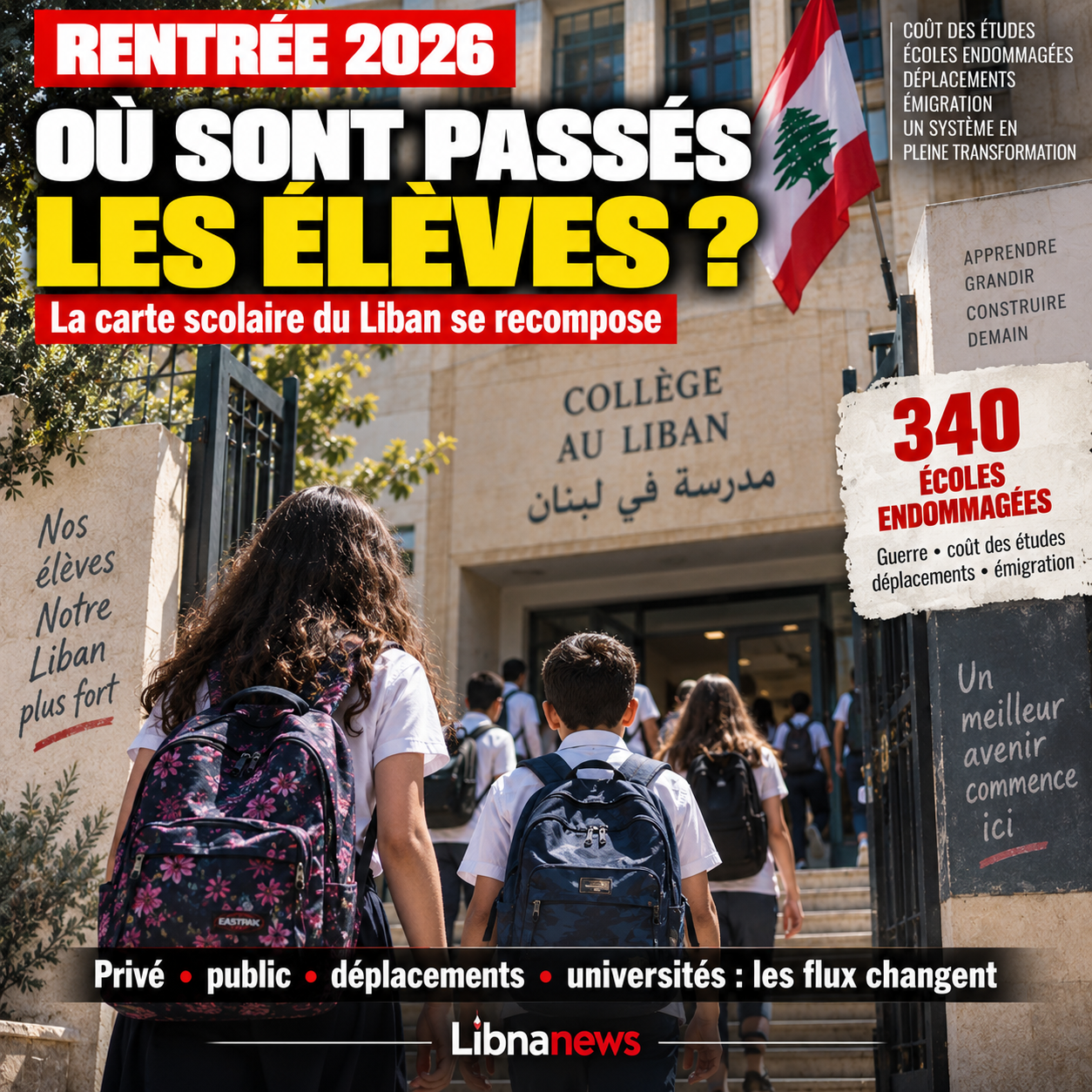
A national assessment conducted by the Ministry of Education in June identified 340 public, private and professional schools damaged by the conflict. Seventeen were completely destroyed. At the beginning of July, at least 100,000 children were at risk of starting the year without a classroom available if the necessary work was not completed in time.
The problem is particularly acute in the South. Dozens of State schools have also served as shelters for internally displaced persons. Some may return to school, others may still have to accommodate families or operate in degraded conditions.
This completely changes the reading of the inscriptions.
A decline in a Southern school may not translate into emigration or inability to pay. The student can simply live temporarily in another region. Her family can wait until they know if she can go back to the village before choosing her institution. She can also register the child near her place of travel without knowing how long this situation will last.
The school map of 2026 may therefore be a photograph of population movements as well as a photograph of the education system.
This distinction will be essential when the final figures are available.
Return to villages does not automatically mean return to the school of origin
Destruction causes an additional problem. A family may return to its locality without the establishment attended by its children being able to function.
It must then find a school in a nearby municipality, organize the transport and bear its cost.
In some locations near the border, families have chosen to return despite security risks. Prefabricated housing has begun to be installed to allow this return. But rebuilding a home and reopening a school are two different operations.
A school requires a secure building, teachers, equipment, electricity and sometimes public transport.
The consequence can be paradoxical: villages find part of their inhabitants without immediately returning to their school population.
In the medium term, this phenomenon can accelerate the concentration of students in schools in major cities and towns. Small schools in the affected areas may lose enough staff to make their reopening economically difficult.
The risk is then to turn a war-related closure into a lasting disappearance.
The cost of schooling now acts far beyond the fees displayed
For families not directly displaced, the cost remains the determining variable. But this should not be reduced to the amount of schooling.
This includes transportation, books, supplies, activities and sometimes ancillary payments requested by the institution. The increase in fuel particularly increases the first item.
A family with two or three children can therefore bear a much larger increase than that visible in the school rate alone.
This situation also affects geographical choices. A cheaper school but located away from home can become more expensive once transportation is added. Conversely, a family may prefer a community-based institution even if its educational project is less suited to its first choice.
The Lebanese school market is therefore recomposed according to a total cost logic.
This may encourage local public schools when they operate normally. But it can also strengthen some private schools free or semi-free able to maintain lower fees.
School reputation remains important. It is simply no longer the only criterion.
The demographic decline must be separated from the economic crisis
Another variable is more difficult to measure: the number of children actually living in Lebanon.
A decline in national enrolment can be interpreted as an educational problem, while it is partly the result of a decline in the school age population. Lebanese emigration, departures from foreign families and demographic changes directly influence the workforce.
It will therefore be necessary to wait for consolidated data to distinguish between two phenomena.
The first is a decrease in the total number of children in the country. In this case, declining enrolment does not necessarily mean that more children are deprived of school.
The second is a decrease in the enrolment rate among children present. This would be much more worrying.
Historical data already show that school participation declines as education progresses. The enrolment rate is high at primary level and then falls sharply at secondary level. Economic pressure is therefore likely to affect adolescents, for whom the family can arbitrate between continuing education, vocational training and early entry into the labour market.
It is at this level that the risk of dropping out probably deserves the greatest attention.
University diagnosis is even more difficult
The academic situation cannot be read with the same tools.
On 23 September, the Lebanese University is still at the beginning of a registration period which is due to last until 20 November. It is therefore impossible to use current entries as a definitive figure.
Some faculties still have waiting lists. At the Faculty of Technology, the students on these lists were scheduled to appear on 23 September to see if places had been released. This shows that a general decline cannot be inferred from some information from individual establishments.
The private sector also presents different situations. As a benchmark, a large private university had 9,765 students in the fall of 2025, including 2,201 new undergraduate students. These data provide a basis for comparison, but consolidated figures for autumn 2026 are not yet available.
The university issue lies mainly in the ability of families to finance several years of education in dollars.
A family can keep a child in a private school despite the increase in fees, and then no longer be able to finance a private university with a significantly higher annual cost.
The Lebanese University then becomes a natural remedy.
Transfer to Lebanese University may mask the impoverishment of families
A possible increase in enrolment at the Lebanese University should therefore not be automatically interpreted as a renewed academic attractiveness, even if the institution retains a major role.
It can also translate a financial constraint.
This is precisely what will have to be measured when enrolments are closed: how many students come directly from secondary school and how many are transferred from private universities?
Requests for transfer between faculties and branches are also explicitly provided for in the 2026-2027 calendar.
The same phenomenon may exist between private universities. A family can look for an institution that offers more financial assistance, a shorter program, or the possibility of staying at home rather than renting accommodation near campus.
University geography can therefore also change.
The student chooses less only one training. He now calculates at the same time university fees, accommodation, transportation and opportunity to work during his studies.
The most discreet risk is that of the student who does not register anywhere
Transfers between institutions remain visible. Abandonment is much less.
A student leaving a private university for Lebanese University appears in the statistics of both institutions. A person who defers his studies for one year or abandons his curriculum may disappear from the data without reason being immediately known.
Yet it is this population that deserves the most attention.
The economic crisis can cause a young person to work rather than continue his education. One family may decide to fund one child’s education as a priority rather than another. A student can go abroad not to study but to work.
These trajectories have a lasting effect on the country’s human capital.
Lebanon has historically offset part of its economic weaknesses with a high level of education. While the crisis reduces access to higher education by family income, it does not only cause immediate social hardship. It changes the qualification of the generation that will enter the labour market in a few years.
Private schools are themselves taken in an almost impossible equation
However, it would be less likely to present establishments as the cause of higher costs.
Schools must pay their teachers. They have seen their income collapse since 2019 and are demanding just living wages. Institutions must also finance energy, maintenance, insurance and equipment.
Keeping costs artificially very low can therefore lead to another form of degradation: departure of experienced teachers, reduction of services and reduction of quality.
Some schools can compensate through foundations, congregations or donor networks. Others are not able to do so.
This difference probably explains part of the restructuring of the private sector. Stronger institutions can absorb more shocks. Others must increase costs, merge, change managers or, in some cases, consider selling their assets.
The Nazareth school file in Ashrafieh has already shown how far this pressure can lead. However, it should not be generalised to all religious or private schools.
The figures from the start should be read as flows, not just as totals
When statistics 2026-2027 are available, simply comparing the total number of pupils with that of the previous year will not suffice.
We’ll have to measure the movements.
How many students left the private paying for the public? How many joined the free private? How many have changed regions because of the war? How many displaced children remain out of school? How many families have left the country? How many students have left private for Lebanese University? How many have interrupted their studies?
These flows tell very different realities.
A migration from private to public indicates primarily economic pressure on households. A simultaneous fall in both sectors would indicate a decline in the population or a drop-out. A decline concentrated in the South would indicate the effect of the war. A particularly strong decline in the superior would raise the question of university cost.
It is only by separating these movements that one can understand what is actually happening.
The re-entry of 2026 could mark a new stage of educational decommissioning
The signal transmitted by the first enrolments therefore does not yet make it possible to announce a national drop in enrolment. Definitive data are missing and, at university, enrolment is still open.
But the available trends already draw a deeper problem than a bad start.
Private payers lost students before the new war. Families now face higher costs of education and transportation. Hundreds of schools have been damaged. At least 100,000 children were exposed to the risk of not having a classroom in the school year. Travel changes school geography. And the cost of higher education can push more young people to Lebanese University or out of university.
The decisive question is therefore not yet how many registrations were lost in September. It is to determine what becomes of children and young people who disappear from the lists where they previously appeared.
If they reappear in another institution, Lebanon is mainly undergoing a recomposition of its educational card. If they leave the country, it undergoes a new demographic contraction. If they do not reappear anywhere, the problem becomes more serious:the economic crisis and war no longer move students only between schools; they begin to move them out of the education system itself.