

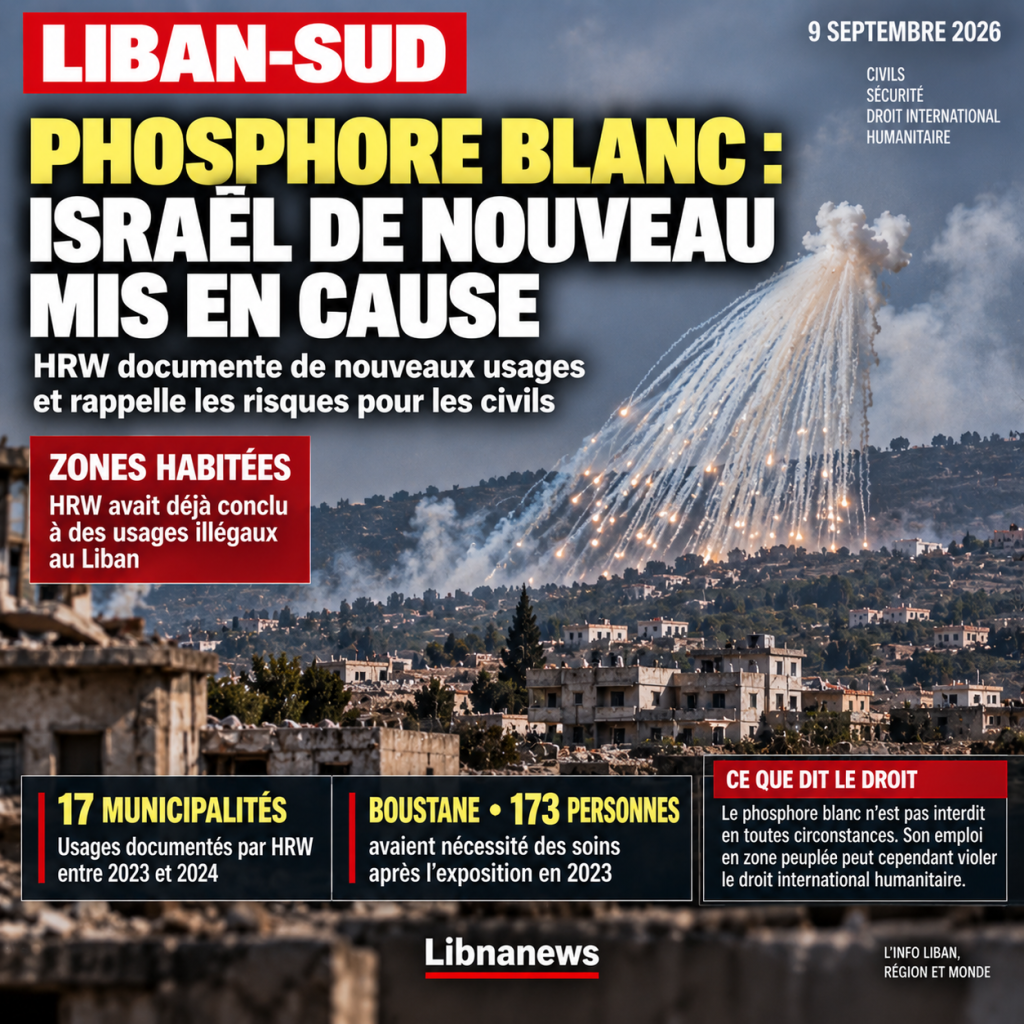
Human Rights Watch questions Israel’s use of white phosphorus munitions in Lebanon and highlights the legal risks associated with their use in inhabited areas. The human rights organisation believes that recent uses of this substance illustrate the shortcomings of international law governing incendiary weapons. But in Lebanon, the controversy goes beyond the question of future regulation: Israel already has a heavy documented precedent. Human Rights Watch had established that Israeli forces had used white phosphorus in residential areas in southern Lebanon, illegally exposing civilians to serious burns, fires and respiratory damage.
Israeli white phosphorus again involved in Lebanon
Human Rights Watch’s new position comes as Israel’s use of white phosphorus munitions is again reported in Lebanon. For the organization, these events demonstrate the need to strengthen the international rules applicable to such weapons.
The legal problem is not an absolute ban on white phosphorus. This substance can be used to produce a smokescreen, mark a target or illuminate an area. However, its use becomes extremely problematic when it occurs above or near areas where civilians are present.
White phosphorus ignites in contact with oxygen and can reach a temperature of about 815 degrees Celsius. Its fragments can cause deep burns, reach bones and continue to burn as long as they remain exposed to air.
In a residential area, the dispersion of tens or hundreds of incandescent fragments greatly increases the risk to the population. Buildings, crops and other flammable materials can also fire, extending damage well beyond the initial point of impact.
Human Rights Watch had already found illegal use
The question of the legality of the Israeli use of white phosphorus in Lebanon does not begin with recent events. Human Rights Watch had already investigated several Israeli attacks in the south of the country after the border clashes began in October 2023.
The organization had concluded that Israel had used white phosphorus in at least17 municipalities in southern Lebanonbetween October 2023 and June 2024. Of these, five communities had experienced aerial explosions of ammunition over populated residential areas.
HRW considered that this use in inhabited areas exposed civilians to unjustified risks. The organization called on Israel to immediately cease the use of white phosphorus projected by artillery in populated areas.
The NGO had also concluded that the use of white phosphorus in some villages did not comply with the precautionary obligations imposed on belligerents. The presence of civilian populations makes it particularly difficult to use a munition whose fragments disperse over a large area.
This distinction is essential. Human Rights Watch does not argue that any use of white phosphorus is automatically prohibited. She claims thatsome documented Israeli uses in Lebanon were illegal because of the circumstances in which they were carried out and the risks imposed on civilians.
At least 173 people had been affected in Boustane
One of the most important documented cases concerns the village of Boustane, in the Tyre District. An Israeli attack on white phosphorus on 15 October 2023 had caused effects on a large part of the population.
According to data collected by Human Rights Watch from local authorities, at least173 people needed medical careafter exposure to white phosphorus. These were mainly respiratory symptoms associated with smoke inhalation.
The inhabitants described a strong smell and difficulty breathing after the attack. Smoke produced by white phosphorus can cause serious irritation to the airways, eyes and mucous membranes.
The damage was therefore not limited to those directly affected by burning fragments. The use of the substance in or near a village may affect residents who are not at the point of impact.
Boustane is precisely the type of situation that feeds HRW’s legal argument. When munitions producing significant white phosphorus dispersion are used in a civilian environment, their user must take into account the predictability of damage.
Dhayra, Aïta al-Shaab and other documented villages
Human Rights Watch had also documented the use of white phosphorus in Dhayra, the border town of Tyre District. The organization had analysed videos and collected evidence to identify the use of this substance.
Other localities in southern Lebanon had been affected. The HRW survey had identified uses in at least 17 municipalities, including several areas where the explosive ordnance exploded in the air over residential areas.
This method of dispersion is particularly dangerous. A white phosphorus munition that explodes in height projects many inflamed fragments into an extended area, rather than concentrating its effects on a specific point.
In an open area without civilians, this feature can be used to quickly produce a smoke screen. In a village, it turns a large area into a potentially dangerous area.
As a result, Human Rights Watch had called on Israeli forces to focus on alternative solutions that did not pose the same risks. In particular, the armies have smoke ammunition that does not contain white phosphorus and allows some of the same tactical effects to be achieved.
Agricultural land also burned
In South Lebanon, the use of white phosphorus also raises the issue of environmental and agricultural damage. Incandescent fragments can cause fires in fields, olive groves, forests and dry vegetation areas.
These destructions have direct economic consequences for border villages. Much of their activity depends on agriculture, including olives, tobacco and other crops.
Fires can also prevent people from returning after an attack. Unfully consumed ammunition remains dangerous, as phosphorus can re-ignit when it is again exposed to oxygen.
Contamination of an area therefore requires security operations prior to normal population return. In the context of repeated bombardments, these operations become more difficult for relief services and specialized teams.
The effects of white phosphorus do not necessarily stop with the end of the bombardment. They can prolong the risks to the inhabitants and complicate the rehabilitation of the land.
Why its use may be illegal
White phosphorus occupies a particular situation in the law of armed conflict. There is no international treaty fully prohibiting the substance as a weapon, unlike chemical weapons or certain other categories of weapons.
However, its use remains subject to the general rules of international humanitarian law. The armed forces must distinguish between military objectives and civilians, avoid indiscriminate attacks, respect the principle of proportionality and take all possible precautions to reduce the damage inflicted on the population.
Therefore, a weapon does not need to be completely prohibited in order to make its use in a specific situation illegal. Authorized ammunition may be used in a manner contrary to international humanitarian law.
It is precisely on this ground that Human Rights Watch criticizes Israel. The organization considers that the use of white phosphorus projected by artillery in densely populated areas creates such a high risk of civil damage that Israeli forces should abandon this method.
HRW had called on Israel to ban the use of air-explosive white phosphorus munitions in inhabited areas. It considers that the existence of less dangerous smoke solutions reinforces the obligation to choose ways to reduce risks to civilians.
A flaw in the CCW
The new Human Rights Watch intervention also highlights a flaw in international law. Protocol III of the CCW regulates the use of incendiary weapons, particularly in areas where civilians are concentrated.
But its definition of incendiary weapons includes an exception for munitions whose incendiary effect is considered secondary. The white phosphorus used officially to create smoke may thus escape certain specific restrictions under the protocol.
This distinction is challenged by Human Rights Watch. For a person burned with white phosphorus, the declared intent to produce a smoke screen does not change the physical consequences of exposure.
For several years, the organization had therefore called for States to strengthen Protocol III. It hopes that white phosphorus munitions will be subject to stricter restrictions when they produce foreseeable incendiary effects.
The position defended today is based precisely on the practices observed on the ground. For HRW, Lebanon provides a new example of the consequences of a regulation that does not sufficiently cover certain incendiary munitions.
Israel generally invokes smoking
Israel has historically maintained that its white phosphorus munitions are used in accordance with international law, including to produce smoke screens. This is used to mask movements of soldiers or to prevent the adversary from observing certain positions.
However, this justification does not exhaust the legal question. Even when a munition pursues a legitimate military objective, its use remains subject to the rules for the protection of civilians.
The location of the attack, the presence of populations, the mode of dispersion and the existence of less dangerous alternatives must be taken into account. This is why HRW focuses its criticisms on the use of white phosphorus in residential areas.
Investigations in Lebanon used several types of elements to identify these munitions. The organization analysed photographs, videos, testimonies and, in some cases, the characteristics of the projectiles found.
Other international organizations have also documented the use of Israeli white phosphorus in Lebanon since 2023. These findings gradually transformed what could initially appear as a series of isolated incidents into a recurring issue of protection of civilians.
Amnesty International mentioned a possible war crime
Human Rights Watch is not the only organization that has raised the issue of legality. Amnesty International had investigated several Israeli white phosphorus attacks in southern Lebanon as early as October 2023.
In the case of Dhayra, Amnesty considered that an attack should be investigated as follows:possible war crime. Among other things, the organization noted the damage inflicted on civilians and the context in which ammunition was used.
The definition of war crime requires, however, a precise legal and factual analysis of each attack. It is not enough to establish the presence of white phosphorus to automatically conclude a war crime.
Repetition of documented incidents nevertheless reinforces calls for independent investigations. It also raises the question of the responsibility of commanders who authorized the use of these munitions in inhabited areas.
Lebanon has long been asking for accounts
The Lebanese authorities have repeatedly denounced the Israeli use of white phosphorus in their territory. Beirut has also transmitted complaints and evidence to international bodies regarding attacks in the South.
The subject now exceeds the only immediate physical damage. Fire, land contamination and the destruction of livelihoods have lasting consequences for border communities.
The recent resumption of the use of these munitions is also taking place in a context of sharp Israeli escalation in southern Lebanon. Nabatiyeh and several surrounding communities have suffered a series of strikes in recent days, resulting in dozens of deaths and injuries.
This concomitance reinforces concerns about the protection of civilians. It comes as the United Nations calls for an immediate cessation of hostilities and calls on all parties to respect their obligations under international humanitarian law.
HRW wants to transform Lebanese precedent into international reform
For Human Rights Watch, documented episodes in Lebanon now show the concrete limits of current regulations. The organization wants states to fill the gap that allows certain white phosphorus munitions to escape the most severe restrictions on incendiary weapons.
But this request for reform does not alter existing obligations. Even in the absence of a universal ban on white phosphorus, Israel remains bound by the principles of distinction, proportionality and precaution when conducting military operations in Lebanon.
Previous Human Rights Watch surveys show that this issue is no longer theoretical. The organization documented Israeli uses in at least 17 Lebanese municipalities and observed gunfire over residential areas, with significant health consequences for some populations.
The new use reported in 2026 revives a file that has never been closed. Future verifications will have to determine precisely where these munitions have been used, under what conditions, what damage they have caused and whether the circumstances of their use constitute further violations of international humanitarian law.




