

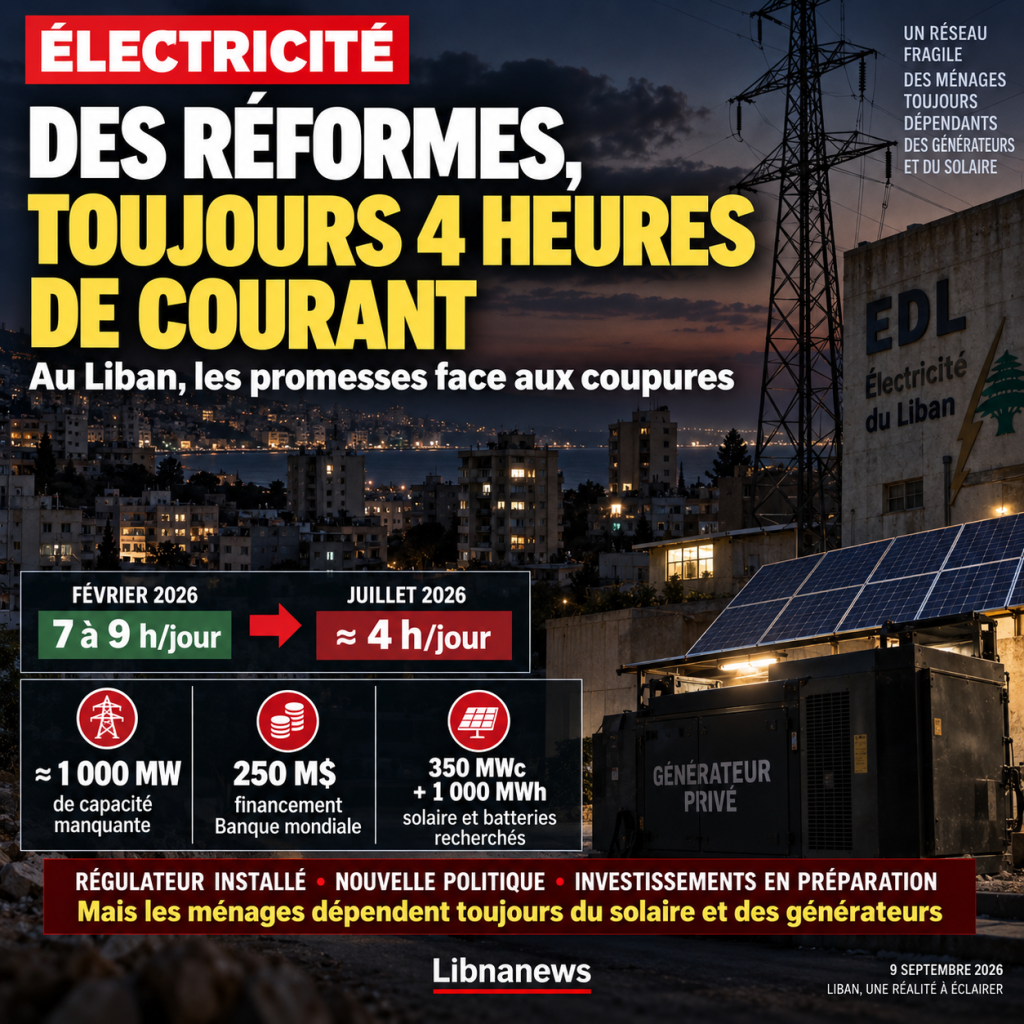
More than a year after Joe Saddi’s arrival in the Ministry of Energy and Water, institutional reforms have advanced, but public electricity in Lebanon remains deeply deficient. Electricity in Lebanon (EDL) still recognized in July 2026 an average of about four hours a day, compared to seven to nine hours reached in February. The network lacks nearly 1,000 megawatts of available capacity and the public institution itself warns that a general collapse of the system can occur daily. The contrast is striking: the government has finally established the regulatory authority planned since 2002, adopted a new sectoral policy and opened the door to new investment, but households remain dependent on private generators and solar to provide most of their needs.
Seven to nine hours in February, about four hours in July
The figure alone summarizes the persistence of the crisis. According to Joe Saddi, EDL had managed to provide between seven and nine hours of electricity per day by the end of February 2026. This improvement had been achieved without further direct financial contribution from the Consolidated Revenue Fund to the public institution, a result that the Minister presented as an important step towards a more sustainable operation.
A few months later, this progress had been largely erased. On 13 July, EDL officially reported that the national average diet was around four hours daily. In other words, an average household received only about one sixth of the day’s public electricity and had to find another source for the remaining 20 hours.
The average also masks geographical and technical differences. Lines supplying essential facilities benefit from special conditions. The airport, the port, the courthouses, the central prisons or some water pumping stations must maintain a higher power supply. For reasons of network configuration, some residential areas connected to the same departures may also enjoy a higher power supply time.
EDL began publishing data from electronic meters installed on distribution departures to document the actual hours provided. This approach improves transparency, but it does not change the underlying problem: in 2026, the public network remains unable to provide continuous power.
Electricity in Lebanon: nearly 1,000 MW missing on the grid
The drop in feeding hours is primarily due to a physical problem of available production. During the summer, EDL reported that up to about 1,000 megawatts of grid capacity were missing. This deficit weakens the balance between production and consumption and significantly reduces the margin available to the manager to absorb an incident.
An electrical network must maintain a very precise balance at all times. When the available capacity becomes too low, changes in frequency and voltage become more difficult to control. A power plant that stops, a line that triggers or a sudden increase in demand can then cause chain disruption.
EDL itself used an alarming vocabulary. The establishment warned that the lack of capacity made possible a « blackout », i.e. a general collapse of the network, at any time and potentially every day. This fragility also prevents the company from guaranteeing normal feeding times when several incidents occur simultaneously.
The problem therefore lies not only in the theoretical number of plants built in Lebanon. It is due to the actual power available, the accessible fuel, the condition of the production units, the maintenance and the capacity of the transmission system to deliver electricity. An existing power plant on paper does not necessarily represent an immediately mobilizable capacity.
This situation makes the DC target very distant. Before even covering 24 hours, EDL must have sufficient production to gradually increase power without endangering the stability of the system.
Joe Saddi’s promises were first of all promises of reform
When Joe Saddi took office in February 2025, he inherited a sector marked by decades of deficits, incomplete investments and delayed political decisions. From his first major public intervention on 26 March 2025, the new minister insisted on a break with the interim solutions and promised to apply the remaining laws.
His first project concerns governance. Law 462 of 2002 provided for an independent authority to regulate the electricity sector. For more than 20 years, this institution had never been effectively established, even though it had to regulate licences, promote competition and further separate the regulatory functions from the political decisions of the ministry.
The government finally appointed the Electricity Regulatory Authority on 11 September 2025. Joe Saddi then presented this decision as a cornerstone of the sector’s reorganization. The delay before its arrival is considerable: more than two decades separate the adoption of the law from the effective establishment of its regulator.
This reform is real and measurable. However, it does not immediately produce additional megawatts. Installing a regulatory authority can improve bidding, investment and market surveillance in the medium term, but does not immediately re-activate an unavailable plant or unit.
This is precisely where the gap felt by consumers lies. The institutional architecture advances while the daily service remains very insufficient. For a family that receives four hours of LED, the success of an administrative reform does not replace the twenty hours during which it has to rely on a battery, solar panels or generator.
A new policy approved in July 2026
The government took another step on 23 July 2026 by approving a new electricity policy. The text focuses on regulation, the transition framework and the long-term model. It aims to gradually change the organisation of a system long dominated by EDL and directly led by the State.
However, this policy is not a detailed programme for the construction of power plants. The ministry explicitly stated in August, after criticism by former minister Walid Fayad. The issue of new capacity must be addressed in a separate production plan at the lowest cost.
This document is prepared with the Autorité de régulation, Électricité de France and funding from the Agence française de développement. It must determine the additional capacities needed, their timing and the best mix between the different energy sources. It must also integrate costs, security of supply, network constraints and the flexibility required for the system.
This method aims to avoid an old practice: to decide on investments or technologies without having an updated overall scheme. But it also confirms that in September 2026 an essential part of the future production architecture remains at the planning stage.
A sector that has accumulated more than $30 billion in deficit
The current crisis cannot be understood only through the cuts of 2026. The Ministry of Energy recalls that the annual deficit of LEDL reached about $1.8 billion in 2018. Over several decades, the cumulative deficits associated with the sector have exceeded $30 billion.
Several causes are documented. For a long time, tariffs were kept well below the actual cost of production. The State offset the gap by budgetary transfers, a large part of which was used to finance the purchase of fuel for power plants.
To this added the poor performance of aging plants and their high operating costs. The department also estimated the network’s technical losses at 16% and non-technical losses at 21% in its historical diagnosis. In addition, these two categories accounted for a considerable proportion of electricity injected into the system.
Technical losses include the state and configuration of the transmission and distribution networks. Non-technical losses refer more to illegal connections, fraud, miscounting and invoicing or recovery difficulties.
The ministry has also historically estimated the additional consumption associated with the presence of Syrian refugees at about 500 MW. This figure belongs to previous industry diagnoses and should not be confused with the current available capacity deficit announced by EDL in 2026.
Rates increased, but service quality did not follow
For years, one of the paradoxes of EDL was to sell electricity at a price disconnected from its cost. The grid was based on an official exchange rate of £1500 per dollar and prices that were no longer related to fuel costs after the collapse of the Lebanese currency.
A major tariff reform began in 2022. For some consumers, the variable price was raised around 27 cents per kilowatt hour, before several adjustments. The principle was to bring revenues closer to the cost of production and to allow EDL to finance its operations further.
This has profoundly changed the bill for households. The consumer now pays for public electricity much closer to the real costs than before the crisis, while the number of hours provided remains much lower than a normal service.
The improvement of revenues has therefore not yet produced a proportional improvement in food. The tariff reform addresses the financial problem of EDL, but it does not solve only production constraints, necessary investments in the network, unpaid payments or losses.
The result is particularly difficult for households. They support an EDL bill that has become more expensive while continuing to finance a second private electricity infrastructure. The actual cost of electricity is not limited to the amount claimed by the public institution.
The state itself owes tens of millions to EDL
One of the most revealing obstacles concerns public administrations. In July 2026, Joe Saddi publicly demanded that the State and its institutions settle the sums owed to EDL. The Minister estimated the combined effect of certain exemptions and debts of public bodies to the institution at approximately $50 million per month.
The figure is considerable for a company that has to buy its fuel and finance its operations with its revenues. Fifty million dollars per month would be the equivalent of $600 million if that rate persisted over twelve months.
Joe Saddi posed the problem in terms of the financial responsibility of the State. It considers that EDL cannot be required to achieve equilibrium if public institutions consume electricity without fully or regularly regulating what they need.
This question shows that the reform does not only concern individuals, illegal connections or areas where recovery is difficult. The State itself must change its consumer behaviour and include in public budgets the real cost of energy used by its administrations.
The contrast with February is important. Saddi pointed out that EDL had managed to reach seven to nine hours of power without asking for a dollar or an additional pound from the Treasury. A few months later, he challenged public debt and exemptions as one of the obstacles to the continuity of this improvement.
Solar has increased because the public network has fallen
The collapse of EDL has profoundly transformed the Lebanese energy landscape. Since the beginning of the economic crisis, photovoltaic panels have increased in buildings, houses, shops, farms and industrial facilities.
This has enabled some of the population to reduce their dependence on generators. It also created a decentralized production capacity that did not exist on this scale before the crisis.
But this development was largely carried out as a private response to the failure of the public service. Households with sufficient resources purchased panels, inverters and batteries. Those who do not have the means to do so remain more dependent on LEDL and neighbourhood generators.
Nor can individual solar systems entirely replace a national network. A modern economy needs a system that can feed industries, infrastructure, hospitals, water systems, transport and utilities with stable energy on a large scale.
The challenge of Joe Saddi is therefore to integrate renewables into the system rather than let two parallel worlds develop: an undernourished public network and a multitude of independent private facilities.
350 MW of solar and 1000 MWh of batteries sought
The strategy is beginning to take a more concrete form. In 2026, the Regulatory Authority issued a call for expressions of interest to identify future production projects. The deadline for filing files was finally extended until September 30, 2026.
The solar shutter covers a total capacity of up to 350 MWc. This power would be distributed between a maximum of five network-connected projects, a major difference with individual roof installations.
These plants shall be accompanied by battery storage systems up to 1000 MWh. Storage is essential to absorb part of solar production during the day and restore it when production declines or when demand increases.
The call also concerns decentralised thermal projects. Each unit could provide between 20 and 100 MW net. Natural gas must be the main fuel considered, with the possibility of using heavy fuel oil as a backup solution.
These figures show that the government is preparing significant new capabilities. They also show why the effects are not yet visible on bills and feeding hours: as of 9 September, the procedure is still in the stage of identifying investors and potential projects.
$250 million from the World Bank to rebuild part of the system
Another important project is the World Bank funding of $250 million for renewable energies and the strengthening of the electricity system. Of this total, 220 million must go back to EDL and 30 million to the Litani Office.
The project provides $65 million to strengthen the operational and commercial systems of EDL. This component must in particular improve the management and control tools necessary to operate a modern electrical enterprise.
An envelope of $170 million is intended to increase renewable production connected to the network and to strengthen infrastructure. In this context, approximately $90 million is to be used to finance a 150 MW solar power plant in Bekaa.
The programme also includes a national monitoring centre. This equipment is crucial for real-time supervision of production, transport and distribution, especially when more variable renewable sources are integrated into the network.
More advanced meters must also be deployed. Their interest goes beyond simply reading consumption: they can improve billing, detect certain anomalies, track losses and give EDL a much more accurate view of what is happening on its network.
The rehabilitation of the Ashrafieh post, damaged during the explosion of the port of Beirut on 4 August 2020, is also one of the announced investments. This work shows how the reconstruction of the sector combines old needs with the damage caused by successive crises.
The private generator remains the real daily rescue service
For consumers, the problem is much more immediate. When public electricity is available four hours a day, the remaining twenty hours must be covered otherwise. The private generator continues to play a central role in many neighbourhoods.
The Ministry publishes a monthly indicative rate to regulate the billing of generators. By June 2026, the price of kilowatthours had been set at 41,973 Lebanese pounds, plus fixed costs related, inter alia, to the undersigned ampling.
At this price, 100 kWh consumed from a generator represents about 4.2 million pounds before fixed charges. A consumption of 200 kWh represents about 8.4 million pounds, always before these costs.
These amounts illustrate the weight of the parallel system on the household budget. They should not be directly compared to an EDL invoice without taking into account differences in pricing and fees, but they show why the absence of a public current has a concrete economic cost.
The generator system is in fact a decentralized diesel production directly financed by consumers. It responds to a need created by rationing, but with significant financial, environmental and health costs.
Real institutional reforms, but not yet service reform
The balance sheet of Joe Saddi cannot therefore be reduced to the absence of improvement. Since 2025, the sector has undergone institutional changes that had been delayed for years.




