

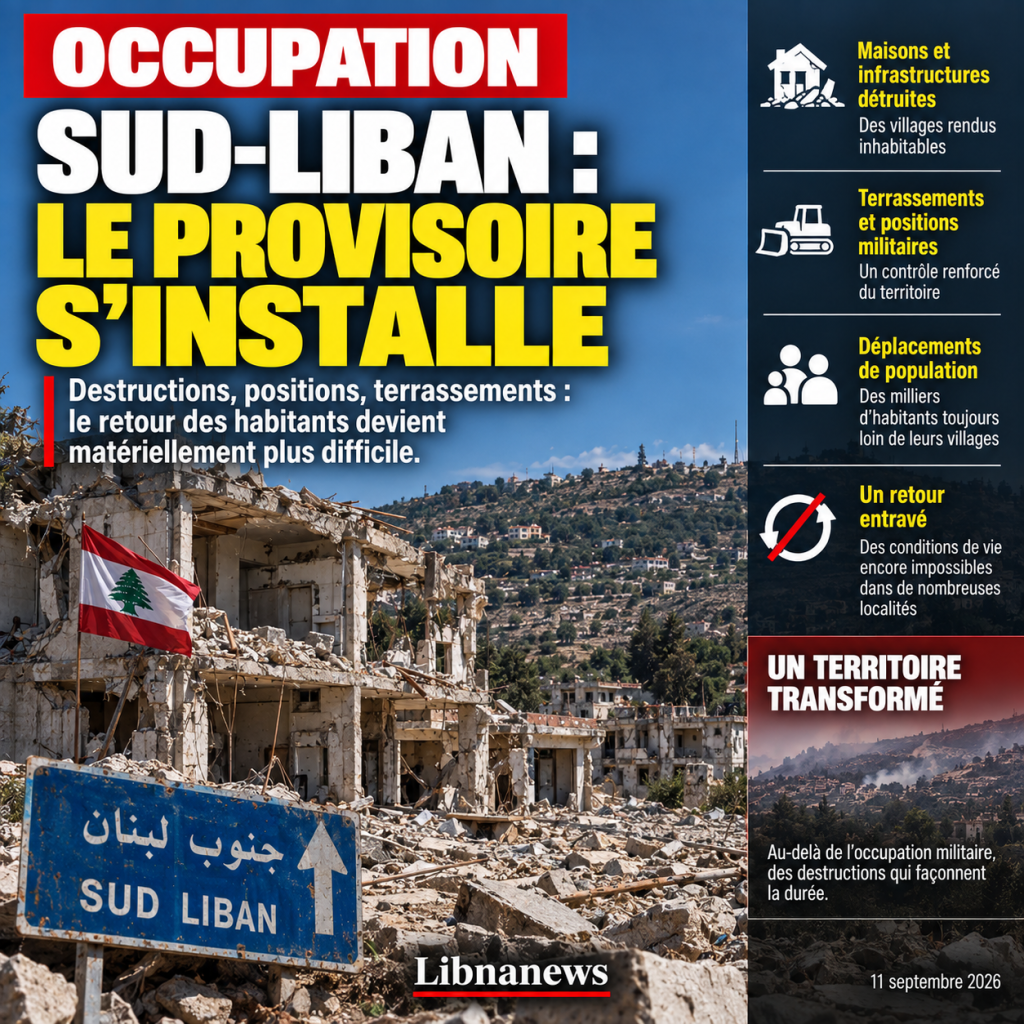
The systematic destruction of houses, public facilities and infrastructure in southern Lebanon now gives the Israeli presence a dimension that goes beyond the only temporary military occupation. Israel claims to be acting to neutralize Hezbollah’s capabilities and establish a security zone. But demolition of the building, earthworks, military positions, obstacles to movement and the material impossibility of returning the inhabitants are gradually transforming the territory. These facts alone do not prove the existence of an official annexation or permanent installation plan. However, they show that the physical conditions of a prolonged presence are being created.
An occupation that is no longer measured solely by soldiers
The debate over the length of the Israeli presence in southern Lebanon can no longer be limited to the number of military positions held north of the Blue Line. For several months, operations have also included demolitions, earthworks, destruction of homes and strikes against infrastructure. United Nations reports documented Israeli positions on Lebanese territory, troop movements, engineering work and demolition of buildings in villages north of the Blue Line.
This material transformation is essential. A force may temporarily occupy a height and then withdraw. The situation becomes different when it destroys houses, alters access, controls the axes and makes the return of the inhabitants difficult. Even without legal annexation, the territory can then function as a zone permanently separate from the civilian life that previously occupied it.
Mansouri, symbol of destruction of civil life
The events of Mansouri illustrate this evolution. On 9 September, an Israeli telepilot dropped explosive material on the roof of the local public school, according to reports from the Lebanese press. The school, which welcomed 336 students according to the Centre for Educational Research and Development, was directly threatened a few days from the beginning of the school year.
On the morning of September 11, most of the school was destroyed, according to the National Information Agency. A school is one of the infrastructure that allows a community to return and stay. Its disappearance obliges families to seek a solution elsewhere, delays the return to school and increases the cost of a sustainable return. Mansouri also experienced a succession of blasts, with destruction of buildings that directly complicate the return of the inhabitants.
Destroying a house is also about acting on the return
In a war, a house can be destroyed because it is considered a military objective. But when demolitions become numerous in a given area, their effect exceeds each individual target. They change the capacity of a population to reoccupy its territory by making it more expensive, slower and sometimes impossible to return without prior reconstruction.
A family whose house remains standing may return when conditions of security permit. A family whose housing has been dynamic must have resources, compensation, materials and an administrative environment capable of rebuilding. If the school, road or water network is also damaged, the return ceases to be a simple individual decision and becomes a collective reconstruction project.
It is this mechanism that feeds the fear of a permanent occupation. The strategic effect of destruction also lies in the time it takes to repair what has disappeared. The longer this time increases, the more the military presence in the area becomes de facto durable.
A « safe zone » assumed by Israel
Since the resumption of the military campaign in March 2026, Israel has expanded its presence in parts of southern Lebanon and described controlled areas as a safe area. On 10 September, following the destruction of the Ali al-Taher underground complex, the Israeli authorities claimed that they had completed the establishment of a secure area and obtained operational control of that strategic height.
Israel presents this presence as a response to the threat of Hezbollah. His argument is that the movement must not be able to restore military capabilities near the border. The June ceasefire, however, provided for a process involving Israeli withdrawal and the disarmament of Hezbollah. This process has become bogged down, with Israel making its withdrawal conditional on disarmament guarantees while Hizbullah refuses the modalities imposed on it.
This blockage has a concrete consequence: what was to come under a transitional arrangement can become a lasting reality. A temporary military zone acquires more permanent features when it has consolidated positions, controlled axes, earthworks, constant monitoring and a largely destroyed civilian environment.
Destroyed positions, earthworks and villages
International findings provide a material basis for this concern. In a 2026 report, members of the Security Council were able to observe directly one of the Israeli positions in Lebanese territory in the area of operations of the Finul. The document also refers to the visible destructions in villages and their peripheries near the Blue Line, where very few houses remained standing in certain areas.
Another United Nations report referred to Israeli personnel operating outside certain positions, carrying out earthworks and troop movements north of the Blue Line. Finul also confirmed demolitions of buildings. These elements do not demonstrate an annexation project, but they describe a presence that produces sustainable site development and modifications.
Distinction is essential. To claim that Israel has decided to annex part of southern Lebanon would require evidence that is not available. To recognize that a military occupation is materially consolidating, on the other hand, is based on observable facts: positions, works, controls, destruction and the maintenance of forces in the territory.
The precedent of the « safe zone »
In Lebanon, the term « security zone » has a particular historical resonance. Israel maintained an occupied area in the South for years prior to its withdrawal in May 2000. This experience explains why the terms used today and the consolidation of positions raise concerns that go beyond the military evolution of the last few days.
It would be misleading to say that history repeats itself identically. The regional context, actors and the international framework have changed. The present presence cannot therefore be mechanically assimilated to that of the 1980s and 1990s. However, the precedent shows that an area presented as necessary for Israel’s security can last well beyond an initial military operation.
Destruction can create land without inhabitants
One of the major risks is the combination of occupation and displacement. This week the United Nations reported new population movements caused by the escalation in the South. According to the local authorities cited by the United Nations, approximately 20,000 people, or nearly 5,000 families, had left Nabatiyah district in the previous week. At the same time, there was a sharp increase in Israeli military activity.
A territory emptied of its inhabitants becomes easier to control militarily. This does not mean that the displacement of civilians is necessarily the stated objective of each operation. But the territorial effect exists: the less people, the less economic and administrative life, and the more the return depends on a political decision and a reconstruction programme.
This dynamic explains why the destruction of civilian infrastructure must be analysed beyond the immediate material balance. A destroyed school, a damaged water network or a razed neighbourhood can have a strategic effect without constituting a military position. They reduce the capacity of a population to reoccupy its territory under normal conditions.
Beirut begins to reason over time
The decisions taken in Beirut show that the Lebanese State itself no longer treats the situation as a parenthesis of a few days. On 10 September, the Council of Ministers approved a draft law to prevent disposal and real estate sales in areas occupied by the Israeli army. The measure aims to protect properties in areas where residents do not necessarily have normal access to their land and houses.
At the same time, Prime Minister Nawaf Salam stressed the need for prefabricated housing to facilitate the return of the inhabitants to a first phase. The fact that the government is considering this type of solution shows the extent of the problem: the return no longer depends solely on the cessation of the fighting. A roof must now be provided to families whose homes have disappeared or become uninhabitable.
The proposed ban on real estate sales also has a strategic dimension. It aims to prevent an exceptional military situation from leading to irreversible transfers of property while owners are displaced or prevented from accessing their property. The State thus seeks to freeze land legally while the territorial situation remains unstable.
Ali al-Taher changes the military scale
The operation in Ali al-Taher demonstrates Israel’s strategic focus on land control. On 10 September, the Israeli army announced that it had destroyed an underground network of more than two kilometres that it attributed to Hezbollah. It claims to have discovered command centres, weapons depots and facilities for a prolonged underground presence. Not all of these claims could be independently verified.
Beyond the contents of the complex, the important element is the control of the height itself. The Israeli authorities presented the operation as the completion of a step towards establishing a secure area. A dominant height offers surveillance, movement control and military advantage over a wider space. Its control therefore has a value that goes beyond the destruction of a tunnel.
This logic explains why withdrawal becomes more difficult as positions are considered essential to safety. Each height, axis or observation point can be presented as necessary to prevent the return of Hezbollah. In addition, these requirements can transform a temporary presence into a sustainable territorial arrangement.
Israeli argument: preventing the return of Hezbollah
To understand this dynamic, we must restore the Israeli argument. Israel claims that its operations target Hezbollah’s infrastructure, combatants and stockpiles of weapons and that a withdrawal without effective disarmament would re-establish the threat against its border communities. Land strikes and operations are therefore presented as security measures, not as a project to colonize Lebanese territory.
At this stage, the available evidence does not show the settlement of an Israeli civilian population in southern Lebanon or an official annexation decision. The situation therefore differs from a process of civil settlement. The analysis focuses on a military occupation that may be long-term, not on the unproven assertion of a settlement project.
But the lack of civil settlement does not make the question of the secondary duration. Protracted military occupation can profoundly alter territory without establishing a new population. It can create forbidden areas, prevent agriculture, move people, transform roads and delay reconstruction for years.
A sustainable occupation is also built by absence
Perhaps the most difficult phenomenon to measure is what disappears. A dynamited house no longer houses a family. A destroyed school no longer receives students. An inaccessible field is no longer cultivated. A cut-off road no longer connects two villages. As these absences accumulate, the Territory gradually ceases to function as before, even if its legal boundaries have not changed.
The destruction in southern Lebanon is therefore a political as well as a military indicator. They do not allow us to read the exact intention of the Israeli government, but they allow us to observe the result produced: a space where the return of Lebanese sovereignty and the civilian population becomes materially more difficult.
Time then plays a strategic role. Every additional week of military presence, every new demolition and every extended displacement makes restoring the previous situation more costly. An occupation can thus settle for the duration without an official date marking its beginning.
The test will be the real return of the inhabitants
The key question, therefore, is not just whether Israel claims to want to remain. It is to determine whether the conditions created actually allow for a rapid withdrawal and return of the inhabitants. On this point, the indicators are worrying: military positions maintained, ground operations, destruction, displacement and damaged civilian infrastructure combine.
The most concrete criterion will be return. If the inhabitants can return to their villages, rebuild, reopen schools, access their land and find Lebanese institutions, the logic of a military zone can gradually be reversed. If, on the contrary, destruction continues as Israeli positions consolidate, the lasting nature of the occupation will become increasingly difficult to present as a mere temporary consequence of the fighting.
In southern Lebanon, the stakes in the coming weeks will therefore be as much in the villages as in the negotiations. A military presence is measured by its soldiers and positions. An occupation that settles is also measured by what it prevents from returning.




