






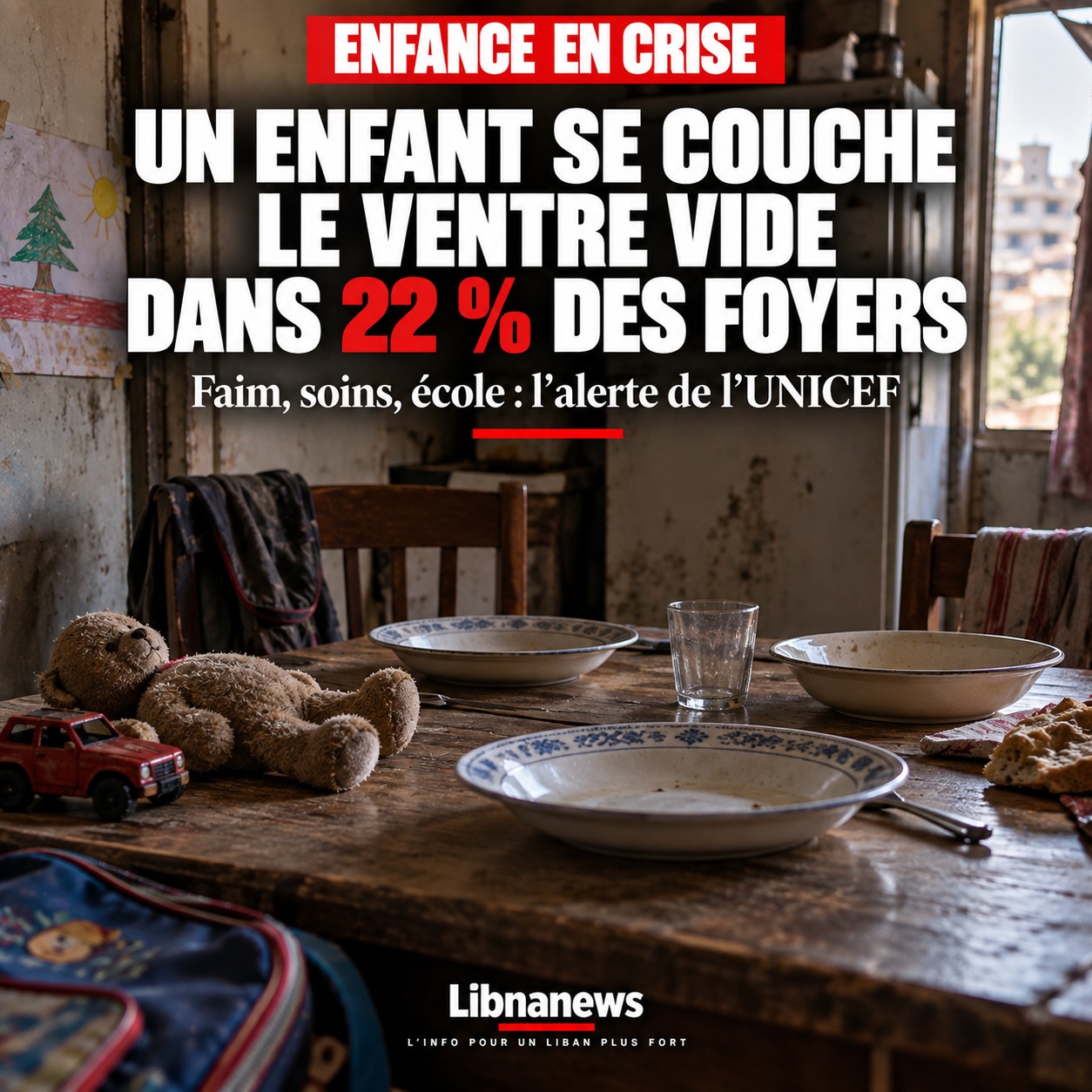
In Lebanon, the economic crisis and the consequences of the conflict now directly address the most basic needs of children. In 22 per cent of the households surveyed, at least one child lay empty during the two weeks preceding the survey, according to a new evaluation published by the United Nations Children’s Fund (UNICEF). More broadly, four out of five families are now struggling to meet their basic needs, while access to care, education and adequate food is deteriorating.
The UNICEF report, published at the end of September 2026 and entitled « A nightmare without end », describes an accumulation of difficulties for families living in Lebanon. Poverty leads some to reduce spending on their children, to abandon medical care or to withdraw them from school. The work of minors is progressing at the same time as the physical and psychological consequences of the war continue to increase.
The indicators thus describe a crisis that no longer only affects income. It directly affects the food available in the home, the health of children and their ability to pursue normal schooling. For the most vulnerable families, arbitration is now about essential expenses that should not be competing.
In Lebanon, 22 per cent of households report that a child has been hungry
The figure summarizes the extent of the social deterioration: 22 per cent of households surveyed by UNICEF report that at least one of their children lay on an empty stomach during the two weeks preceding the survey. This proportion means that food deprivation now affects more than one in five households surveyed.
Food is only part of the problem. According to the same assessment, four out of five families face difficulties in meeting their basic needs. The persistence of the economic crisis, combined with the consequences of the conflict, reduces the room for manoeuvre of households whose resources were already weakened by several years of instability.
Where disposable income is no longer available to meet all needs simultaneously, families must choose between food, medical care, education and other essential expenses. The report shows that these arbitrations directly affect children.
The phenomenon cannot therefore be reduced to a single measure of income poverty. The reported hunger in households is one of the most immediate manifestations of a crisis that affects several dimensions of everyday life.
Almost a third of families give up care
The health situation is a second major indicator. According to UNICEF, 31 per cent of households surveyed reported that at least one of their children did not receive the necessary medical care. Lack of money is the main reason put forward by families.
This means that close to one in three households had to give up the necessary care for a child. In a system where a large proportion of medical expenditure remains borne by households, the contraction of income quickly turns an economic problem into a health problem.
The consequences can be immediate when treatment is delayed. They may also occur later if diseases, injuries or disorders that would have required early management are not properly monitored.
For Marcoluigi Corsi, UNICEF representative in Lebanon, the various indicators must be considered together. « Children and young people in Lebanon are forced to bear a burden that no child should bear, » he said on the occasion of the publication of the report.
He adds: « Families are pushed to the brink of the abyss, while children are deprived of health care and education, forced to work, and suffering from deep psychological distress. ».
Child labour has more than doubled since January 2025
One of the most worrying developments concerns the work of minors. In 14 per cent of the households surveyed, at least one child is now working, according to UNICEF. This proportion has more than doubled since January 2025.
This increase is a direct indicator of the survival strategies adopted by some families. When a child starts working to supplement the household’s income, the consequences can affect his/her education, health and development simultaneously.
Early work also increases the risk of dropping out of school. The financial difficulties that lead a child to gainful employment are often the same as those that lead families to reduce their spending on education.
The increase since January 2025 shows above all the rapid deterioration. In less than two years, the share of households reporting work by at least one child has more than doubled, while the education system must also absorb the consequences of the conflict.
Since 2 March, 261 children have been killed and 1,056 injured
To the economic crisis is indeed added the human balance of the war. Since 2 March 2026, at least 261 children have been killed and 1,056 injured, according to United Nations data collected by UNICEF.
This represents an average of seven children killed or injured each day during the reporting period.
The consequences do not stop at the number of immediate victims. Of the injured children who survived, 12 per cent now live with disabilities. For these children and their families, the effects of the conflict will therefore extend beyond initial injuries and require long-term care, rehabilitation and support.
This is precisely at a time when almost a third of the households surveyed already report difficulties in providing the necessary medical care for their children. The conflict therefore increases health needs while the economic crisis reduces the ability of families to respond to them.
436 schools damaged or destroyed
Education is the other major front of the crisis. According to UNICEF, 436 schools were damaged or destroyed by the conflict. This situation threatens to deprive nearly 100,000 children of a classroom.
Educational staff also paid a heavy price. At least 86 teachers were killed or injured. These losses affect a school system already weakened by several years of economic crisis, interruptions and funding difficulties.
However, the destruction of infrastructure explains only part of the educational difficulties. Almost half of the families surveyed reported having reduced their spending on education. In 17% of households, children had to stop going to school.
Pressure is therefore exerted on both sides. Some schools can no longer function normally because of the damage caused by the conflict, while some families no longer have the resources to maintain their children in the education system.
Even among those who continue to attend school, learning is disrupted. Nearly one third of children were unable to learn normally, mainly because of difficulties in concentration and emotional disorders.
770,000 children facing psychological distress
The least visible consequences of the crisis are also among the most widespread. UNICEF estimates that 770,000 children have suffered from psychological distress in the past six months.
More than half of the households surveyed observed a deterioration in the emotional well-being of their children. Nearly two-thirds of children report signs of anxiety or nervousness.
These data give another dimension to the difficulties encountered in schools. A child may remain officially educated while being less able to attend classes, concentrate or learn because of fear, displacement, loss of a relative or economic insecurity experienced by his or her family.
Mental health thus appears to be a link between the different dimensions of the crisis. War creates direct trauma, while poverty adds daily insecurity to food, care, housing and education.
Among the 18-25 age group, 67% were unemployed
Prospects remain difficult when children reach adulthood. A previous evaluation conducted by UNICEF in 2026 among young people aged 18-25 showed that only 22 per cent were still in school or university.
Financial difficulties were the main obstacle to continuing education. At the time of the survey, 67% of the young people surveyed were unemployed.
These figures illustrate the risk of a sustainable chaining. Poverty can cause school drop-out or push children to work. Discontinuous training then reduces their job prospects, while the labour market offers few opportunities for young people who reach adulthood.
The consequences of the current crisis could therefore continue well after a possible improvement in the security situation. Restoring destroyed buildings will not be enough if families no longer have the means to send their children to school, if young people drop out of school or if psychological trauma is not addressed.
Four out of five families in difficulty
The different indicators published by UNICEF describe the same dynamics. Four out of five families are struggling to meet their basic needs; 22% report that at least one child has been lying on an empty stomach; 31% had to give up the necessary care for a child; 14 per cent now have at least one working minor.
In addition, 261 children have been killed and 1,056 injured since 2 March, 12 per cent of the injured survivors living with disabilities. At the same time, 436 schools were damaged or destroyed, nearly 100,000 children were at risk of losing their classrooms and at least 86 teachers were killed or injured.
The psychological cost is equally high: 770,000 children have suffered from psychological distress in the past six months. More than half of families experience a deterioration in their emotional well-being and almost two thirds of them experience anxiety or nervousness.
For UNICEF, responding to the emergency therefore involves simultaneously addressing several needs. « The rehabilitation of Lebanon requires immediate protection of children and respect for their right to health care, education, protection and opportunities to build their future, » stresses Marcoluigi Corsi.
The urgency remains, first of all, the most basic figure in the report: in more than one out of five households in Lebanon, one child experienced hunger to the point of lying empty in the two weeks preceding the investigation.