





Thirty-three years of waste and a crisis from Tripoli
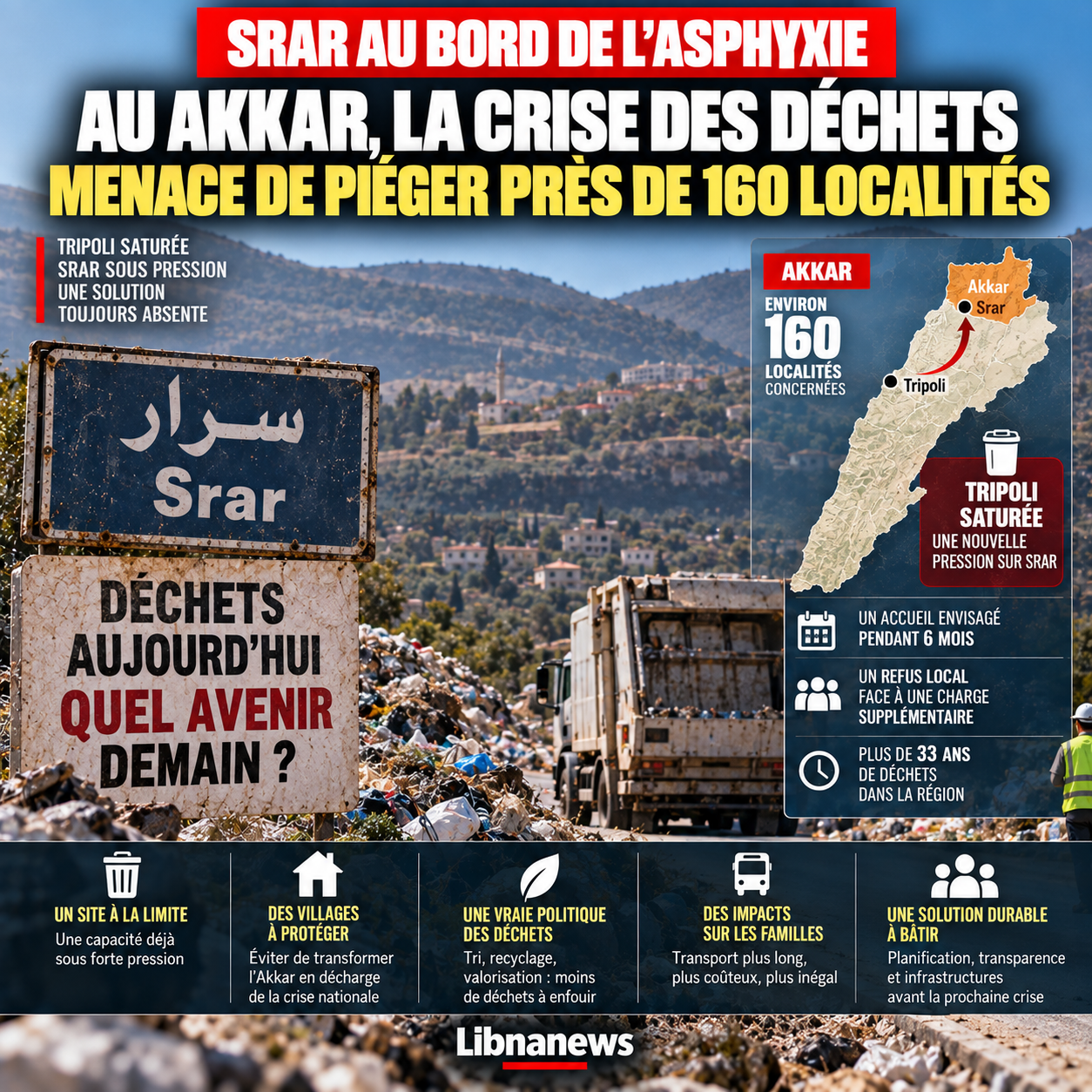
The saturation of the Tripoli site has placed Srar at the centre of a crisis that Akkar has been experiencing for more than three decades. The site has been receiving waste from the region for more than 33 years. It already had to absorb the needs of a territory composed of a large number of municipalities and villages. Yet, in the face of the emergency in Tripoli, the idea of temporarily transferring waste from the city was again advanced. The scenario envisaged was presented as a transitional scenario. Solutions prepared by the government and the Ministry of the Environment would take at least six months to become operational. Srar was therefore to serve as a relay during this period. According to the information gathered, Nawaf Salam brought together MPs from Akkar to seek a temporary solution to accommodate the Tripoli waste site for six months. But what might appear from Beirut as an emergency solution immediately awakened an old conflict in the North. For many local residents and officials, Akkar can no longer be considered as the land reserve to which waste from other regions is directed when their own facilities reach saturation.
The reaction is rooted in the history of the site. Already in 2015, at the height of the national waste crisis, Akkar had been considered as one of the possible destinations for Beirut garbage. Eleven years later, the Tripoli proposal has reactivated the same sentiment: that of a region that is being asked to absorb the consequences of public policies decided elsewhere when it lacks infrastructure itself. This time, the opposition led to the closure of Srar to waste from outside the governorate. The crisis has therefore not been resolved. She moved. Tripoli still faces the saturation of its own system, while the Akkar must manage the political and technical consequences of the challenge of Srar. The problem thus far exceeds the dispute between two neighbouring territories. It reveals the absence of a device capable of absorbing a local breakdown without transferring the emergency to another region. In an integrated system, the saturation of an installation should trigger predetermined solutions. In the North, it provokes political negotiations between territories to find out which will accept the waste that the other can no longer receive. The provisional nature of the proposal is no longer sufficient to reassure. In Lebanon, temporary arrangements often tend to last. Accepting an additional six months can therefore be seen locally as opening up a new regional vocation that the inhabitants refuse.
Nearly 160 localities depend on a system already under pressure
The fragility of the dossier appears even more clearly when we observe the population that Srar must already serve. The system covers approximately 160 localities in Akkar. This figure immediately transforms the perspective. Srar is not an empty space available to accommodate the surplus of a large nearby city. It is already one of the essential links in the daily waste management of much of the governorate. Adding the volumes produced by Tripoli therefore does not mean using unused capacity without consequence. This means asking a regional facility to simultaneously act as a local solution and a safety valve for an external crisis. The debate should therefore begin with a technical assessment: what capacity is actually available, what volumes are entering daily, what residual lifespan of the site and under what conditions are waste treated there? The political urgency preceded this discussion. When garbage accumulates in a city, pressure pushes the authorities to immediately find a place to move them. The destination then becomes the priority, even before the question of treatment is settled.
This reversal summarizes one of the historical problems of waste policy in Lebanon. evacuating street bags is not waste management. This only moves their physical presence. A complete policy starts up with the reduction of volumes, then sorting, separate collection, recycling, the recovery of organic matter and finally the burial of what cannot be treated otherwise. When almost all public attention is focused on the final destination, the landfill becomes mechanically the point of rupture. The larger the volumes arriving on site, the smaller its lifetime. A new crisis then arises and we must find another ground. Srar’s case shows the limits of this logic. An infrastructure that has been operating for more than 33 years cannot be considered an unlimited reserve. The question therefore is not just whether it can absorb a few months of additional waste. It involves determining what Akkar will do with its own waste in the coming years if the available capacity continues to decline. The refusal of Tripoli waste can be read as a territorial reaction. It can also be understood as an attempt to protect an already necessary capacity in about 160 localities that do not have immediate alternatives.
The memory of 2015 feeds a deep territorial mistrust
The reference to the 2015 crisis is not anecdotal. It explains much of the current political sensitivity. At the time, the inability to manage Beirut waste had led to the search for solutions in several regions. The Akkar had been mentioned among the territories likely to receive some of the volumes. That perspective had provoked strong opposition. It was based on a sense of territorial injustice: one of the country’s most disadvantaged regions had to accommodate the environmental consequences of consumption in other areas without benefiting from a comparable level of public investment. The same reasoning reappeared in 2026. Why should Srar become Tripoli’s solution when the Akkar must already manage its own needs? And why should one region accept an additional charge because another facility has reached its limit?
This mistrust does not mean that any interregional cooperation is possible. Modern waste policy can be based on facilities serving several territories. Some infrastructures even require a scale large enough to be economically viable. But such mutualization must be organised before the crisis. It requires clear contracts, cost allocation, environmental standards, control mechanisms and compensation for the host territory. It cannot be improvised when the waste begins to accumulate. In the case of Srar, the six-month proposal comes precisely in a context of urgency. It is therefore seen less as part of a planned regional system than as a request to Akkar to temporarily resolve an external problem. Provisionality even fuels mistrust. If the solutions promised in Tripoli take more than six months, what will happen? Will the transfer be extended? If a new crisis then arises elsewhere, will Srar be asked again? As long as these questions remain unanswered, the local opposition retains its own logic. It is not only about a few additional trucks. It concerns the function which the State intends to assign to the territory in a sustainable manner.
Behind the political battle, a poorly documented environmental issue
Perhaps the most worrying aspect of the file is the weakness of the public data available in the elements studied on the precise environmental status of the site. The corpus establishes its seniority, its regional role, the very large number of localities concerned and the conflict over the reception of Tripoli waste. However, it does not provide a comprehensive set of measures to accurately establish the current state of soil, groundwater, emissions or leachate. This absence should be reported rather than filled by assertions. It itself raises a question of public policy. A facility that has been in use for more than three decades should be monitored regularly, accessible and sufficiently detailed to ensure that people know what is buried, how releases are controlled and what actions are taken when standards are not met. Without this transparency, the debate becomes almost inevitably political. Opponents suspect the worst. The authorities claim that the situation can be managed. In between, the citizen has little to assess the risk.
The issue is particularly important in a region where agricultural and water resources are directly relevant to the local economy. A poorly managed waste site can produce visible nuisances, such as odours or fires, but also more difficult to detect. Liquids from the decomposition of waste must be collected and treated. The gases must be checked. Waste should not be buried without preparation under conditions that allow its dispersion. Any capacity extension should therefore be preceded by a technical study on the state of the existing plant. In the case of temporary reception of Tripoli waste, the additional daily volume and its effect on the life of the site should also be known. This information is not ancillary. They determine whether the proposed transfer constitutes a manageable risk or a simple way to delay saturation. The Srar crisis shows that confidence can no longer be based solely on political assurances. After 33 years of operation and several episodes of national controversy, the region needs data. Without them, each transfer proposal automatically reactivates the suspicion that the provisional will become permanent and that the consequences will remain local.
Tripoli and Akkar caught in the same absence of durable solution
Opposing Tripoli to Akkar would be an incomplete reading. The two territories are actually facing two manifestations of the same problem. Tripoli reaches the limit of the capacity of its system. The Akkar protects an installation on which it already depends. One is looking for an immediate solution. The other refuses to become this solution. Neither has, in the immediate future, an alternative architecture sufficiently ready to eliminate the conflict. The Government and the Ministry of Environment are working on solutions that would require at least six months to implement. This delay explains the search for a transitional arrangement, but it also shows the backlog. Infrastructure to replace or supplement a saturated site should ideally be ready before it reaches its limit. When the schedule begins after saturation, the authorities are ordered to manage an intermediate period under pressure.
This period is the most dangerous. When waste can no longer be disposed of normally, wild deposits increase. Municipalities may be tempted to find their own solutions. Waste can be burned or deposited on unsuitable land. The health and environmental crisis then spreads instead of remaining concentrated in a controlled facility. The government’s challenge is to manage the emergency without turning Srar into a permanent default solution. This means announcing a clear timetable for the infrastructure for Tripoli and making the timetable verifiable. A six-month commitment is of value only if the work for those six months is identified, funded and monitored. Otherwise, the deadline becomes a simple political bargaining unit. The Akkar precisely has historical reasons for doubting the interim solutions. In order to convince local officials of temporary cooperation, the State should be able to demonstrate that the alternative will actually be ready on the scheduled date. Otherwise Srar’s refusal will remain the best guarantee available to the region to avoid indefinite extension.
The role of municipalities at the heart of a financially fragile system
The presence of approximately 160 localities in the Srar system also raises the issue of governance. Waste management is partly based on municipalities and their groupings, while their resources are very uneven. Some can organize regular collection. Others are more dependent on common solutions. The cost of fuel, trucks, maintenance and personnel weigh heavily on local budgets. The economic crisis has further reduced their margins. A policy that requires more sorting and separate collection must therefore be accompanied by financing and equipment. It is easy to ask municipalities to reduce the volumes sent to the final site. It is much more difficult to do so when they do not have a sorting centre, composting network or stable contracts for recyclable materials.
Srar could precisely be placed in a regional strategy rather than treated as a landfill. Akkar needs a management chain where the quantity for final storage is gradually decreasing. Organic waste accounts for a significant proportion of household waste and can, when properly separated, be treated other than by landfill. Recyclable materials can also be extracted upstream. But these mechanisms require a market, facilities and organized collection. They cannot be created solely by an awareness campaign. The state and municipalities must determine who finances the equipment, who buys the recovered material and how households participate in sorting. The failure of many waste policies comes precisely from the concentration on the last link. As long as the truck continues to bring a mixture of organic, plastic, paper and other waste to the final site, the capacity is quickly filled. A real reform of the Akkar system should therefore measure its success not in terms of the number of tonnes transported to Srar, but in terms of the number of tonnes which no longer need to be buried there.
Six months to avoid reproducing 30 years of emergency management
The proposal to temporarily accept Tripoli waste for six months can finally be read as a warning. It shows what happens when permanent solutions are not ready when they become indispensable. The government must resolve an immediate emergency. Akkar wants to prevent an external emergency from compromising its own capacity. Both positions are understandable. What is missing is a system capable of making them compatible. This should be based on three elements: a strictly limited and controlled transitional solution, a public timetable for new infrastructure and a transformation of the Akkar system to reduce the volumes arriving in Srar. Without these three conditions, the conflict will recur.
The current crisis also has a national dimension. Srar recalls that no region can indefinitely become the waste receptacle of others. But it also recalls that no big city can wait until the saturation of its installation before preparing the next stage. The waste problem never disappears. It only changes where public policy fails. After more than thirty-three years of operation, Srar arrives at a time when his vocation must be clarified. Should he continue serving only the Akkar? Can he participate in a wider regional system? Under what environmental and financial conditions? And above all, how much waste can it still receive without compromising its future? As long as these responses are not public and measurable, each truck from outside will remain a political symbol. Behind the Tripoli crisis and the Akkar resistance is therefore a much simpler question: after decades of temporary solutions, is Lebanon finally able to plan what it will do with its waste before the next site is full?