





Two years after the assassination of Hassan Nasrallah, new elements appear in the weeks preceding the beheading of part of the Hezbollah command. They do not yet make it possible to reconstruct the entire Israeli operation. However, they change the nature of the questions asked. The debate no longer focuses solely on Israel’s technological superiority. It now concerns the depth of infiltration, the internal security of the party, the flow of sensitive intelligence and the Israeli ability to combine human intelligence, technical surveillance and operations prepared long in advance.
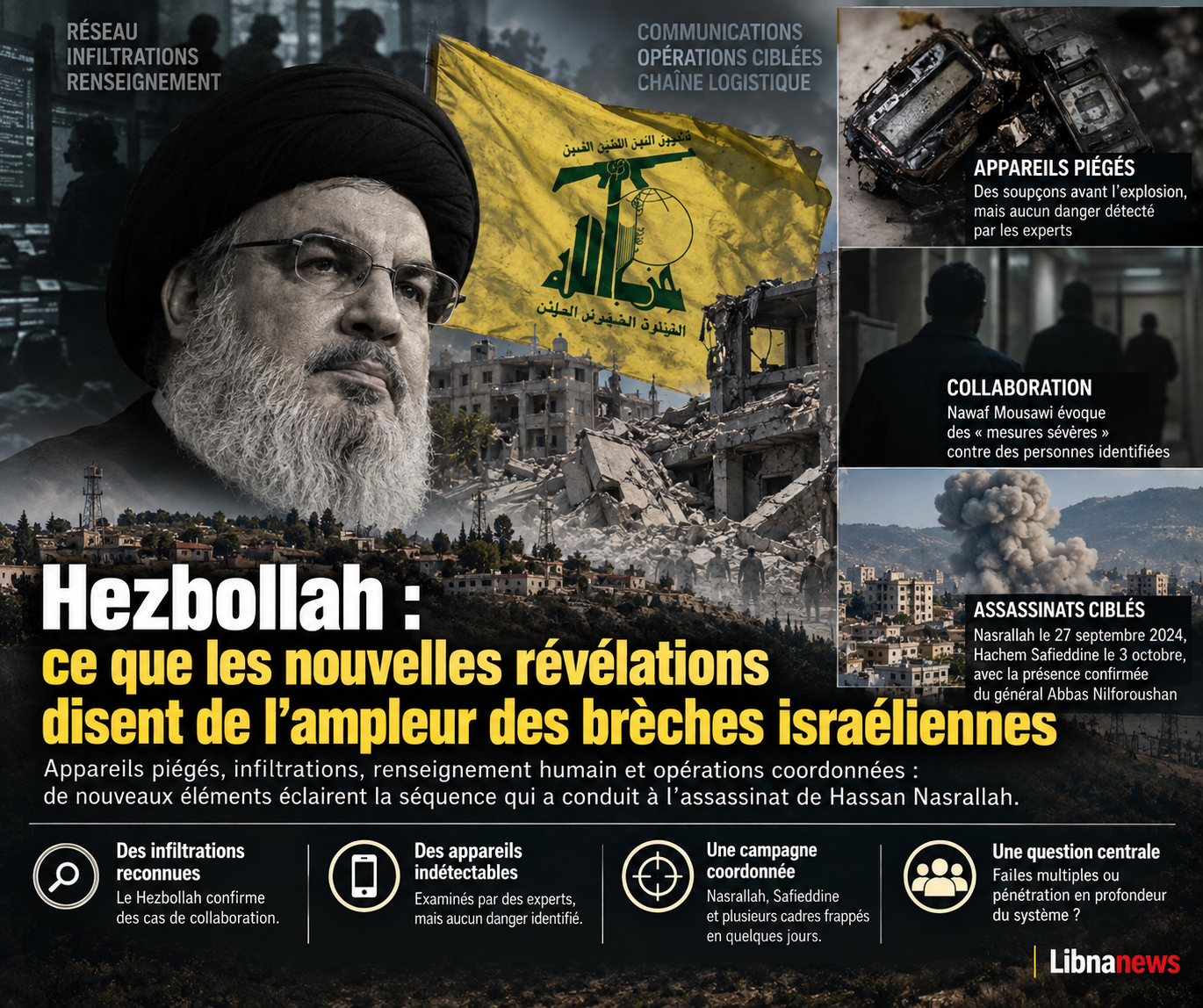
The most significant testimony comes from Nawaf Mousawi. The former Member of Parliament for Hezbollah acknowledged that « severe measures » had been taken against persons whose involvement in collaborative acts had been established. He gave no names, no functions, no numbers. This lack of detail precludes turning this report into a list of agents or a specific scenario. But the admission is important: the problem of infiltration is no longer just an external accusation. The party itself acknowledges that it has discovered cases sufficiently serious to justify internal measures.
A second revelation concerns the trapped communication devices that exploded on September 17, 2024, ten days before the assassination of Hassan Nasrallah. These aircraft were reviewed by experts from a technologically advanced Western country. They had been solicited after suspicions about possible trapping. However, according to the now publicized account, none of them would have been able to identify the danger posed by the materials used.
Taken together, these elements move the investigation. How could an organization built around secrecy be struck simultaneously in its communications, frameworks and summit? And above all, is it a succession of separate faults or the different manifestations of the same penetration of the system?
IEDs had raised suspicions prior to their explosion
Information about communication devices is probably the most disturbing. It states that the risk was not completely unknown until 17 September 2024.
The aircraft had aroused suspicion. The hypothesis of trapping had therefore been considered before their explosion. It is precisely for this reason that they would have been presented to foreign specialists with a high technological level.
Expertise wouldn’t have detected anything.
This detail greatly changes the reading of the operation. Had the aircraft been used without any control, their explosion would have mainly revealed a supply chain failure. On the contrary, the fact that they were examined after the appearance of suspicion shows that the operation would have resisted a verification procedure.
The problem, therefore, is not limited to how the aircraft integrated the Hezbollah network. It is also necessary to understand how their modification could have escaped from experts alerted about the risk they were looking for.
Available sources do not give the nature of the materials used. Nor do they describe the tests performed. It would therefore be risky to speculate on the exact technique used or on the scientific reasons for the failure of the expertise.
Only one conclusion can be drawn: the device was difficult enough to identify so that the examination mentioned did not prevent the operation.
This suggests a much higher degree of preparation than improvised sabotage.
An operation involving knowledge of the supply chain
The episode of the apparatus immediately raises the question of the supply chain.
For an operation of this nature to produce a massive effect, it is not enough to modify a few devices. However, they must reach the right people, be distributed within the network and be considered safe enough to be used.
This logic requires knowledge of internal functioning.
The source files do not allow to establish where the devices were modified, by whom, or at what stage of their routing. Nor can they identify a precise complicity within Hezbollah.
But the existence of an operation involving internal communications requires a distinction between several possible levels of vulnerability: acquisition, transport, technical control, distribution and use.
A single-level failure could have been accidental. Rather, the success of the entire sequence reveals an adverse system capable of working on several links.
It is here that Nawaf Mousawi’s statements about collaboration take on their full importance.
They do not prove that the sanctioned persons participated in the operation of the trapped devices. There is no evidence to establish this link. On the other hand, they confirm that, as Hezbollah re-examines its flaws, some are not attributed solely to Israeli technology.
There is also a human dimension.
« Strict measures » without names or functions
Nawaf Mousawi spoke of people whose involvement in the collaboration would have been proved. He indicated that severe measures had been taken.
He stopped there.
This restraint itself reveals the limits of what can now be established. A number of information was circulated on the identity, functions and hierarchical level of suspected persons. They are not confirmed by the available evidence. They should not therefore be transformed into facts.
What is known is more limited, but already significant.
Hezbollah conducted internal investigations. According to this statement, it would have been possible to establish the involvement of certain persons. The party then reacted against them.
The essential question becomes that of their access.
Infiltration does not have the same range depending on whether it affects a peripheral level or a person capable of accessing leadership movements, communication systems or security procedures.
However, there is still no reliable evidence available to accurately situate the persons concerned in this hierarchy.
This absence prevents measuring the exact extent of penetration.
However, it no longer reduces the totality of events to a technological domination exercised from the outside.
Succession of assassinations raises a different question
The period before the death of Hassan Nasrallah is not characterized by an isolated strike. It is marked by a succession of operations affecting several levels of Hezbollah.
The communications apparatus exploded on September 17, 2024. Several executives were struck in the following period. Hassan Nasrallah was murdered ten days later, on 27 September. Hachem Safieddine, who held a central position in the party’s apparatus and was called to play a major role in his succession, was killed six days after him on 3 October.
This chronology is essential.
A clandestine organization can absorb a surprise operation. It can change its procedures after a first strike. It can move its officials and reduce its communications.
The problem with Hezbollah is that the strikes continued even though the level of alert should necessarily have been maximum.
This leads to a deeper question: Had Israel only obtained specific information or had sufficient knowledge of the system to anticipate party reactions after each strike?
The available sources do not allow a definitive answer.
But the concentration of operations over such a short period makes the assumption of multiple vulnerabilities much more important than that of a single leak.
The presence of an Iranian senior official at Nasrallah
The commemoration of the second anniversary of Hassan Nasrallah’s death also provided confirmation of the identity of an Iranian official killed by him.
Naim Kassem quoted General Abbas Nilforoushan and developed his role. He presented him as an experienced official, with strategic management training, who had commanded the Al-Quds Force in Lebanon and Syria for five years before completing his course in the direction of the force in Lebanon. He was next to the Hezbollah leadership when he was killed.
This confirmation gives another dimension to the pre-strike intelligence.
The target wasn’t just Hassan Nasrallah. The meeting also brought together a senior Iranian military official.
The ability to know the existence of such a meeting is therefore a central element of the investigation.
Stories have circulated about information from Iran and the prior knowledge of a meeting between the two men. Available sources refer to these accounts but do not establish them as facts.
We must therefore stop at what can be said: Nilforoushan was with Nasrallah and his identity was publicly recalled by Naim Kassem.
The rest remains an open question.
But this only presence shows that the intelligence that allowed the strike involved a space where the structures of Hezbollah and those of the Al-Quds Force crossed.
The problem does not stop in Lebanon
Discussions during the commemoration also addressed Israeli penetrations into Iran.
This is an important point to understand the new perception of the problem within the camp concerned. The faults are no longer described as exclusively Lebanese. They are close to Israeli operations that have hit Iranian officials.
This paralleling suggests a question about the security of the whole axis rather than that of Hezbollah alone.
If Lebanese and Iranian networks are closely connected, their vulnerabilities can also be transmitted.
Information obtained in Iran may have consequences in Lebanon. Monitoring in Lebanon can map relations with Iranian officials. Travel, communications and meetings become potential exposure points.
However, we must not go further than the sources.
They do not demonstrate the existence of a single infiltration through Iranian and Lebanese aircraft simultaneously. They show that the actors involved now bring the two problems closer together.
This is already an important change.
Technological superiority is not enough to explain everything
Israeli technology is obviously part of the problem. Electronic monitoring, the operation of communications and the ability to conduct specific strikes play a major role.
But technology alone does not produce the information necessary for all operations.
Knowing the location of a sensitive meeting often requires several types of information. Identify the habits of a network, monitor procedural changes after an attack, and determine which people use the means of communication that involve data accumulation.
The episode of trapped devices is particularly revealing.
A technical operation becomes truly effective when it is adapted to the organisation it is targeted. You need to know your needs, methods and circuits.
This is why the question of human infiltration becomes complementary to that of technology.
The danger to Hezbollah would then not be a single Israeli tool, but a combination of several capabilities: technical surveillance, logistical knowledge, exploitation of habits and human intelligence.
The current revelations do not allow us to measure each other’s contribution.
However, they make an explanation based on a single factor much less convincing.
After Nasrallah is also a safe reconstruction
Political succession has been resolved. Naim Kassem was elected Secretary General on 27 October 2024, after agreement of the Choura Council.
But succession does not resolve the security crisis revealed by the assassinations.
Replacing a leader is an institutional procedure. Restoring a compromised security system is much more complex.
What procedures have failed must be determined. We need to check the communication networks. Supply chains need to be reviewed. People who have had access to sensitive information must be identified. Finally, it is necessary to know whether the methods put in place after the first strikes were themselves observed by the opponent.
This is probably one of the biggest challenges Hizbullah has faced since 2024.
A clandestine organization is based on trust. A real or supposed infiltration attacks this resource.
As suspicion increases, internal controls are strengthened. The heavier the controls, the slower the flow of information. A military structure can then become less effective precisely because it seeks to become safer.
This can result in adverse intelligence even after the disappearance of the agents or devices that allowed the first operations.
The generalised suspicion trap
This is a rarely visible consequence of this type of crisis.
When an organization discovers collaborators in its ranks, it must investigate. But if it fails to determine exactly the extent of the network, doubt can affect far more people than the actual ones.
Every leak becomes suspicious. Every known displacement of the adversary raises the question of its source. Each precise strike can be interpreted as proof of a new infiltration.
The risk is then to confuse several phenomena.
Information may come from a human agent. It can also be obtained by technical monitoring, aerial observation, data exploitation or cross-checking of behaviour.
To systematically attribute every Israeli success to an internal agent would therefore lead to a misreading of the problem.
Moreover, the available declarations do not make it possible to do so.
They confirm cases of collaboration. They do not demonstrate that every Israeli operation was made possible by a collaborator.
The reconstruction of the security system requires precisely a distinction between these different vectors.
The stories about Yahya Sinwar remain without proof
The commemoration also brought much more difficult narratives.
One of them claims that Hassan Nasrallah accused Yahya Sinwar of « collaboration » after learning of the outbreak of the operation of 7 October 2023, due in particular to its unilateral nature and its consequences for the other components involved in the principle of unity of the fronts.
There is no evidence available to confirm this accusation.
It is reported as a narrative requiring confirmation of a person with a direct knowledge of the facts.
It cannot therefore be used to reconstruct the relationship between Nasrallah and Sinwar.
Its reappearance two years after Nasrallah’s death, on the other hand, shows something else: the magnitude of the documentary vacuum surrounding the decisions taken at the top of the war.
When the main protagonists disappear, indirect narratives multiply. Some may contain accurate information. Others may reflect political conflicts or ex post reconstructions.
The journalistic method imposes a clear border here.
A question can be mentioned because it is circulating. It does not become a fact because it is spectacular.
The story of a « suicide » does not stand up to the same level of evidence
Another claim reported goes even further. A relative alleged that Hassan Nasrallah had « suicided » rather than been murdered, because of a state of despair after the explosions of the communications apparatus and the successive assassinations of his cadres.
This account is not established.
The same information also indicates that Nasrallah reportedly requested the evacuation of civilians around the site before the strike in order to prevent hundreds of innocent people from being killed. Again, the available source presents this element as a narrative attributed to a relative, not as a demonstrated fact.
It would therefore be incorrect to construct a psychological analysis on that basis.
What is certain is much simpler: Hassan Nasrallah was killed in an Israeli strike. The interpretations of his state of mind or of an alleged will to die do not have, in the available files, a level of proof to hold them back.
The distinction is all the more important as the period after the death of a leader often produces a multiplication of competing narratives.
True revelation is less spectacular, but more important
The strongest elements are ultimately not the most sensational stories.
The real new subject is three points.
Hezbollah recognizes that people have been involved in collaborative activities and that severe measures have been taken.
The trapped communications devices had been suspected and examined by experts prior to their explosion, without the danger being identified.
Finally, the presence of General Abbas Nilforoushan with Hassan Nasrallah confirms that the strike of 27 September simultaneously reached the Hezbollah summit and an important leader of the Al-Quds Force.
These three elements suffice to ask a question much more serious than rumours.
Had Israel managed to penetrate not a single secret of Hezbollah, but its operational environment?
The difference is considerable.
Knowing a location allows a strike. Understanding an organization allows a campaign.
The succession of operations in September and October 2024 is more like a campaign than the exploitation of a unique opportunity.
The available sources do not yet allow reconstruction of the complete architecture. However, they show that Hezbollah itself had to respond to problems of internal collaboration, while the operation of the trapped devices had reached a level of sophistication capable of resisting prior verification.
This is probably where the true teaching of new revelations lies.
Two years after Hassan Nasrallah’s assassination, the most important question is no longer just how Israel found Hizbullah’s secretary-general on 27 September 2024. It is to understand how long, how many sources and how many levels of penetration were needed to prepare the sequence that preceded and followed his death.
Until these elements are established, much of the operational history of this period will remain unknown.