





Sleeping establishments rather than permanently closed
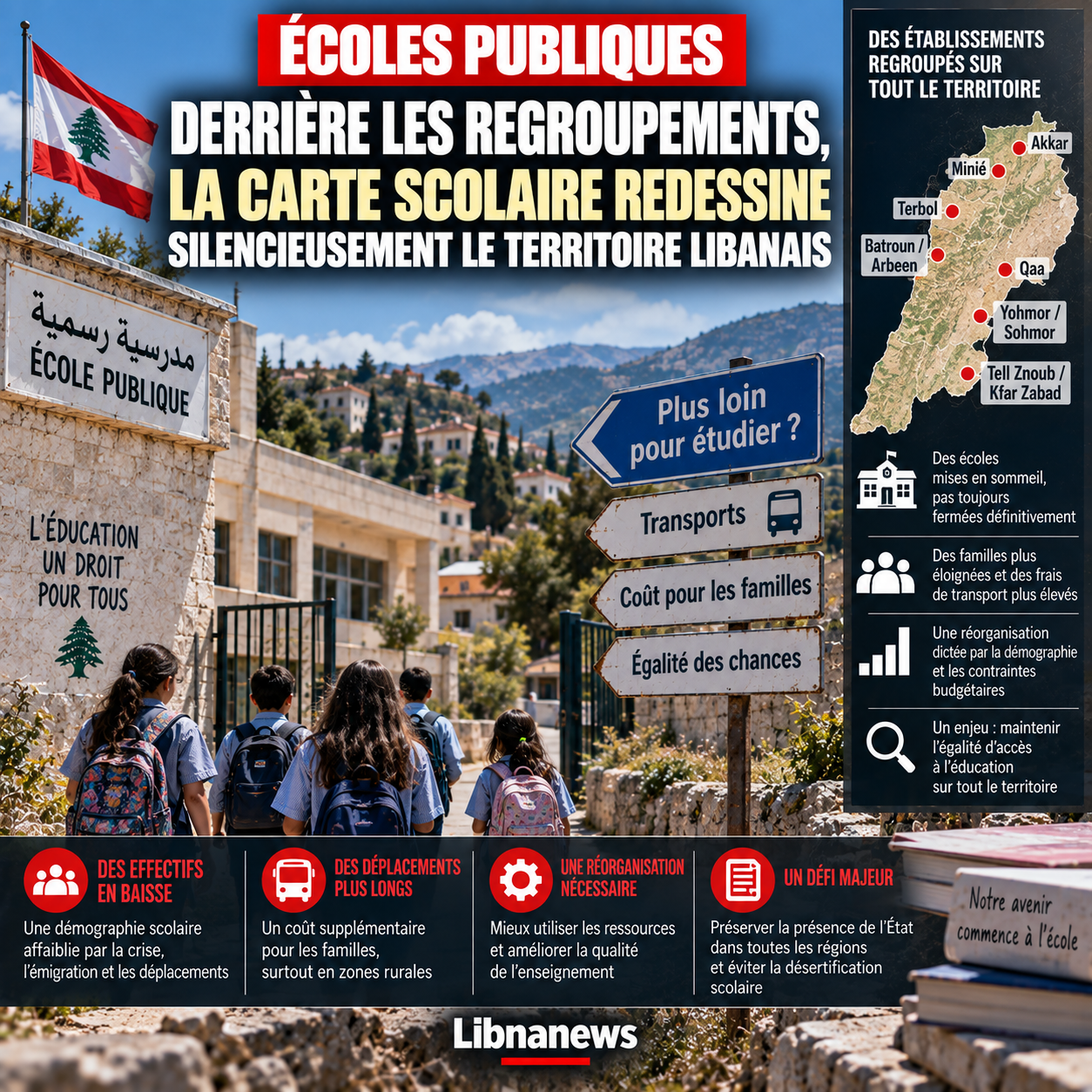
The reorganization of public education is not limited to a list of schools that open or close their doors. It affects how the State intends to maintain a school network that has become expensive, very uneven in different regions and weakened by successive crises. The measures examined for the school year 2026-2027 provide for the consolidation of certain establishments whose numbers have become too low to justify their operation under the present conditions. However, the Ministry of Education insists on an important distinction. The schools concerned would not necessarily be permanently abolished. Their activity would be suspended or regrouped, which would theoretically leave the possibility of reopening if the number of pupils increased again. This administrative nuance is essential. It shows that the authorities are seeking to rationalize the school map without taking on an irreversible disappearance of establishments, some of which occupy an important place in their village or neighbourhood. However, for families, the difference between suspension and closure can become quite theoretical when the nearest school receives more pupils for several years. Children must then join another institution. Teachers can be redeployed. Transport is becoming a new constraint. The building ceases to function daily. A decision presented as temporary can therefore have lasting effects on local life.
The economic logic of clustering is easy to understand. Maintaining a school for a very small number of pupils imposes fixed costs. It requires a building, management, teachers, staff and operating expenses. Where there are several nearby establishments each with small staff, their regrouping can help to concentrate resources and provide more coherent guidance. But accounting rationality is not enough to measure the consequences of such a decision. A public school is not a simple production unit whose efficiency is calculated by dividing expenditure by the number of pupils. It is also a territorial service. In some villages, it is one of the last public institutions still present daily. Its disappearance, even temporary, obliges families to integrate distance into their school choices. A school located a few kilometers away may seem close on a map. It is much less for a family that does not have a car, for a very young child or in an area where public transport is scarce. The costs saved by the Ministry may then reappear in the household budget. Daily travel becomes an additional expense, precisely when income remains under pressure. This is why the reorganization of the school card must be examined beyond the number of schools concerned. The real question is whether grouping can improve education without turning access to school into a logistical problem for the most vulnerable families.
Nahar-30 09 2026.pdf
School demography also tells the country’s crises
The decline in school enrolment is not necessarily a sign that this school is working badly. It can be the result of a much wider transformation of the territory. Lebanon has experienced a series of economic, social and security crises for several years, which have changed the places of residence of families. Some have left their village to get closer to a job pool. Others have emigrated. The displacement caused by the clashes also temporarily or permanently altered the distribution of pupils. To this is added the general demographic evolution. A locality where the number of children is decreasing mechanically ends up having a school whose capacities no longer correspond to the actual population. The ministry then faces a dilemma. Maintaining all structures preserves proximity, but disperses means. Bringing them together can improve the use of teachers and buildings, but sometimes accelerates the decline in public services in already fragile areas. The school map thus becomes an indirect photograph of the country’s transformations. When a school loses its students, you have to wonder where they left and why. A simple administrative decision can hide a much deeper demographic evolution: emigration of young households, displacement to cities, impoverishment of a region or change in the relationship between public and private education.
This last dimension is particularly important in Lebanon. The education system is historically based on a coexistence between a large private sector and the public school. However, the economic crisis has changed families’ financial capacities. Some who could previously bear the costs of a private establishment had to look for less expensive solutions. In other cases, emigration and population decline have reduced both sectors. Serious school planning must therefore distinguish between trends. Closing or suspending a school because its local population has been declining for a long time does not have the same meaning as regrouping a school whose numbers have temporarily dropped after displacement. The possibility of reopening referred to by the authorities makes sense here. It maintains public capacity if families return. The building must be maintained during the period of suspension and the administration must keep a clear record of its status. A « temporarily » closed school can rapidly deteriorate. Furniture disappears, equipment ages and the building can be reassigned. A few years later, the reopening becomes much more expensive than the minimal maintenance of the site. The concept of suspension therefore really protects the future only if it is accompanied by a heritage strategy and monitoring of demographic developments.
School transport becomes the hidden cost of rationalisation
The first concrete effect of a grouping is displacement. When a school ceases to accommodate its students, they must join another school. In a dense urban environment, this transfer can sometimes be relatively simple. In a rural or mountainous area, a few kilometres are enough to change the organisation of a family. It is necessary to find a means of transport, adapt schedules and bear an additional daily expense. The problem is even more sensitive for primary school children. For them, proximity is an element of security and autonomy. A school in the village sometimes allows the child to be accompanied on foot. A school in a nearby town turns this route into a paid service. This economic dimension is particularly important in the current social context. Trade unions themselves place the cost of transport at the centre of their demands. Fuel affects drivers, employees and civil servants. It also weighs heavily on families who now have to carry their children further. A rationalization that reduces the Ministry’s spending can thus shift part of the burden to households. To determine whether a merger is truly economic, this cost transfer should be included in the valuation.
The question is not limited to money. Travel time also affects school life. A child who must leave earlier and return later has less time to work or rest. Weather and traffic problems can increase absenteeism. The most vulnerable families are generally the most exposed, as they have fewer alternatives. A grouping policy should therefore be accompanied by a genuine school transport strategy. It could include organised circuits, targeted support or coordination with municipalities. Without this system, the school map may be drawn according to the location of the buildings without taking into account the real ability of the students to reach them. This issue is also crucial for measuring territorial equality. Two children can officially have the same right to public education, while facing radically different access conditions. For one, the school is a few blocks away. For the other, it requires an expensive and uncertain daily journey. Grouping is therefore socially acceptable only if the State guarantees that the additional displacement does not become a barrier to schooling. Otherwise, the savings made on an establishment may be paid by families in the form of transport, or by the education system in the form of absences and dropouts.
Regrouping can also improve a school too small
However, rationalization should not be described solely as a loss. A school with very few pupils can itself face serious educational difficulties. Teachers sometimes have to cover several levels. The supply of materials becomes limited. Cultural, sports or scientific activities are more difficult to organize. Equipment costs a small number of users. In some situations, a larger establishment may offer better conditions. It can bring together more specialised teachers, create more balanced classes and have facilities that a small school could not finance. Grouping can therefore improve the quality of education provided that the host institution has the necessary capacity. The number of rooms, sanitary facilities, laboratories, sports facilities and especially the number of teachers must be checked. An administrative merger of two schools without strengthening the student-hosting site would only displace the difficulties. Overcrowded classes would then replace too small classes.
The redeployment of teachers is a central issue. A rational school card cannot only move students. It must also redistribute human resources. Some schools may lack teachers, while others have teachers who have become disproportionate to the number of children. The reorganization is theoretically an opportunity to correct these imbalances. But it can also create tensions. A long-term teacher in a locality may have to make a much larger journey. Its situation is then similar to that of families: the cost of transport and the length of travel become elements of the reform. The success of the consolidation therefore depends on the accuracy with which each operation is prepared. It is not enough to see that a school has few pupils. It is necessary to determine where they will be accommodated, how many places exist, which teachers will be transferred and how each will move. A uniform policy applied to very different territories could produce contradictory results. A small isolated school can be indispensable even with few pupils, while a small school located a few hundred meters from a better equipped school can be rationally grouped. Distance and geography are as important as numbers.
When school disappears, the village loses more than a class
The issue is becoming even deeper in the outlying localities. Schooling is often one of the elements that allow a young family to stay in a village. The presence of an establishment reduces travel, creates jobs and maintains daily activity. She also participates in collective life. Parents meet there. School holidays mobilize the inhabitants. The building can accommodate local activities. Its closure thus gradually changes the relationship between the family and its territory. When it is already necessary to travel several kilometres for the school, then more for a doctor, an administration or a job, the departure to a larger city becomes more rational. The disappearance of services can thus speed up the demographic decline that originally justified their consolidation. It’s a hard circle to interrupt. A locality is losing people, so its school has fewer pupils. The school is suspended, which further reduces the attractiveness of the village. New families leave, making reopening less and less likely.
This mechanism obliges the school card to be placed in a spatial planning policy. The Ministry of Education cannot, of course, maintain every institution indefinitely to compensate for the absence of other public policies. But the decision to regroup a school should be coordinated with the municipalities and administrations concerned. Some localities are expected to develop. Others are experiencing a sustained decline. Some of them host displaced populations or may see people returning after a period of conflict. A school card that only looks at the current year may become obsolete very quickly. The current workforce must therefore be combined with demographic and territorial projections. The possibility of reopening announced by the authorities is a useful precaution, but it must be accompanied by public criteria. From how many students could an institution reopen? How long would his suspension status be maintained? Who evaluates local demand? How is the building preserved? Without precise answers, temporaryity can become an administrative formula to avoid the word « closure » without offering a real prospect of return.
A necessary reform provided that its criteria are published
The reorganization of the school map can be defended on solid arguments. A weakened public system cannot disperse its resources without examining their effectiveness. Almost empty buildings while other schools lack teachers or equipment are a misuse of available resources. But the legitimacy of the reform depends on the transparency of the criteria. Families must be able to understand why their school is concerned. Is the number of students the only factor? Is the distance to the host facility taken into account? Is there a minimum threshold? Do educational performances play a role? Is the condition of the building involved? Is the decision reviewed annually? The clearer the rules, the less the grouping can be interpreted as an arbitrary decision or as the result of a local power relationship. This transparency is particularly important in a political system where the territorial distribution of services can quickly take on a community or partisan dimension.
The same requirement applies to results. A consolidated school should be monitored. It is necessary to measure the attendance rate of former students, possible dropouts, travel time, class evolution and educational results. A budget economy is not a success if it leads to an increase in school dropout. Conversely, a grouping that improves learning conditions while guaranteeing transport can be a useful reform. The department thus has an opportunity to transform a defensive measure, imposed by the weakness of resources and the downsizing of certain personnel, into a real planning exercise. But this ambition implies not considering schools as interchangeable points on a map. Each establishment belongs to a territory, a population and a local history. The challenge is to streamline the network without accelerating desertification in the most fragile regions. Behind the administrative formulation of « grouping » is therefore a much broader question: how far can the state concentrate its services to save resources without making their access more difficult precisely to the citizens who depend most on public schools.