





In Yarun, Bint Jbeil district, it was not only brush that burned in early August. Old olive trees, cultivated land and family plots were ravaged by fire in this locality a few kilometres from the border with Israel. Approximately 1,200 dunums, or 120 hectares, were reported to have been affected in the area by early local estimates. Some trees were hundreds of years old. They had crossed the Israeli occupation, the May 2000 withdrawal, the 2006 war and the clashes that began in October 2023. They did not survive the new destructions. For their owners, the loss is not measured at the price of a young plant: it represents several years of harvest, part of the family’s heritage and sometimes the only economic activity that can be considered for a sustainable return to the village.
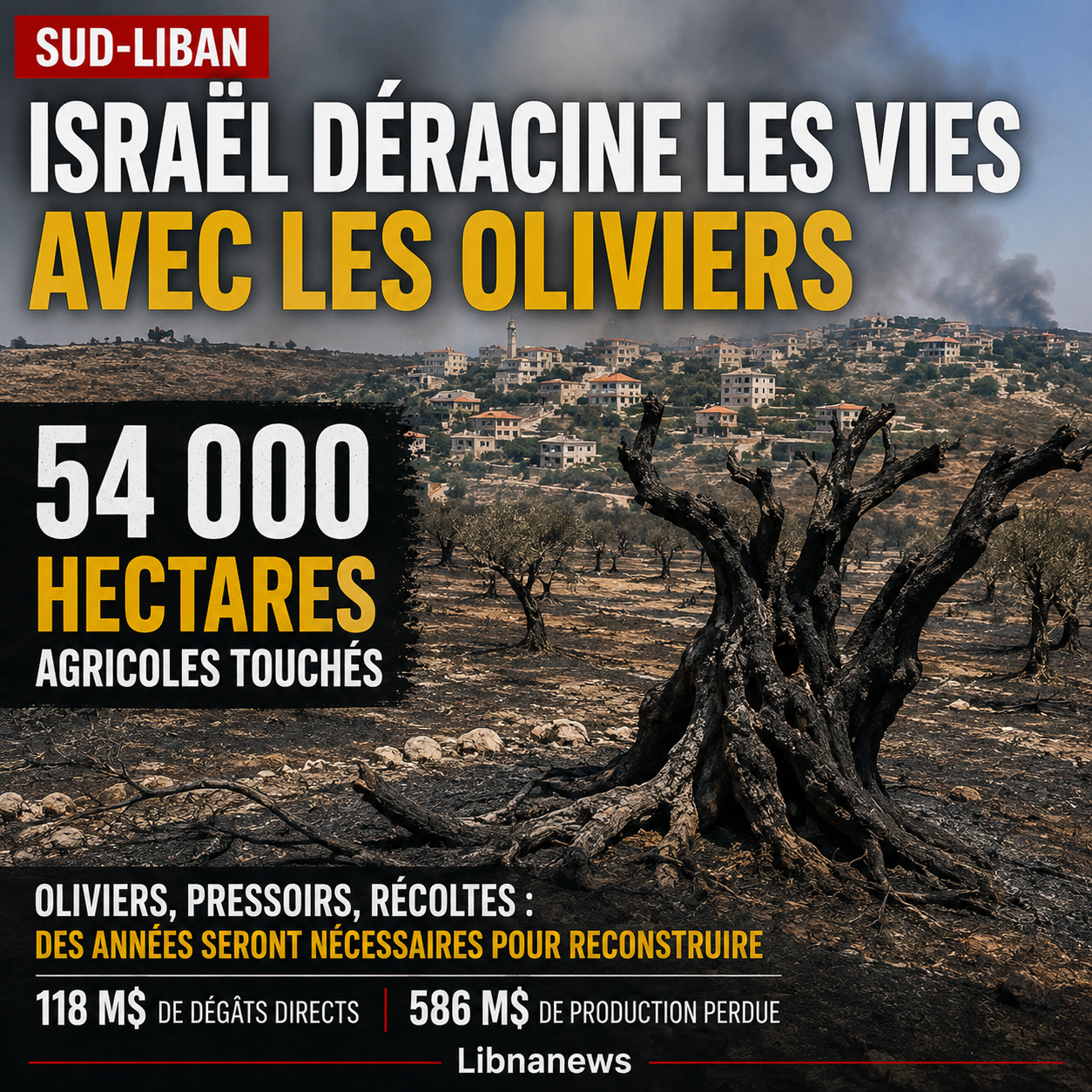
Yarun is just one example of much wider agricultural destruction. In April 2026, the Lebanese Ministry of Agriculture estimated that54,000 hectaresagricultural land affected by the war across the country, over some 240,000 to 250,000 hectares actually cultivated. In other words, about22.5 per cent of the lebanese agricultural areahad been affected. In the South and Nabatiyah, damage is concentrated on olive trees, citrus fruits, banana trees, tobacco, vegetable crops and the infrastructure necessary for their exploitation. Tens of thousands of trees have been burned or destroyed, presses have disappeared and thousands of hectares have become temporarily or permanently inaccessible.
The fires of summer 2026 make this situation worse. Lebanese Civil Defence officials accuse Israeli forces of having caused several bursts of fire with fire, flares or other ammunition. Rescue teams claim to have been forced to withdraw from certain areas due to the presence of drones or new strikes. Israel does not recognize a policy of agricultural land and affirms that its operations meet security requirements related to Hizbullah activities. But for the farmer who returns to his blackfield, the immediate result does not depend on this battle over intentions: the tree is dead, the harvest has disappeared and several years will be necessary before a new orchard can produce.
From Yarun to Kfar Kila, lands disappear with villages
The map of agricultural destruction largely matches that of the villages most affected by military operations. Yarun, Aitah al-Sha`b, Kafr Killah, Meiss al-Jabal, Shiam, Blidah, Hula, Markabah and the surrounding areas of Naqurah and Alma al-Sha`b have suffered, to varying degrees, shelling, fire, destruction of buildings and prolonged periods during which inhabitants could no longer access their land. In some localities, the destruction of homes and farms overlaps, turning the problem of reconstruction into a much larger issue than housing.
Kfar Kila offers one of the most extreme examples. This border town had about5,500 inhabitantsbefore the final stages of the conflict. In the spring of 2026, on-site estimates reported more than90% of village destroyed. Behind the razed buildings there is a local economy which was partly dependent on agricultural land and olive oil. For a family that finds both its destroyed house and its damaged operation, the return therefore requires two simultaneous reconstructions: that of the place of life and that of the income which allows to remain there.
The same mechanics appear in other villages. In Aitah al-Sha`b, the destruction of the building was accompanied by damage in the surrounding lands. In Meiss al-Jabal and Blida, access to certain plots remained complicated by the military situation and the risks associated with ammunition. In Yarun, this summer’s fires added a new layer of damage to lands that had already suffered several years of confrontation. Time itself is becoming a destructive factor: an unmaintained plot for two or three seasons is deteriorating, irrigation systems are deteriorating and farmers are losing their outlets.
47 000 olive trees destroyed in the first months
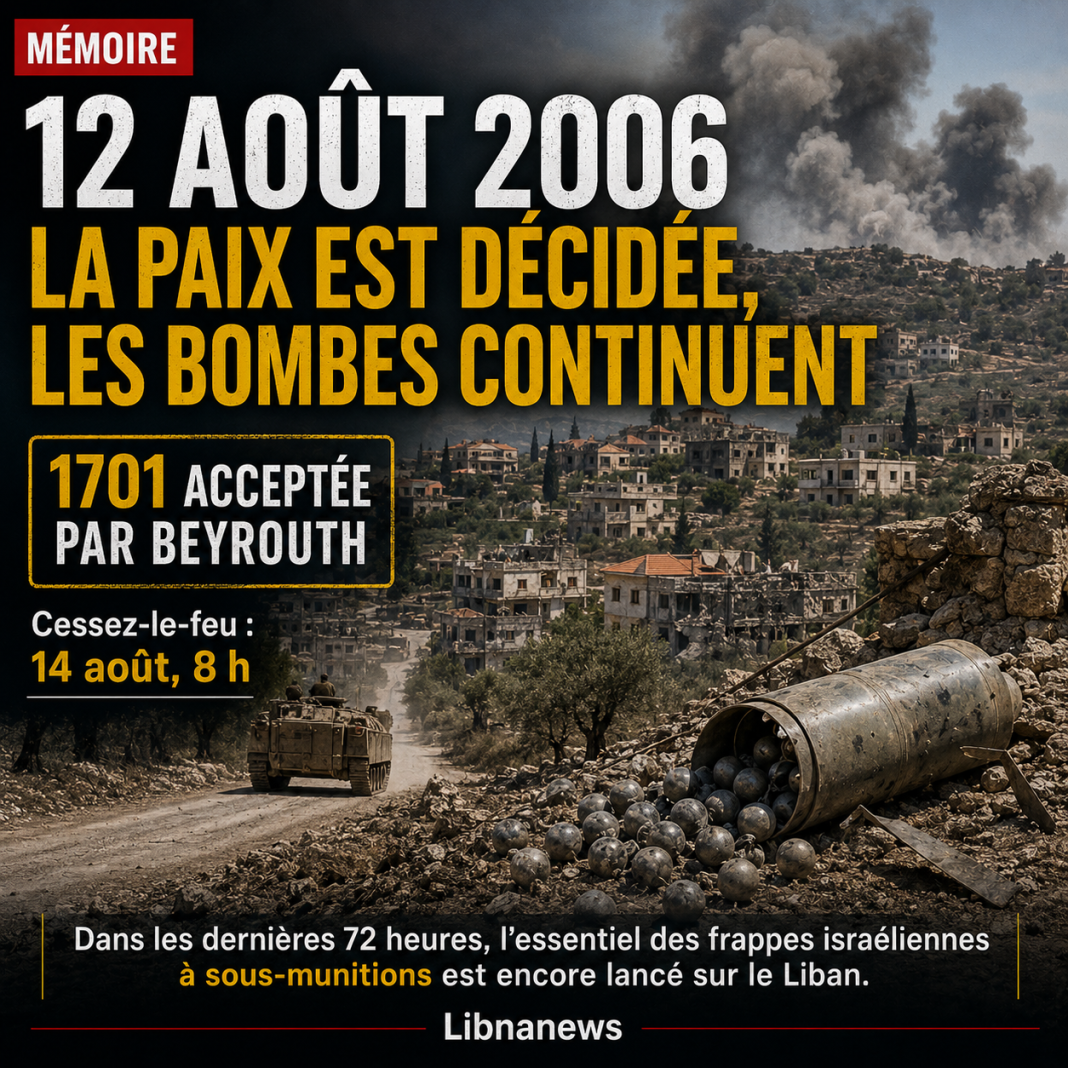
The magnitude of the losses is not 2026. As early as February 2024, after only four months of confrontations at the border, an initial humanitarian assessment reported about47,000 olive trees destroyedsouth Lebanon. This assessment was already considerable, but it preceded the most destructive phases of the 2024 war, land operations, subsequent demolitions and the new hostilities of 2026.
The post-war 2024 assessments made it possible to clarify some of the damage through satellite images and field observations. An international study identified the total destruction of134 hectares of olive grovesto which were added48 hectares of citrus fruit,44 hectares of banana plantationsand about15 hectares of other fruit trees. These figures refer to areas identified as lost and do not necessarily cover all damaged or inaccessible parcels.
Perhaps the most revealing figure is elsewhere. More12,000 hectares of agricultural landhad been abandoned in the southern governorates and Nabatiyah because their farmers could no longer reach them. Not all of these lands were destroyed. Many were simply located in areas that became too dangerous to allow for size, irrigation or harvesting. An olive grove that survives physically but whose fruit cannot be picked still represents an economic loss to its owner.
So war destroys agriculture in two ways. It can burn the tree directly, but it can also separate the farmer long enough from its field for harvest and income to disappear. In a region where many farms are family-sized and small, two lost seasons may be sufficient to put a household in lasting difficulty.
A mature olive tree does not replace itself with a simple plant
The price of a young olive tree gives a misleading picture of the loss. Buying a plant is relatively inexpensive. Replacing the productive capacity of a mature tree is another matter. Depending on the variety, soil conditions, irrigation and agricultural methods, several years are required before a significant harvest is obtained. It is often necessary to wait longer before achieving a yield comparable to that of a well established adult tree.
A mature olive tree can produce several tens of kilograms of olives in a good year, although yields vary greatly depending on the seasons and farming practices. Part of this crop is for table consumption, but most of the family farms are used to produce oil. Several kilograms of olives are required to obtain a litre of oil, the yield depending on the variety and maturity of the fruit.
For a family with 100 or 200 productive trees, the destruction of the orchard potentially represents several tons of olives lost each year. To this production adds the value of family work organized around the harvest. When the tree disappears, it is not only organic capital that is destroyed: it is a small agricultural enterprise.
A two or three hundred-year-old olive tree presents a different problem. Its heritage value is not reproducible. An owner can plant a new tree on the same plot, but no aid program can give it three centuries of growth. It is this dimension that explains the emotion caused by images of old burnt trunks in Yarun and other villages in the South.
South provides around 40% of Lebanese olives
The stakes go far beyond the directly affected owners. The South represents, according to available agricultural estimates, about38% to 40% of domestic olive production. The region is therefore one of the country’s main olive farms, alongside the Kura, Akkar and several areas of Mount Lebanon.
This produces a very fragmented economy. Unlike large producing countries where olive cultivation can be heavily industrialized, Lebanon has many small family properties. Part of the crop is consumed directly, another sold and a third processed into oil in local presses. Annual income may seem modest at the national level, but sometimes it is an essential component of a rural household’s budget.
This structure makes producers particularly vulnerable. Large farms can spread their risks among several plots or have cash to absorb a bad year. A family whose most heritage consists of 150 olive trees around its village can lose almost all its agricultural capital in a single series of fires.
The decline in southern production also affects consumers. Less local oil means a reduced national supply, while production, transport and packaging costs have already increased sharply since the economic crisis. In the long run, Lebanon may be forced to import more products than it was capable of producing locally.
$118 million damage, 586 million lost production
Economic assessments measure the gap between visible damage and its actual cost. An assessment of the environmental and agricultural consequences of the conflict estimated that$118 millionphysical damage directly to the agricultural sector. The economic losses associated with production were about$586 million.
The difference between the two amounts is essential. Destroyed equipment can be estimated at its replacement cost. A crop that has not taken place represents lost income. When the destroyed asset is a perennial tree, the loss is repeated for several years.
The estimated $586 million lost in production shows that the economic impact is almost five times greater than the only physical damage identified in this assessment. The conflict not only destroys what exists at the time of the strike. It also destroys what the land should have produced afterwards.
For a country in financial crisis since 2019, these amounts are far from secondary. They are income that has not entered the villages, purchases that have not been made, seasonal wages that have not been paid and agricultural products that have not reached the markets.
Press stations, cooperatives and nurseries have also disappeared
Destruction does not stop at the edge of the fields. Agricultural infrastructure has also been affected. Data available in 2026 show about23 fully destroyed agricultural cooperativesand16 olive mills or pressesdestroyed. More200 nurseriesalso suffered damage or loss.
The case of presses is particularly important. An olive grove of commercial value only if the producer can process or sell its harvest under acceptable conditions. Olives for oil must be pressed quickly after collection to preserve their quality. The disappearance of the local mill therefore obliges farmers to transport their production further, at an additional cost.
If several presses in a region are destroyed at the same time, the remaining plant must absorb more volumes. Delays can increase and transportation costs can increase. The initial damage thus spread to farms which were not necessarily directly affected by the bombings.
Nurseries play an equally strategic role in reconstruction. The South will need tens of thousands of new plants. However, companies capable of supplying these trees have themselves suffered damage. The chain necessary for agricultural reconstruction is therefore partially destroyed at a time when demand is going to rise sharply.
Fire adds to the destruction of war
The fires of summer 2026 occur on already fragile terrain. Civil Defence officials in the Nabatiyah area believe that in some areas close to the confrontation line,30 to 40 % of surfaceshave been affected by the accumulated fires and destruction. This estimate covers the most exposed areas and cannot be extended mechanically to the whole of the South, but it gives the measurement of the local disaster.
Fire crews accuse Israeli forces of using flares and various types of ammunition that cause certain fires. They also claim that their interventions can be complicated by drones and the risk of further strikes. The Israeli authorities more widely reject the accusations that they would voluntarily seek to destroy the agricultural environment and claim to target the infrastructure of Hizbullah.
The distinction between intentional destruction and the consequence of a military operation should be examined separately for each event. However, it does not affect the immediate agricultural effect. A fire that crosses an olive grove in the dry season can destroy in a few hours a capital formed for several generations.
Climate change further exacerbates this vulnerability. High temperatures, dry vegetation and prolonged periods without rain allow the fire to spread rapidly. A munition or rocket that causes a fire departure can therefore cause much greater damage to the area initially affected.
White phosphorus left another trace
To these fires are added the consequences of the white phosphorus munitions used in certain areas of the South since 2023. Several uses have been documented near Lebanese localities. Israel claims to use these munitions in accordance with applicable law and in particular to create smoke screens, while Lebanese authorities and human rights organizations have denounced their use near inhabited and agricultural areas.
White phosphorus ignites in contact with oxygen and can cause fires that are particularly difficult to control. For farmers, its impact exceeds the immediate destruction of vegetation. Concerns have also been raised about soil, tailings and plot safety before crop recovery.
The problem is combined with the problem of unexploded ordnance. Before returning to work, a farmer may have to wait for inspection and clearance. Each additional month without access may result in further loss of harvest and delay the work required to restore the orchard.
Re-culture becomes a much more complex process than a physical return to the village. The end of a military operation does not automatically mean the return of agricultural activity.
Water, other less visible victim
A tree can survive a bombardment and then die if its productive environment has disappeared. Damage to water systems, basins, pipelines and pumping facilities is therefore an important part of the balance sheet.
Some traditional olive groves are relatively drought resistant, but young plantations and many other crops need regular access to water. Citrus fruits, bananas and vegetable crops are even more dependent on irrigation.
The destruction of a pipeline can thus render unproductive a parcel which has not suffered any direct impact. In several villages, agricultural roads were also damaged. An owner can theoretically access his field on foot while being unable to bring in a tractor, transport his harvest or bring the necessary equipment to restore it.
These infrastructures will have to be accounted for in the reconstruction. Without them, replanting the trees will not be enough.
Agriculture already exsangued before the most recent destruction
The Lebanese agricultural sector did not address this war in a normal situation. Since 2019, the financial crisis had already exploded the cost of fertilizers, plant protection products, fuel, spare parts and machinery. Bank credit had almost disappeared, forcing producers to finance the season’s expenses themselves.
Under these conditions, many smallholders had reduced investment. Some delayed the renewal of the equipment or limited the maintenance of their plots. The war struck a sector with very few financial reserves.
This fragility explains why a few thousand dollars of damage can be enough to put a family farm out of play. A producer who has lost his trees must finance the restoration of the soil, buy new plants, repair irrigation, and wait several years before returning to a harvest. Meanwhile, he must also live.
For an displaced family whose house was destroyed, the constraint is even greater. It must choose between rebuilding the housing and rebuilding the farm. Without sufficient public or international assistance, many households are unlikely to be able to do both simultaneously.
Agricultural loss increases food dependence
The national cost of such destruction also appears in imports. Lebanon is already heavily dependent on foreigners for food. The agricultural crisis in the South further reduces its capacity to produce locally.
Olives are only part of the problem. The South and Nabatiyah also produce citrus fruits, bananas, tobacco, vegetables and various fruit crops. Thus, destruction affects several markets simultaneously.
Each tonne which is no longer produced must be replaced by a decrease in consumption, by production from another region or by an import. In the latter two cases, prices may rise. Other agricultural regions have limited capacity to quickly compensate for the loss of thousands of hectares. Imports require currencies and aggravate the trade deficit.
Agricultural destruction therefore has a macroeconomic cost. It reduces rural incomes, reduces domestic production and potentially increases the bills of food imports.
A family can rebuild their home and never come back
Yet the most lasting consequence remains human. In border villages, return depends not only on the reconstruction of housing. A family whose house has been destroyed can theoretically receive compensation and rebuild. But if her field has disappeared, her press has closed and her trees will not produce for several years, she must find another income.
For some people, this means working in Beirut, Saida, Nabatiyah or another area. For others, this may mean staying abroad. Children of displaced families can continue their education away from the village, find employment elsewhere and no longer return to settle permanently.
An absence from war then becomes a lasting displacement without any formal decision to expel. It is sufficient that the cost of return becomes higher than the means of the family.
It is in this perspective that the destruction of an olive grove takes on a political dimension. She’s not just earning income. It materially reduces the possibility of remaining on earth.
Destroying income can empty a village as surely as destroying houses
A border town does not live solely from its buildings. It lives on its inhabitants, their jobs, their farms and their exchanges. When these activities disappear, rebuilding the walls is not enough to rebuild the village.
An owner can go back to a new home and find out that he can no longer afford to live there. If his olive grove has burned and the press in the area has disappeared, he will have to work elsewhere. Its presence in the village then becomes intermittent, then perhaps only seasonal.
In the long term, this transformation can profoundly change the demographics of the South. Older people return more easily to family land. Young people in employment need a job and a regular income. If the rural economy is not rebuilt at the same time as the building, villages risk losing precisely the generations needed for their future.
The problem should therefore not be measured solely in terms of the number of dwellings to be rebuilt. It is also necessary to measure how many farms will be able to resume profitable activity.
New plantations will not produce immediately
Replanting olive trees will be indispensable but insufficient. Young trees must first root, be protected, cut and maintained. Several years are needed to achieve significant commercial production, even more so to regain the productive capacity of an adult plantation.
This period creates an economic vacuum. Suppose a family traditionally draws several thousand dollars a year from its oil and olives. Although all her plants are replaced for free, she still loses that income for several seasons.
A genuine reconstruction policy will therefore have to provide for multi-annual compensation, not just aid for the purchase of trees. It will also have to finance fertilizers, equipment, labour and maintenance during the phase when the new plantation does not produce enough.
Without this support, households with the least savings will abandon their land before the new trees mature.
Centennial olive trees create another form of loss
For the oldest trees, no public policy can really restore the previous situation. A century-old olive tree or several centuries-old olive tree has a value that exceeds its annual yield.
These trees are often related to the history of a plot. They may have served for decades of reference between properties. They appear in family stories and sometimes in the memories of several generations.
In the villages of the South, where forced displacement and successive wars have already changed the lives of the inhabitants several times, this plant permanence has particular importance. A family that leaves their village can return years later and find the same tree.
Its destruction thus erases a material landmark of return.
This makes the image of the deracinated olive much stronger than that of a simple loss of harvest.
A deracinated tree also changes the landscape
The disappearance of orchards can also complicate property issues. In some rural areas, the boundaries between plots are known through old roads, walls, trees or uses. When the terrain is deeply disturbed, these landmarks can disappear.
Titles obviously remain the legal reference where they exist and are properly registered. But on the ground, reconstruction can become more difficult when an entire landscape has been levelled or burned.
This issue will become more important when work begins. Agricultural roads will have to be reopened, water systems restored and the boundaries of certain plots verified.
Land reconstruction will not always be as simple as planting a tree at the previous location.
The South may also lose its know-how
The olive tree not only produces agricultural property. It maintains local know-how: size, graft, harvest, fruit selection, pressing and oil preservation.
When families leave the village for a long time, these skills can also disappear. A young person who abandons farming for ten years to work in another city or abroad does not necessarily return to exploit the family plot when the situation improves.
The destruction of the agricultural economy thus accelerates an already old development: the ageing of the rural population and the departure of the youngest to cities.
The risk is to rebuild land without finding enough farmers to grow it.
Reconstruction must therefore be measured in years, not only in dollars
The first figures of the damage are necessary to mobilise funding. However, they are still insufficient to measure the real cost. A house can receive a reconstruction value. A mill can be replaced by new equipment. A road can be repaired.
For an olive grove, the calendar is different. Its economic reconstruction does not end on the day the new plant is grounded. It ends when the family recovers a yield that can replace the one she had before the war.
It can take years.
Aid programmes will therefore have to accompany producers over time. Single compensation may be spent on immediate housing or consumption needs before exploitation regains its productive capacity.
The challenge will be to preserve the presence of families long enough to wait for the next generation of trees.
Israel invokes security, Lebanon denounces lasting destruction
Israel presents its operations in the South as necessary to prevent Hezbollah from reconstituting a threatening military presence near the border. The Israeli army claims to target combatants, weapons depots, tunnels and military infrastructure and to take measures to limit damage to civilians.
The Lebanese authorities make a radically different reading of destruction. They accuse Israel of striking civilian living conditions and of gradually transforming certain border areas into hard-to-persist areas. Lebanese officials also used the term « ecocide » to describe the extent of environmental damage.
This qualification requires a precise legal demonstration and cannot be established by political declarations alone. But the material extent of the damage is already documented: burned land, destroyed trees, abandoned farms, damaged agricultural infrastructure and villages where much of the building has disappeared.
The central question is therefore no longer whether agricultural damage exists. It is to measure how long they will prevent people from returning to normal economic life.
Olive trees become a question of return
In this border strip, the tree eventually takes on a dimension that goes beyond agriculture. The resident who cultivates his field declares his presence every year. He comes back to trim the branches, clean the plot, pick the fruit and maintain the paths.
When this routine becomes impossible for several years, the relationship to earth changes. Property may remain legally intact, but its economic reality weakens.
Therefore olive groves should be considered as a central component of the return of displaced persons. Restoring a house without restoring the income attached to it risks producing reconstructed but poorly inhabited villages.
In Yarun and other border localities, blackened trunks are now a concrete measure of this threat. Some trees had survived centuries. Materially replacing them is possible. Reconstitute the revenues, memory and continuity they represented will take much more time.
The South must therefore be rebuilt simultaneously in concrete and roots. The figures already give the size of the project:54,000 hectares affected, at least 47,000 olive trees destroyed in the first months, more than 12,000 hectares abandoned after the war of 2024, 16 presses destroyed, 23 cooperatives lost and nearly $586 million of agricultural production stolenin the available evaluations.
These numbers, however, tell only part of the story. In each village, behind a listed hectare or tree, there is an owner who wonders if he will still have something to harvest when he can return home. In southern Lebanon, uprooting the olive trees is thus making it much more difficult to re-root families.