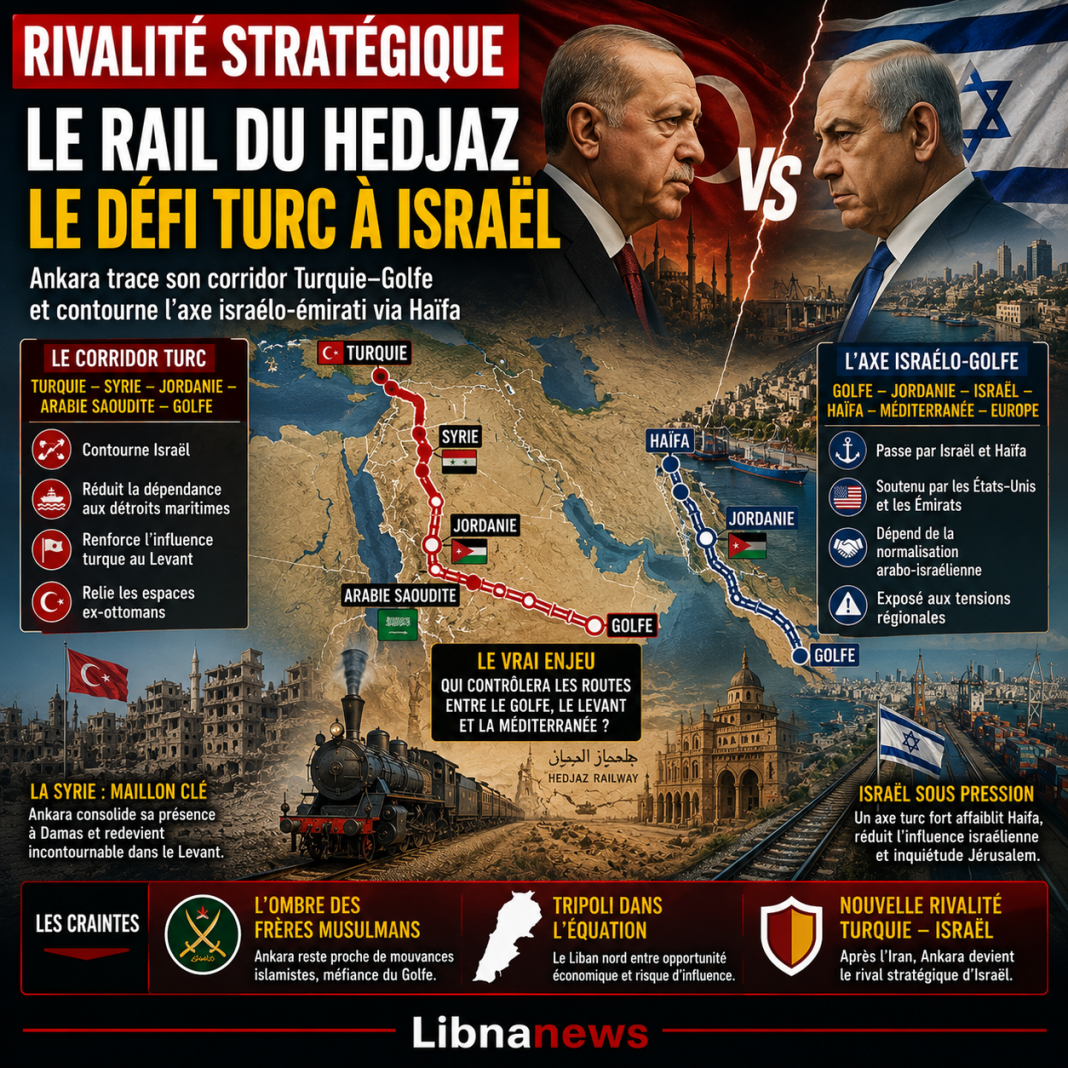






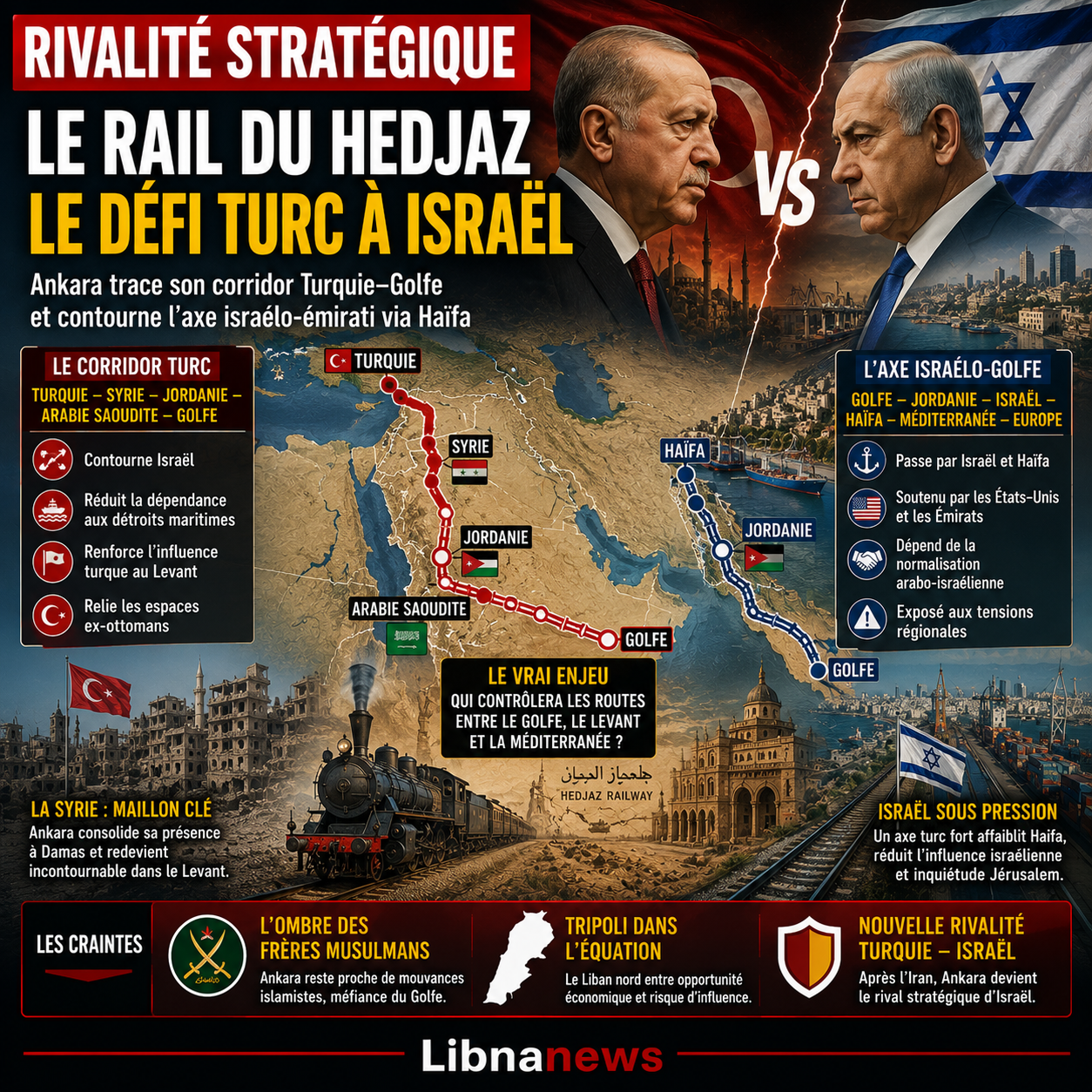
The project to revive the Hedjaz railway is not only a matter of rail, ports and freight. It is part of a broader recomposition of influence axes in the Middle East. Ankara today presents it as an economic corridor linking Turkey to the Gulf through Syria, Jordan and Saudi Arabia. But its scope is beyond logistics. The route reactivates an Ottoman memory, repositions Turkey at the heart of the Levant and competes with projects supported by Israel, the United Arab Emirates and the United States to connect the Gulf with the Mediterranean via Haifa.
The Turkish-Saudi project, discussed in June, aims to modernise a historic railway axis linking Turkey to Syria, Jordan and then Saudi Arabia. Project proponents highlight cost reduction, land road safety and the possibility of bypassing maritime vulnerabilities, including the Strait of Ormuz. But this economic justification is not enough to explain the Turkish interest. As in the early twentieth century, the Hedjaz rail is also a tool for political projection. It allows Ankara to connect the former Ottoman spaces, strengthen its presence in Syria, move closer to Saudi Arabia and offer an alternative to the corridors that give a central role to Israel.
This dimension is already worrying several actors. Israel is carefully observing the Turkish return to the Levant. The Gulf countries and Jordan must arbitrate between several competing roads. Lebanon looks at this project through the prism of Tripoli, Syria and Turkish influence in the north of the country. Each time, the question is the same: is the railway an economic project, or is the modern form of a battle for the axes of power?
A high-political economic project
Turkey presents the revival of the Hedjaz rail as a regional connectivity project. Turkish Minister of Transport Abdulkadir Uraloğlu referred to a line linking Turkey to Syria, Jordan and Saudi Arabia, with a broader ambition towards the Gulf. The official argument insists on trade, the transport of goods, the movement of passengers and the securing of alternative routes to the maritime routes exposed.
This economic reading is based on realities. The war against Iran, tensions around the Strait of Ormuz, attacks on maritime routes and the fragility of supply chains have increased interest in land corridors. Turkey wants to become a platform between Europe, the Levant and the Gulf. Saudi Arabia is seeking to diversify its roads. Jordan can become a transit country again. Syria, if it stabilizes, can recover an essential geographical function.
But rail is never neutral in this region. The historic Hedjaz, built by the Ottoman Empire in the early twentieth century, linked Damascus to Medina and symbolized both religious, administrative and strategic ambition. Its modern recovery therefore evokes more than just infrastructure. It refers to Turkey’s ability to become once again an organizer of regional traffic, in a space that wars, borders and rivalries have fragmented for a century.
Ankara also uses connectivity as a power tool. Rail provides standards, financing, technical dependencies, business networks, port relays and political interests. In the case of Hedjaz, the economy serves as an acceptable language for a much wider influence strategy. That is precisely what worries Israel and some Lebanese actors.
An alternative to the corridors through Haifa
The Turkish-Saudi project directly competes with another vision of the Middle East: that of the corridors linking India, the Gulf, Israel and Europe. The India-Middle East-Europe corridor, announced in 2023 at the G20, provides maritime, rail, energy and digital connectivity between India, the United Arab Emirates, Saudi Arabia, Jordan, Israel and Europe. In this architecture, Haifa occupies a strategic position as a Mediterranean port.
There is also the idea of a land corridor linking the Emirates with Israel through Saudi Arabia and Jordan, with Haifa as an outlet. This project, sometimes described as the « Peace Railway », is based on normalization between Israel and some Arab countries. It aims to bypass vulnerable maritime routes, connect the Gulf with the Mediterranean and make Israel a regional logistics hub.
The Hedjaz rail offers another way. It passes through Turkey, Syria, Jordan and Saudi Arabia. It can link the Gulf with Europe without giving Haifa a central role. This is an important point. In the rivalry of corridors, the issue is not just transport. The question is which state becomes indispensable. If the corridor passes through Haifa, Israel gains a regional transit role. If he passes through Turkey and Syria, Ankara and Damascus recover a lost centrality.
This competition places Saudi Arabia and Jordan in a delicate position. Riyadh better multiply the options. It does not want to depend solely on an Israeli-American axis, especially without a credible Palestinian settlement. Amman, on the other hand, can benefit from both architectures, but it is in the middle of American demands, economic interests and a public opinion very sensitive to any further normalization with Israel.
The Turkish project therefore allows Arab countries to have an additional map. It does not immediately replace corridors via Haifa. He’s competing politically with them. He tells regional actors that a road to Europe can exist without passing through Israel.
The Muslim Brotherhood Factor
Another element complicates the project: the ideological perception of the Turkish-Syrian axis. For several Arab capitals, including Riyadh, Abu Dhabi, Cairo and Amman, Turkey remains associated with the political support given since the Arab spring to Islamic movements close to the Muslim Brotherhood. This memory still weighs, even if the economic relations between Ankara and the Gulf countries have warmed up.
Saudi Arabia has long regarded the Muslim Brotherhood as an ideological threat to the Gulf monarchies. Their model of political electoral, social and transnational Islam was perceived as a competitor of monarchical legitimacy. The United Arab Emirates shared this concern even more prominently. Egypt, after the fall of Mohamed Morsi, also made the fight against the Muslim Brotherhood one of the pillars of its domestic and regional policy.
Turkey, for its part, has maintained political and ideological ties with several currents from or close to this universe. Ankara welcomed opponents, supported certain Islamist parties and developed a regional policy often perceived in the Gulf as favourable to political Islam. Recent reconciliations have not erased this mistrust. They simply contained behind economic and strategic interests.
Syria adds another difficulty. We must avoid saying that the current Syria would simply be « Muslim Brotherhood ». The reality is more complex. The new Syrian power is described by several analyses as a power derived from Islamist movements, in a pragmatic recomposition, seeking to rebuild a state and reassure its neighbours. But his rapprochement with Ankara feeds the suspicions of Arab capitals hostile to political Islam. For Riyadh, rail can therefore be logistically useful, while strengthening an ideologically sensitive Turkish-Syrian axis.
This contradiction is important. Saudi Arabia can support a railway corridor with Turkey out of economic interest, while maintaining political distrust of Turkish influence. The problem is not just on the rails. It affects the nature of the power that could structure the Turkey-Syria-Levant axis. If Damascus gets closer to Ankara and if Islamist networks close to the Muslim Brotherhood universe are gaining in weight, Riyadh is faced with a dilemma: accompanying a useful corridor, but likely to strengthen an ideological current that it has been fighting for years.
Israel is also interested in this dimension. A strengthened Turkey-Syria axis, supported by Islamist references and capable of spreading towards Lebanon, would be perceived as a strategic threat different from the Iranian axis, but equally worrying in the long term. Israel would not only look at a railway project. He would see a Turkish influence in the Levant, backed by a rebuilt Syria and potentially capable of weighing in Lebanon.
Lebanon and Tripoli’s sensibility
In Lebanon, the rail record has a particular resonance. The project to rehabilitate the Tripoli-Abboudieh line, towards the Syrian border, was presented by the Ministry of Public Works as a first step to reconnect the port of Tripoli to the regional networks. On paper, it is an economic project. It aims to give northern Lebanon a logistics function, to link Tripoli to Syria, and potentially to Turkey, Jordan and the Gulf.
But this issue has already raised concerns. Tripoli is a strategic city. It has an important port, a Sunni social depth, proximity to Syria and a history of economic marginalization. Any increased foreign presence in northern Lebanon is read politically. Turkey has developed cultural, religious, humanitarian and economic links there for years. For some Lebanese officials, rail rehabilitation could strengthen this influence.
These concerns do not mean that the rehabilitation of the Tripoli station or the line to Syria is in itself problematic. Lebanon needs infrastructure. Its rail network has almost stopped for decades. The port of Tripoli can become a lever of development. But in such a fragmented country, a transport project can quickly become a question of regional alignment.
Northern Lebanon is also observed by Israel. A corridor linking Tripoli to Syria and then Turkey can be read as an extension of Turkish influence to the eastern Mediterranean. If combined with an increased Turkish role in Syria, it can change the balance in the Levant. Israel, which is already monitoring Iran and Hezbollah in Lebanon, can see this as another form of strategic penetration, less military but potentially sustainable.
Syria, the central link of the project
The recovery of Hedjaz depends on Syria. Without Aleppo, Homs, Damascus and the roads to Jordan, the project remains incomplete. This is why Turkey attaches particular importance to normalizing or stabilizing its relations with Damascus. Rail is also a tool for Turkish return to Syria, under cover of economy and reconstruction.
This dimension is of direct interest to Israel. Since the fall of the former Syrian order and the recompositions that followed the war, Israel has observed with concern any foreign military or strategic presence on its northern flank. For years, the main concern was Iran and Hezbollah. But a Syria where Turkey would play a structuring role opens up another perspective.
Recent Israeli analyses already describe Turkey as an emerging strategic threat. Some Israeli experts claim that the Hebrew state must prepare for a lasting competition with Ankara. They don’t all talk about a certain war. But they evoke an increasingly open rivalry, in Syria, the Eastern Mediterranean, Gaza, Lebanon and around energy or trade corridors.
The risk to Israel would be the creation of a Turkey-Syria axis capable of weighing Lebanon. This hypothesis becomes more sensitive if certain scenarios evoke Syrian involvement in Lebanon against Hezbollah, or on the contrary a Syria serving as a strategic depth to forces close to Ankara. In both cases, Israel does not want to see another major regional actor settle down on the lines linking Aleppo, Damascus, Tripoli and Beirut.
Israel facing the Turkish ascent
Relations between Israel and Turkey have deteriorated sharply. President Recep Tayyip Erdoğan claimed that Israeli attacks on Syria and Lebanon also threatened Turkish security. Benjamin Netanyahu responded with virulence. The Israeli government has also moved towards the recognition of the Armenian genocide, a very sensitive decision for Ankara. These actions reflect a deep diplomatic breakdown.
In this climate, the Hedjaz rail is not perceived by Israel as a mere construction site. It is read in a wider sequence: Turkish return to Syria, Turkish influence in northern Lebanon, Ankara’s support for the Palestinian cause, opposition to Israeli policy in Gaza and competition in the eastern Mediterranean. For some Israeli security circles, Turkey becomes a strategic rival after Iran.
This idea is increasingly circulating in Israeli and regional strategic literature. Analyses speak of a Turkey that could become Israel’s main new challenge in the medium term. Others stress the rise of rivalry in Syria. We must be careful: this does not mean that both countries are moving mechanically towards war. But this shows that the Israeli strategic horizon is moving. After Iran, some are already thinking of the balance of power with Ankara.
The Hedjaz rail enters this projection. It gives Turkey a means to exist as a power of transit, reconstruction and connectivity. It allows Ankara to speak economy, but also to build influence. For Israel, which wanted to take advantage of the corridors through Haifa, it was direct competition.
The 2006 « New Middle East » in the background
The debate refers to an old formula: the « new Middle East ». In July 2006, during the war between Israel and Hezbollah, US Secretary of State Condoleezza Rice spoke of « the pains of the birth of a new Middle East ». This formula remained as a symbol of a brutal vision: the destruction in Lebanon was presented, in part of American strategic thinking, as the price of a regional recomposition.
Literature on this concept is abundant and often cruel. It shows how wars, corridors, standardizations and alliances have been thought of as regional remodeling instruments. In 2006, the idea was to marginalize the Iran-Syria-Hezbollah axis and strengthen an Arab centre aligned with Washington. Two decades later, logic did not disappear. It moves to commercial roads, ports, railway lines, cables, energy corridors and logistics networks.
The Hedjaz rail project is part of this battle. It proposes a Middle East different from that conceived by the promoters of the Israeli-golfo-Western corridors. It gives Turkey a central role. It reactivates Syria as a transit territory. It reduces the indispensable character of Haifa. It offers Arab countries an option that does not depend entirely on normalization with Israel.
That is why the project is economic in its form, but political in its effect. It is not just about transporting goods. The question is who organizes the space between the Gulf and the Mediterranean. In 2006, the « new Middle East » involved war and military domination. In 2026, it also went through infrastructure.
A new rivalry of corridors
The Middle East becomes a map of competing corridors. The first axis is Israel and its partners: Gulf, Jordan, Haifa, Mediterranean, Europe. The second is Turkey: Anatolia, Syria, Jordan, Saudi Arabia, Gulf. The third is Iran and its allies, more fragmented but still active through Iraq, Syria and Lebanon. The fourth is the sea routes, which are under tension around Ormuz, Bab al-Mandeb and the Suez Canal.
These axes are not only economic. They create addictions. A country through a corridor becomes important. A port connected by rail is gaining weight. A State capable of securing a road becomes indispensable. This is the logic that Turkey seeks to exploit. This is also the logic Israel wanted to develop through Haifa.
Jordan is at the centre of this rivalry. It can be the passage of both projects: the one to Haifa, and the one to Syria and then Turkey. Saudi Arabia can also play on both tables, especially as long as normalization with Israel remains politically costly. The Emirates, which is more committed to the corridors to Israel, is seeking to secure alternative roads to the Strait of Ormuz. Every actor wants to avoid dependence on one road.
Lebanon, weakened but geographically located, can become relevant again if Tripoli is reconnected to Syria. But this relevance has a price: it attracts influences. Turkey, Syria, the Gulf, Israel and Europe will not only look at northern Lebanon as a periphery, but as a possible entry into the Levant corridors.
An economic project that masks the issue of influence
Turkey insists on the economic dimension of the project. It is right on one point: the region needs land roads, rail networks and alternatives to vulnerable straits. Recent wars have shown that shipping chains can be cut, slowed down or increased. A terrestrial axis can make sense.
But the context makes it impossible to read purely commercial. Turkey is moving forward in a region where Israel is trying to lock its own corridors, where Iran uses strategic depth, where the Gulf countries are diversifying their alliances, where Syria is rebuilding as a transit space and where Lebanon remains crossed by competing influences.
The Hedjaz rail becomes a tool of influence. It gives Ankara a technical, economic and symbolic presence. He speaks of commerce, but he touches Ottoman memory. He talks about logistics, but he changes the relationship between Haifa, Tripoli, Damascus, Amman, Riyadh and Istanbul. He talks about integration, but he is part of a competition with Israel.
That is why Israel will not look at him neutrally. Tel Aviv can accept competing economic routes as long as they do not threaten its strategic centrality. But a Turkey-Syria-Golf axis that bypasses Israel and strengthens Ankara in the Levant will be seen as a challenge. This challenge can remain diplomatic and economic. It can also become safe in a context of growing rivalry.
Lebanon between opportunity and mistrust
For Lebanon, the issue is delicate. The country needs networks. Tripoli needs an economic future. The rehabilitation of the rail to Syria can create jobs, restore a role to the port, reconnect the north to regional trade and reduce isolation. Refusing a project solely for fear of Turkish influence would be economically costly.
But accepting it without strategy would be dangerous. Lebanon cannot become a mere passive link to a Turkish axis. It must define its conditions: public control of infrastructure, transparency of financing, balance with European and Arab partners, role of the State, protection of sovereignty, and lack of political control over Tripoli or the North.
The same caution applies to Israel. Lebanon must not let Israeli concerns dictate its railway policy. But he must understand that any Tripoli-Syria-Turkey connection will be read in a tense regional context. An infrastructure can become a safety issue, even if it is designed for trade.
The real challenge is therefore the capacity of the Lebanese State to manage the project. If the state is strong, rail can become a tool for development. If the state is weak, it can become a foreign influence channel. This is the difference between an infrastructure policy and a dependency.
A battle that begins with the tracks
The project to revive the Hedjaz railway is taking on a new economic turn, but its political aspect remains obvious. Ankara is looking to move to the centre of regional traffic. Riyadh diversifys its options, while remaining wary of Turkish ideological influence. Amman wants to preserve his transit role. Damascus can become indispensable again. Tripoli can hope for a logistical renewal. Israel sees the emergence of an axis that bypasses Haifa and strengthens a Turkish rival already increasingly present in the region.
The case therefore goes beyond rail nostalgia. It affects the architecture of the Middle East after the wars of Gaza, Lebanon, Syria and Iran. It prolongs, in a less spectacular form, the old battle of the « new Middle East ». The 2006 bombs left room for corridors, but the logic of recomposition remains. Whoever controls the roads controls part of the regional order.
The Hedjaz rail is not yet built. Financial, technical and security barriers are numerous. Syria remains fragile. Funding remains to be specified. The sections to be rehabilitated are important. But the idea is already enough to produce political effects. It obliges Israel to regard Turkey as a regional competitor. It forces Lebanon to think of Tripoli as a geopolitical node. It obliges Arab countries to arbitrate between Haifa and Istanbul.
The project can therefore become a trade corridor. It can also become a corridor of influence. It is this dual nature that explains the concerns. And that is why the debate will not only focus on the tracks, but on the map of power they draw between the Gulf, the Levant and the Mediterranean.