

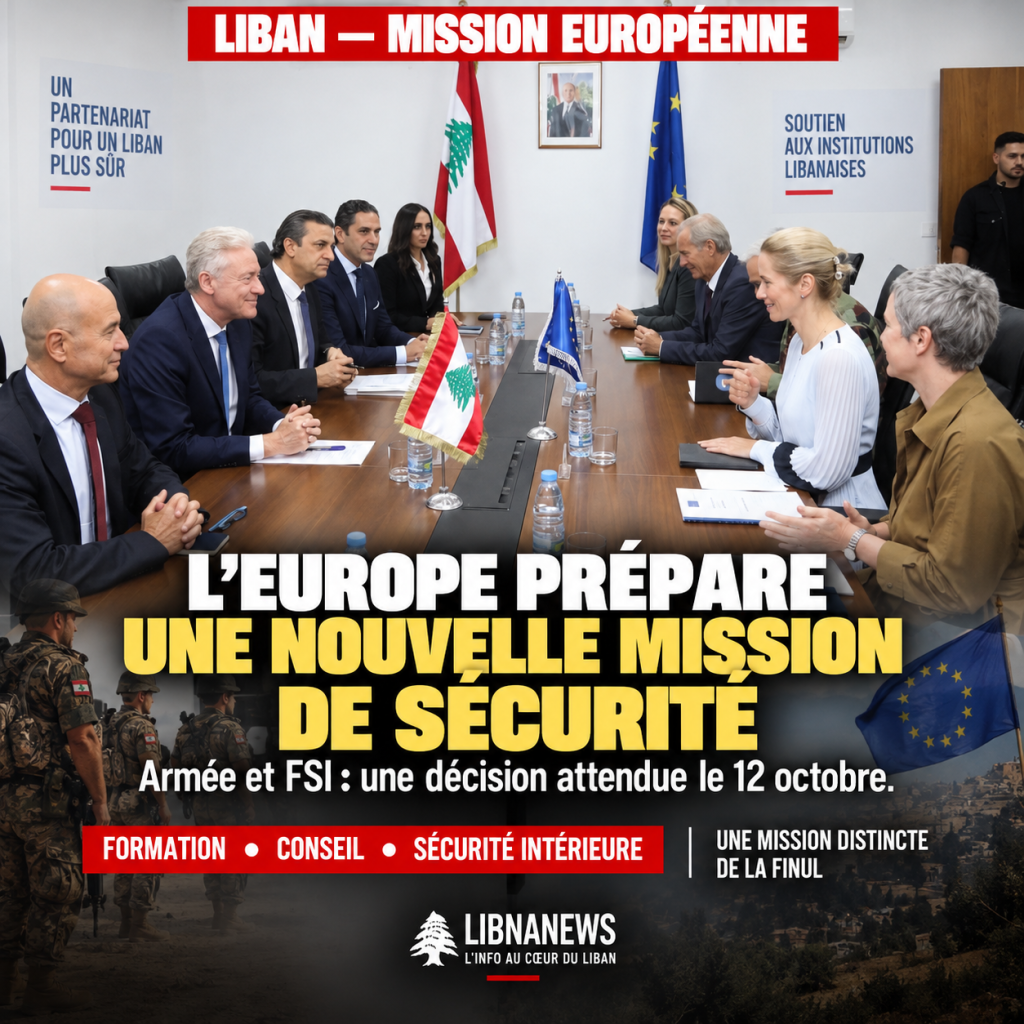
The Head of European Diplomacy, Kaja Kallas, announced Thursday 8 October 2026 in Beirut that the EU Foreign Ministers should approve, on Monday 12 October, the establishment of a training and advisory mission for the Lebanese Army and the Internal Security Forces. This mission will not replace the United Nations Interim Force in Lebanon (UNIFIL) and will not be limited to the south of the country. Lebanese Foreign Minister Youssef Raggi called on Brussels to support the State’s decision to hold the arms monopoly and to help end the Israeli occupation of Lebanese territories.
The European Union is about to take a new step in its security engagement in Lebanon. On a visit to Beirut on Thursday 8 October, Kaja Kallas announced that the planning of a European training and advisory mission had been completed. Its creation is expected to receive official approval from European Foreign Ministers on Monday 12 October.
This initiative responds to a formal request from the Lebanese authorities. It aims to strengthen the capabilities of the army and the Internal Security Forces, including in territorial control, border surveillance and internal security.
The announcement took place at a joint press conference with Lebanese Foreign Minister Youssef Raggi. He presented the future mission as support for the restoration of state authority, in a context marked by tensions with Israel and debates on the arms monopoly.
A European mission expected on 12 October
Kaja Kallas stated that preparations for the new mission had been completed. It will be part of the European Union’s common security and defence policy, known as CSDP.
» We have completed the planning of a new mission to provide training and advice to the Lebanese Armed Forces and the Internal Security Forces, » she said, according to statements reported at the press conference.
The European official added that she expected formal approval of its creation on Monday 12 October at the meeting of the Union’s Foreign Ministers.
This deadline is the next institutional stage of the project. The mission is therefore not yet formally established, even if its preparation is completed.
Its objective will be to accompany Lebanese security institutions in the exercise of their responsibilities throughout the country.
European assistance will include training, advice and strengthening of operational skills. It will also concern border security and the maintenance of internal security.
Kaja Kallas linked this initiative to the demands of UN Security Council Resolution 1701, which governs security arrangements in southern Lebanon.
However, the statements made public do not specify the size of the future mission, its own budget, the duration of its mandate or the date of its actual deployment.
These elements should be determined in the framework of European decisions and arrangements with the Lebanese authorities.
The new mission will not replace UNIFIL
The head of European diplomacy wished to distinguish clearly the future mission of the United Nations Interim Force in Lebanon.
» It will not replace UNIFIL and will not be limited to the south, » said Kaja Kallas.
This clarification responds to questions about the future of the international presence in southern Lebanon.
UNIFIL has a United Nations-defined mission. Its mandate is linked to the security situation in the south of the country and the implementation of the relevant Security Council resolutions.
The future European mission will have a different function. It will provide institutional and technical assistance to Lebanese forces, without automatically taking over the responsibilities of the United Nations force.
Its geographical scope will also be wider.
Kaja Kallas indicated that the capacity-building of the army and security forces would cover all Lebanese territory. Border surveillance and internal security will be covered.
This distinction is important to understand the nature of the European commitment announced in Beirut.
At this stage, it is not a matter of deploying a new international force to replace peacekeepers in southern Lebanon.
Rather, the mission announced must help strengthen national institutions that are called upon to fulfil their security responsibilities.
Brussels warns against a security vacuum
Kaja Kallas also discussed the future of the United Nations presence in southern Lebanon.
She indicated that this issue was still under international discussion.
The European Union stands ready to work with Lebanon, the United Nations and the members of the Security Council to prepare for the next stage.
The European official warned, however, that any security vacuum should be avoided after the departure of UNIFIL.
This warning highlights the difficulties associated with possible changes in the international arrangements in the south of the country.
The presence of the Lebanese Armed Forces, its operational capabilities and arrangements with international partners will be key to ensuring continuity of security.
During their interview, Youssef Raggi and Kaja Kallas also referred to the possibility of an international force to succeed UNIFIL.
Discussions included the assumption of a mechanism approved by a Security Council resolution.
No final decision was announced on the composition, mandate or modalities of this possible force.
The European training mission and the future international arrangement in the south therefore remain two separate dossiers.
Youssef Raggi calls for support for arms monopoly
The Lebanese Foreign Minister welcomed the European project.
Youssef Raggi considered the mission to be a significant investment in the Lebanese state and its institutions.
According to him, the training and expertise provided to the army and the Internal Security Forces will help strengthen public authority, security and the rule of law.
In particular, the Minister insisted on Lebanon’s decision to reserve the state monopoly on arms and the use of force.
« Lebanon has made a clear sovereign decision to reserve arms and the use of force to the State alone throughout its territory, » he said.
He presented this approach as an essential condition for the restoration of national sovereignty.
For the head of Lebanese diplomacy, the strengthening of security institutions must enable the reconstruction of a State capable of fully exercising its responsibilities.
He called on the European Union to continue its support for the legitimate institutions of Lebanon in order to achieve this objective.
This request gives a political dimension to the mission announced by Kaja Kallas.
Beyond technical assistance, Beirut hopes that the European commitment will accompany the process of restoring state authority throughout the country.
The issue of arms monopoly remains particularly sensitive due to the presence of the Hezbollah arsenal outside the direct control of national military institutions.
Kaja Kallas himself stressed the need for Lebanon to exercise its full authority over its territory, including through the further disarmament of Hezbollah.
It stressed the principle that the Lebanese State should be solely responsible for the security and stability of the country.
European and Lebanese declarations thus converge on the objective of strengthening national institutions.
However, they do not specify the practical modalities under which the new mission could accompany the state arms monopoly process.
Lebanon demands an end to Israeli occupation
Youssef Raggi also called on the European Union to support efforts to end the Israeli presence in the occupied Lebanese territories.
The Minister associated this claim with the full implementation of Security Council resolution 1701.
He said he was counting on Brussels to support Lebanon in restoring its sovereignty and to secure an end to the Israeli occupation.
This request is part of the discussions on the implementation of the framework agreement on the situation in the south of the country.
At their meeting, the two officials discussed the progress of the negotiations and the reasons for the delay in implementing the agreement.
Kaja Kallas reaffirmed European support for the agreement on southern Lebanon concluded under the aegis of the United States.
It also stressed the need for the Lebanese State to exercise control over its entire territory.
The discussions therefore focused on two complementary commitments that Beirut presents: the restoration of exclusive State authority and the end of the Israeli presence in Lebanese territories.
No new timetable for Israeli withdrawal or full implementation of security arrangements was announced during the press conference.
The European Union details its financial assistance to Lebanon
Kaja Kallas’ visit also clarified European financial commitments to Lebanon.
The European Commissioner recalled that €505 million of assistance had been announced in September, for a period up to 2027.
This envelope complements the EUR 1 billion programme presented by the European Union in 2024.
Funding must support several priorities: economic recovery, security, border management and essential services.
Kaja Kallas also detailed European support for the Lebanese armed forces.
Since 2022, assistance to the army through the European Peace Facility has reached EUR 182 million, according to the figures it has presented.
This amount places Lebanon third among the beneficiaries of this European mechanism.
Youssef Raggi thanked the European Union for its continued support.
In particular, he referred to the allocation of approximately EUR 1 billion provided for in the multiannual European budgetary framework, as well as EUR 100 million for the Lebanese Armed Forces by the European Peace Facility.
The Minister expressed the wish to see this assistance strengthened in the next period.
The amounts quoted by the two officials correspond to different programmes and reference periods. They cannot therefore be added up without taking into account their possible overlaps.
The future training mission will be part of this broader European commitment.
However, its specific funding was not communicated at the press conference.
Brussels calls for progress in reforms
Kaja Kallas also insisted on the economic and financial reforms expected of the Lebanese authorities.
It called for moving from political commitments to their effective implementation.
The European official made particular mention of the economic and banking sectors.
In her view, reforms were an essential condition for mobilizing broader international support and attracting the investment needed for the country ‘ s recovery.
Youssef Raggi assured that the Lebanese government intended to pursue political, economic and financial reforms.
These commitments come as Lebanon continues to suffer the consequences of the financial crisis that began in 2019.
Banking restructuring, the treatment of financial losses and the restoration of confidence in institutions remain major issues.
For Brussels, progress in these areas must accompany the country’s security and institutional support.
No new financial conditions or specific deadlines for reforms were announced during the meeting.
The Syrian issue also addressed
Discussions between Youssef Raggi and Kaja Kallas also focused on relations between Lebanon and Syria.
Both officials mentioned the importance of cooperation between Beirut and Damascus, as well as the conditions for the return of Syrian refugees.
Kaja Kallas recognized the importance of their presence on Lebanese infrastructure and public services.
She stressed that a safe and sustainable return required appropriate conditions in Syria.
The reconstruction of infrastructure, the functioning of schools and hospitals and security are among the elements mentioned.
The European leader assured that the European Union would continue to support Syria, the refugees and the host communities.
No new return mechanism or specific timetable was presented at this meeting.
A European decision expected Monday
At the end of the press conference, Youssef Raggi said that Lebanon wanted to turn the page of the past and open a new phase based on the restoration of state authority.
The Minister called on Europe to become an essential partner in this transition.
He stressed that Lebanon did not only wish to receive assistance in managing its crises, but also to obtain the means to overcome them.
The next concrete step now concerns the meeting of EU Foreign Ministers, scheduled for Monday, 12 October.
It is on this occasion that Kaja Kallas awaits the official approval of the new training and advisory mission.
The modalities of its deployment, the numbers mobilized and the financial resources allocated to it remain to be specified.





Comments