

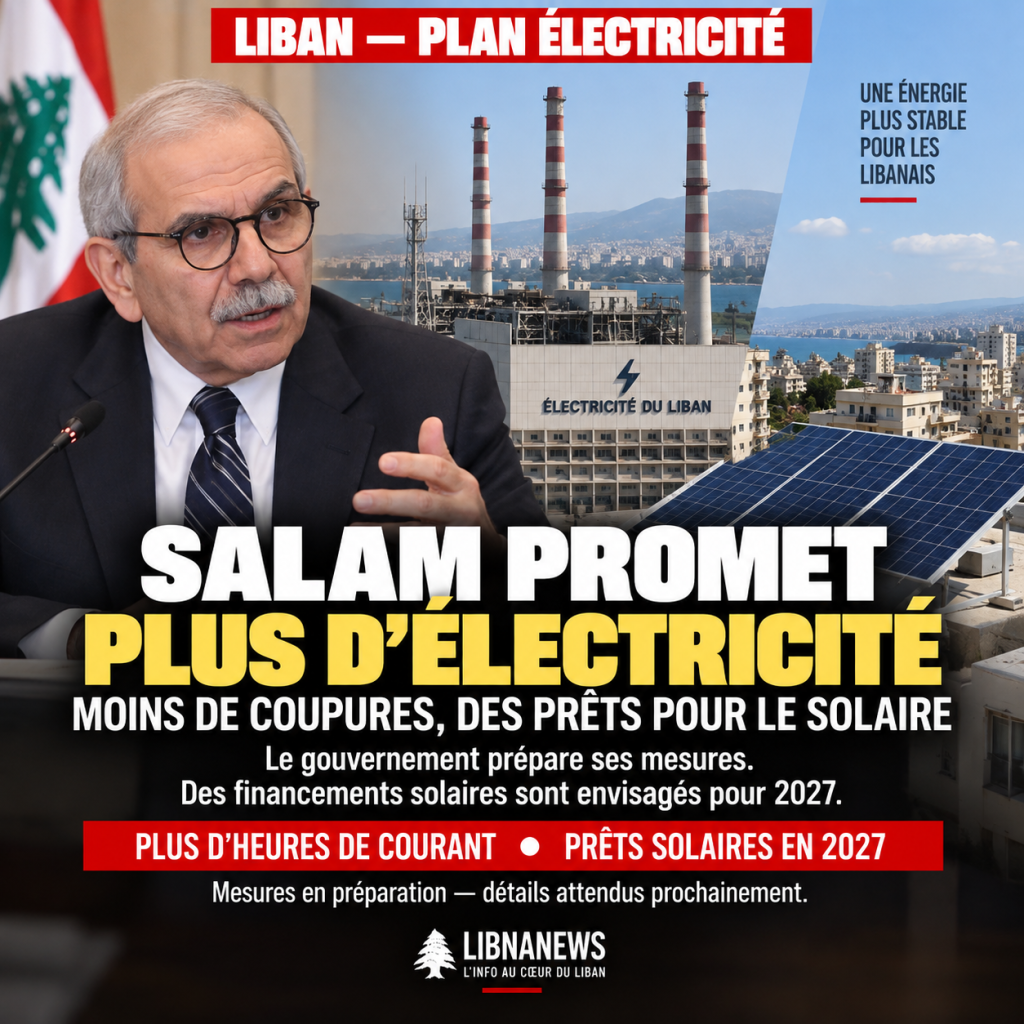
Lebanese Prime Minister Nawaf Salam announced Thursday, 8 October 2026 that the government was preparing solutions to increase the hours of electricity supply, improve the regularity of service and reduce costs. The Ministries of Energy and Finance are working on these measures, details of which will be presented in the coming weeks. Draft budget 2027 also provides for loans to households wishing to install solar panels.
The Lebanese Government is preparing further measures to improve electricity supply and reduce household energy expenditure. Prime Minister Nawaf Salam announced on Thursday 8 October that the Ministries of Energy and Finance are working on sustainable solutions for the electricity sector. The objective is to increase the hours of distribution, ensure a more regular diet and reduce its cost. However, the Head of Government did not specify the technical or financial means envisaged. He indicated that additional information would be provided in the coming weeks.
This announcement comes in a context of continuing difficulties for the Lebanese electricity sector. For several years, insufficient public supply has forced many households and businesses to use private generators or solar installations. This entails additional costs, which are added to the electricity bills of Lebanon. The measures announced by Nawaf Salam therefore address two directly related problems: the availability of public electricity and the overall cost borne by consumers.
Electricity in Lebanon: Increasing Distribution Hours
The first priority announced by Nawaf Salam concerns the increase in power supply hours. The government wants to improve the amount of electricity available on the public grid and ensure more regular distribution. These two objectives are complementary, but they address distinct challenges. An increase in production alone does not guarantee a sustainable improvement of the service if the technical and financial constraints of the network persist.
The Prime Minister also stressed the need to reduce costs. This approach concerns a sector whose financial difficulties have long affected public finances and consumers. For households, real energy expenditure depends on several factors: the price of public electricity, subscriptions to private generators and possible investments in solar systems. Improved public supply may reduce the use of generators, but actual savings will depend on the rate and number of overtime provided.
Government statements do not yet determine how these objectives will be achieved. Nawaf Salam announced no new power plant, no energy supply contract, no special investment in infrastructure. He did not further clarify whether the measures would include a change in the management of the network or the sector’s funding mechanisms. These issues will need to be clarified when the government’s announced agenda for the coming weeks is presented.
The Ministries of Energy and Finance associated with the project
The Head of Government indicated that solutions were being developed jointly with the Ministries of Energy and Finance. This coordination reflects the constraints of the electricity sector, whose recovery requires both technical decisions and financial resources. Improvement of production and distribution must take account of the budgetary capacity of the State. The government will therefore have to specify how it intends to finance the measures envisaged without creating new burdens that are difficult to sustain.
The Lebanese electricity sector is experiencing long-standing structural difficulties, compounded by the economic and financial crisis triggered in 2019. Funding problems, supply constraints and infrastructure limitations have contributed to reducing the capacity of the public service to meet the needs of the population. The use of private generators has thus been imposed as a substitute in many regions. Photovoltaic installations have also developed, particularly among households and companies able to finance their equipment.
In this context, the central issue remains continuity of service. A one-time increase in distribution hours would not be sufficient to ensure a sustainable improvement if it were not accompanied by stable financing and operating conditions. The Government will also need to determine how the announced measures will be integrated into the operation of Electricity Lebanon. No timetable for achievement or target for overtime was communicated on Thursday.
Loans for solar panels provided for in the 2027 budget
In parallel with the public network measures, Nawaf Salam announced an initiative to facilitate family access to solar energy. Draft budget 2027 provides for appropriations for the public housing establishment to finance loans for the purchase of photovoltaic systems. The aim is to enable households to reduce their dependence on private generators and to reduce their monthly bills. This measure would constitute a public funding mechanism for residential solar equipment, subject to its adoption and the definition of its terms and conditions.
The acquisition of a solar installation is an initial expenditure which may limit its access to families with low incomes. The cost depends in particular on the power of panels, electrical equipment and the storage capacity required. The use of credit would allow this investment to spread over time, rather than having to finance it in full at the time of purchase. However, the economic interest of the scheme will depend on the actual repayment conditions and savings on electricity expenditure.
The Prime Minister did not specify the amount of appropriations envisaged in the 2027 budget proposal. Interest rates, repayment periods, funding ceilings and eligibility criteria are also unknown. No estimates of the number of households eligible for these loans were provided. This information will be necessary to determine whether the scheme will reach a large part of the population or whether it will remain reserved for families already with a certain financial capacity.
The operational role of the Habitat Public Establishment will also need to be defined. The announcement does not specify whether this body will directly distribute the loans or whether it will intervene through a mechanism involving financial institutions. Guarantee conditions and selection of beneficiaries could have an important influence on the accessibility of the programme. At this stage, this is a heading in the budget preparation, not an appropriation already available to individuals.
Reduce private generator bills
Support for solar installations responds directly to the dependence of Lebanese households on private generators. Where public electricity does not meet their needs, consumers must use other sources of power. This leads to an increase in energy expenditure, particularly for families with limited incomes. The government presents solar loans as a means of gradually reducing this burden.
Photovoltaic systems can cover part of domestic consumption during sunny hours. When they include batteries, they also store part of the electricity produced for future use. However, their efficiency depends on installed capacity, weather conditions, household needs and storage capacity. A solar installation therefore does not necessarily guarantee complete autonomy from the public network or generators.
The advantage of the announced measure lies in the possibility of making these facilities accessible to more families. Households that cannot immediately bear the cost of a facility could consider this investment if credit conditions are adapted to their resources. Savings on subscriptions to generators could then contribute to the repayment of loans. However, this result will depend on the cost of the equipment, the proposed financial conditions and the actual consumption of each household.
The development of solar energy does not exempt the government from restoring a reliable public electricity service. Individual facilities meet the needs of equipped households, while the national network must provide food accessible to the entire population. The two guidelines announced by Nawaf Salam thus pursue complementary objectives. One aims to improve community service, while the other seeks to reduce family spending through private debt-financed facilities.
Expected consequences for households and businesses
Improving electricity supply could have an impact on daily household spending, but also on business operations. Shops, workshops and service establishments need regular feeding to maintain their activities. Network interruptions often require the use of back-up equipment, the operation of which represents an additional cost. More stable public distribution could reduce some of these expenditures, provided that tariffs remain competitive.
However, companies are not directly affected by the solar lending programme presented on Thursday. Nawaf Salam indicated that the funds envisaged in Budget 2027 would be allocated to families through the Public Housing Facility. No comparable arrangements for small businesses or businesses were announced. The economic effects of future measures will therefore depend mainly on improvements to the public network and the conditions for its implementation.
For consumers, the question will also be whether the increase in power hours will allow for an effective reduction in subscriptions to generators. This trend depends on how these services are billed and on the regularity of public supply. Limited or irregular improvement may not be sufficient to significantly change family spending. The Government will therefore need to specify the expected results and the means to ensure continuity.
A schedule still limited to upcoming announcements
Nawaf Salam set a first deadline for presenting solutions for public electricity. The Ministries of Energy and Finance are expected to provide details in the coming weeks. This presentation will provide information on the measures selected, their possible cost and the time frame envisaged for their implementation. It will also need to clarify whether the government is planning additional investments or changes in the organization of the sector.
The solar loan programme will follow a different timetable, as it depends on the draft budget 2027. The appropriations announced will have to be specified in the budget text and then subject to the procedures necessary for their implementation. This means that the households concerned do not yet have sufficient information to apply or assess the conditions for financing. The authorities did not notify the opening date of the loans or the practical arrangements for registration.
The announcements of 8 October thus set two separate deadlines for the Lebanese energy sector. The first concerns the forthcoming presentation of measures to improve public supply and reduce costs. The second concerns the appropriations envisaged for solar energy in Budget 2027. The government still needs to clarify the funding, implementation modalities and expected results of these two initiatives.





Comments