

In Salamiyé, in central Syria, a renovated pumping station is functioning again, according to the Aga Khan Foundation. Near Tartous, the site covered a source; at Deraa, on the return to service of a set of stations and wells. These three projects are not measured at the same stage. On 18 November, the World Bank placed the acceleration of its own projects on the agenda of its visit to Damascus, including the one on water and sanitation.
In Salamiyé, the station works: still to measure the service
At the Al-Qantara station, work focused on pumping equipment, power supply and monitoring. The Aga Khan Foundation, which carried out the project with the Hama Water Service and local communities, indicated at the end of September that the work required to commission the station had been completed. It documents the station in operation. This does not give the number of hours that water arrives each week in Salamiyé housing.
The Foundation follows a separate operation for four villages in the sector, including Barri and Mofekar. In September it was still documenting tank rehabilitation and connection work. This project should not be confused with the Al-Qantara station or treated the four villages as beneficiaries already served by the new facility.
At Tartous, capture a source; in Deraa, restore a dessert
In the Tartous region, the Al-Baghla project aims to recover part of the source water that was not used. The Aga Khan Foundation and the Tartous Water Service worked on a collection tank and a pipeline. At the last point published by the foundation on this site, the works entered their final phase at the end of July and the installation was being handed over to the operator. More than 15 villages are targeted. This number describes the planned area, not the villages for which the service was resumed.
In Deraa, UNICEF and the German Development Bank KfW support the local public service to rehabilitate a main station, auxiliary station and three wells. UNICEF plans up to 1,680 cubic metres of drinking water per day once the system is fully operational, benefiting more than 70,600 people. This ceiling is a network-wide capacity expected. It does not give the volume actually distributed every day or the amount that comes to each household.
Funding doesn’t say when water will come to tap
In April, the World Bank approved a $150 million grant to rehabilitate water and sanitation infrastructure. The project includes treatment and supply networks in Idlib, Homs and Hama, as well as sanitation facilities in Damascus. This funding should not be allocated to the three projects described here. The Bank published a procurement plan in September; the visit of 18 November was aimed at advancing the implementation of the financing already approved.
The public exhibits thus follow different results: a re-service station, a source in development or a volume expected after construction. In order to compare effects on households, surveys should be made over the same period: frequency of distribution, water quality at the point of delivery, and expenses incurred to obtain supplies elsewhere when the network stops.
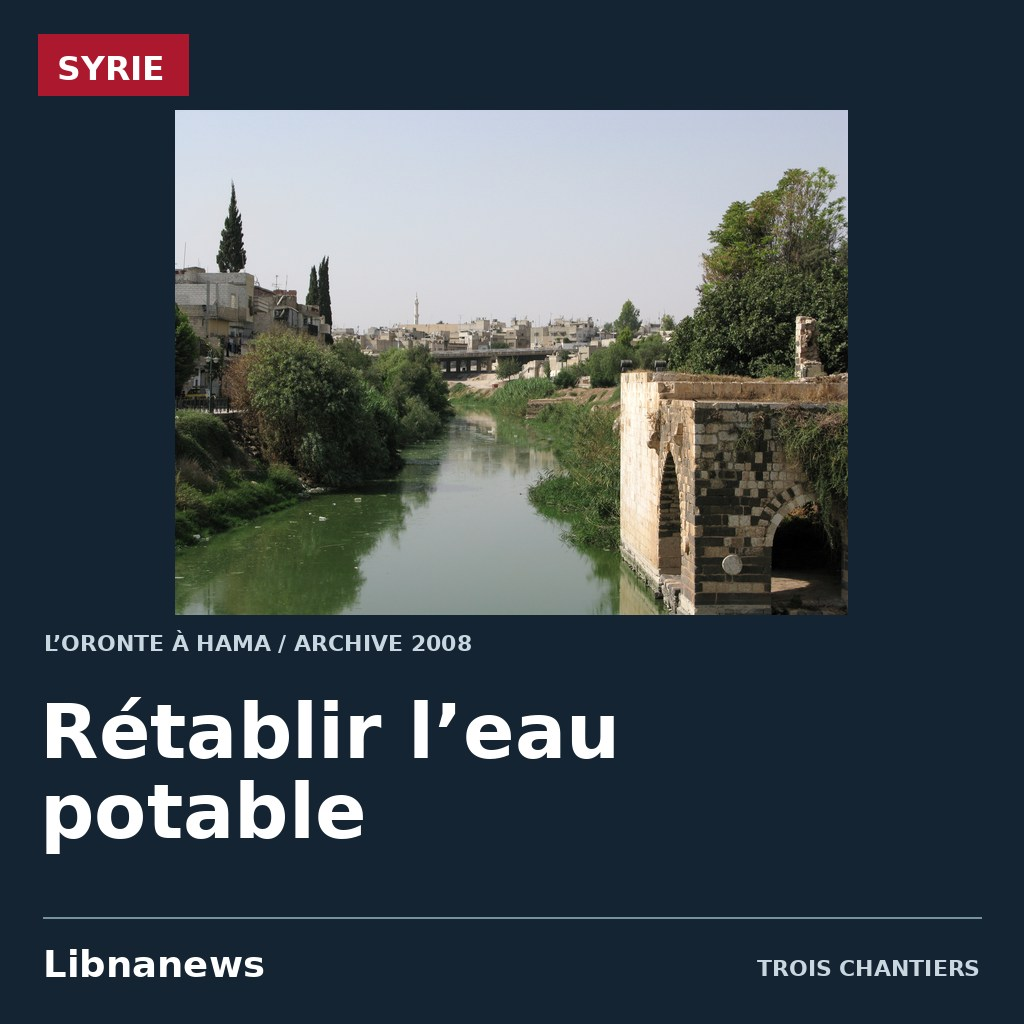
Archive: The Oronte in Hama, August 19, 2008. Vyacheslav Argenberg / Wikimedia Commons, CC BY 4.0. Whole photo resized and dressed by Libnanews. It shows none of the 2026 construction sites.





Comments