7 octobre 2026
Lebanon’s citizen media
All sections

News

Joe Saddi puts the government under pressure: behind electricity, the first political warning of the Lebanese Forces

Joe Saddi puts the government under pressure: behind electricity, the first political warning of the Lebanese Forces
A « retirement » calculated between government retention and threat of rupture
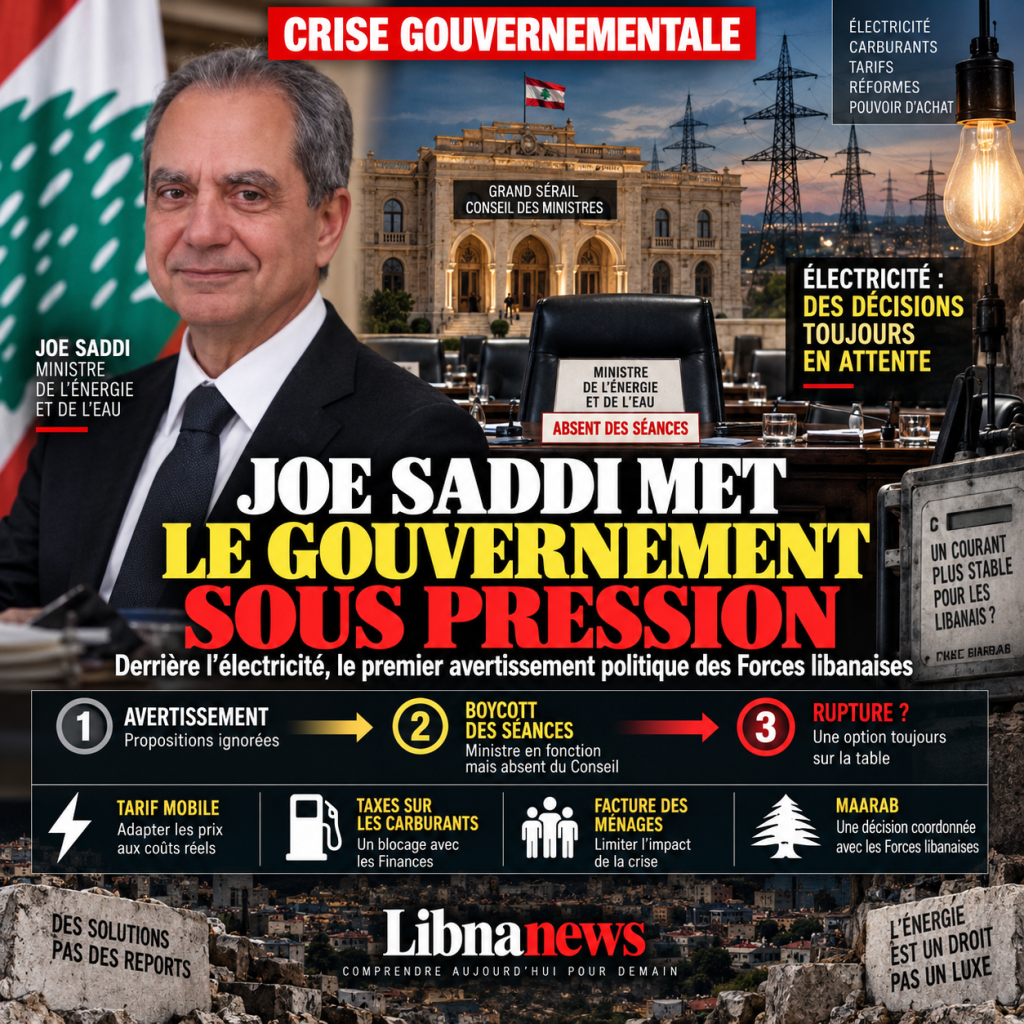
Joe Saddi didn’t quit. The Minister of Energy has chosen a more ambiguous and politically more manageable formula: he is currently no longer participating in the meetings of the Council of Ministers while continuing to serve as head of his ministry. This distinction is the starting point of the case. It allows him to protest against the functioning of the government without abandoning the sector he leads, and the Lebanese Forces to raise pressure without immediately causing an open ministerial crisis. Saddi presented its decision as a consequence of the lack of a government response to several proposals to maintain power supply and mitigate the impact of the global energy crisis. He stated that his withdrawal from the sessions was not a waiver of responsibility, but a way of forcing the entire government to assume a responsibility which he considered too largely left to the Ministry of Energy alone.
The chosen form is therefore as important as the background. A resignation reportedly created a vacancy and forced the Lebanese Forces to decide immediately whether they remained in the Government. A simple public protest could have been absorbed as an additional ministerial dispute. Abstention places the crisis between these two extremes. It allows Saddi to continue to enforce laws, manage the public service and defend its reforms, while refusing to endorse government meetings that he believes do not take the necessary decisions. The message to Prime Minister Nawaf Salam is clear: the minister believes that he has exhausted the technical warnings. Now, the absence of arbitration becomes a political problem.
The concrete disagreement: fuel taxes and mobile electricity prices
The conflict is not just about a perceived lack of support. It crystallised around specific proposals. At a meeting on the consequences of the global fuel price surge, Saddi defended several mechanisms to reduce the final bill. These included a change, suspension or removal of certain fuel charges to limit the increase paid by consumers. This option was met with a central objection from the Ministry of Finance: the revenue concerned is involved in financing public commitments, including increases granted to the public sector. To remove them without alternative resources would therefore shift the energy sector crisis to the state budget. This is one of the nodes of the conflict: Energy accounts for the overall cost to the household, while Finance must protect from revenues already earmarked for other expenses.
The second point concerns the public electricity tariff. Saddi proposed a mobile pricing system capable of evolving with the actual costs of producing and purchasing fuel. His argument is economic: even if the price of public kilowatt-hours increases in certain circumstances, electricity supplied by Electricity from Lebanon remains cheaper than electricity purchased from private generators. A controlled increase in the tariff could therefore allow more hours of public power supply and reduce the much more expensive amount of electricity that households buy from generators. The reasoning is not only about Lebanon’s electricity bill, but about the total energy bill of the household. Saddi blames the government for looking separately at the public price and taxes while the consumer adds up the public bill, private subscription and fuel.
A meeting without arbitration, then the breakup
The Minister’s decision comes after a government meeting described as difficult. The proposed solutions were not supported. The Ministry of Finance has not acted on the idea of reducing fuel levies due to the lack of alternative revenues. Nor did the proposal for a mobile tariff lead to a decision. For Saddi, this lack of arbitration means that he agrees to let the energy shock pass to the consumer. He states that he warned, provided the figures and presented the solutions before finding that no operational response followed. It is this sequence that he uses to justify his withdrawal from the Council of Ministers.
His argument also seeks to shift political responsibility. For decades, the Ministry of Energy has borne much of the symbolic cost of failure in the electricity sector. Saddi won’t let this mechanics happen again. By publicly stating that the government must decide, it seeks to prevent the consequences of the crisis from being attributed to the minister alone. The strategy is transparent: document warnings, publicize rejected options, and establish that tax or budgetary arbitrations exceed its jurisdiction. If the current hours decrease or the energy bill increases, he may argue that the problem was not in the absence of proposals but in the collective refusal to adopt them.
The case goes beyond Saddi: the decision was coordinated with Maarab
The element that turns the case into a political crisis is the direct involvement of the Lebanese Forces. Saddi’s decision does not appear to be a purely personal initiative. It comes after a long meeting between the parliamentary and ministerial components of the party, its executive body and several officials around Samir Geagea. Consistent information presents the decision as coordinated with Maarab. The Forces considered that abstention was, at this stage, a sufficient response. They have not announced their departure from government, and the assumption of collective resignation is still presented as premature. But the possibility has now entered explicitly into the debate.
This graduation is calculated. The party can support its minister without immediately burning the next step. He can observe the reaction of Nawaf Salam, President Joseph Aoun and the Minister of Finance before deciding whether to return to normal participation, continue boycotting the sessions or go further. Abstention thus becomes an instrument of internal negotiation. It offers Maarab a means of measuring the balance of power within the government while avoiding the political cost of an immediate breakdown. If compromises are found, the minister can take his place around the table. If nothing changes, the Forces may present a possible escalation as the result of a series of ignored warnings.
The message sent to Baabda a few hours before the announcement
The political dimension is even clearer in the approach taken to Joseph Aoun. Prior to Saddi’s announcement, Samir Geagea sent MP Melhem Riaci to Baabda. Officially, the meeting with the President focused on political and social conditions as well as regional developments. But the information surrounding the meeting indicates a broader message from Maarab on the functioning of the government. Criticism was not just about the economy. They also dealt with the sovereignist register. The Forces expressed concern that poor economic management, combined with political and security difficulties, would lead to a social explosion.
The timetable is revealing: the message to Baabda precedes the minister’s decision by a few hours. The sequence gives forbearance a wider scope than the electrical record alone. Maarab warns the Presidency before activating a first means of lobbying the government. This does not mean that an exit scenario has already been decided. On the contrary, the Forces maintain a margin of manoeuvre. But they point out that they no longer want to be regarded as automatically in solidarity with decisions they contest. This position also allows them to protect their political position: to participate in the government while showing to their electorate that they do not endorse economic inaction or what they consider insufficient on matters of sovereignty.
An electrical crisis in the midst of a world energy market under stress
The government conflict takes place in a context that reduces room for manoeuvre. The regional crisis and disruptions on major energy routes have increased fuel costs. For a country heavily dependent on imports and with few financial reserves, each international increase is rapidly passed on to electricity production, transport and private generators. The problem is magnified by the particular structure of the Lebanese system: when public supply falls, households continue to consume electricity. They simply transfer their consumption to a more expensive private source. A budget saving achieved by limiting fuel purchases can therefore result in a much higher expenditure borne directly by families.
This is the heart of Saddi’s argument in favour of the mobile rate. The Panel finds that the relevant comparison is not between an old public tariff and a new public tariff, but between the cost of an additional hour provided by Electricity of Lebanon and that of the same hour purchased from a generator. However, its opponents must solve another equation: automatically increasing tariffs in a country where income remains fragile can also increase unpaid wages and social pressure. The decision cannot therefore be purely technical. It involves determining who absorbs the global increase: the State through lower revenues or subsidies, Electricity of Lebanon through its balance sheet, or the consumer through its invoices.
Minister highlights reforms to challenge impotence charge
Saddi accompanied his arm with a review of his visit to the ministry. In particular, it recalls the establishment of the regulatory authority for the electricity sector, provided for by a 24-year-old law but not implemented. In his view, this authority is now preparing the launch of licences allowing the private sector to produce and distribute electricity in the coming months. The political argument is clear: the Minister wants to distinguish between reforms that are directly within his jurisdiction and fiscal and financial decisions that require collective government voting. He thus seeks to show that he is not asking for a white-seing to pursue the old model, but for arbitrations necessary for a transition which he claims to have initiated.
This is important for understanding the Lebanese Forces strategy. The party has an interest in presenting the Ministry of Energy as a laboratory for breaking up with previous practices. The sector has been at the heart of political and financial controversies for years. Successfully demonstrating a functional regulatory authority, a regulated openness to the private sector and a closer pricing of costs would allow the Forces to claim a different method. Conversely, a further collapse of the power supply would expose them directly. The conflict with the government is therefore also used to establish a boundary of responsibility before the consequences of the crisis become visible in the homes.
The real risk for Nawaf Salam: a sectoral issue becomes a precedent
For the Prime Minister, the danger exceeds the number of meetings in which Saddi will or will not attend. If a minister can suspend his or her presence in the Council while remaining in office, and if his or her party turns that abstention into political pressure, other components could be tempted to use the same method. The government would then enter into a logic of conditional participation where each block would remain officially in power while boycotting the arbitrations that displease it. In an already fragmented system, such a practice would weaken the capacity of the Council of Ministers to function as a collective body. Salam must therefore find a compromise on the substance without giving the impression that partisan pressure is sufficient to obtain privileged treatment.
It must also avoid a break with the Forces at a time when the Government is simultaneously facing the southern issue, negotiations with Israel, reconstruction, relations with international financial institutions and social tensions. An exit of ministers close to Maarab would not necessarily automatically bring down the executive, but would change its political legitimacy and revive the debates on its composition. Rumours of reshuffle already exist. The Saddi crisis could give them concrete material. That is why the compromise sought must probably be presented as a response to the energy emergency and not as a concession to a party.
Forces keep ultimate threat in reserve
At this stage, the Lebanese Forces have not decided to leave the government. This is precisely what makes their position effective. A threat used too early loses some of its value. By keeping their ministers in place while allowing Saddi to withdraw from the sessions, they create a climbing ladder. First step: technical warnings. Second step: political message to Baabda. Step 3: Forbearance from the minister concerned. The next steps could be an extension of the challenge to other ministers, a more comprehensive public challenge to government policy, or, at the end of the process, a debate on the continuation of the party in the executive. There is no evidence to suggest that the latter decision is being taken.
The Government’s response will therefore determine the next steps. An agreement on tariffs, levies or another form of support for the sector would allow Saddi to return by claiming that he had obtained collective support for the crisis. A total lack of response would instead reinforce Maarab’s argument that the problem no longer lies in technology but in governance. The electricity crisis would then become the vehicle for a much wider debate: how far can a party remain in solidarity with a government whose economic arbitrations it contests and a part of the sovereignist orientation?
A test of truth before the bill arrives in households
The timetable requires a quick response. The energy crisis does not leave the government the luxury of prolonged institutional conflict. If world prices remain high and public food cannot be increased, the difference will be paid by households through generators, transport and prices of goods. The battle around taxes or the public tariff may seem technical, but it directly concerns the distribution of this bill. Saddi wants the state to accept part of the cost or modify the operation of the sector to reduce dependency on generators. Finance is trying to avoid creating a new budget hole. In between, the Council of Ministers must arbitrate.
The minister’s abstention is thus a first political test for the government coalition. It is not yet a rupture and should not be presented as such. However, she is more than a mood gesture. It was preceded by warnings, discussed within the Lebanese Forces, accompanied by a message to the Presidency and justified by concrete proposals that had not been decided. It is this combination that gives it its scope. The government can still contain the crisis. But if it fails, the electricity issue will have created a precedent: that of a party that remains in the executive while suspending its participation in its main decision-making place to get a change of course.


Libnanews
Beta translationThis article is an automated beta translation. Please use caution and verify sensitive details against the French original when needed.

A « retirement » calculated between government retention and threat of rupture

Joe Saddi didn’t quit. The Minister of Energy has chosen a more ambiguous and politically more manageable formula: he is currently no longer participating in the meetings of the Council of Ministers while continuing to serve as head of his ministry. This distinction is the starting point of the case. It allows him to protest against the functioning of the government without abandoning the sector he leads, and the Lebanese Forces to raise pressure without immediately causing an open ministerial crisis. Saddi presented its decision as a consequence of the lack of a government response to several proposals to maintain power supply and mitigate the impact of the global energy crisis. He stated that his withdrawal from the sessions was not a waiver of responsibility, but a way of forcing the entire government to assume a responsibility which he considered too largely left to the Ministry of Energy alone.

The chosen form is therefore as important as the background. A resignation reportedly created a vacancy and forced the Lebanese Forces to decide immediately whether they remained in the Government. A simple public protest could have been absorbed as an additional ministerial dispute. Abstention places the crisis between these two extremes. It allows Saddi to continue to enforce laws, manage the public service and defend its reforms, while refusing to endorse government meetings that he believes do not take the necessary decisions. The message to Prime Minister Nawaf Salam is clear: the minister believes that he has exhausted the technical warnings. Now, the absence of arbitration becomes a political problem.

The concrete disagreement: fuel taxes and mobile electricity prices

The conflict is not just about a perceived lack of support. It crystallised around specific proposals. At a meeting on the consequences of the global fuel price surge, Saddi defended several mechanisms to reduce the final bill. These included a change, suspension or removal of certain fuel charges to limit the increase paid by consumers. This option was met with a central objection from the Ministry of Finance: the revenue concerned is involved in financing public commitments, including increases granted to the public sector. To remove them without alternative resources would therefore shift the energy sector crisis to the state budget. This is one of the nodes of the conflict: Energy accounts for the overall cost to the household, while Finance must protect from revenues already earmarked for other expenses.

The second point concerns the public electricity tariff. Saddi proposed a mobile pricing system capable of evolving with the actual costs of producing and purchasing fuel. His argument is economic: even if the price of public kilowatt-hours increases in certain circumstances, electricity supplied by Electricity from Lebanon remains cheaper than electricity purchased from private generators. A controlled increase in the tariff could therefore allow more hours of public power supply and reduce the much more expensive amount of electricity that households buy from generators. The reasoning is not only about Lebanon’s electricity bill, but about the total energy bill of the household. Saddi blames the government for looking separately at the public price and taxes while the consumer adds up the public bill, private subscription and fuel.

A meeting without arbitration, then the breakup

The Minister’s decision comes after a government meeting described as difficult. The proposed solutions were not supported. The Ministry of Finance has not acted on the idea of reducing fuel levies due to the lack of alternative revenues. Nor did the proposal for a mobile tariff lead to a decision. For Saddi, this lack of arbitration means that he agrees to let the energy shock pass to the consumer. He states that he warned, provided the figures and presented the solutions before finding that no operational response followed. It is this sequence that he uses to justify his withdrawal from the Council of Ministers.

His argument also seeks to shift political responsibility. For decades, the Ministry of Energy has borne much of the symbolic cost of failure in the electricity sector. Saddi won’t let this mechanics happen again. By publicly stating that the government must decide, it seeks to prevent the consequences of the crisis from being attributed to the minister alone. The strategy is transparent: document warnings, publicize rejected options, and establish that tax or budgetary arbitrations exceed its jurisdiction. If the current hours decrease or the energy bill increases, he may argue that the problem was not in the absence of proposals but in the collective refusal to adopt them.

The case goes beyond Saddi: the decision was coordinated with Maarab

The element that turns the case into a political crisis is the direct involvement of the Lebanese Forces. Saddi’s decision does not appear to be a purely personal initiative. It comes after a long meeting between the parliamentary and ministerial components of the party, its executive body and several officials around Samir Geagea. Consistent information presents the decision as coordinated with Maarab. The Forces considered that abstention was, at this stage, a sufficient response. They have not announced their departure from government, and the assumption of collective resignation is still presented as premature. But the possibility has now entered explicitly into the debate.

This graduation is calculated. The party can support its minister without immediately burning the next step. He can observe the reaction of Nawaf Salam, President Joseph Aoun and the Minister of Finance before deciding whether to return to normal participation, continue boycotting the sessions or go further. Abstention thus becomes an instrument of internal negotiation. It offers Maarab a means of measuring the balance of power within the government while avoiding the political cost of an immediate breakdown. If compromises are found, the minister can take his place around the table. If nothing changes, the Forces may present a possible escalation as the result of a series of ignored warnings.

The message sent to Baabda a few hours before the announcement

The political dimension is even clearer in the approach taken to Joseph Aoun. Prior to Saddi’s announcement, Samir Geagea sent MP Melhem Riaci to Baabda. Officially, the meeting with the President focused on political and social conditions as well as regional developments. But the information surrounding the meeting indicates a broader message from Maarab on the functioning of the government. Criticism was not just about the economy. They also dealt with the sovereignist register. The Forces expressed concern that poor economic management, combined with political and security difficulties, would lead to a social explosion.

The timetable is revealing: the message to Baabda precedes the minister’s decision by a few hours. The sequence gives forbearance a wider scope than the electrical record alone. Maarab warns the Presidency before activating a first means of lobbying the government. This does not mean that an exit scenario has already been decided. On the contrary, the Forces maintain a margin of manoeuvre. But they point out that they no longer want to be regarded as automatically in solidarity with decisions they contest. This position also allows them to protect their political position: to participate in the government while showing to their electorate that they do not endorse economic inaction or what they consider insufficient on matters of sovereignty.

An electrical crisis in the midst of a world energy market under stress

The government conflict takes place in a context that reduces room for manoeuvre. The regional crisis and disruptions on major energy routes have increased fuel costs. For a country heavily dependent on imports and with few financial reserves, each international increase is rapidly passed on to electricity production, transport and private generators. The problem is magnified by the particular structure of the Lebanese system: when public supply falls, households continue to consume electricity. They simply transfer their consumption to a more expensive private source. A budget saving achieved by limiting fuel purchases can therefore result in a much higher expenditure borne directly by families.

This is the heart of Saddi’s argument in favour of the mobile rate. The Panel finds that the relevant comparison is not between an old public tariff and a new public tariff, but between the cost of an additional hour provided by Electricity of Lebanon and that of the same hour purchased from a generator. However, its opponents must solve another equation: automatically increasing tariffs in a country where income remains fragile can also increase unpaid wages and social pressure. The decision cannot therefore be purely technical. It involves determining who absorbs the global increase: the State through lower revenues or subsidies, Electricity of Lebanon through its balance sheet, or the consumer through its invoices.

Minister highlights reforms to challenge impotence charge

Saddi accompanied his arm with a review of his visit to the ministry. In particular, it recalls the establishment of the regulatory authority for the electricity sector, provided for by a 24-year-old law but not implemented. In his view, this authority is now preparing the launch of licences allowing the private sector to produce and distribute electricity in the coming months. The political argument is clear: the Minister wants to distinguish between reforms that are directly within his jurisdiction and fiscal and financial decisions that require collective government voting. He thus seeks to show that he is not asking for a white-seing to pursue the old model, but for arbitrations necessary for a transition which he claims to have initiated.

This is important for understanding the Lebanese Forces strategy. The party has an interest in presenting the Ministry of Energy as a laboratory for breaking up with previous practices. The sector has been at the heart of political and financial controversies for years. Successfully demonstrating a functional regulatory authority, a regulated openness to the private sector and a closer pricing of costs would allow the Forces to claim a different method. Conversely, a further collapse of the power supply would expose them directly. The conflict with the government is therefore also used to establish a boundary of responsibility before the consequences of the crisis become visible in the homes.

The real risk for Nawaf Salam: a sectoral issue becomes a precedent

For the Prime Minister, the danger exceeds the number of meetings in which Saddi will or will not attend. If a minister can suspend his or her presence in the Council while remaining in office, and if his or her party turns that abstention into political pressure, other components could be tempted to use the same method. The government would then enter into a logic of conditional participation where each block would remain officially in power while boycotting the arbitrations that displease it. In an already fragmented system, such a practice would weaken the capacity of the Council of Ministers to function as a collective body. Salam must therefore find a compromise on the substance without giving the impression that partisan pressure is sufficient to obtain privileged treatment.

It must also avoid a break with the Forces at a time when the Government is simultaneously facing the southern issue, negotiations with Israel, reconstruction, relations with international financial institutions and social tensions. An exit of ministers close to Maarab would not necessarily automatically bring down the executive, but would change its political legitimacy and revive the debates on its composition. Rumours of reshuffle already exist. The Saddi crisis could give them concrete material. That is why the compromise sought must probably be presented as a response to the energy emergency and not as a concession to a party.

Forces keep ultimate threat in reserve

At this stage, the Lebanese Forces have not decided to leave the government. This is precisely what makes their position effective. A threat used too early loses some of its value. By keeping their ministers in place while allowing Saddi to withdraw from the sessions, they create a climbing ladder. First step: technical warnings. Second step: political message to Baabda. Step 3: Forbearance from the minister concerned. The next steps could be an extension of the challenge to other ministers, a more comprehensive public challenge to government policy, or, at the end of the process, a debate on the continuation of the party in the executive. There is no evidence to suggest that the latter decision is being taken.

The Government’s response will therefore determine the next steps. An agreement on tariffs, levies or another form of support for the sector would allow Saddi to return by claiming that he had obtained collective support for the crisis. A total lack of response would instead reinforce Maarab’s argument that the problem no longer lies in technology but in governance. The electricity crisis would then become the vehicle for a much wider debate: how far can a party remain in solidarity with a government whose economic arbitrations it contests and a part of the sovereignist orientation?

A test of truth before the bill arrives in households

The timetable requires a quick response. The energy crisis does not leave the government the luxury of prolonged institutional conflict. If world prices remain high and public food cannot be increased, the difference will be paid by households through generators, transport and prices of goods. The battle around taxes or the public tariff may seem technical, but it directly concerns the distribution of this bill. Saddi wants the state to accept part of the cost or modify the operation of the sector to reduce dependency on generators. Finance is trying to avoid creating a new budget hole. In between, the Council of Ministers must arbitrate.

The minister’s abstention is thus a first political test for the government coalition. It is not yet a rupture and should not be presented as such. However, she is more than a mood gesture. It was preceded by warnings, discussed within the Lebanese Forces, accompanied by a message to the Presidency and justified by concrete proposals that had not been decided. It is this combination that gives it its scope. The government can still contain the crisis. But if it fails, the electricity issue will have created a precedent: that of a party that remains in the executive while suspending its participation in its main decision-making place to get a change of course.

Libnanews
Newsdesk Libnanews - translated by IA

Libnanews est un site d'informations en français sur le Liban né d'une initiative citoyenne et présent sur la toile depuis 2006. Notre site est un média citoyen basé à l’étranger, et formé uniquement de jeunes bénévoles de divers horizons politiques, œuvrant ensemble pour la promotion d’une information factuelle neutre, refusant tout financement d’un parti quelconque, pour préserver sa crédibilité dans le secteur de l’information.

All articles by this author →

Comments

Laisser un commentaire

Votre adresse e-mail ne sera pas publiée. Les champs obligatoires sont indiqués avec *

