

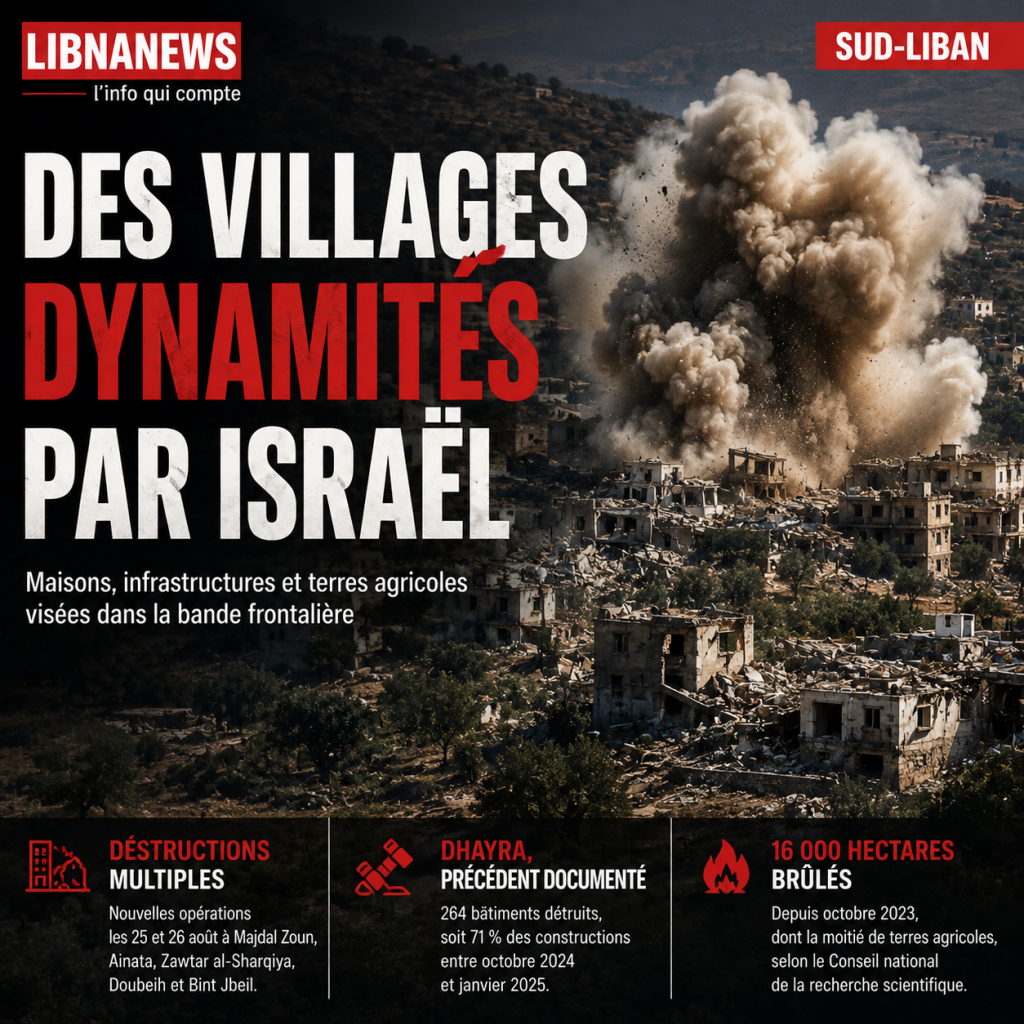
For several days, Israeli forces have been increasing the blasting of homes and infrastructure in villages in southern Lebanon, prolonging a documented practice since the land offensive of 2024. On 25 and 26 August, further destruction was reported, including in Majdal Zun, Ainata, Zawtar al-Sharqiya, Doubeih and Bint Jbeil. There are reports of villages almost entirely destroyed, but there is no sufficient evidence to say that an entire locality was razed in one operation this week. Dhayra’s precedent, however, shows the extent of such destruction: Amnesty International has identified it by satellite264 buildings destroyed, representing 71% of the municipality’s constructionsbetween October 2024 and January 2025. The current campaign comes as the Lebanese authorities accuse Israel of gradually transforming the border band into uninhabitable territory.
Dynamiting has increased since 25 August
The current sequence accelerated on Tuesday, August 25. Several explosions have been reported in villages and areas close to the border, along with aerial bombardments, artillery fire and movements of Israeli military vehicles.
In Ainata, Bint Jbeil district, destruction operations were reported as Israeli artillery struck the western area of the town. Explosions were also heard around Haris and Sarbine. Further north, extensive blasting was reported in Zawtar al-Sharqiya, Nabatiyah District.
In Doubeih, on the western outskirts of Mais al-Jabal, in the Marjayoun caza, Israeli forces used explosives to demolish several buildings. Military vehicles ran parallel to Houla and Markaba, as well as from Taybeh towards Qantara.
The following day, Wednesday, August 26, the campaign continued. A new blast was reported in Majdal Zun, Tyre District. Explosions and raking also involved Sarbine and other areas of Bint Jbeil.
These transactions therefore do not correspond to a single event. They form a succession of destructions spread over several villages and several days.
Can we talk about an entire village razed this week?
Caution is essential on this point. Images of destroyed buildings and reports of massive explosions may give the impression that an entire village has been energized within hours. However, the information currently available for 25 and 26 August does not show that an entire locality has disappeared during a single operation.
On the other hand, several villages have suffered successive destruction. In some cases, these add to the already considerable damage caused in previous weeks or months. The cumulative result can therefore be that of a village largely destroyed without a single date when all its buildings would have been dynamic.
This distinction is important. It does not reduce the extent of destruction, but avoids an impossible statement to demonstrate. Instead, documented Israeli operations demonstrate a repetitive approach: taking or controlling an area, laying explosives in buildings, blasting, using bulldozers and continuing destruction in subsequent operations.
It was precisely this process that had been observed in the previous phase of the war.
Dhayra: 71 per cent of buildings destroyed
The caseDhayra, in the Tyre District, is one of the best documented examples. In October 2024, a video broadcast on social networks showed a huge explosion simultaneously destroying a set of buildings. Some Israeli publications then presented images such as « the explosion of an entire village in Lebanon ».
Amnesty International subsequently authenticated and geo-localized the images. The organization established that they had been filmed in Dhayra. His analysis of satellite images then measured the extent of the destruction accumulated in the municipality.
Between October 2024 and January 2025,264 buildings were destroyed in Dhayra. This represented71% of all municipal structuresAccording to the analysis published by Amnesty.
The figure does not mean that the 264 buildings exploded at the same time. On the other hand, it shows that a very large majority of the local built-up fabric disappeared during the period when Israeli forces controlled or operated in the area.
Dhayra is therefore an essential precedent for understanding the dynamitations currently observed. The destruction of a locality can result from a succession of explosions and demolitions rather than from a single spectacular detonation.
Kfar Kila among the most devastated localities
Dhayra is not an isolated case. Satellite analyses conducted after the 2024 war showed massive destruction in several border villages, including Kfar Killa.
Amnesty International has identified897 structures destroyed in Kfar Killa, or about36% of municipal buildings, in the period studied. The destruction was not only a result of fighting. Buildings were also demolished following the installation of Israeli forces in the area.
In Maroun al-Ras, another particularly exposed village, the organization identified700 structures destroyed, representing approximately31% of frame. Part of the destruction had been caused by bulldozers and controlled explosions.
Aïta al-Sha`b also suffered considerable damage. The destruction affected hundreds of buildings, with entire neighbourhoods transformed by bombardments and ground operations.
These data show that current dynamitations are not a method that appeared in August 2026. They extend a practice already observed and documented on a large scale in border villages.
Destruction after the end of the most intense fighting
One of the most sensitive elements concerns chronology. Part of the destruction documented in 2024 and 2025 occurred as Israeli forces already controlled the areas concerned and direct fighting had decreased.
This difference is important under international humanitarian law. The destruction of a building during a combat may be justified in certain circumstances by military necessity. The systematic destruction of civilian property in an area under military control raises different legal issues.
Amnesty International considered that some destruction in southern Lebanon should be investigated to determine whether it constituted violations of international humanitarian law or even war crimes. In particular, the organization examined demolitions carried out with explosives and bulldozers.
Israel asserts that its operations are aimed at Hezbollah’s military infrastructure and meet security requirements. The Israeli army claims that the Lebanese movement has established military infrastructure in or near the southern civilian areas.
The legal question therefore depends on each destruction: the nature of the building, possible use for military purposes, the situation at the time of its demolition and whether or not there is a compelling military necessity.
Zawtar al-Sharqiya, new illustration in August
The operations conducted in August 2026 show that this issue remains fully current. In Zawtar al-Sharqiya, Israeli forces destroyed civilian infrastructure in an area where the Lebanese army was to deploy.
The Lebanese army itself denounced in August the destruction of the municipal building, a school, a clinic, a day care centre and several houses in the town. It considered that these operations hindered its deployment and delayed the return of the inhabitants.
This accusation is particularly important because it does not come solely from politicians or associations. The Lebanese military institution considers that Israeli destruction directly undermines the implementation of security arrangements.
The problem therefore exceeds that of real estate. When a municipality, school or clinic disappears, it is the very ability of a village to find a normal life that is affected.
But al-Jabal and the villages on the border
But al-Jabal is another example of the accumulation of destruction. The village and its surroundings have been repeatedly bombarded since the beginning of the conflict. This week’s operations in Doubeih, on its western periphery, show that demolitions are continuing.
The situation is comparable in several localities of Bint Jbeil and Marjayoun. Hula, Markaba, Ainata, Aïta al-Shaab, Yarun, Maroun al-Ras and Kfar Killa have been affected to different degrees since October 2023.
In some areas, the destruction of the building is now accompanied by traffic restrictions. In particular, the inhabitants of Rmeich, Debel and Ain Ebel must use organized convoys to reach or leave their villages because of the Israeli military presence in the surrounding areas.
The border band thus presents a fragmented geography. Some localities remain inhabited but isolated, others are partially destroyed and others remain under military control or difficult access.
Bulldozers complete blasting
Explosives are only part of the means used. Israeli bulldozers have also been observed destroying buildings, opening roads or changing land in several localities.
These operations also concern vegetation. Trees and orchards were removed from areas controlled by the Israeli army. In August, Lebanese official information reported, inter alia, that600 olive trees uprooted in one village.
The combination of blasting, bulldozing and fire is transforming the territory more than the destruction of the houses alone. At the same time, it affects housing, agricultural land and the infrastructure necessary for economic recovery.
This reality feeds Lebanese accusations that the operations would not only target specific military objectives but would help to create a border strip largely emptied of its inhabitants and buildings.
16,000 hectares of land burned since 2023
Real estate destruction must be reconciled with environmental damage. The Lebanese National Council for Scientific Research estimates that160 square kilometreseither16,000 hectaresthe area burned as a result of israeli military activities since october 2023.
About half of these areas would be agricultural. The CNRS estimates that8,500 hectareshad burned during the war of 2023-2024 andadditional 7,500 hectareshave been affected since the resumption of the conflict in 2026.
Even after the June agreement, aboutan additional 350 hectareswould have burned. Fires were again reported this week in fields and olive groves near areas under Israeli operations.
Satellite images also show surfaces whose vegetation has disappeared as a result of bulldozing or grubbing up. The environmental balance thus exceeds the only 16,000 hectares burned.
Nawaf Salam speaks of « scorched earth »
In the face of the accumulation of these destructions, Prime Minister Nawaf Salam accused Israel of leading a« politics of the burned earth »in southern Lebanon. Environment Minister Tamara Elzein used the term « ecocide » to describe damage to land and ecosystems.
CNRS director Chadi Abdallah also accused Israel of systematically burning the land in order to create a buffer zone free of homes, populations and the natural environment. This accusation expresses the main fear of the Lebanese authorities: the emergence of a strip of territory south of the border that is materially difficult to rehabit.
Israel rejects this interpretation. His army claims to take into account the environmental impact of its operations and to take measures to reduce damage to civilians and the environment. It presents its destruction as linked to the neutralization of Hezbollah’s infrastructure and the protection of its forces.
The opposition between the two narratives therefore concerns both the intention and the destruction themselves. The extent of damage can be measured by satellite; determining why each building has been destroyed requires specific analysis.
A « safe zone » of about ten kilometres
The context has changed since the Israeli offensive resumed in 2026. Israel now maintains a military presence in a band that it presents as a « security zone », extending approximately 10 kilometres into Lebanese territory.
It is in or around this area that much of the current dynamiting, fire and ground movements are concentrated. The inhabitants of several villages no longer have free access to their properties, while firefighters and rescue teams sometimes have to wait for coordination before they intervene.
This situation also allows Israeli forces to carry out demolition operations in areas where direct clashes are limited. It is precisely this difference between destruction in combat and destruction in a controlled area that fuels legal criticism.
For Lebanon, this band remains entirely within its territory. The Government therefore calls for the withdrawal of Israeli forces and the deployment of the Lebanese army in accordance with the negotiated arrangements.
Villages difficult to rebuild even after a withdrawal
The issue of dynamiting appears fully when considering the return of the inhabitants. A military withdrawal will not be enough to immediately make the villages whose houses, schools, clinics, networks and agricultural land have been destroyed.
Dhayra provides the most spectacular example with71% of destroyed buildings. Kfar Killa and Maroun al-Ras also have considerable levels of destruction. In these localities, reconstruction should cover entire neighbourhoods and not some isolated buildings.
Agricultural land is an additional problem. A house can theoretically be rebuilt in a few months or years if funding exists. An adult olive tree or destroyed orchard takes much more time to regain its level of production.
The current destruction therefore has an effect that far exceeds its date of execution. Each additional blasting increases the financial cost of returning and extends the time needed to restore a normal local life.
The precedents give meaning to the explosions of August
Therefore, the explosions reported this week in Majdal Zun, Ainata, Zawtar al-Sharqiya, Doubeih and the Bint Jbeil area cannot be regarded as a mere succession of independent incidents.
Taken in isolation, they correspond to local operations. Replaced in the timeline since 2024, they extend a method of destruction already documented in several border villages: blasting of groups of buildings, bulldozing, destruction of infrastructure and gradual transformation of the landscape.
It would therefore be premature to say that Israel « shaved an entire village » on 25 or 26 August 2026. What can be established is different and more precise: Lebanese villages continue to be methodically destroyed, sometimes building after building and sometimes by simultaneous explosions, while some had already lost a considerable part of their urban fabric in the previous phases of the conflict.
Dhayra’s precedent measures the phenomenon:264 buildings and 71% of the municipality destroyed. The operations of the last few days now pose a concrete question to the Lebanese authorities and the international bodies responsible for monitoring the situation: how many more buildings will have disappeared when access to the villages finally allows for a new comprehensive satellite assessment?




