





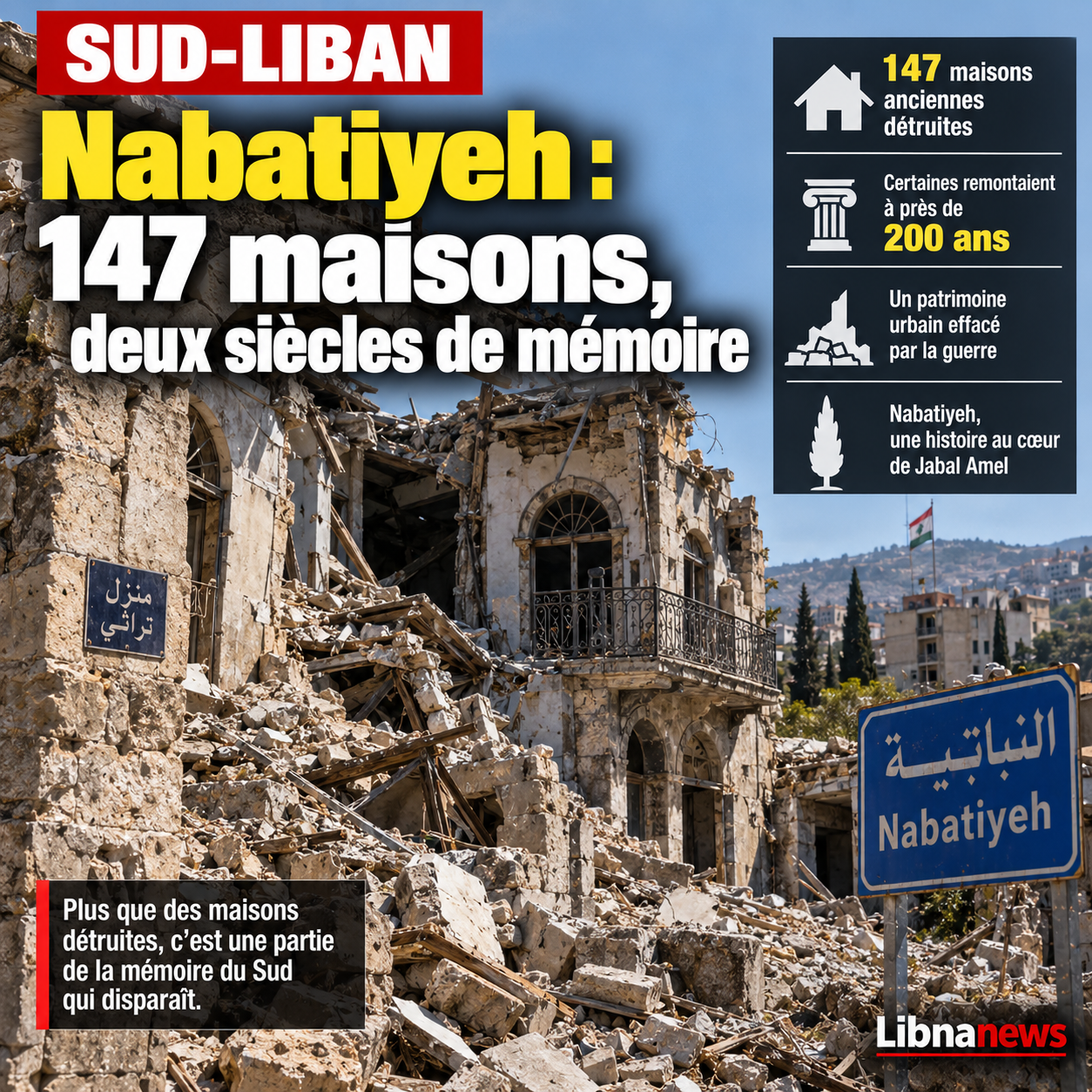
In Nabatiyah, destruction is not only measured by the number of dwellings that have become uninhabitable. They also include old houses, family homes, reception spaces and buildings that told almost two centuries of local history. In its 29 September 2026 edition, Asharq Al-Awsat devotes an investigation to this less visible dimension of the war. The newspaper records in Nabatiyah only,147 old houses completely destroyedisraeli bombings in the last two wars. Many were between 80 and 150 years old. Some homes and family reception rooms had been built almost two centuries ago.
The stakes therefore go beyond real estate reconstruction. A recent house can, at least materially, be rebuilt according to plans close to the original. The disappearance of a historic home is something else. It erases an architecture, archives, an ancient relationship to the city and sometimes the physical trace of families who have participated in its political and social history. The Asharq Al-Awsat investigation thus raises a question that may become central to the reconstruction of the South: how can we restore a heritage when the value of what has disappeared cannot be calculated only in square metres?
Almost two centuries old heritage
The figure of 147 houses gives a first measure of destruction. However, it is not enough to account for the nature of the buildings concerned. Asharq Al-Awsat states on 29 September 2026 that their age generally varied between 80 and 150 years. Some houses and diwaniyat, these family reception and sociability spaces, were about 200 years old.
These constructions documented different periods of Nabatiyah history and, more broadly, Jabal Amel. Their interest came from their architecture, but also from their function. They belonged to old families and, for some, to personalities who had occupied a place in the political or social life of the South.
The traditional house was not just a dwelling. It could serve as a meeting place, reception and family transmission. Its architecture also reflected the techniques, materials and organizational forms of society at the time of its construction.
The disappearance of these buildings thus breaks several continuitys at once. It changes the urban landscape. It removes material witnesses from the past. It also deprives subsequent generations of spaces in which part of local history remained physically perceptible.
Asharq Al-Awsat does not present these losses as a mere statistical consequence of the bombings. The newspaper builds its investigation around the idea of an erasure of the architectural heritage of the South.
This qualification, however, requires a distinction to be made between what the report establishes and what is interpreted. The number of houses destroyed and their seniority are presented as items collected by the newspaper. The idea of intentional destruction of memory is a broader reading, supported in particular by the cultural and social actors interviewed.
The old market of Nabatiyeh also affected
Destruction is not just about private property. Asharq Al-Awsat also refers to the old Nabatiyah market, some of which, according to the newspaper, date back to the Mamluk period.
The market belongs to another category of assets. A family home retains the memory of a lineage and its environment. An ancient market tells the collective history of a city. It retains the traces of trade, trade, travel and daily life.
Its destruction therefore directly affects urban continuity.
In a city transformed by wars, ancient buildings also serve as landmarks. They make it possible to recognize a neighbourhood and maintain a link with previous generations. When these landmarks disappear simultaneously, reconstruction can produce a city that is materially new but historically impoverished.
This is one of the problems that will arise when construction starts. Should we rebuild identically? Keep the ruins? Reconstitute some facades? Document the buildings before they disappear? Or focus on the rapid reconstruction of housing?
The source files do not yet provide an institutional answer to these questions. On the other hand, they show that the magnitude of the losses now requires them to be laid.
Families that don’t confuse with Hezbollah
One of the most sensitive elements of Asharq Al-Awsat’s investigation concerns the political identity of some affected families.
The newspaper points out that several old houses destroyed belonged to families or figures historically located at a distance from Hezbollah or even politically opposed to the party. This finding is used to challenge a reading that destruction would only involve Hezbollah-related buildings or infrastructure.
This element deserves careful formulation. The fact that a house belongs to a family opposed to Hezbollah does not in itself establish why it was struck. Similarly, the files provided do not individually determine the military motive for each of the 147 destructions.
However, information is important.
It shows that the map of property losses exceeds that of structures directly associated with Hezbollah. Elements of South history that belong to different political traditions have also disappeared.
The destruction of heritage thus becomes a matter common to a much wider society than the sole basis of the party.
This is also what makes the file particularly important for reconstruction. Restoring the architectural memory of the South cannot be conceived as a programme for a single political formation or for a single population category. The buildings concerned told a history prior to the current political configuration.
An architectural memory specific to Jabal Amel
Asharq Al-Awsat’s report includes these destructions in the story of Jabal Amel. This dimension allows us to understand why a 150-year-old house cannot be treated as a simple property.
Old homes bear traces of a way of life. Their internal organization, reception spaces and materials testify to particular social relationships. Some are also related to the history of notables, families, religious or political actors who have marked the region.
The heritage is therefore not only monumental.
A city can lose its history without a large fortress or famous monument disappearing. It is enough to destroy, one after another, the ordinary buildings that formed its ancient fabric.
This is precisely what makes the figure of 147 houses of concern. Taken separately, each of these buildings may seem secondary to a large infrastructure. Taken together, they formed an important part of Nabatiyah’s visual and historical identity.
Their collective disappearance changes the very nature of the city.
This loss becomes even more difficult to measure when destruction also involves documents, photographs, libraries or household objects kept inside. Asharq Al-Awsat insists on the memorial dimension of homes. However, the available files do not allow for a complete inventory of what was in each case.
It is therefore necessary to avoid encrypting what is not documented.
Rebuilding a house is not returning its story
Reconstruction is a particular problem here. For recent buildings, the main objective is generally to restore housing and infrastructure necessary for daily life. For a heritage building, the question is different.
An old building can be rebuilt materially without regaining its historical value.
Stones can be replaced. A facade can be reproduced. Volumes can be imitated. But the continuity of the original building is lost. A house that has passed through several generations does not become the same simply because a new construction resumes its appearance.
This distinction should affect future compensation programmes.
If compensation is based solely on the area destroyed, a historic house may be assessed as any other building. Its cultural and memorial value then disappears a second time: first physically, then administratively.
Asharq Al-Awsat’s investigation thus opens a question that goes beyond Nabatiyah. How many heritage buildings were damaged or destroyed in other cities and villages in the South? What inventories existed before the war? Do the owners have plans, photographs or documents for a faithful restoration?
The files of 29 September 2026 do not give a complete balance sheet for the whole of the South. They only establish that Nabatiyeh is already a major case.
Heritage in the midst of much wider destruction
The cultural issue cannot, of course, be separated from the human situation.
On 29 September 2026, several newspapers still described Israeli operations in the South. Al Sharq reported strikes and bombings in several localities, including Zawtar al-Sharqiya, Qantara, Tallousa and areas close to Mays al-Jabal, Haris and Hadatha. The newspaper also reports a major explosion by Israeli forces in Mansuri.
Al Jumhouria also describes the continuation of air operations, artillery fire and destruction in the districts of Tyre, Nabatiyeh, Marjayoun and Bint Jbeil.
The preservation of heritage therefore takes place in a territory where the immediate priority remains the security of the inhabitants, their return and the reconstruction of housing.
This emergency can naturally relegate architectural conservation to the background.
However, both objectives are not incompatible. Documenting a building before clearing does not mean indefinitely delay reconstruction. Identifying recoverable architectural stones or elements can be integrated into operations. Keeping the photographic archives may allow further restoration.
The problem arises especially when no inventory is made before the rubble is removed.
In this case, some of the information needed for future restoration is permanently lost.
A reconstruction that could unify the South
The danger lies not only in buildings already destroyed. It also concerns how they will be replaced.
After a war, speed often pushes towards standardized solutions. Housing needs to be rebuilt quickly. Materials must be available. Costs must be controlled. Aid programmes naturally favour procedures which can be applied on a large scale.
This logic is understandable. However, it can profoundly transform the appearance of cities and villages.
If 147 ancient houses in Nabatiyeh are replaced by buildings or contemporary buildings unrelated to their architecture, the city will find housing but not its historical landscape.
The same problem may arise in villages.
The reconstruction of the South will therefore have to arbitrate between three requirements: to allow the inhabitants to return quickly, to respect their choice of owners and to preserve as much as possible the heritage characteristics of the old areas.
The sources provided do not yet describe any public policy that meets these three objectives.
It is precisely this vacuum that makes the case urgent.
Memory also becomes a political issue
The heritage of the South is not politically neutral. It tells a region whose history does not begin with recent conflicts.
It is one of the most interesting elements of Asharq Al-Awsat’s report. Recalling that some homes belonged to families far from Hezbollah, the newspaper highlights Jabal Amel’s historical and political plurality.
To preserve this memory therefore means to preserve several accounts.
The South has experienced notables, political movements, religious traditions, intellectuals and forms of sociability that cannot be summarized in the only contemporary confrontation between Israel and Hezbollah.
Old houses are sometimes the last material witnesses to this story.
Their disappearance is therefore likely to simplify the region’s narrative retrospectively. When buildings disappear, it becomes easier to forget the social worlds to which they belonged.
That is why heritage reconstruction can also serve a civic function. It can restore a local history in all its diversity, without reducing it to the current political divisions.
The urgency of an inventory before major construction sites
The figure published by Asharq Al-Awsat could serve as a starting point for much larger work.
Even before reconstruction, we should know exactly what has been lost, what remains standing and what can still be saved. Such an approach requires a building-by-building inventory.
For each old building, several information would be required: approximate construction date, owner, pre-war condition, historical function, architectural characteristics, damage suffered and restoration possibilities.
Family photographs could also become valuable when official archives are incomplete.
Such documentation would then make it possible to distinguish between buildings that can be restored and those that require reconstruction. It would also help identify buildings whose value exceeds their private interests.
But the source files do not make it possible to say that a comprehensive inventory of this kind exists today.
The data of 147 houses shows precisely why it becomes necessary.
The reconstruction of the South cannot only be financial
The reconstruction debate often focuses on the necessary amounts. This question is obviously essential. Thousands of families must return to housing, infrastructure must be restored and economic activities must resume.
But Asharq Al-Awsat’s investigation shows the limits of an exclusively financial approach.
How much is a 150-year-old house worth? Its surface can be evaluated. The price of the land can be calculated. The cost of reconstruction can be estimated. But none of these figures fully measure its historical value.
The question becomes even more complex for an old market or a home linked to the political history of a city.
A reconstruction policy should therefore distinguish at least two categories: the material compensation due to the owners and the protection of a heritage of collective interest.
Both do not respond to the same logic.
The purpose of the compensation is to compensate individual damage. Heritage conservation seeks to preserve a memory that belongs to society as a whole.
In Nabatiyah, the 147 houses identified by Asharq Al-Awsat show that these two dimensions are now inseparable.
What the numbers cannot rebuild
The destruction of the South will one day be translated into budgets, tenders and work schedules. Roads will be repaired. Housing will be rebuilt. Water and electricity systems will need to be restored.
However, the ancient heritage requires another temporality.
A destroyed house can disappear in seconds when it took almost two centuries to accumulate its meaning. It will take a few years to rebuild materially. Returning everything that she represented is much more difficult.
The survey published by Asharq Al-Awsat on 29 September 2026 makes it possible at least to establish a first benchmark:147 old houses completely destroyed in Nabatiyah.
This figure is not yet a complete heritage record of the South. However, it is sufficient to show that reconstruction cannot be considered solely as the replacement of buildings destroyed by new buildings.
In Nabatiyeh, part of what disappeared belongs to the history of the city itself. The question is no longer just how much will reconstruction cost. It is also to determine what is still possible to save, document and transmit.