





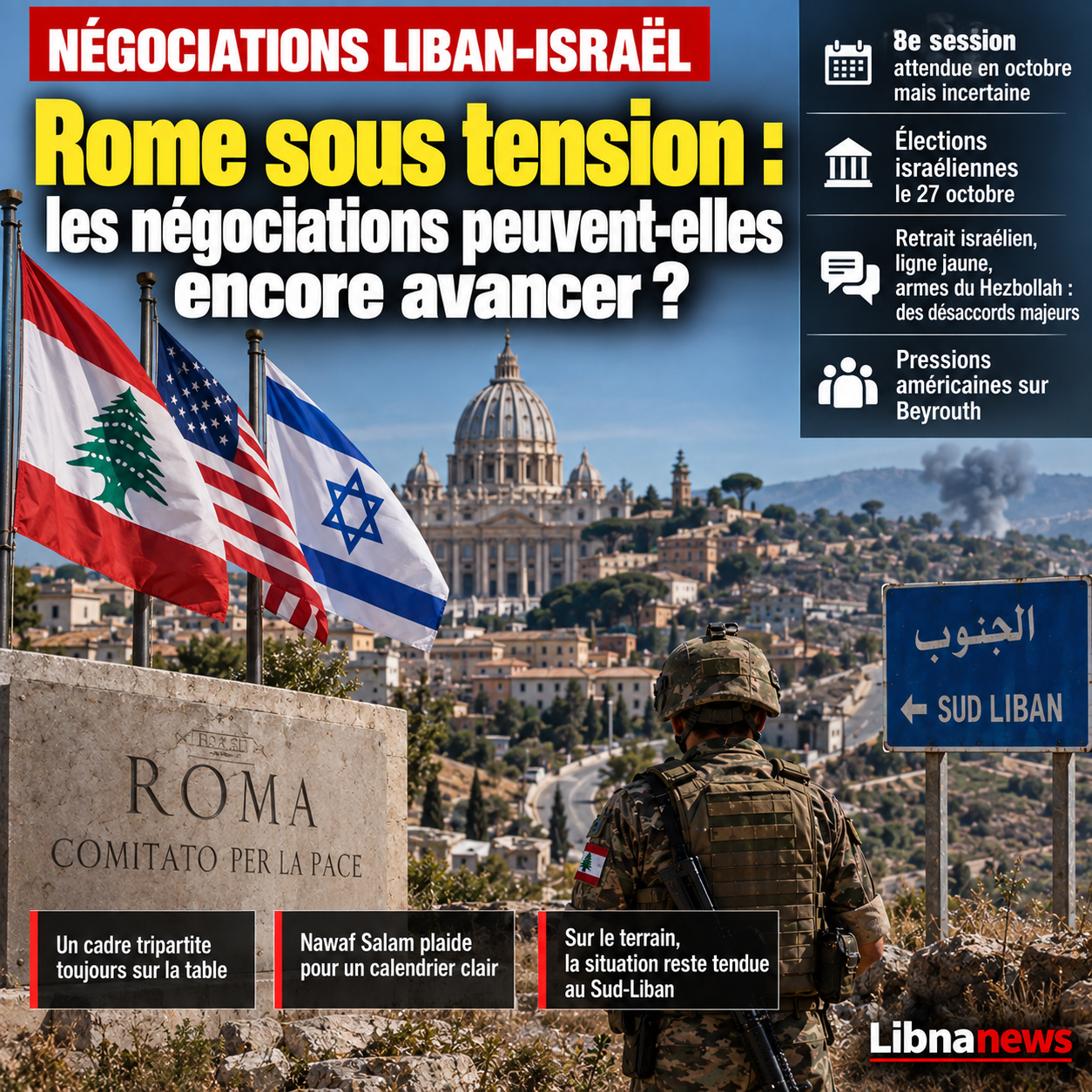
The next stage of negotiations between Lebanon and Israel was to be held in Rome. Yet, in the 29 September 2026 editions, the Lebanese newspapers no longer describe this deadline with the same certainty. Al Akhbar is still talking about an eighth session due in October under American mediation. Al Joumhouria, for its part, reports a decline in the chances of a new meeting being held in the Italian capital during the month. This divergence is not only a matter of timing. It reflects the difficulties encountered in a process that must now address simultaneously Israeli withdrawal, security in the South, Hezbollah weapons and mechanisms for verifying the commitments of both parties.
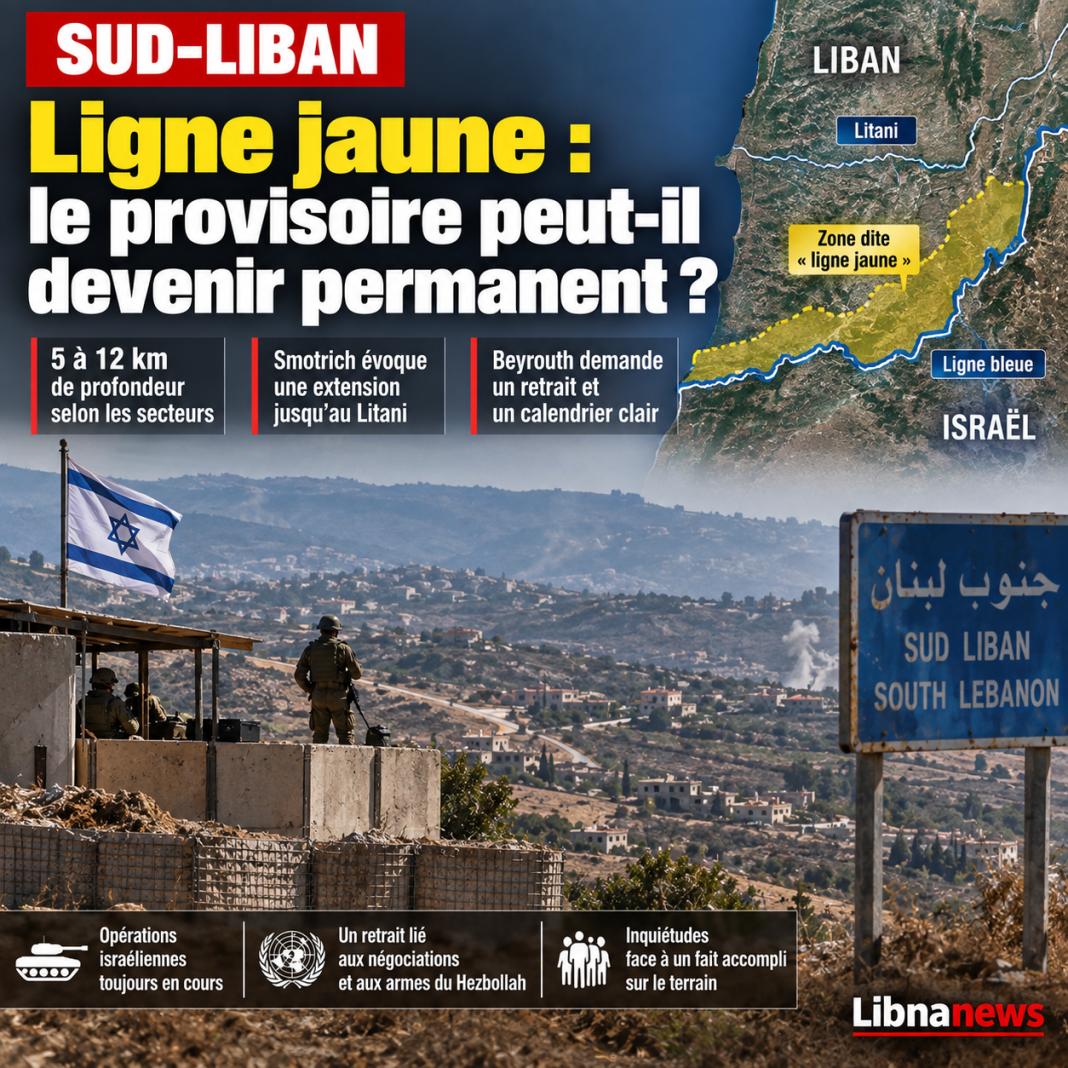
The seventh session had already shown the extent of disagreement. According to Al Akhbar of 29 September 2026, its blocking is not the result of a mere technical dispute. Israel is said to have consolidated on the ground a concept based on a « yellow line », also described as an advanced line of defence. In the areas concerned, the depth of the Israeli presence would vary between five and twelve kilometres. The debate on the next Rome meeting therefore focuses on an essential question: is there still enough common political ground for a new session to produce something other than a repetition of the positions already expressed?
An eighth session still awaited by Al Akhbar
Al Akhbar writes on 29 September 2026 that the wait continues before an eighth session of direct negotiations between the Lebanese authorities and Israel, under American sponsorship, scheduled for Rome the following month. The newspaper puts this deadline in an unchanged military context. Israeli forces remained present in several areas of the South and, according to him, continued to regard their device as a buffer zone.
This presentation suggests that the negotiation channel is not officially closed. A future session remains to be considered. However, the analysis of the newspaper also shows how far the positions remain.
The « yellow line » concentrates part of the disagreement. Al Akhbar explains that Israel assigns him a specific military function: to prevent land threats or direct fire in the immediate vicinity of its border localities. However, this line would not resolve the issue of rockets and drones capable of operating from more remote areas.
The problem therefore goes beyond the Israeli presence. It also concerns the freedom of action that Israel wishes to keep beyond this line. Even an agreement on redeployment would not necessarily mean an end to military operations further north.
For Lebanon, such logic poses a major challenge. The negotiation process must lead to Israeli withdrawal and the restoration of State authority. It cannot simply transform a land occupation into a permanent capacity for remote intervention.
It is on this ground that the next meeting should progress theoretically. But nothing in the 29 September files shows that a compromise is already available.
Al Joumhouria finds fewer chances
Al Joumhouria gives a more pessimistic reading of the deadline. In its 29 September 2026 edition, the newspaper reports that the officials following the dossier note a decrease in the chances of holding a new session in Rome in October.
The newspaper links this uncertainty to the Israeli calendar. The Knesset elections are scheduled for 27 October. As the deadline approaches, political margins for making concessions are reduced.
Al Joumhouria develops this dimension at length. According to his analysis, Benjamin Netanyahu would have little interest in presenting before the election concessions that could be used against him by his opponents. The newspaper therefore considers that even if a session took place, its chances of producing a breakthrough would be low.
Two levels must be distinguished here. The decrease in the chances of holding the meeting is information attributed to the officials according to the file. The assessment of Netanyahu’s electoral behaviour is more a matter of analysis published by the newspaper.
This distinction does not detract from the main observation: the diplomatic calendar is now colliding with the Israeli political calendar.
Negotiations are no longer only between two parties seeking a security arrangement. It intervenes at the heart of a campaign where the situation in Lebanon can itself become an electoral argument.
Smotrich still hardens the climate
Bezalel Smotrich’s statements further complicate the context.
Al Jumhouria reports that the Israeli Minister of Finance has declared that he wishes to annex at least territories to the « yellow line » in Gaza and to the Litani in Lebanon. It justifies this position by the need to change the territorial conditions after the war in order to create a lasting deterrent.
This declaration did not amount to a decision of the Israeli government. Nor can it be said that Israeli negotiators have formally annexed to the Litani as a condition in Rome.
However, it changes the negotiating environment.
Al Jumhouria stresses that these statements contradict the Israeli commitment not to have territorial ambitions in Lebanon as it appears in the framework discussed. The question is therefore no longer purely military. It affects confidence in the commitments made in the process.
Asharq Al-Awsat, in his edition of the same day, also reviews Smotrich’s comments. The newspaper examines them with greater caution. He cited retired Lebanese General Hicham Jaber, who believed that land claims should be understood as a way of raising the ceiling of Israeli demands.
Both publications make it possible to distinguish the political fact from its interpretation. Smotrich made a claim concerning the Litani. However, the available sources do not demonstrate that this claim constitutes the official position to be defended at the next session.
For Beirut, however, it remains a worrying signal.
Nawaf Salam tries to put the frame back in the center
As uncertainty grows around Rome, Nawaf Salam seeks to strengthen the American role in applying the existing framework.
Several newspapers on 29 September 2026 reported on his meeting with US Secretary of State Marco Rubio in Washington. Al Binaa reported that the Prime Minister had requested the transition to a concrete phase of the tripartite framework. He stressed the principles of reciprocity and progressivity.
The Lebanese message is accurate. The Israeli withdrawal and extension of State authority must move forward in parallel.
Salam also calls for a clear timetable for the implementation of commitments. It calls for a credible mechanism to ensure that each party complies with its obligations. The aim is to avoid a delay or failure to perform being used as a justification to block the entire process.
Al Joumhouria reports the same priorities. The Prime Minister also reportedly called on the United States to exert more pressure on Israel to put an end to attacks and destruction in the southern villages.
Beirut’s position is therefore to prevent negotiations without a deadline.
If the Israeli withdrawal depends on a series of objectives, the achievement of which can be considered to be continually inadequate, the Israeli presence may continue. On the other hand, if the arms measures were returned after a total withdrawal, Israel might consider that its security guarantees would disappear.
The principle of progressivity seeks precisely to overcome this contradiction.
US messages reported by Al Araby Al Jadid
However, the information published by Al Araby Al Jadid shows that discussion with Washington is more difficult than the official diplomatic language suggests.
According to the 29 September 2026 newspaper, Nawaf Salam received several messages in New York, including American messages. They have reportedly indicated that Israel intends to continue its operations and maintain its security zone in the South until the Lebanese State takes, in accordance with that stated position, measures deemed sufficiently serious regarding Hezbollah’s weapons.
Al Araby Al Jadid added that US officials considered the government’s actions insufficient. They are said to have called for an acceleration of the state’s arms monopoly process and a more firm approach to the issue.
This information is attributed to the newspaper’s sources. They cannot therefore be transformed into an official American position without this clarification.
They nevertheless shed light on Rome’s potential blockage.
If Washington considers that Lebanese progress is insufficient, US mediation may focus more on Beirut obligations. While Lebanon also considers that Israel is not fulfilling its own commitments, the reciprocity requested by Nawaf Salam becomes difficult to implement.
The negotiation is then caught up in a classic question: who should act first?
Hezbollah refuses the current framework
The weapons issue further complicates the government’s policy space.
Al Araby Al Jadid reports that Naim Kassem has asked the Lebanese authorities to review the course of negotiations, end concessions and return from a direct format to an indirect format. The secretary general of Hezbollah therefore rejects part of the current architecture.
Al Sharq of 29 September 2026 also goes back to his statements. Naim Kassem refused to dissociate the issue of weapons from that of Israeli withdrawal, the return of the inhabitants and the prisoners ‘ file.
The government’s position is different. Nawaf Salam asserts that the State’s arms monopoly is a Lebanese objective and that it must move forward with the restoration of sovereignty.
Lebanese negotiators must therefore deal with two simultaneous constraints.
Outside, Israel and the United States are calling for progress on weapons. Inside, Hizbullah refuses to deal with this issue independently of withdrawal and other conflict-related issues.
A meeting in Rome cannot resolve this contradiction if no political compromise is prepared upstream in Beirut.
The terrain continues to weigh on the table
Negotiations are also under military pressure.
Al Sharq reported several Israeli strikes, bombings and operations in the south on 29 September. The newspaper mentions Zibqin, Yater, Tallousa, Mays al-Jabal, Haris, Hadatha, Qantara and Zawtar al-Sharqiya. It also reports Israeli tank movements in the Arnoun area.
Al Araby Al Jadid describes a South that wakes up almost daily under a new climbing sequence. The newspaper also reports the dismantling by the Lebanese army of an Israeli spy camera equipped with a solar device near Wadi Zibqin.
These operations are not outside the diplomatic process. They directly determine the climate in which negotiators work.
For Lebanon, the continuation of strikes makes it more difficult to defend a process whose results remain unclear. For Israel, military pressure seems to remain a tool to change security conditions before any agreement is reached.
Negotiations and military action are therefore not followed. They move simultaneously.
Rome risks becoming a meeting without results
This is probably the main question raised by the comparison between Al Akhbar and Al Jumhouria.
Al Akhbar continues to speak of an eighth session expected. Al Joumhouria observes that the chances of holding her down decrease. But the two newspapers converge indirectly on one point: even if the meeting takes place, there is still no decisive element to announce a breakthrough.
The holding of a session is therefore not synonymous with progress.
To produce a result, Rome should at least clarify the sequence of commitments. What withdrawal must Israel make? How fast? What steps should the Lebanese State take in parallel? How will they be checked? What freedom of action would Israel retain after a possible withdrawal? And what would be the status of the « yellow line »?
These questions are now added to the post-UNIFIL question. In the same edition, Al Joumhouria reports diplomatic concerns about the absence of a clearly defined replacement device. Security in the South cannot therefore be considered solely through relations between Beirut and Israel. It also depends on the international presence and future capabilities of the Lebanese army.
A negotiation that ignores these elements could produce an agreement that is difficult to implement.
October becomes a political month before being diplomatic
The timetable is now one of the main obstacles.
The Israeli elections are scheduled for 27 October. In this context, any territorial or military concession can be used in political competition. On the contrary, Smotrich’s statements illustrate an overbidding dynamic.
Al Joumhouria believes that this reality reduces the chances of progress before the election. Even a meeting in Rome could therefore have the main function of keeping the channel open.
This function is not negligible. In a context of strikes and military presence on the ground, maintaining a channel of discussion can prevent a complete rupture.
But it is very different from a negotiation that can produce a withdrawal.
The real test would therefore not necessarily be whether delegations were going to Rome. It will be necessary to determine whether the United States is able to obtain commitments from both parties that are sufficiently specific to make the meeting useful.
An uncertainty that reveals the fundamental blockage
The information available on 29 September 2026 does not indicate that the eighth session is cancelled. Al Akhbar continues to present her as expected. Nor can they guarantee that it will take place. Al Joumhouria reports a decrease in probability.
This divergence itself constitutes information.
It shows that the process remains open but fragile. No diplomatic calendar seems strong enough to withstand developments in Israeli terrain and policy.
Obstacles are now clearly identified. Israel wants guarantees for Hezbollah and maintains a military presence in the South. Lebanon demands a complete withdrawal and seeks to impose reciprocal progress. Hezbollah challenges the direct format and refuses to deal with its weapons independently of withdrawal. Washington is trying to maintain the framework while, according to Al Araby Al Jadid’s reports, exerting significant pressure on Beirut.
In these circumstances, Rome can only be a step.
His outfit would show that the channel is not broken. Its postponement would confirm that the positions remain too far away to justify immediately a new session. In both cases, the problem would remain the same: to transform an existing diplomatic framework into executable commitments on the ground.
The real question is therefore no longer just when the next meeting will take place. She knew what the parties would really be willing to negotiate there.