





Hezbollah does not seem to consider direct negotiations between Lebanon and Israel as the only space for the future of the South. The available evidence shows a much more regional reading. The party’s parliamentary sources claim that it first observes the evolution of the discussions between Washington and Tehran. Their justification is explicit: Iran maintains the Lebanese case as a priority and would not be willing to abandon it. This position is of particular importance at a time when the Iranian proposal on the Strait of Ormuz specifically includes the cessation of fighting in Lebanon as a condition for a settlement with the United States.
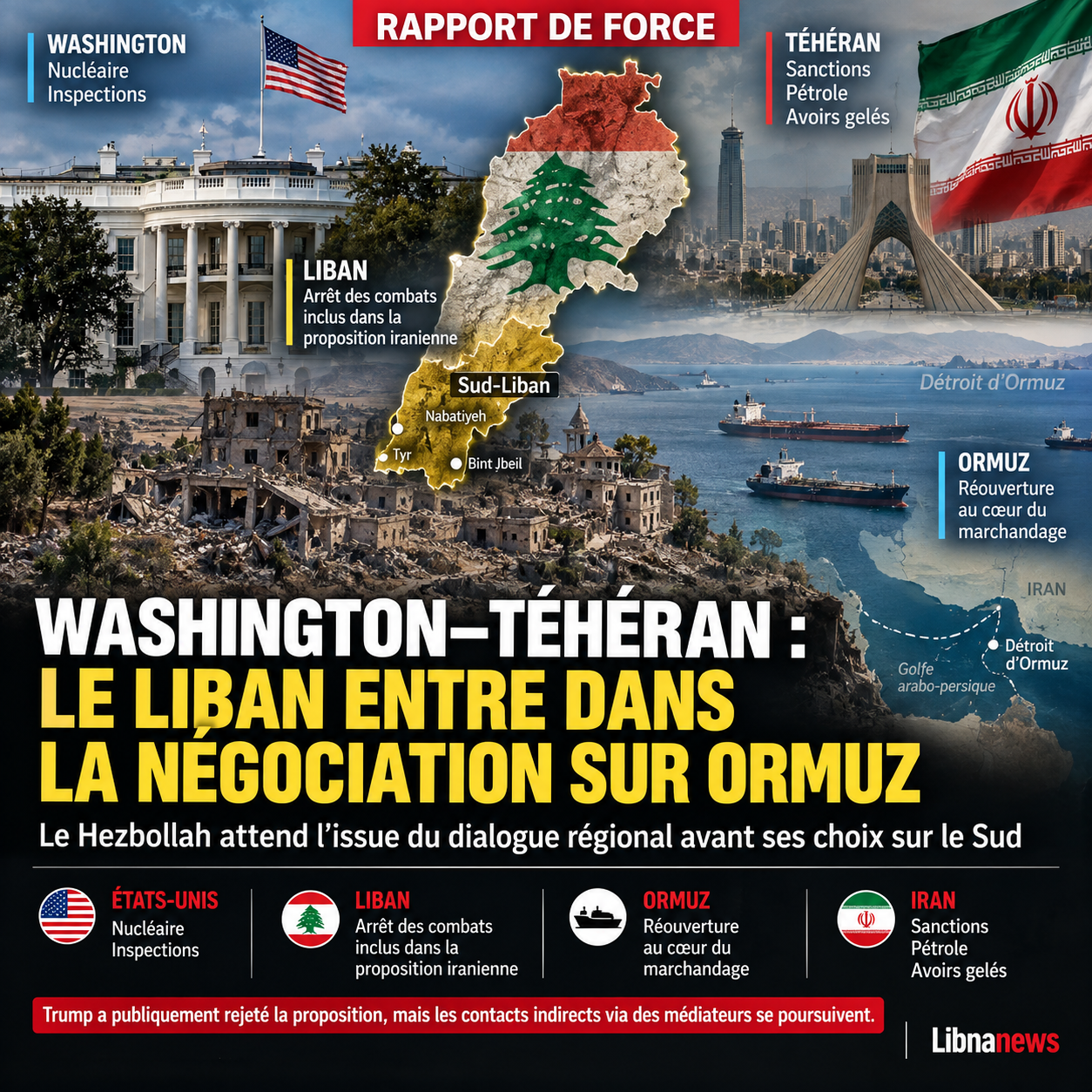
The reconciliation of the two files changes the scale of analysis. Hezbollah’s weapons, Israeli withdrawal and the military future of the South are discussed in Beirut and in negotiations with Israel. But Lebanon also appears in a much broader discussion where Tehran seeks to lift the blockade of its ports, easing oil sanctions, releasing its frozen assets and ending fighting on several fronts. Washington is asking for progress on nuclear power. Lebanon thus finds itself at the crossroads of two negotiations that do not respond to the same actors or to the same balance of power.
Hezbollah looks first to Washington and Tehran
The confidences of Hezbollah’s parliamentary sources make it possible to understand the hierarchy retained by the party. They claim that Hezbollah « monitors developments » and focuses on maintaining the Lebanese file in Iranian negotiations rather than direct discussions with Israel.
This position does not mean that the party refuses any discussion of its weapons. The same sources indicate that it is open to a debate on arms, but on two essential conditions. This debate must remain Lebanese and be part of a defence strategy.
These two conditions deeply move the frame.
For Hezbollah, therefore, weapons should not be negotiated directly with Israel. Nor should they be treated as mechanical execution of external demand. They can be discussed among Lebanese, in a broader reflection on the defence of the territory.
This position is consistent with Naim Kassem’s statements. The Secretary General of Hizbullah requested a review of the course followed by the Lebanese authorities. He wanted to put an end to what he presented as concessions and return from direct negotiations to an indirect format.
The disagreement with the government, therefore, is not solely about the fate of weapons. It also concerns where this issue should be resolved.
The government is seeking to enshrine it in an architecture that includes Israeli withdrawal, sovereignty and state monopoly of arms. Hezbollah wants to put it back in a national defence dialogue, while considering that the regional balance of power remains decisive.
It is precisely here that Iran enters the equation.
Lebanon appears black and white in the Iranian proposal
Connection is not just an interpretation of Hezbollah. The Iranian project presented in the United States explicitly links Lebanon to the settlement sought around Ormuz.
According to information published on 29 September 2026, Tehran proposed to reopen the Strait in exchange for a package of measures. These include the cessation of fighting on all fronts, including in Lebanon, the release of several billion dollars of frozen Iranian assets, the end of sanctions against oil exports and the lifting of the United States embargo on Iranian ports.
Negotiations on the nuclear programme would then resume.
Lebanon does not therefore appear as a peripheral issue added after the fact. It is part of the sequence proposed by Tehran to reach a wider agreement.
This gives particular significance to the sources of Hezbollah. When they claim that Iran remains committed to the Lebanese issue, they rely on a reality visible in the Iranian proposal: Tehran is indeed seeking to include the cessation of hostilities in Lebanon in the proposed transaction in Washington.
The essential question then becomes that of the nature of this commitment.
Including Lebanon in an agreement can serve Lebanese interests if it leads to the cessation of attacks and paves the way for Israeli withdrawal. But this also means that part of the Southern calendar depends on negotiations whose main stakes far exceed Lebanon.
Ormuz, oil, sanctions, frozen assets and nuclear assets then weigh on the same diplomatic balance.
Ormuz indirectly becomes a Lebanese file
The Strait of Ormuz is geographically far from Lebanon. Yet the Iranian proposal creates a direct political link between the two spaces.
Tehran calls for the lifting of the maritime blockade of its ports and the reopening of Ormuz as part of a wider exchange. Controlling or disrupting this passage is a major means of pressure because it affects international energy flows.
By integrating Lebanon into the proposal, Iran seeks a settlement that is not limited to its territory.
This corresponds to the regional structure of confrontation. The various fronts were politically and militarily linked. An agreement focused solely on Ormuz would therefore leave homes open that could cause further escalation.
Tehran seems to be looking for the opposite: turning a negotiation arising from the strait crisis into a broader de-escalation mechanism.
For Hezbollah, this architecture has an obvious advantage. It prevents the party from facing negotiations with Israel alone in a context where the military power ratio is unfavourable. It puts the Lebanese case back in a negotiation where Iran has much greater means of pressure.
This strategy, however, has a counterpart.
The more Lebanon depends on the American-Iranian settlement, the less Beirut controls the calendar alone.
Washington wants to bring the discussion back to nuclear
The American positions reported in the files clearly show the limitations of the Iranian project.
Washington does not want an agreement to boil down to the reopening of Ormuz and to ease economic pressure. US officials are demanding concessions on Iran’s nuclear program. They include the return of inspectors.
An American official also said that the two sides remained distant on a decisive question: who should take the first step?
This sequence problem closely resembles that encountered in the Lebanese file.
Tehran wants to obtain American measures before ceding on some files. Washington is asking for guarantees before reducing pressure. In Lebanon, Beirut calls for a parallel progression between Israeli withdrawal and restoration of state authority, while Israel and its partners demand more results on weapons.
Two different negotiations therefore face the same obstacle: the lack of confidence needed to act first.
Qatari mediation seeks precisely to organize the stages.
The draft discussed includes the reopening of Ormuz and the lifting of the blockade, before moving forward on sanctions and other elements of the regulation. Discussions with Oman also concern the organization of navigation in the Strait.
However, there is no guarantee that this architecture will succeed.
The information available speaks of limited progress, not agreement.
Trump publicly rejects, but intermediaries continue
The American position adds additional ambiguity.
Donald Trump publicly rejected the Iranian proposal. He explained that Tehran was quickly seeking an agreement because of the economic pressure it was experiencing.
However, contacts did not stop.
The information available indicates that Qatari mediators continue to work with both parties. Officials speak of positive signals and modest progress. Tehran also claims that it did not receive any official rejection from intermediaries.
This difference between public declaration and diplomatic channel is essential for Hezbollah.
If the party relies on the evolution of the American-Iranian dialogue, it does not only look at Trump’s statements. He observed the survival of the negotiation channel.
The fact that intermediaries continue their work means that the hypothesis of an agreement is not abandoned.
But that doesn’t mean she’s close.
The nuclear file remains open. The question of the first stage is not resolved. Sanctions are still a major issue. Finally, stopping the fighting on the different fronts implies the engagement of several actors who are not all directly present at the table.
Hezbollah therefore bets on a process that really exists, but whose outcome remains uncertain.
A wait strategy rather than an immediate military decision
This situation helps to understand why an immediate entry of Hezbollah into a broader direct confrontation does not appear, in the available information, as the preferred short-term scenario.
The party is watching.
This attitude is not necessarily passive. It consists of allowing for the development of a regional negotiation which could profoundly alter the conditions under which the Lebanese case will then be dealt with.
A major military escalation of Hezbollah could have the opposite effect. It could provoke a new Israeli offensive and reduce the space available to intermediaries.
On the contrary, waiting allows to see whether Tehran obtains an arrangement encompassing Lebanon.
However, this strategy has a cost.
While Hizbullah awaits the results of the regional dialogue, the South remains subject to Israeli operations. A safe area remains. The destruction continues. The inhabitants await their return and reconstruction.
Thus, Iranian diplomatic time is not necessarily the same as Lebanese time.
This is one of the most important contradictions of the current situation.
What exactly does « Iran will not disengage from Lebanon » mean?
The formula used by Hezbollah’s parliamentary sources can be read in two very different ways.
For the party, it is a guarantee. Hezbollah would not be left alone in the face of Israel and American pressure. Tehran would use its own negotiations to obtain a settlement on the Lebanese front.
But from the point of view of the State, the same formula raises a question of sovereignty.
If Lebanon is negotiated in Washington and Tehran, what place is left in Beirut to define its own conditions?
The Iranian proposal aims to halt the fighting in Lebanon. It is an objective which naturally reaches the interests of the affected populations. But the details are decisive. A cessation of hostilities does not automatically answer questions of Israeli withdrawal, occupied positions, prisoners, Hezbollah weapons and state authority.
The final content of a possible American-Iranian agreement could therefore influence Lebanon without solving all its problems.
This distinction is fundamental.
Regional de-escalation can create conditions for a Lebanese settlement. It cannot necessarily replace this regulation.
Two tables for the same territory
Lebanon is thus at the centre of two negotiating tables.
The first is directly Lebanese-Israeli, with American mediation. It deals with the ground: withdrawal, security, military positions, state authority and verification mechanisms.
The second is American-Iranian. It addresses much broader issues: Ormuz, sanctions, oil, frozen assets and nuclear. But it now explicitly understands the cessation of fighting in Lebanon.
Both processes can be strengthened.
An agreement between Washington and Tehran could reduce regional pressure and facilitate a solution in the South. It could offer Hezbollah a framework for accepting certain developments without presenting them as a capitulation. It could also facilitate Israeli withdrawal if broader safeguards were established.
But the two tables can also come into contradiction.
Beirut could move towards a compromise that is not appropriate in Tehran. Conversely, Washington and Iran could achieve a regional formula that did not fully meet Lebanese demands.
The question, therefore, is not only whether Iran is protecting the Lebanese issue in its negotiations.
We need to know what Lebanon would be negotiated and what priorities.
Hezbollah’s weapons remain the most difficult point
However, the party’s parliamentary sources introduce an important opening. They don’t say weapons are out of discussion. They claim that Hezbollah agrees to discuss it within Lebanon and as part of a defence strategy.
This formulation may seem known. In the current context, however, it has a different scope.
It means that the party distinguishes the principle of a discussion of its weapons from the framework in which this discussion is conducted.
The refusal therefore concerns both the method and the substance.
Hezbollah does not want disarmament to appear as an obligation achieved by Israel through military pressure. It seeks to maintain a national framework for negotiating its future role in the defence of the country.
The problem is that the government is at the same time defending the principle of State monopoly of arms throughout the country.
The distance remains considerable.
Can a defence strategy include a transition to gradually place military capabilities under the authority of the State? Or is it used to maintain an autonomous armed structure within a new political framework?
The source files do not answer this question.
They only show that this space for discussion still exists in the discourse of Hezbollah’s sources.
Naim Kassem wants to return to the Indirect
Naim Kassem’s request to suspend direct negotiations with Israel complements this strategy.
The Secretary General of Hizbullah wishes to return to an indirect formula. This position responds to an obvious political logic: to refuse that the relationship with Israel gradually turn into normal bilateral negotiations as occupation and attacks continue.
It also has a strategic dimension.
Indirect negotiation gives more weight to intermediaries. It therefore makes it easier to link the Lebanese case with other regional negotiations.
On the contrary, the government seems to consider that negotiation remains the only realistic way to achieve a withdrawal.
Thus, the disagreement is about the degree of autonomy that Lebanon must maintain in relation to regional confrontation.
Hezbollah believes that the Iranian power ratio improves the Lebanese position.
On the contrary, its opponents may consider that this dependency prevents Lebanon from defining its own priorities.
Sources identify this discrepancy. They do not make it possible to determine the outcome.
The risk of Lebanon becoming variable in a large transaction
The main issue finally appears here.
The inclusion of Lebanon in the Iranian proposal can be read as proof that Tehran does not abandon it. It can also be read as proof that the Lebanese issue belongs to a negotiation whose primary objectives are Iranian and American.
Both readings are not necessarily incompatible.
Iran can seek to protect its Lebanese ally while using this as part of its own negotiation. Washington can seek to stabilize Lebanon while using sanctions and Ormuz to obtain nuclear concessions.
Lebanon lies between these interests.
For Beirut, the key question is therefore to transform a possible regional détente into a specific national result: stop attacks, Israeli withdrawal, return of inhabitants, reconstruction and restoration of state authority.
Without this translation, a large regional transaction could only freeze confrontation.
Hezbollah now seems to be betting that Iran will get more for Lebanon than direct negotiations can get alone.
This bet explains part of his concern. He also explains his insistence on internal dialogue on weapons.
But it exposes the country to a major uncertainty: as long as Washington and Tehran have not decided what they are willing to trade, part of the future of the South remains suspended from a negotiation that is taking place away from Beirut.