

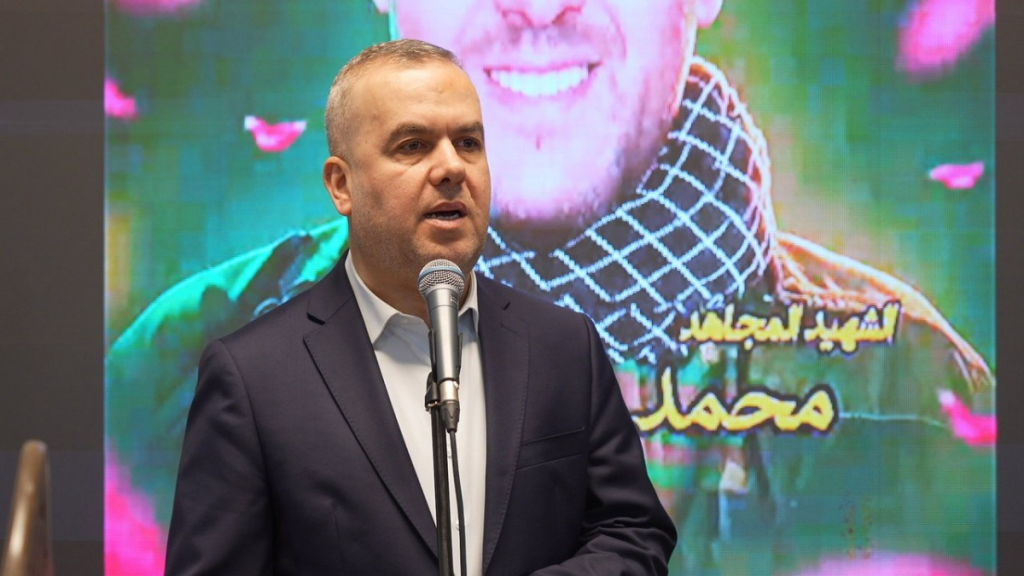
Hassan Fadallah calls on the Lebanese authorities to review their strategy and join the Islamabad process between the United States and Iran. In remarks aired Monday, November 9, 2026 by the NNA, the deputy for Hezbollah states that Tehran wants to put Lebanon at the forefront of any new agreement. The day before, Hussein Hajj Hassan also called for the country to be included in a possible regional settlement. These positions do not constitute the announcement of an agreement concluded or a guaranteed Israeli withdrawal.
Fadllallah asks for a change of strategy
In its 9 novemberThe National Information Agency reports an intervention by Hassan Fadllallah at a Hezbollah ceremony in honour of fighters from Tayri. He called on the authorities to abandon the path taken so far and to seek a national agreement on another approach.
It focuses on maintaining the capabilities of « resistance », an agreement between Lebanese and the support of the regional balance of power. « Iran insists that Lebanon be the first point of any new agreement, » he says. The priority he assigns to Tehran remains as his statement, not as a joint commitment announced by the American and Iranian negotiators.
Fadllallah believes that this combination would make it possible to obtain the departure of Israeli forces from the South. It also maintains its commitment to armed struggle. His call for a regional diplomatic route therefore does not involve the commitment of Hezbollah to disarmament.
Hajj Hassan formulates a requirement for a future agreement
Hussein Hajj Hassan expressed himself in a separate speech, published by NNA Sunday 8 November. The MP participated in a commemorative ceremony in Hazine, Bekaa. He placed Lebanon at the centre of the regional equation related to the Strait of Ormuz, which he presents as an Iranian means of pressure.
Its Arabic wording is prescriptive: « Any possible agreement in the future must necessarily include Lebanon ». He also called for other actors involved in regional confrontation to be taken into account. It does not describe the clauses of an already accepted text.
Distinction is essential. The desire to include Lebanon, the assertion that Iran will defend this demand and the existence of an applicable commitment are three different levels. Neither speech provides a timetable for withdrawal, a monitoring mechanism or an Israeli agreement to new obligations.
The June memorandum and its limitations
The Islamabad process refers to the American-Iranian negotiations facilitated by Pakistan. The british House of Commons Research Service a 14-point memorandum between Washington and Tehran was signed on 17 June 2026. It states in its note of 2 July that no common official text had then been published. The versions communicated to journalists and made public by Iran were close.
According to this synthesis, the first point provided for the permanent cessation of military operations on all fronts, including the one between Israel and Hezbollah in Lebanon. The document also opened an initial period of 60 days to negotiate, inter alia, navigation in the Strait of Ormuz, Iran’s nuclear programme and sanctions.
But the Lebanese government, Israel and Hezbollah were not parties to this bilateral memorandum. The inclusion of the Lebanese front in its objectives was therefore not sufficient to settle the modalities for a ceasefire and withdrawal into Lebanese territory. The Members’ comments do not show that these difficulties of implementation are now resolved.
A separate framework agreement between Lebanon and Israel
Another instrument was signed in Washington on 26 June: the framework agreement between the Lebanese and Israeli governments, under American mediation. It must be distinguished from the American-Iranian memorandum, concluded nine days earlier.
In its communiqué of 27 juneFrench diplomacy had listed its objectives: the restoration of Lebanese sovereignty, the state monopoly of arms, Israeli withdrawal, humanitarian access and the return of displaced persons. This support focused on a framework to produce these results, not on their immediate achievement.
Aoun maintains diplomatic channels
President Joseph Aoun continues to defend the negotiations. The 29 October, receiving German Minister Reem Alabali-Radovanhowever, it had noted the lack of progress expected on four issues: ceasefire, israeli withdrawal, border demarcation and prisoners.
According to the President’s report, Aoun had also reaffirmed the readiness of the State and the army to address security concerns through official mechanisms. This finding of insufficient results did not amount to abandoning diplomacy or joining the process called for by Hezbollah.
The debate is in line with the Nawaf Salam, which reaffirms the priority of avoiding a new war and the state monopoly on decisions of war and peace. It continues as Washington and Tehran negotiate under military pressure. The question remains of the commitments that each actor would accept and apply in Lebanon, beyond the guidelines advocated by the Members.
Photo: Hassan Fadllallah, photograph aired by the NNA with his dispatch of November 9, 2026. The exact date of shooting is not specified. Photograph retained without retouching or cropping. © NNA.





Comments