

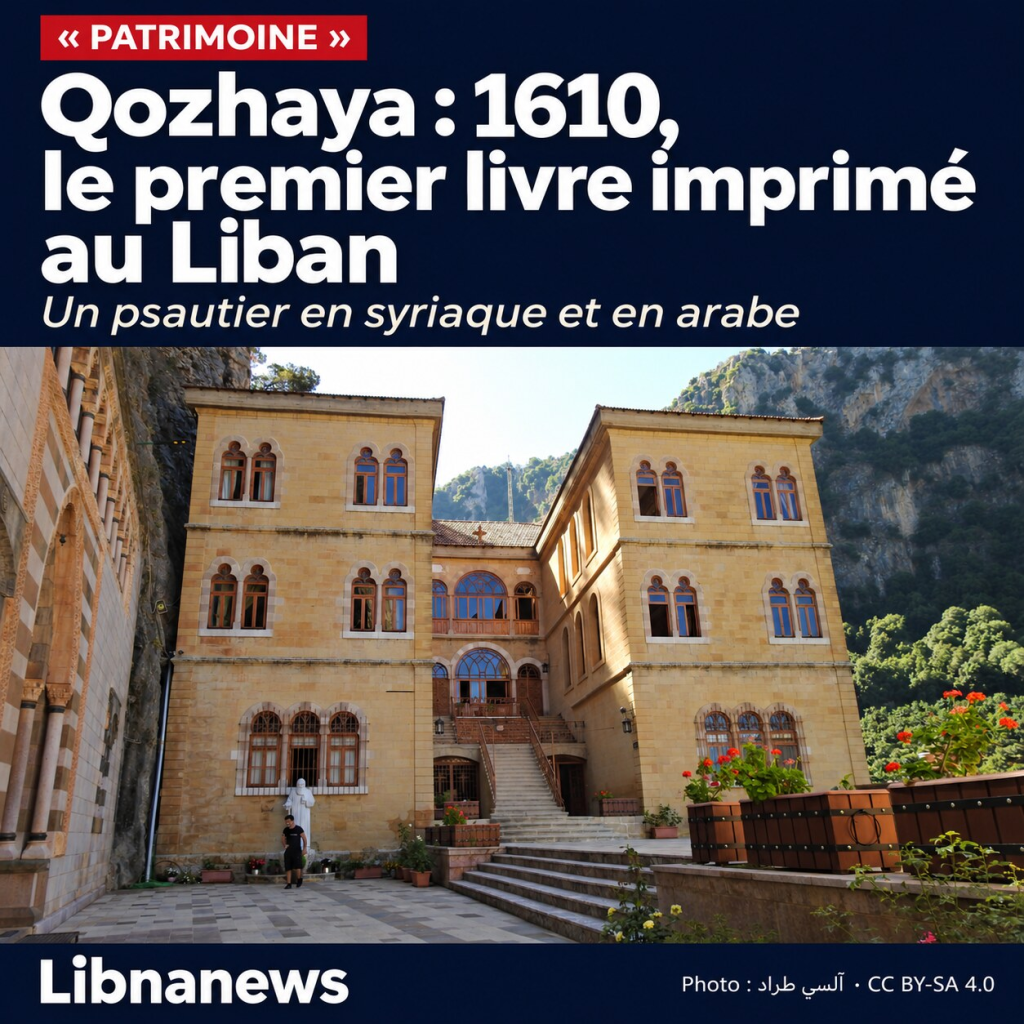
On November 10, 1610, the impression of the poacher of Qozhaya was completed at the monastery of St.Antoine in northern Lebanon. On the eve of the 416th anniversary of that date, the book tells a story more precise than that of a « first printing ». Two languages share his pages. Religious trained in Rome work with an Italian printer. Travellers then take copies to Europe. The volumes retained make it possible to follow this adventure, while leaving several questions open.
In the Qadisha Valley, the monastery belongs to a landscape of cliffs, caves and cultivated terraces. Its history is not limited to religious architecture. At the beginning of the seventeenth century, it received a demanding technical operation: to reproduce a biblical text with moving characters. The result is the first printed book in Lebanon of which copies remain. It also sheds light on the relations between Mount Lebanon, Rome and the first European collectors of Eastern books.
The Psalter of Qozhaya, a date inscribed in the book
A psalmist gathers the Psalms, the Bible texts used in prayer. Qozhaya has a decisive characteristic for the historian: he bears his own manufacturing indications. The colophon, which was placed at the end of a work, placed the print finish on November 10, 1610. The date therefore comes not only from a later account of the monastery.
It makes it possible to distinguish a preserved object from a tradition often taken over. An edition of 1585 appears in ancient catalogues and in several accounts of Maronite history. However, there is no materially identified copy that can be verified today. His existence remains discussed. The 1610 edition offers pages that researchers can examine and compare.
Nuance matters when we talk about the « first book ». Qozhaya does not mark the beginnings of printing throughout the Ottoman Empire. Jewish printers worked in Constantinople as early as 1493. An Armenian workshop published in the 16th century. The singularity of the psalmist lies in its place of production in Mount Lebanon and in the association of the Syriac with Arabic. It does not require the removal of previous experiences from other communities.
Two languages, but Syriac characters
At first glance, pages can deceive an unwarned reader. The book combines Syriac and Arabic, but both texts use Syriac letters. Arabic transcribed in this alphabet bears the name Garchouni, also written garchouni. The language of the text and the form of its characters are therefore not confused.
The Syriac version occupies the right column. The Arabic version is on the left. Characters differ in size. Black ink bears the essentials of the text, while red distinguishes certain elements. This organization allows two versions of the same religious ensemble to be held side by side, without abandoning the graphic universe familiar to Maronite readers.
The choice responds to a concrete cultural situation. The Syriac remains a liturgical language. Arabic occupies a growing place in the life and writing of communities. The book brings these uses together on a single page. His presentation thus gives a material form to a bilingualism which the expression « Syriac book » or « Arab book » imperfectly describes.
This must also be distinguished from an Arab print. The psalmist contains much Arabic, but his alphabet is Syriac. This clarification explains why printing stories can advance different dates. They do not always measure the same phenomenon: the appearance of a language in a print, the use of an alphabet or the installation of a workshop in a region.
Sarkis Rizzi and the men of the workshop
The project is organised around Sarkis Rizzi, known in Latin documents as Sergius Risius. This former student of the Maronite College of Rome bears the title of Archbishop of Damascus. His coat of arms appears in the book. It provides the editorial impetus for the Psalter and supports its funding.
The work is not based on one man. The book names Pasquale Eli, master printer from Camerino, Italy. He also mentions the deacon Youssef ibn Amimeh of Karmsaddé. These names indicate cooperation between typographical competence and knowledge of local languages. The finished object results from a workshop, not from an abstract initiative.
Another religious, Girgis Amira, intervenes in the preparation of the Syriac text. The introduction recognises its assistance. Manufacturing therefore includes several responsibilities: financing, selecting and checking the text, composing the pages, and printing. The intellectual and manual functions join, without becoming interchangeable.
Introductory and final inscriptions are valuable for this reason. They keep the names of people that the tourist narrative sometimes reduces to the word « monks ». They also place the experience in a network beyond the valley. The passage through Rome and the use of an Italian typograph make the circulation of know-how around the Mediterranean visible.
Before the workshop, books from Rome
Printed does not arrive at Mount Lebanon in the form of a machine. Books made elsewhere before local production. In 1580, the papal legate Giovanni Battista Eliano brought from Rome texts in garchouni. He distributed them to the participants of the Qannoubine Synod.
This circulation prepares a familiarity with printed works. It does not prove that a workshop is already working on site. The transition from an imported book to a local edition involves other means: compositional material, paper, ink and people able to use the set. The distinction avoids turning any printed material into proof of printing.
Relations with Rome are also religious. Books are used to transmit texts of doctrine and prayer. They are part of the exchanges between the Papacy and Eastern communities. In Qozhaya, however, this story takes a local form: the place of manufacture appears in the book, together with the men who make it.
The exact route of equipment remains less secure. An Italian origin is part of the network of known actors. It is not enough to reconstitute a complete transport, order or inventory. The dates of dispatch, the quantities of characters and the precise installation procedures shall not be presented as established without corresponding documents.
What the pages reveal beyond the text
The volume consists of eight unnumbered initial pages and 260 pages numbered in Syriac letters. This structure explains the descriptions that speak from 260 to 268 pages. They may refer to the same work, whether or not they include the preliminary pages.
The verses do not follow the modern numbering that many readers know. They are grouped by five, with a marker in the margin. This details how to find a passage. He also recalls that reading an old print requires understanding his navigation tools, not just his language.
Examination of paper provides another set of indices. The material study includes a watermark representing an anchor in a circle. Marks of paper can help bring together known production sheets. They are elements of investigation. They do not alone give the full course of a stock to the monastery.
Mobile print requires dialing the lines, placing the pages, and then checking the tests. In a bilingual work, the correspondence between the columns adds a reading constraint. Possible errors are not just about words. A lag in the organization can complicate the reconciliation of the two versions.
The book thus preserves several simultaneous stories. The text has a religious tradition. The typography provides information on manufacturing. Paper provides trade indices. The annotations then added reflect readers and owners. These traces do not all date from the same moment, which makes it necessary to distinguish them.
Copies purchased, offered and taken
The psalmist does not remain locked in his place of printing. A copy passes into the hands of the German traveller Tobias Emmanuel Adami, shortly after its publication. Its acquisition note mentions a price of two piasters. The book later joined the collection of librarian Adam Rudolph Solger, acquired by the city of Nuremberg in 1766.
Another trajectory begins with a gift. In 1612 Henning von Steinberg received a copy of a Maronite patriarch. A Latin note preserves the memory of this meeting in a monastery near the cedars. The identification with Qannoubine, a patriarchal seat, remains a probable historical reconstruction rather than a location explicitly developed by the note.
Buying and donating show two modes of circulation. The work can become a travel acquisition, but also a present. The copies thus leave the immediate framework of their religious use. They enter collections where their language, their origin and their rarity take on another importance.
These paths illuminate the diffusion without measuring its full extent. They do not allow to calculate the initial draw. Nor do they say how many readers use the book in local communities. A few surviving copies are solid witnesses; they do not automatically represent the entire production.
An experiment whose continuity remains uncertain
The technical success of 1610 was not enough to establish an ongoing editorial activity. The research does not have a comparable series of publications immediately from the same workshop. The fate of the press and the characters therefore remains a central question.
A number of explanations have been made: the movement of equipment, the departure of specialists and the lack of sustained support. They do not all have the same level of evidence. The absence of a workshop register prohibits telling a closure with a certain date, cause and officials.
The difference between making a book and maintaining a printing shop helps to understand the problem. An edition can mobilize funds and expertise on an ad hoc basis. Regular production requires renewing supplies, preparing other texts and retaining trained workers. These are structural needs of activity, not proven causes of interruption in Qozhaya.
Nor does the Psalter measure an immediate transformation of literacy. No verified numbers on his readership warrant such a conclusion. Its importance lies first of all in what remains observable: a well-established local production, a bilingual system and copies that travel beyond the mountain.
A heritage of stone and paper
Qadisha and the cedar forest of God have been on the world heritage since 1998. The property includes a monastic landscape where buildings, caves and agricultural terraces form a whole. Qozhaya belongs to this religious geography. The psalmist reveals a less immediately visible dimension: places of retirement also participate in the transmission of texts and techniques.
The monastery joined the Maronite Lebanese Order in 1708, almost a century after the impression of the psalmist. This chronology prevents automatically assigning the 1610 edition to the institution which then owns the premises. It also invites us to distinguish the buildings visible today from the exact space occupied by the printers. A contemporary photograph places the monastery in the valley; It does not reconstruct the old workshop or its equipment. To explain the book, the built heritage and documents must therefore be read together, respecting their own dates. It is this superposition that gives the site its historical depth.
The book is now being preserved in several institutions. Bibliographic censuses report copies in Lebanon, France and Germany. Dispersal requires comparing records, possession marks and material particularities. A copy may retain one page, annotation or binding that is missing from another.
Digital reproductions facilitate remote examination. They allow us to look at the layout of the columns and some indications of provenance. They do not replace all observations on the subject: paper thickness, book structure, binding and old interventions sometimes require direct examination.
Wolfenbüttel’s copy keeps a gap in his career. The gift of 1612 is documented. His passage through Helmstedt before his arrival at the ducal library is also. Between Steinberg’s death in 1639 and his presence in collections in the 18th century, the chain of owners remained incomplete. The book is kept; part of his trip remains to be written.





Comments