

Joseph Aoun announced on 9 November a new stage in support of southern agriculture. In the face of the gathering of farmers from the South and the sustainable agricultural cooperative in Sarda, the president said he had been informed by the Minister of Agriculture of the allocation of $7.5 million in aid. He added that $40 million had to be followed to provide 1,500 plastic greenhouses and 50 water pumps for land currently accessible.
This announcement concerns future financing and equipment, not a balance sheet of payments or deliveries. It comes at a time when Nizar Hani, in an interview published the same day, still describes a need of an additional $5 million to reach the 25,000 beneficiaries of the emergency plan. Immediate support to operators and the rehabilitation of means of production meet different needs.
Agricultural aid in the South: financing emergency, then reviving production
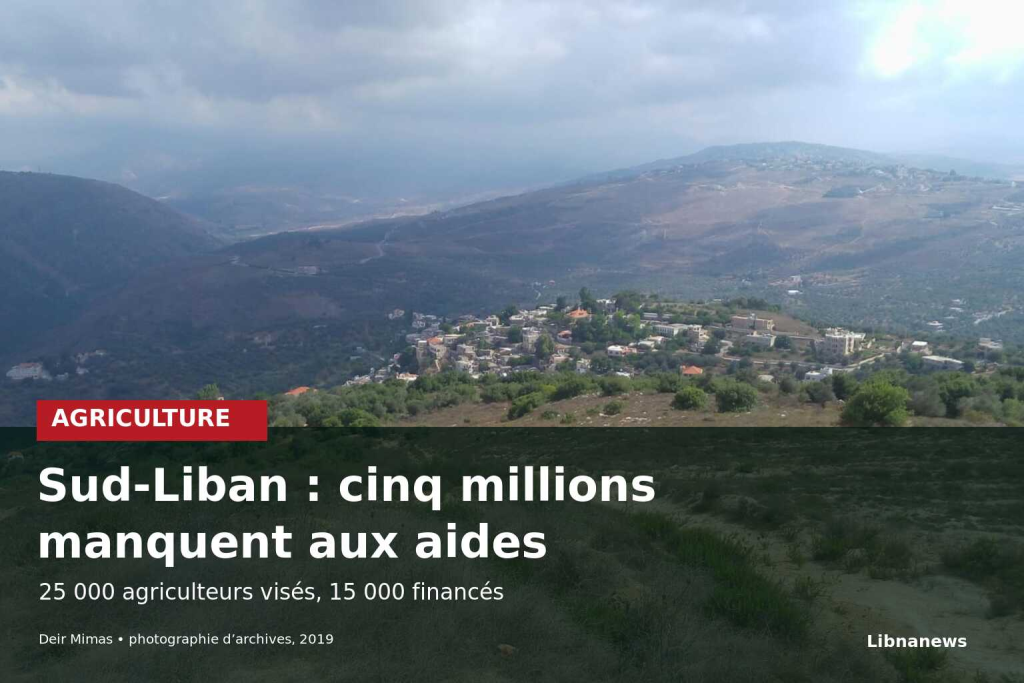
In the emergency plan presented by Nizar Hani, whose amounts had already been exposed on 27 August, the first phase represents $12.5 million. The 7.5 million mobilised must cover 15,000 beneficiaries out of a target of 25,000, or 60 per cent of that envelope. It combines monetary assistance of $400-500 per farmer, support for livelihoods and cooperatives, and paid work. The second phase should cover productive assets and the reactivation of production systems.
The $40 million mentioned on November 9 by Joseph Aoun is associated with specific equipment and accessible land. This announcement does not specify that part of the envelope would fill the five million missing from the emergency window. It therefore does not allow this deficit to be considered to be eliminated or to establish a total of aid already received by farmers.
Both interventions meet different needs. Immediate aid is needed to meet an urgent expenditure. Reconstruction must restore an operation capable of producing: equipment, facilities and means of work. The emergency envelope does not therefore constitute full compensation for agricultural losses.
The number of beneficiaries funded remains a cover objective, not a balance sheet of payments already received. No consolidated balance sheet of individual payments shall accompany the figures reaffirmed by the Minister. For farmers, the payment period counts as much as the envelope: a seasonal expenditure cannot always wait for the end of administrative procedures.
The agricultural register, the obligatory passage of targeting
The course presented by Nizar Hani begins with registration of needs and integration into the agricultural register. Next are the audit, the prioritization of applications and the distribution of interventions among partners. Implementation results must be traced back to the coordination mechanism to identify operators still without assistance and avoid identical interventions on the same file.
Since 19 August, exceptional measures have facilitated registration until 31 December 2027. In non-cadastral villages, the Ministry accepts a Mokhtar certificate certified by the municipality for less than three months, with a plan signed by the neighbouring owners and the area of the land. In the absence of a municipality, the mukhtar certifies the documents in accordance with the conditions laid down.
An old land document can also be accepted in all localities, provided that it is accompanied by the recent electronic certificate provided via LebanonPost. Other documents in the file remain required. The Ministry’s regional departments and agricultural centres are responsible for guiding farmers and verifying documents. Registration facilitates access to programmes; it is not a payment decision.
In Kfar Kila, bringing the registration of internally displaced persons closer
The displacement of families complicates the census. On 11 September, during a meeting with a delegation from Kfar Kila, the Minister announced mobile registration days in the locations of displaced farmers. The operation must be organised with the mukhtar and the Nabatiyah agricultural service. The municipality and the mukhtar must receive a list of registrants to assist those whose procedures are incomplete.
The delegation also requested permission to access land between Kfar Kila and Deir Mimas, including preserved olive groves. The Ministry referred to coordination with the army and the ceasefire monitoring mechanism. Nizar Hani reported that some previous approaches had allowed access to crops, while others had failed.
This constraint reduces the scope of financial support. Without access, an operator may lose a crop on a still productive plot. Conversely, returning to his land is not enough if the equipment has been destroyed. Financing, authorisation of access and timetable of agricultural work must be joined to allow the resumption.
Targeted aid for 465 farmers
On 21 October, the Ministry and FAO announced a separate intervention of approximately $140,000 for 465 vulnerable farmers in the South and Nabatieh. Each recipient is required to receive $300 for expenses such as forage, veterinary care and inputs required to continue production.
This aid is targeted at small Lebanese farmers who are still active in the dairy sector, especially those who hold large ruminants in production and have been directly affected by the hostilities. FAO points out that the sector supports more than 13,000 farms in Lebanon. The cost of animal feed and limited access to veterinary services already weighed on them before the additional effects of the conflict.
The 465 beneficiaries of this intervention do not automatically add to the general programme target: the two areas may overlap. For rural families, these ad hoc aids preserve the means of production that are still usable. They alone do not fill the $5 million that is missing from the contingency plan.





Comments