


World markets are trying to regain ground on Monday, November 9, 2026. Tokyo bounced, Wall Street opened up and oil fell. But this respite does not solve the question that goes through finance: at what price do the investments promised by artificial intelligence cost? The results of Constellation Energy and European announcements show that projects are moving forward. However, their profitability depends on the availability of electricity, construction deadlines and credit.
The contrast gives its consistency to this day. A drop in the barrel can alleviate the costs of importing companies. A raise in shares can facilitate a raise in capital. However, none of these movements guarantees that a data centre will be connected on time or that its revenues will cover its debt. For both investors and businesses, the shift from promises to cash flows becomes a central test.
Data verified until 1846 in Beirut (1646 UTC). Reading points: the courses below are observations of 9 November, taken at different times. Asian fences are distinguished from European and American surveys in session. The ECB’s exchange rates are daily references, not online negotiable prices. An unpublished deadline remains as unknown.
Global markets: still uneven rebound
In Asia, the movement remains mixed. In Tokyo, Nikkei 225 finished at about 58,775 points, up 2.33%, while Topix won 2.97%. Shanghai grew by 0.32%. On the other hand, Hong Kong’s Hang Seng fell by 0.1% and South Korean Kospi by 0.81%. The rounded fences are derived from the RTHK report issued at 5:13 p.m. in Hong Kong at 0913 UTC. The text does not give the exact time of the last course.
This dispersal prohibits talking about a uniform restart of Asian values. A market place brings together different sectors and companies. The weight of component manufacturers, banks or exporters is changing its reaction to the same news. Thus, the increase in a Japanese index alone does not lead to a change of perspective for all AI suppliers.
In the United States, the three major indices opened in the green at 0930 EST, or 1430 UTC. The following surveys show a more marked increase. Nasdaq Composite wins 2.41% at 16:12:20 UTC. This observation concerns a meeting still in progress; it does not prejudge the American closure.
A positive opening after a decline sequence can reflect several behaviours. Some investors buy securities that have become cheaper. Others close sales positions. Portfolios can also change composition without increasing their total exposure to shares. Without detailed flow data, to attribute the rebound to only one of these mechanisms would be excessive.
In Europe, the latest records available before closing confirmation also show gains in Paris and Frankfurt. The CAC 40 point precedes the final fixing; it does not constitute a definitive closure. The table shows the hours of each index. Boursorama displays the hours in French time, i.e. Paris UTC+1 on 9 November; the conversions below are to UTC. The variations refer to the reference of the previous sitting.
| Index | Level | Change | Final exchange, UTC | Provider dissemination |
|---|---|---|---|---|
| ACC 40 | 8 235.50 | +1.19 % | 16h 31 min 15 | Euronext Paris, real time announced |
| DAX | 26 265.56 | +1.72 % | 16:30:05 | XETRA deferred, duration not specified |
| Euro STOXX 50 | 6 291.43 | +1.96 % | 16:09:30 | DJ STOXX deferred, duration not specified |
| Dow Jones | 52 180.46 | +1.74% | 16:20:35 | Index Deferred ex, duration not specified |
| S&P 500 | 7 527.05 | +2.04% | 16h 11 min 14 | CBOE deferred, duration not specified |
| Nasdaq Composite | 25,172.72 | +2.41% | 16h 12 min 20 | Index Deferred ex, duration not specified |
Source: Boursorama rating pages, « last exchange » blocks. Beirut time = UTC+2. The lines are not simultaneous. Even for CAC 40, the term « real time » describes the flow announced by the supplier, not an automatic updating of this article.
To assess the robustness of the recovery, the level of the index is not sufficient. The participation of several sectors, the volumes exchanged and the financing conditions provide additional information. An increase concentrated on a few large capitalisations may mask a more fragile situation for medium-sized enterprises. The equity and credit markets can thus send different signals during several sessions.
Oil drops, without eliminating the risk of supply
At 1427 GMT, or 1627 hours in Beirut, the Brent exchanged US$ 93.27 per barrel, down 5.2 per cent. The U.S. WTI was worth $86.71, down 4.5%, according to Reuters. The first contracts concerned were the Brent of January 2027 and the WTI of December 2026. These are intraday observations of futures contracts, not settlement prices. The technical delay of the quotation is not indicated by the dispatch.
The agency links this relaxation to Donald Trump’s statements reducing the prospect of new American strikes against Iran. At the same time, it reports continuing attacks on navigation near the Strait of Ormuz. The financial response therefore reflects a risk reassessment. It does not demonstrate a sustainable return to normal or the disappearance of threats to shipping.
The price of oil includes expectations of production and consumption, but also the risk of a break. If operators consider a break less likely, this component may decrease rapidly. Physical shipments follow another schedule. Their cost includes freight, insurance, delivery conditions and crude oil characteristics. A contract rated in London or New York does not directly represent an invoice of fuel delivered to Lebanon.
The transmission to consumers involves several stages. An importer purchases refined products, finances its inventory and pays for their shipment. The distributor then sells volumes acquired at different dates. A reduction in crude oil can improve the conditions for replacing stocks without immediately reducing the cost of the stock already held. The movement of the day is favorable to buyers, but its final effect depends on its duration.
Producers and consumers do not win at the same time at a cheaper barrel. For an oil company, it can reduce the value of sales. For a carrier, it can relieve a large load. Hedging contracts further modify this sharing. A company that has set its purchase price is less rapidly benefiting from a fall, but it has also protected itself against an increase. You have to read your commitments before deducting the effect on your profits.
Dollar and euro: distinguishing the reference from the transaction price
The European Central Bank publishes a reference of $1,1193 for a euro by 9 November. The same euro is 176.79 yen, 0.83430 pounds sterling, 0.9164 Swiss francs and 7.4689 yuan. All these values use the euro as a basic unit. They do not represent a dollar-yen quote, nor do they represent a bank’s proposed commercial terms and conditions to its customer.
The ECB’s conciliation procedure normally takes place around 14.10 CET, i.e. 13.10 UTC and 15.10 Beirut. The publication usually takes place around 4 p.m. CET, or 5 p.m. in Beirut. This lag is that of a daily institutional reference, not a delay in stock exchanges. The ECB explicitly advises against its use as a transaction price.
For a Lebanese company invoiced in euros but cashing in dollars, the real risk lies between the order and the payment. An exchange change may change the margin even if the supplier’s price remains the same. The conversion date, bank charges and possible coverage count as much as the rate shown in a table. A common reference facilitates comparison; it does not replace the bank quote.
The dollar is also involved in international financing. A company that borrows in this currency but sells in another carries two distinct risks: the cost of interest and the conversion of its revenues. The second may increase even as the first decreases. This is why a one-off relaxation of the green note is not enough to diagnose a general relaxation of financial conditions.
U.S. employment puts credit cost back to centre
The official report published Friday, November 6, remains an important item of the week. The Bureau of Labor Statistics estimates the increase in self-employment in October at 165,000. The unemployment rate is 4.1%. Creations are concentrated in professional services, health and transport. These figures describe the October labour market, not a measure of activity on Monday.
The same publication provides a nuance: the number of people working part-time for economic reasons increases by 339,000. There are 4.8 million. Additional employment and general improvement in the situation of households are therefore not equivalent concepts. The number of hours, regularity of income and consumer prices complete the diagnosis.
For a central bank, an economy capable of creating jobs gives more room to examine inflationary risk. But an isolated report does not dictate a rate decision. Revisions, wages, prices and credit conditions must be reconciled. Presenting a future increase or fall in rates as acquired would confuse market expectations with an institutional decision.
The effect on technological enterprises depends in particular on the value given to their future profits. When the required yield increases, profits expected in several years are worth less today. Companies already profitable do not react like those that still have to finance their expansion. In the second case, a decline in valuation may make an increase in capital more costly for existing shareholders.
IA: Credit forces to look at revenue
An agency survey published on Monday describes banks and investors more cautious about new AI-related financing. According to interviewees, lenders are more interested in client commitments and construction risks. This observation does not prove a general cessation of funding. It states that projects can no longer be judged solely on the announced growth of their IT capacity.
A data centre incurs expenses before selling all its services. It is necessary to acquire or rent the land, build, install the equipment and obtain electricity. Revenues then depend on the availability of the site and commercial contracts. As a result, a delay in connection with the connection can delay the receipt of receipts while interest and certain charges continue to run. The first problem is that of the cash schedule.
The quality of the client is important, but it does not answer all the questions. Does the contract cover the entire duration of the debt? Does the customer pay a reserved capacity or only its use? Can it terminate if delivery is late? These clauses determine the real visibility of income. Two projects of comparable size may have very different financial risks.
The value of equipment is another variable. A building and a chip do not have the same rhythm of obsolescence. If the processors are to be replaced before the original loan is repaid, the operator must provide a new expense. A positive operating margin can then coexist with a continuing need for funding. Post-investment flows provide better information than turnover alone on this constraint.
The Nvidia folder adds a risk specific to a central player in this channel. In its communiqué of 8 November, the Board of Directors announced an independent investigation related to information on a possible foreign intelligence operation against Jensen Huang. He claims that he has no reason to believe that the group’s secrets or national security have been compromised and maintains his confidence in the leadership. No investigation findings are published.
For economic analysis, this uncertainty of governance must be separated from orders and actually documented deliveries. An investigation is not evidence of a supply disruption. However, it may encourage investors to request more information on internal controls and business continuity. This requirement becomes particularly sensitive when a sector depends heavily on a small number of suppliers.
Constellation: electricity becomes a long-term commitment
Constellation Energy released on Monday a net profit of $5.19 per share in the third quarter and adjusted operating income of $5.06 per share. The group raises and tightens its annual forecast adjusted to a range of $12.50 to $12.80 per share. The adjusted measure is not the standard accounting result: it is based on the reprocessings submitted by the company.
In particular, the press release recalls a 20-year electricity purchase contract with Amazon, covering 690 megawatts and supporting investment in Calvert Cliffs. He also announced a 20-year agreement on 270 megawatts in his Peak+ offer, with a start planned in 2028. These commitments cover powers and durations; they do not constitute already produced volumes of electricity.
This distinction is essential. The megawatt measures a power available at a given moment. The megawatt hour measures energy supplied for a period of time. Judgments, availability and contractual conditions determine what will actually be delivered. Multiplying a power announced by every hour of a year would give a theoretical maximum, not necessarily the production purchased.
A long contract can facilitate an investment by giving the producer greater commercial visibility. For the buyer, it secures part of its needs and sometimes costs. However, both parties remain exposed to implementation: authorizations, works, maintenance and network capacity. The contract organises risk sharing; He doesn’t remove them.
The decline in oil and the demand for electricity in the data centres therefore belong to different markets. Crude is mainly used to produce fuels and raw materials. A computer site needs reliable power supply at a specific location. A cheaper barrel does not automatically resolve a connection queue or a local shortage of transformers.
The physical constraint behind digital projects
The International Energy Agency estimates the global electricity consumption of data centres at 485 terawatt hours in 2025. Its central projection reached 950 terawatt hours in 2030. These are all data centres, not just those dedicated to AI. The 2030 value is a projection, subject to improvements in efficiency and the pace of deployment.
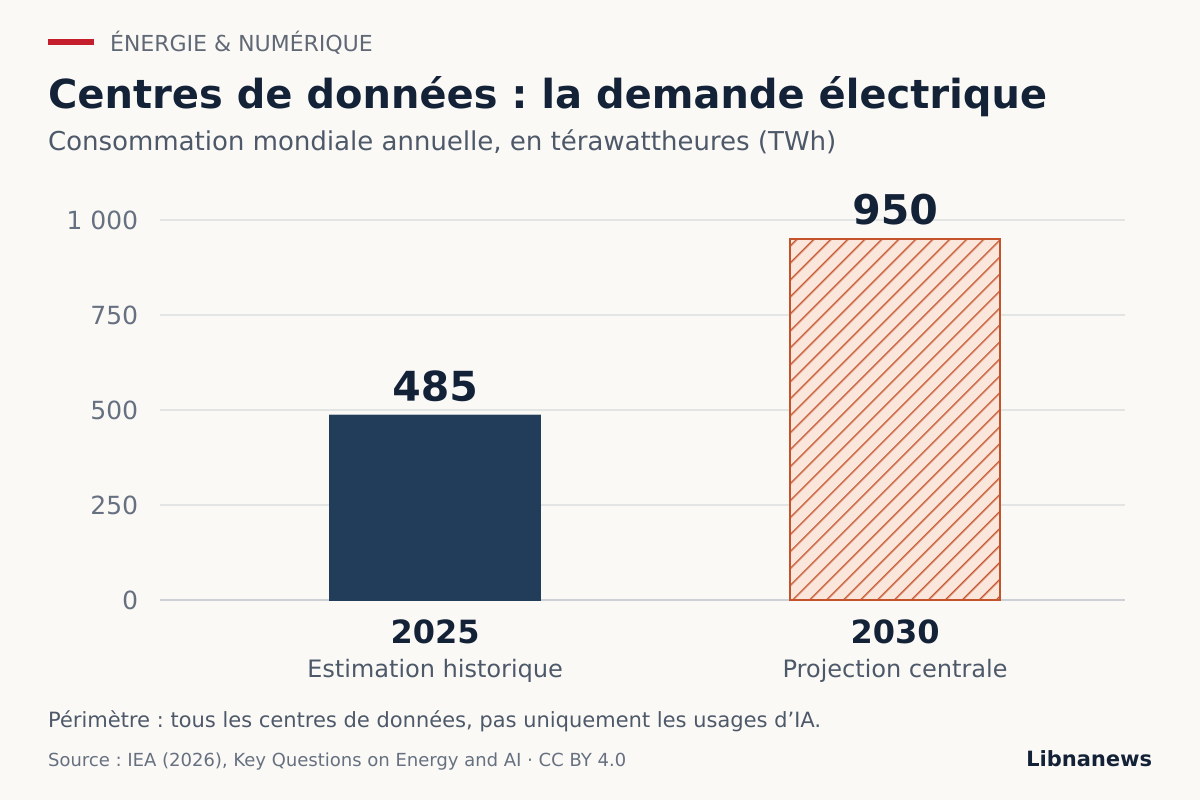
The graph thus compares a historical estimate and a scenario. It does not draw a certain trajectory year by year. This caution changes the economic use of the figures. A manufacturer may use a projection to prepare its capabilities; A lender must also test what happens if demand is growing slower, or if it is concentrated in other regions.
An agency survey published this Monday describes developers looking for used gas turbines and aircraft engines converted to power their sites. It indicates very long delays for new equipment. This use of available equipment illustrates the economic value of time: starting to produce earlier can justify a different solution than the one chosen for its energy efficiency alone.
However, the calculation must incorporate fuel, maintenance and emissions. Cheaper equipment to acquire can cost more to operate. A stand-alone facility also requires authorization and supply logistics. So the choice is not just to buy a machine quickly. It engages the economy of the site for several years.
In Europe, banks and investors are looking for their place
The project presented on Monday by Crédit Agricole provides another example of capital allocation. The group proposes to bring its Italian subsidiary closer to Banco BPM and to hold about 45% of the new set. The operation remains subject to negotiations, votes and authorisations. It does not constitute a merger already carried out or an immediate change in the accounts of customers.
Its announced economic interest is based on the combination of networks and activities, including banking and insurance. In order to assess such an operation, the amount of synergies must be reconciled with the integration costs. The expected savings depend on operational decisions, compatible IT systems and customer maintenance. They only become profits after they have been realized.
At the same time, the European Investment Bank has announced a public and private alliance of more than EUR 10 billion for growing technology companies. It involves fourteen institutional investors and seven Member States. The first investment decisions are expected in the coming weeks. The announcement brings together intentions and commitments; It does not mean that all this money has already been paid.
Capital financing completes the credit here. An expanding company may agree to share its property to avoid too early fixed refunds. The investor receives in return a share of future earnings, with the risk of losing its bet. This mechanism is suitable for certain projects whose revenues remain uncertain. It does not dispense with rigorous selection or a viable business model.
In Lebanon, follow the invoice and actual volumes
For the Lebanese economy, the immediate link with this day is through imports, energy and foreign exchange. A sustainable relaxation of petroleum products could reduce some expenditure. However, its effect cannot be calculated from the only Brent observed on Monday. Imported volumes, refined product prices, freight and purchase contracts should be known.
The port of Tripoli announced this 9 November that it had processed 18,714 containers in October, a record according to its administration. The press release thanks CMA CGM, in particular, without quantifying its contribution. It does not specify whether the total includes physical units or 20-foot equivalents. Nor does it provide the distribution between imports, exports and transhipment.
This announcement measures port activity, not directly an increase in national income. An empty container, a cargo destined for the local market and a transhipment do not have the same fallout. To appreciate the gains, you have to look at local revenues, jobs and services. The volume remains useful, provided that it is not given a meaning which it does not bear.
The same applies to Lebanese companies exposed to global markets. A movement of the dollar or oil affects each one according to its purchases, sales and debt. Without recent and detailed accounts, it would be misleading to announce a specific winner or loser. The parameters to follow remain concrete: payment deadlines, stocks, invoicing currencies and energy availability.
Next test comes with US prices
The official calendar provides for the publication of American inflation on Tuesday, 10 November, at 8:30 am EST. This corresponds to 1330 UTC and 1530 hours in Beirut. The producer price indices will follow Friday, 13 November. These appointments will provide new data, but their results are not yet known.
Their reading should distinguish between monthly variations, annual developments and the most volatile components. A one-time fall in energy is not the same as a sustained slowdown in services. For global markets, the issue will be whether the improvement observed on Monday can be accompanied by more stable financing conditions. Companies engaged in large investments will have to continue to document their revenues, costs and delivery dates.





Comments