

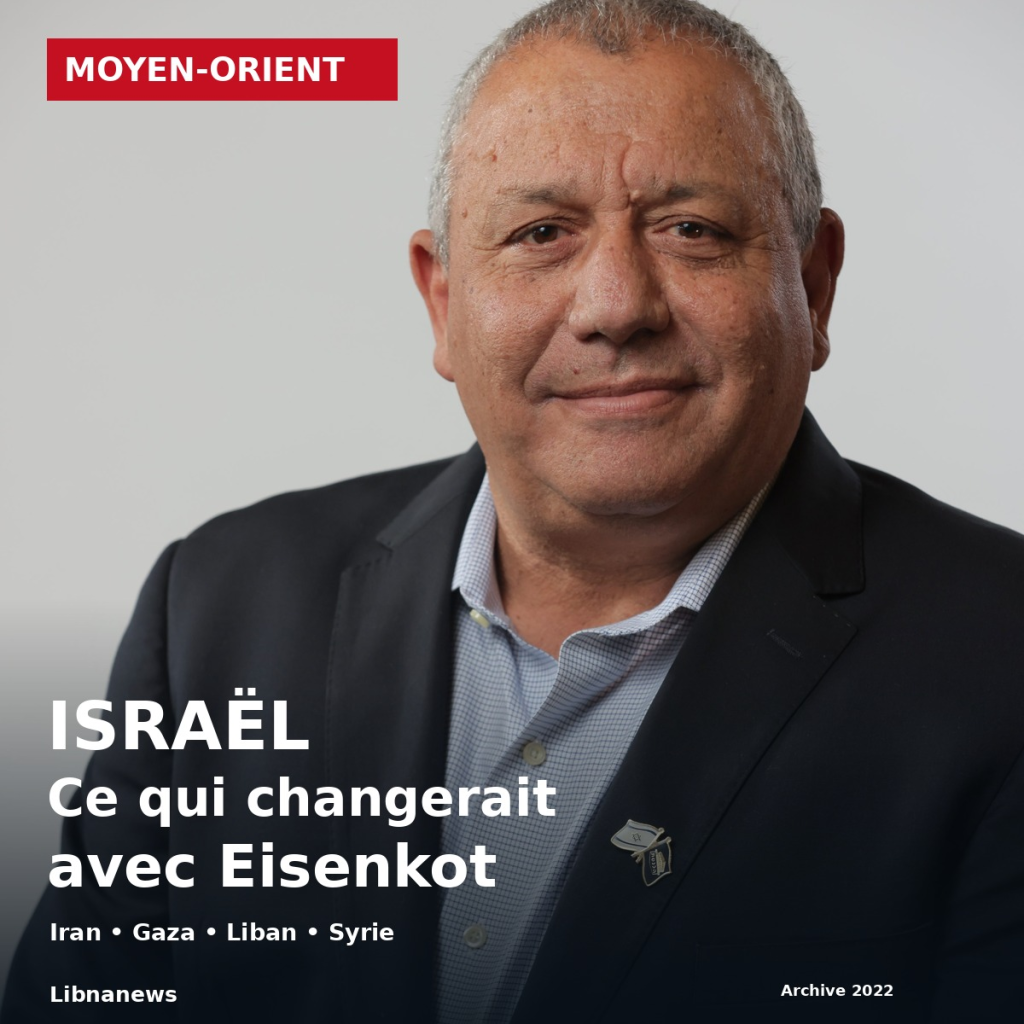
Gadi Eisenkot does not propose to renounce Israeli military power. Its coming to the head of a government would rather shift the way it is used: more coordination with Washington, a search for regional agreements, and a willingness to reduce conflicts with Western partners. For Lebanon, the Palestinians and Iran, an Israeli alternation could therefore change interlocutors and certain decision-making mechanisms without removing military constraints.
President Isaac Herzoghanded over the government’s training mandate to Eisenkot on November 8, 2026. On 9 November, this appointment opened a political negotiation, without any coalition invested or transfer of power. Benyamin Netanyahu remained prime minister until a new executive was set up. However, Eisenkot’s campaign positions identify the files on which an alternation could produce effects, as well as the limitations of these changes.
Iran: Another Way to Build Pressure · Global Voices
The Iranian case most clearly shows the continuity of the objectives and the difference in method. Eisenkot considers Iran the main external threat. In itsoctober 6th interview at the Times of IsraelIt defended joint action with the United States against nuclear capabilities and an intrusive control regime. This is not the programme of an Israeli disengagement from the strategic conflict with Tehran.
The difference appears in how to link threat to military decision. In adeclaration of 31 october, Eisenkot set a limit for the transition: it would only support an operation against a direct, immediate and impossible to delay danger. This formulation challenges a preventive war launched simply because a long-term rivalry remains. It does not exclude an operation considered indispensable.
For Iran, this would mean an adversary who is always determined to prevent a military nuclear capability, but who is more concerned with putting this confrontation in a common American strategy. Stronger coordination could encourage negotiation with controls. It could also make military pressure more organized. Confounding diplomatic coordination and automatic moderation would therefore lead to misreading change.
The determining criterion would be the definition of the objective: to obtain controllable commitments, neutralize a precise capacity or seek a transformation of the Iranian regime. These objectives do not imply the same means or risks. Decisions of a possible government will have to be assessed on this basis, not on the sole personality contrast with Netanyahu.
Gaza: Hamas’s end of power remains the goal
Eisenkot apromised on october 15hamas would no longer govern Gaza within 18 months of its entry into power. He presented two ways: the application of Donald Trump’s framework or the use of military capabilities. He also announced that he wanted to prepare this strategy with the defence officials and present it to the relevant parliamentary committee.
This promise is neither an acquired result nor a guarantee of time. It shows, however, that a change of prime minister would not mean acceptance of Hamas’ continued rule. The issue would move towards the combination of disarmament, civil administration and reconstruction, as well as the identification of actors capable of making these devices work.
For Gazans, useful change would not be measured by the tone of speeches. It would be measured by access to essential goods, security of civilians, conditions of movement and opportunities for reconstruction. A programme that conditions civilian progress to a military outcome must explain how these conditions will be identified and which will assume administrative responsibilities.
It is also a constraint for the Arab States requested. Participating in stabilization or reconstruction involves financial, human and political commitments. They will need to know the mandate, the chain of responsibility and the political perspective. The only disappearance of a personal disagreement with Netanyahu does not provide these answers.
For Palestinians, the obstacle of sovereignty remains
Eisenkot expressed opposition to the establishment of a Palestinian state, a position documented byReuters October 22nd. This position limits the scope of any presentation of its possible government such as the automatic return of a peace process. A preference for a Palestinian administration rather than Hamas in Gaza is not worth recognizing Palestinian sovereignty.
In the West Bank, its commitments, detailed inseptember Jerusalem Post interviewHowever, the impact of violence by Israeli extremists could be concrete if they were translated into decisions: protection of the inhabitants, intervention by the security forces, investigations and sanctions. A change in law enforcement directly affects daily life, even when it does not regulate the political status of the territories.
Two levels must therefore be distinguished. The first is the limitation of violence and unilateral decisions. The second is Palestinian access to a recognized political future. Progress on the former can reduce tensions and improve living conditions. They do not automatically resolve the second.
This distance could become a point of friction with Western partners. A less conflicting Israeli government in its communication would not necessarily receive an agreement on its refusal to accept a Palestinian state. Relationships can relax without substantive differences disappearing.
In Lebanon, the test will be territorial and security
For Beirut, the priority issue will be actions concerning the territory, strikes and security arrangements. Eisenkot commanded the Israeli army and carried an experience directly linked to the Lebanese front. His alternative image of Netanyahu should not be interpreted as the promise of immediate withdrawal or abandonment of Israeli demands towards Hezbollah.
During the campaign, he mentioned the possibility of moving forward with Lebanon as part of a regional initiative under American guarantee. However, this political openness alone does not specify the conditions for an acceptable agreement for Beirut. A guarantee sought by Israel can be seen in Lebanon as a restriction of sovereignty if it maintains a lasting presence or freedom of foreign intervention.
On 8 November, the Yashar party announced that it would bedenied claims broadcast on Channel 14that Eisenkot is already negotiating with foreign interlocutors an Israeli withdrawal from Lebanon. These talks cannot therefore be presented as engaged. The hypothesis of a future initiative must be distinguished from ongoing negotiations.
The international calendar makes this issue particularly concrete. Thesecurity Council resolution 2790uNIFIL last extended its mandate until 31 December 2026, prior to its withdrawal in 2027. The possible change of Israeli government would therefore take place at a time when the question of monitoring the Blue Line and support for the deployment of the Lebanese army after the mission arose.
This issue cannot be resolved by a simple personal relationship between Heads of Government. It requires verification mechanisms, identified responsibilities and applicable commitments. In particular, the UN text recalls the request for Israeli withdrawal from Lebanese territory and the role of the Lebanese army. The planned departure of UNIFIL does not remove the obligations arising from resolution 1701.
The consequence of an alternation could be a more structured negotiation with the US and international partners. But for Lebanon, the result will be that its sovereignty and the security of its inhabitants are respected, not that there is a new Israeli interlocutor who is considered more frequent abroad.
Syria and the Arab States: exchanging guarantees
Eisenkot referred to the possibility of strengthening security arrangements with Syria based on an American guarantee. This logic is to use a military position to secure political and security commitments. It does not mean that an agreement is concluded or that the parties already accept the same conditions.
The advantage of such an approach would be to define what each party obtains in exchange for specific concessions: withdrawal arrangements, controls, limitation of certain military presences or mechanisms for resolving incidents. Without explicit reciprocity, an arrangement remains a list of unilateral requirements. Washington’s ability to guarantee and enforce commitments would then become a central element.
The same reasoning applies to rapprochement with other Arab States. Security assurances and economic benefits are not always enough to erase the political cost of the Palestinian question. Standardization can be sought by several governments while remaining blocked on the conditions necessary for its internal legitimacy.
Washington will remain the necessary passage
The American coordination announced by Eisenkot implies a concrete dependence: to obtain guarantees, military means and a diplomatic line sufficiently durable to support regional agreements. The U.S. President and Congress intervene in this relationship according to different jurisdictions. Even a rapprochement with the White House would not be enough to secure all financing or deliveries of weapons. For Arab partners, the strength of a guarantee also depends on its ability to survive a crisis between the two allies.
This external constraint joins an internal constraint: the parties that would allow Eisenkot to govern do not necessarily have the same regional policy. Presidential recommendations are not a joint programme. Portfolios of defence, finance and foreign affairs, written coalition commitments and decision-making will be as important as the Prime Minister’s name.
Eisenkot could reopen diplomatic channels and make the Israeli strategy more coordinated, without making it a pacifist strategy. The most plausible changes relate to the method, partners and counterparties sought. The most difficult challenges remain Palestinian sovereignty, territorial guarantees in Lebanon and Syria and the conditions for a controllable agreement with Iran. It is on these dossiers, and not on the only possible end of the Netanyahu era, that an alternation will have to produce results.





Comments