

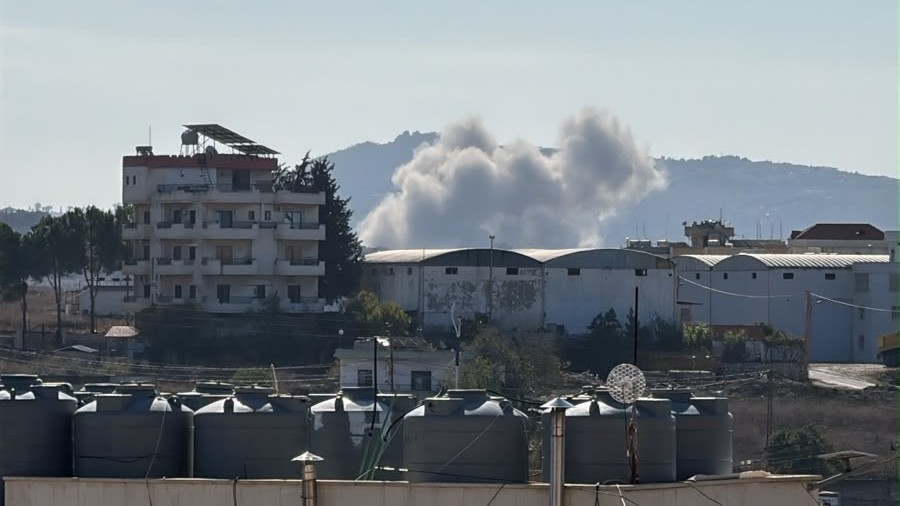
The Israeli army announced on 8 November 2026 that it had found two weapons depots in Meis al-Jabal and an apartment used by Hezbollah in Tiri, near UNIFIL positions. These claims, accompanied by military images, do not constitute an independent verification of the sites or the responsibilities of the United Nations force. They revive a controversy over his mandate within two months of the deadline set by the Security Council.
Three sites presented by the Israeli army
According to the Israeli communiqué, a house and warehouse in Meis al-Jabal were approximately 200 and 100 metres from United Nations positions, respectively. In Tiri, the apartment was reportedly located 250 metres from a post. The announced inventory includes rifles, rocket launchers, ammunition and communication or surveillance equipment. Israel presents these discoveries as a failure of UNIFIL.
The distances and allocation of premises to Hezbollah remain those of the Israeli army. No independent findings of the three sites were found in the items consulted. The publication of photographs and videos makes it possible to document what the army chooses to show; it is not sufficient to establish the exact location, the date of deposit of the equipment, its last user or the information available to peacekeepers.
A geographical proximity, even confirmed, therefore requires additional verification. It does not alone demonstrate that the staff of a United Nations post were aware of, had access to, or voluntarily allowed to operate the contents of a neighbouring building. Conversely, the limitations of this evidence do not allow us to conclude that the weapons announced do not exist. The challenge remains to confront the allegation with the facts on the spot.
UNIFIL recalls the responsibility of both States
In a reaction published on 9 November by Daily Beirut, which reports on an interview with Al-Ain by Kandice Ardiel, the UNIFIL spokesman recalls that the implementation of resolution 1701 is the responsibility of Lebanon and Israel. It stresses that the presence of unauthorized weapons and combatants south of Litani contravenes that resolution, while distinguishing this prohibition from the means entrusted to the mission.
According to reports, UNIFIL does not have the task of forcibly disarming Hezbollah or other armed groups or conducting general searches of private property. Its role is to monitor, report violations and support the implementation of commitments. Kandice Ardiel also recalls that suspicious activities had been reported before October 2023 and that access to the Lebanese authorities was not always granted immediately.
This response addresses responsibilities and means of action. It is not worth authenticating the three sites announced by Israel. Nor is it a technical denial of their content.
Resolution 1701 remains the frame of reference
Adopted in August 2006, resolution 1701 provides, inter alia, that the space between the Blue Line and the Litani River shall be free of armed personnel, military assets and weapons other than those of the Lebanese Government and UNIFIL. The disarmament of armed groups and the exercise of State authority cannot therefore be excluded from the debate on security in the South.
The same architecture is based on the cessation of hostilities, respect for the Blue Line and Lebanese sovereignty. It is not limited to a single obligation imposed on a single actor. The discovery of an unauthorized arsenal, when established, is a subject to be addressed in this context; It does not obviate obligations relating to Israeli operations and the withdrawal of forces from Lebanese territory.
In an interview published by UNIFIL on 10 August 2026, his Deputy Chief Hervé Lecoq stressed the need to implement all dimensions of the resolution, both security and political. It also stressed the usefulness of an international presence capable of reporting the situation to the Security Council and supporting the Lebanese army in restoring State authority.
A mandate that also includes searching for caches
The limitations recalled by the mission do not mean that it would be devoid of any capacity to respond. Resolution 2790, adopted on 28 August 2025, encourages UNIFIL command, in coordination with the Lebanese Armed Forces, to make full use of existing rules of engagement, including to discover tunnels and weapons caches and to respond to obstacles to its freedom of movement.
This clarification is essential in order to assess Israeli criticism: the assessment should cover available information, steps taken, obstacles encountered and follow-up with the Lebanese authorities. The mere presence of a post a few hundred meters from a room does not provide these elements. A survey of specific sites could help to establish the timeline and identify possible failures.
Peacekeepers themselves exposed to attacks
The debate takes place in an environment where mission security remains fragile. On 7 October 2026, UNIFIL announced that several small arms fire had reached one of its positions near Kfarchouba. Impacts had affected the wall, but also housing and vehicles. The soldiers were sheltered and no injuries were reported.
The mission had opened an investigation without designating the perpetrator in the statement. It recalled that attacks against peacekeepers violated the protection obligations of United Nations personnel and could constitute war crimes. This episode, separate from the November 8 announcements, illustrates the risks faced by observation and reporting teams.
In Beirut, Haykal defends the maintenance of the mission
On the Lebanese side, the army commander, Rodolphe Haykal, had defended UNIFIL at a meeting in Yarze on 6 November. The official record presents the mission as a witness to the conflict, tasked with monitoring the implementation of international resolutions and documenting violations and attacks. The general saw it as a reason to maintain his presence.
He had also reaffirmed the objective of extending State authority throughout the territory, while presenting the continuation of the Israeli occupation as the first danger to the country. This statement precedes the statement on Meis el-Jabal and Tiri: it should not be presented as a specific response to these new accusations.
The deadline of 31 December is approaching
Resolution 2790 established the last extension of the mandate on 31 December 2026. It then provides for a downsizing and an orderly and secure withdrawal within one year. The termination of operations on that date therefore does not mean the immediate departure of all personnel and assets from the mission.
The charges on the depots thus fuel two related but distinct debates: what can be established regarding the announced sites, and the mechanism that can ensure the long-term security of the South. In both cases, the restoration of Lebanese authority, the verification of violations and the protection of civilians require documented facts. The images of a party to the conflict do not replace this work.





Comments