

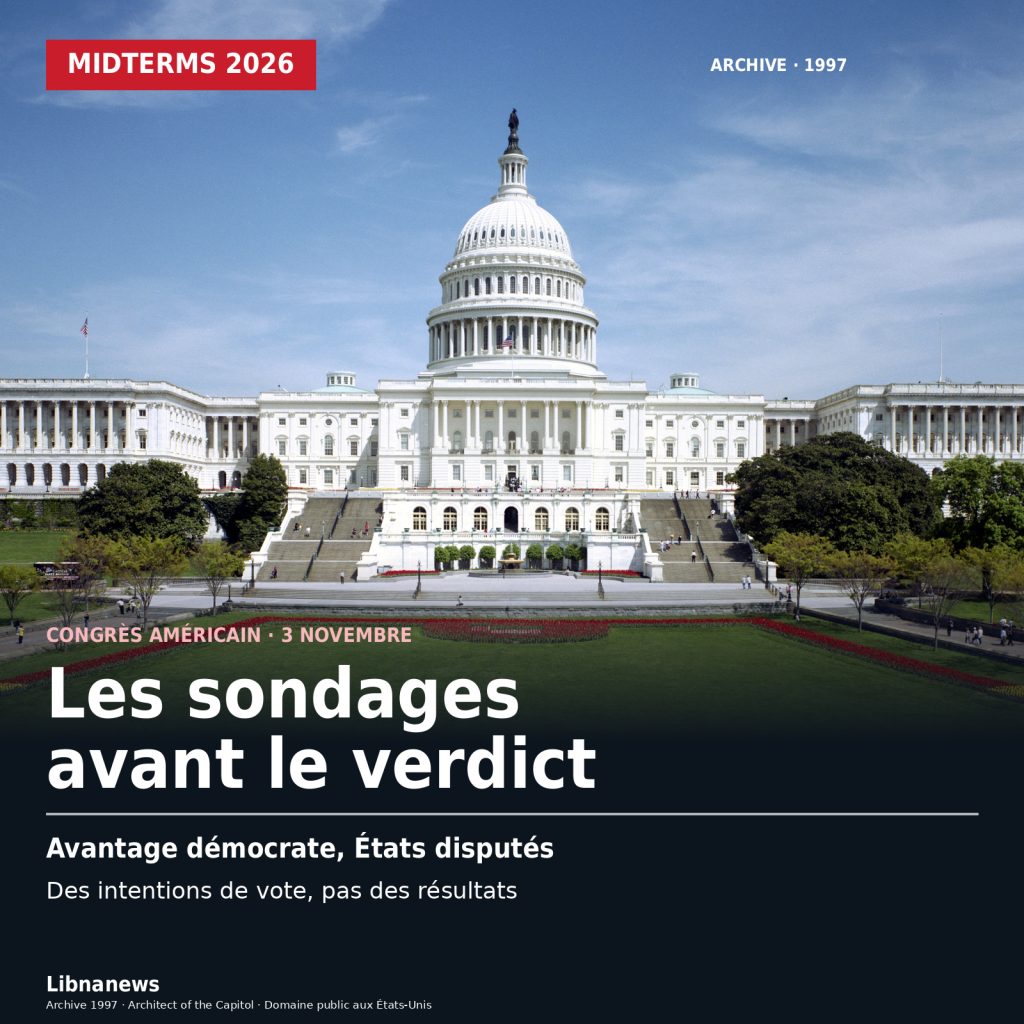
The latest midterm polls in 2026 put the Democrats in a favourable position before the 3 November vote, without guaranteeing them the Congress. The Reuters/Ipsos national survey gives them eight points ahead of the likely voters. The measures published by Siena, however, draw very different power ratios between States. Michigan seems less tight than Iowa, while several Republican seats remain disputed.
This photograph was stopped on November 3, before the results of the election. It describes stated intentions, not stripped ballots. None of the figures presented here constitute a victory attributed to a candidate.
Midterms 2026: eight points at national level
In the Reuters/Ipsos survey, 52% of likely voters choose or favour the Democratic candidate in their constituency. Republicans have 44%. Ipsos interviewed 1,765 adults from 29 October to 2 November. The election result is a sub-sample of 1,212 likely voters, with an announced margin of error of ±2.9 points.
The study uses KnowledgePanel, a probabilistic panel. This population must be distinguished from the only registered population, among which the ratio is 49 to 42 per cent. Mixing the two bases would distort the comparison. Cost of living is at the top of the proposed voting criteria, cited by 50% of adults surveyed.
This national question does not appoint local candidates. It measures a political climate, not an automatic allocation of seats. In the House of Representatives, voters choose their representative in each of the 435 electoral districts. A national advantage can be spread very unevenly between territories.
Seven States, very different
The New York Times/Siena series published on November 1 gives the following intentions for the Senate:
- Michigan:Abdul El-Sayed, Democrat, 53%; Mike Rogers, Republican, 42%.
- Texas:James Talarico, Democrat, 50%; Ken Paxton, Republican, 43%.
- Maine:Troy Jackson, Democrat, 51%; Susan Collins, Republican, 45%.
- Kansas:Adam Hamilton, Democrat, 49%; Roger Marshall, Republican, 44%; David Graham, libertarian, 4%.
- Ohio:Sherrod Brown, Democrat, 49%; Jon Husted, Republican, 44%.
- Alaska:Mary Peltola, Democrat, 48%; Dan Sullivan, Republican, 46%.
- Iowa:Josh Turek, Democrat, 48%; Ashley Hinson, Republican, 47%.
Siena indicates margins of error of ±3.8 points in Michigan, ±3.4 points in Texas, ±4.7 points in Maine, ±4.4 points in Kansas and Ohio, ±5 points in Alaska and ±4.7 points in Iowa. These are the published margins for the completed interviews among the likely electorate.
The detailed dates of the field and the staffing of each survey are not included in the directly searchable press release. The technical sheets to which he refers could not be opened during this verification. These data are therefore not reconstructed from aggregators.
Conquer seats without losing those defended
The interest of this map lies as much in the nature of the seats as in the measured deviations. In Iowa, the Republicans defend the seat left vacant by Joni Ernst. In Kansas, Roger Marshall is looking for his re-election. In Michigan, Democrats must keep Gary Peters’ seat, who is not representing himself.
Michigan is therefore a defence, not a potential gain for the Democratic Camp. A loss in that State would increase the number of conquests needed elsewhere. Conversely, winning one republican seat would not be enough if the party abandoned another.
The Senate has 53 Republicans, against 45 Democrats and two independents who sit with them. The Democrats need a net gain of four seats to reach 51. At 50 to 50, Republican Vice President JD Vance can split the votes. In the House, the majority of a full assembly is 218 elected.
Why an advance is not a certainty
The difference of one point in the Iowa does not allow the candidates to separate firmly. Alaska also has a tight race. However, a margin of error should not be used as a mechanical threshold for the difference between two candidates: the uncertainty of a difference depends on the method of calculation.
Possible errors also exceed sampling. Some voters are less responsive to surveys. Others change their minds or do not vote. Institutes need to estimate who will actually participate. Several surveys can share the same difficulties and make the same mistake.
The figures presented are separate surveys, not an average. An average combines several measures according to selection and weighting rules. However, it does not become an electoral result. A predictive model adds hypotheses: its probability of victory is not a percentage of votes.
The first counts should also be interpreted with caution. The order of returning offices and correspondence votes may temporarily change the appearance of a race. Announcements of winners by the agencies will have to be explicitly awarded and then distinguished from the official certification of results.
Cover: western façade of the American Capitol in Washington, 1997. Photo:Architect of the Capitol / Wikimedia Commons,public domain in the United States. Boxing and graphic dressing Libnanews. Illustration of the Congress, without representation of the vote or the results of November 2026.






Comments