

A larger mission than a simple deployment
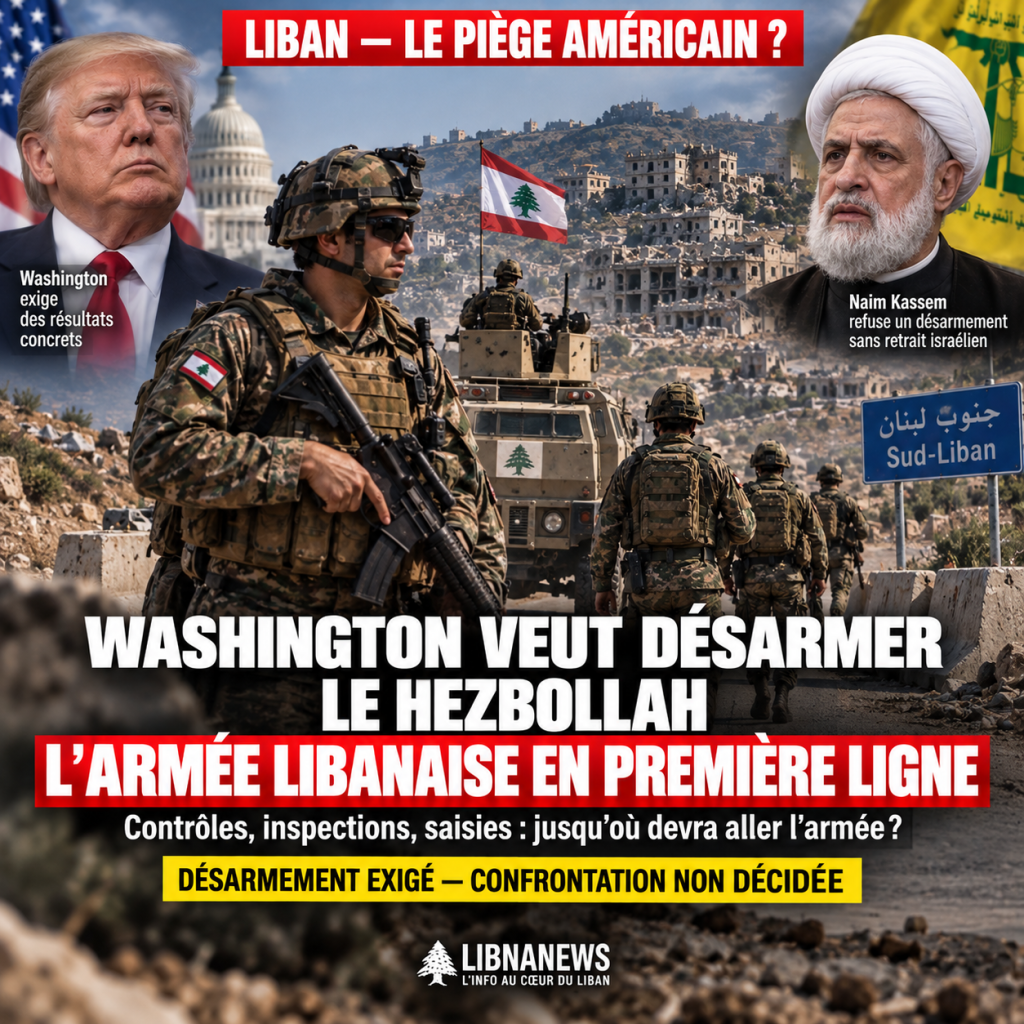
The US pressure on the Lebanese army is not just a demand for additional deployment in the South. US officials demand that the state prevent Hezbollah from reconstructing the military positions and installations destroyed by Israel. The difference is decisive: occupying an evacuated area involves a military presence, while preventing the return of an armed organization involves checks, inspections and sometimes seizure operations. In its October 8, 2026 edition, the press describes an American administration that wants to move from political commitments to observable results. A US official presents the security agreement as a step towards a situation where Lebanese institutions are solely responsible for the territory, weapons and military decisions. However, this is not evidence of an American order asking the army to attack Hezbollah. No operational documents, written instructions and assault schedules are set out in the available information. Rather, the risk of confrontation arises from the gap between the proposed tasks and the absence of a national agreement on their implementation. It is on this gap that the political difficulty of the government of Nawaf Salam is now concentrated.
Former US diplomat Dennis Ross clearly expresses this development. It considers the statements of the Lebanese government to be inadequate and calls for the effective implementation of its written commitments. His argument relates to disarmament, the dismantling of infrastructure and the ban on Iranian-supported groups from resuming positions in sectors affected by Israeli operations. These statements are not the value of a White House decision. However, they illustrate a requirement that is also reflected in the statements given to United States officials: a promise of disarmament only if a mechanism can see its effects. The question is then less abstract than it seems. Who will identify the military sites to be dismantled? Who will find that a deposit is empty or that underground access can no longer be used? How can a legitimate civilian return be distinguished from a military resettlement? The texts consulted do not describe a procedure accepted by all parties. They also do not specify which authority would decide a disagreement between the Lebanese army and an international control mechanism. In the absence of such rules, verification could become a permanent source of challenge, even after a partial Israeli withdrawal.
The territorial paradox of experimental areas
The experimental zone mechanism represents the most concrete part of the proposals examined. In some areas of the South, the Lebanese army would take over security, withdraw weapons from Hezbollah and prevent the reuse of military infrastructure. The idea is to gradually test a device before extending. But there is a contradiction in the conditions attributed to Israel: the Israeli army intends to retain the right to intervene when it considers that a threat is emerging. The responsibility for securing the ground would thus fall to Lebanon, while the decision to use force could remain partially in Israel’s hands. This asymmetry is at the heart of the disagreement. If an Israeli patrol enters an area already under Lebanese control, what authority should manage the incident? If Israel believes that the Lebanese army is acting too slowly, could it strike without agreement? No specific protocol is established in the information consulted. For Beirut, therefore, the challenge is not only to get the departure of Israeli soldiers. It is to ensure that this departure effectively restores decision-making power to the State. An area free of non-State weapons, but exposed to unilateral foreign intervention, would only be in an impeccable position to do so.
The relief of South Lebanon illuminates the scope of the conflict. The heights around Beaufort Castle, the area of Ali al-Taher and the axes leading to Rihane are described as strategic spaces. Their interest lies in the visibility of traffic lanes and the possibilities of movement control. Israel believes that Hezbollah’s Radwan force had prepared operations towards Galilee and wants to prevent the return of offensive capabilities near its border. This justification accompanies a doctrine that favours the prevention of an attack before it is triggered, rather than the response after infiltration. The analysis published on 8 October thus envisages a lasting transformation of the military geography of the South, beyond a succession of point strikes. However, the objective given to Israeli officials must be distinguished from the actual results achieved. The final control of the heights and the extension of the operations towards the Rihane remain hypotheses discussed, not decisions whose execution would be confirmed. For the Lebanese authorities, the consequences go beyond the military domain: the occupied positions and the destruction of housing condition the return of the inhabitants. The deployment of the army will not be enough if the villages remain uninhabitable or subject to access restrictions.
Tampa negotiation and decision-making power
The planned military meeting in Tampa on 20 October should address these issues. Lebanese officials wish to include in the agenda the Israeli withdrawal, particularly around Beaufort Castle, as well as the deployment of the army in the evacuated areas. There are also discussions on audit mechanisms. However, the appointment remains uncertain in the information published on 8 October: its schedule and final maintenance are not confirmed in a uniform manner. An international diplomat described a profound discouragement among Lebanese officials, who felt that they had not obtained the Israeli gestures necessary to advance the negotiations. He also reports that Israeli interlocutors want security arrangements while maintaining freedom of military action. The dispute therefore concerns the order of obligations. Beirut wants withdrawal to make possible an effective national authority. Israel calls for military safeguards before changing its positions. Washington wants verifiable disarmament measures. In the absence of agreement on the sequence, the Lebanese army could be required to produce results before the State regained full control of the land. This is one of the main political risks of the scheme.
Prime Minister Nawaf Salam recalled at the centennial exhibition that decisions on war, peace and national security must be made by constitutional institutions. It also advocated full implementation of the Taif Agreement, not a limited reading of the redistribution of powers. Its reasoning is institutional: a State cannot claim complete sovereignty if fundamental military decisions are not taken. This position is in line with the American objective of strengthening the exclusivity of law enforcement, without proving that the government would have adopted the coercive means desired by some foreign interlocutors. Between a decision in principle and a disarmament operation, several steps remain necessary: defining the sites concerned, organizing responsibilities, establishing procedures and determining the course of action to be taken in case of refusal. The October 8 newspapers do not provide any detailed government military plan or public order prescribing direct confrontation. Assimilating Salam’s speech to an instruction to attack Hezbollah would therefore confuse a political orientation with an operational decision. This difference also protects the analysis of overinterpretations: the objective of a state monopoly of force is explicit, but its method of application remains disputed.
The political and material limits of the army
Hezbollah, led by Naim Kassem, refuses to treat its arsenal as a matter detached from the Israeli presence and threats on Lebanese territory. Its officials favour an internal dialogue and contest the imposed timetables from outside. This disagreement is not just about a date for the handing over of weapons. It contrasts two sequences: proponents of prior state control consider that disarmament will facilitate stabilization; Hezbollah maintains that withdrawal and security guarantees must precede any decisive change in its capabilities. The army alone cannot resolve this political divergence. An inspection carried out in an abandoned area does not present the same risks as an seizure against combatants who refuse to hand over their equipment. The first case may be subject to traditional territorial control; the second could cause a confrontation. There is no evidence that this second scenario was ordered. However, verification requests, if implemented without agreement on the modalities, increase the risk of friction. The challenge for the military command is therefore as much to define an achievable mission as to preserve the cohesion of the institution in a divided political environment.
One often overlooked element concerns means. Reports indicate advanced training conducted by the Lebanese Armed Forces with more than seven countries, including on land and air missions. This cooperation can improve operational skills, but it does not alone demonstrate that the institution has all the equipment and resources needed for an enhanced presence in the South. Ongoing monitoring requires staff, communications, travel and maintenance capacity. It also requires coordination procedures with civilian authorities, particularly when the areas concerned are destroyed or partially deserted. Newspapers do not provide a complete breakdown of the costs, equipment delivered or the number of soldiers assigned to each mission. It would therefore be artificial to conclude that training programmes are sufficient to make an extended disarmament mechanism immediately applicable. Lebanese officials must also take into account other military missions, including border surveillance and internal security. The multiplication of tasks, without precisely identified funding, could undermine the continuity of control sought by Washington.
Security risks beyond Hezbollah alone
The discovery of a shipment of explosives on the Syrian border illustrates this diversity of threats. The published information refers to 245 kilograms of trinitrotoluene, four ready-to-use equipment, eight detonators and cables for firing. The carriers reportedly fled to the Syrian side on the arrival of a Lebanese patrol. No consignees were identified in the items examined. It would therefore be unfounded to present this seizure as a Hezbollah operation or as evidence of a planned destabilization related to the Tampa negotiations. The journalist who reports the case himself asks questions about the intended use of the cargo, without providing an established answer. The Syrian authorities are described as willing to cooperate in identifying the routes and persons involved. The incident shows above all that border control remains an important mission at a time when international expectations are focused on the South. At the same time, an institution responsible for monitoring borders, preventing trafficking and controlling old military infrastructures must prioritize its resources. This practical constraint counts as much as diplomatic declarations in assessing what can really be demanded of the army.
The future of the international presence in South Lebanon adds additional uncertainty. Lebanese officials call for the continuation of UNIFIL or the examination of alternative options to avoid a security vacuum. European possibilities are mentioned, but no definitive arrangements are established in the 8 October information. The issue is directly related to disarmament: international forces participate in monitoring, information exchange and coordination in a region where incidents can rapidly degenerate. Their reduction without a replacement mechanism would increase the burden on the Lebanese army. However, the mission envisaged by Washington requires precisely lasting and verifiable control. It would therefore be necessary to determine who receives the reports, who finds a violation and how a challenge is resolved before it causes a strike. These procedures are essential in an environment where Israel wants to maintain a capacity for intervention. Without accepted rules and without identified interlocutors, a simple divergence of appreciation over a suspicious movement could create an incident. The strengthening of Lebanese authority thus requires diplomatic and technical arrangements, not just more patrols.
Direct confrontation is not an established decision
The facts show real US pressure for the dismantling of Hezbollah’s military infrastructure and enhanced control by the Lebanese army. They also show that the proposals for experimental zones face the Israeli will to preserve freedom of intervention. The Lebanese authorities are calling for an effective territorial withdrawal, while Hizbullah is refusing disarmament imposed independently of security assurances. On the other hand, the documents under review do not suggest that Washington ordered the Lebanese army to attack Hezbollah, nor that the government of Nawaf Salam has adopted an internal confrontation plan. No specific operational ultimatum, public target list and forced seizure schedule are established. This boundary between facts and assumptions does not reduce the seriousness of the case. It specifies its nature. The danger arises from a mechanism that could require the army to enforce contested obligations in territories where the State does not yet have a fully recognized authority. The decisive question therefore is not only whether disarmament is required, but who negotiates its conditions, who controls their implementation and what safeguards protect military and people alike.





Comments