

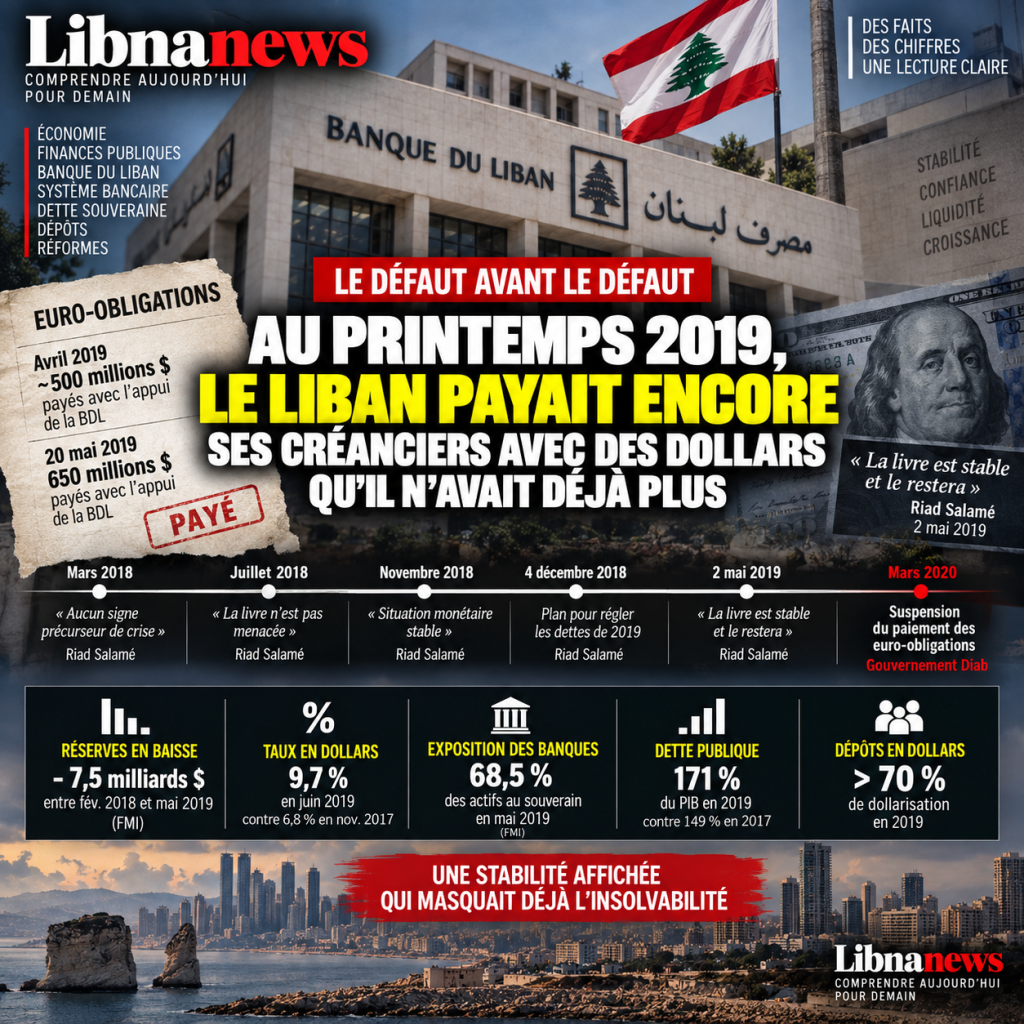
On May 20, 2019, everything still seems to work
On 20 May 2019, Lebanon reimburses 650 million dollars of Eurobonds. For the holder of the title, history stops there: money arrives, at maturity, and Beirut is not in default. In press releases and market screens, the country therefore continues to belong to the world of States that pay their debts. The book is officially worth 1 507.5 for a dollar. Banks normally open. Depositors can still look at their balances in dollars without imagining that they will soon become almost impossible to withdraw.
But behind this payment is already the bulk of the upcoming crisis. The 650 million is not normally found by the Department of Finance. The Bank of Lebanon provides it with currency. A month earlier, approximately $500 million had been settled on the same basis. In two months, approximately $1.15 billion in external debt was therefore honoured while the Consolidated Revenue Fund depended directly on the central bank to obtain the necessary dollars.
It’s not a defect yet. It may be more interesting: this is the time when the appearance of payment and the reality of solvency start to tell two different stories. The creditor is paid. The state already does not have a normal capacity for external financing. The Bank of Lebanon buys time, and this time is paid with the resources of a banking system that itself depends on deposits.
A year earlier, the message was reassuring
It is necessary to come back in March 2018 to understand why this May 2019 scene could pass almost normally. Riad Salamé then spreads the speeches of bankruptcy. The balance of payments is positive over the first two months, deposits are increasing and the Central Bank’s foreign assets are increasing. The governor claims that there is no warning sign of a crisis. The problem in his account is elsewhere: the budget deficit and the failure of the state to reform.
This diagnosis contains a truth that no one can seriously deny. The Lebanese state spends too much, collects badly, accumulates the debt and lets electricity swallow billions. Yet, at the same time, another fragility is growing within the system that is supposed to compensate for these failures. Deposits are slowing down. Rates are rising. The Bank of Lebanon must offer more to attract bank dollars. Its gross reserves remain large, but its commitments to the banking sector are also increasing.
The disagreement that will then go through the entire crisis is already there. For the advocates of the model, the Central Bank and banks are the bulwark that allows the country to survive the mismanagement of the state. For their critics, the rampart is becoming itself a source of danger. The same dollars are used to defend the book, finance the state and reassure depositors. As long as they continue to enter, no one is obliged to choose between these three promises.
The IMF had described the mechanics as early as 2016: bank deposits, attracted by high rates, exchange stability and diaspora transfers, simultaneously finance the state and the external deficit. With declining direct investment, continued deposits become the main source of capital. A slowdown in flows therefore directly threatens reserves and parity.
The risk is amplified by bank exposure to the sovereign. As of June 2016, government securities account for approximately 28 per cent of bank assets and excess deposits and reserves with the Bank of Lebanon about 40 per cent. The combined exposure exceeds six times the first-class equity. Stability is already based on exceptional interlinkages between banks, central bank and state.
July 2018: the book « is not threatened »
On July 11, 2018, Salamé states that the book is stable and is not threatened. It describes a comfortable situation, highlights the increase in deposits and hopes a growth of 5%. It also calls for improved perception of Lebanon abroad. The communication thus combines exchange rate stability, deposits and market confidence.
However, the IMF is already projecting a decline in its non-gold and encumbered assets, from $40.6 billion in 2017 to $37.5 billion in 2018 and $33.7 billion in 2019. The current account deficit is close to 25% of GDP and the dollarization of deposits is approaching 69%. The question is not whether the book holds that day: it holds. It is about how much it costs to maintain it and how long the necessary dollars can continue to enter.
November 2018: declared stability, declining currencies
On 26 November 2018, after a meeting with Michel Aoun, Salamé still ensures that the monetary situation is stable. This statement comes at a time when the Bank of Lebanon’s foreign currency assets decreased by approximately $1.67 billion in the first half of the month. The currency cushion therefore erodes when the official message insists on stability.
The contradiction is less in the immediate finding than in the definition used. For the Bank of Lebanon, stability means first and foremost that parity and the banking system hold. For a solvency analysis, it is also necessary to measure the cost of this stability, accumulated foreign currency liabilities and dependence on new deposits.
4 December 2018: BDL promises to settle 2019 debts
An official statement of 4 December is particularly revealing. After a meeting with the Minister of Finance, Salamé explained that a plan would attract funds to state issues. He claims that the banking sector’s capabilities, obtained in particular through the financial engineering of the previous three years, will help to organise the settlement of domestic and external debts in 2019. It also ensures that the exchange rate and credit will remain stable.
He himself describes the circuit: the Central Bank received deposits in dollars from banks and granted them deposits in books; certain receivables must then be converted into Treasury bills at market rate. Public financing therefore already depends on a circuit organised by the Central Bank rather than on normal access from the Treasury to investors.
Early 2019: the balance sheet is said to be stable, but the BDL replaces the market
Salamé announces that financial operations will continue in 2019. He claims that the balance sheet of the Central Bank remained stable despite the turbulence and that it has sufficient currency to maintain the pound and meet the government’s needs. He explains how to keep external assets rather than increase them.
Meanwhile, commercial banks reduce their participation in regular Treasury financing. The Bank of Lebanon buys more public debt while paying heavily the dollars banks place at home. The Central Bank therefore gradually becomes the intermediary between the banks and a state that the market is financing less and less.
may 2, 2019: « the book is stable and will remain stable »
On May 2, 2019, Salamé told Baabda that the book is stable and will remain stable. It ensures that the Bank of Lebanon has all the capacity to maintain this stability. A few weeks later, the external maturity of $650 million is actually paid. But it is thanks to the dollars provided by the Central Bank to the Ministry of Finance.
The visible result therefore confirms the short-term discourse: the book holds and the creditor is paid. The underlying mechanics tell something else. The Treasury no longer normally has the necessary currencies and the Bank of Lebanon replaces it. Stability exists, but it is financed by a transfer of risk to the balance sheet of the Central Bank.
April and May 2019: $1.15 billion paid with BDL support
The May deadline is about $650 million. Informed sources confirm that the Bank of Lebanon provides funds to the Ministry of Finance in the form of a bridge loan. They state that the April deadline of around 500 million had followed the same pattern. The holders are paid: there is therefore no legal default. But $1.15 billion in successive terms depend directly on the Central Bank.
The IMF then confirms that the mechanism is broader: euro bonds maturing and all external interest payments are settled by the Bank of Lebanon on behalf of the Government. The counterparty is a negative balance in Treasury currency with the Central Bank and a zero-rate bridge loan. The May payment is therefore no exception; it is the visible expression of a system already installed.
June 2019: « Government solvency is not at stake »
In June, Salamé still claims to have no problem with the repayment of euro bonds of the year and believes that the government’s solvency is not at stake. He indicated that the Ministry of Finance and the Central Bank preferred not to issue new dollar debt as long as visibility remained low, but added that the country had liquidity. When asked about diaspora transfers, he said that the Bank of Lebanon would close the gap if they were not enough.
This answer summarizes the core of the model: if private dollars are missing, the Central Bank fills the gap. But it is not an external source of currency. It itself obtains these dollars mainly from the banking system, therefore from depositors. Lack of funding is not removed; it is converted into a debt of the Central Bank to banks.
What the IMF sees at the same time
In July 2019, the IMF’s diagnosis contrasts with the capacity story. Reserves have decreased by approximately $6 billion since the beginning of 2018 in the mission communiqué; the full report figures the decrease to more than 7.5 billion between the peak of February 2018 and May 2019. Deposit growth in 2018 is the lowest since 2005. Dollarization exceeds 70%. Credit to the private sector is declining and unproductive loans are increasing.
Government securities account for approximately 14 per cent of bank assets and deposits with the Bank of Lebanon for 55 per cent. The combined exposure to sovereign wealth amounts to 68,5 % of assets, i.e. more than eight times the first-class equity. Banks earn $2.7 billion in additional interest income in 2018 on their accounts, mainly with the Bank of Lebanon, stabilizing their profits around $2.2 billion despite a weak economy.
Banks earned more from BDL as credit fell
These figures explain why bank profitability could temporarily survive economic deterioration. Interest on investments with the Bank of Lebanon offsets the weakness of private credit and the increase in doubtful debts. Bank profitability therefore does not prove that the economy is sound; It is increasingly dependent on the remuneration offered by the Central Bank.
The conflict of incentives is obvious. Placing dollars with the Bank of Lebanon at high yields becomes more attractive than financing businesses in a stagnant economy. Banks reduce their private credit while their exposure to the sovereign increases. The Central Bank obtains the necessary dollars for parity and state financing, but pays a growing price to attract them.
Gross reserves against net position: the blind corner of speech
The official communication often insists on the high level of gross reserves. The number is real, but incomplete. The IMF points out that financial transactions simultaneously accumulate foreign currency liabilities to banks. Reserves fed by dollars borrowed from the banking sector do not provide the same protection as a stock of currencies free of corresponding liabilities.
This is what makes it clear how the Bank of Lebanon could still pay while weakening. It did have available short-term funds. However, some of these resources corresponded to obligations to banks. Using them to finance the Treasury gradually transformed the explicit public debt of the Central Bank into a debt to the banking system.
Legal failure in 2020, financing incapacity long before
On 7 March 2020, the government announced that it would not pay the Eurobond of $1.2 billion due on 9 March. On 23 March, he suspended payment of all euro-bonds in foreign currency. This is the legal break: for the first time, creditors are no longer paid according to the conditions laid down.
But the economic breakdown is anterior. As of 2019, the market no longer normally finances external debt, the Bank of Lebanon pays maturities and interest on behalf of the government, reserves decline and banking exposure to the sovereign approaches 69 per cent of assets. March 2020 therefore does not create insolvency; it ceases to mask it by the balance sheet of the Central Bank.
Why the account « the defect created the crisis » is incomplete
The default of March 2020 aggravated financial isolation, reduced the value of euro bonds and created additional losses for their holders. He can be criticized for his lack of preparation and for failing to immediately undertake an orderly restructuring. But chronology prevents it from being the original cause of the crisis.
Continuing to pay would have required continuing to get the dollars somewhere. In 2019, the response was already the Bank of Lebanon. Therefore, extending payments would have extended the transfer of Treasury bonds to the balance sheet of the Central Bank and, behind it, to banks and their depositors. The real issue is not only why Lebanon failed in March 2020. This is why the system continued for months to present as solvent a State whose foreign debt service was already dependent on the Central Bank.
What the BDL bought: time, but not a solution
The Bank of Lebanon’s strategy did indeed buy time. The creditors of April and May 2019 were paid, parity held and the state avoided immediate restructuring. This time could theoretically lead to deficit reduction, electricity reform, exchange rate adjustment or negotiated restructuring.
These adjustments were not made in time. Deficits persisted, flows returned and the cost of stabilization increased. The mechanism designed as a bridge to reform has become a means of prolonging a model whose source of dollars was tarnishing. The gap between what the Bank of Lebanon said and what the data showed is therefore not only due to a forecast error. It is based on two different readings of stability: the ability to avoid a break-up today, and the ability to finance this failure to break up in the future.
Ghobril: see state disease without seeing banks’ disease
Nasib Ghobril occupies a special place in this chronology because it allows us to understand the dominant reading of a part of the banking sector before the collapse. The chief economist of Byblos Bank did not describe a healthy economy. He criticized debt, deficit, weak growth, the cost of the public sector, the lack of reforms and competitiveness problems. He believed that Lebanon could have avoided part of the slowdown if the leaders had given priority to fiscal and structural reforms. But this severe criticism of the state accompanied a much more reassuring judgment on the financial system. In 2018, Ghobril claimed that the banking system remained resilient and had high levels of liquidity, supported by loyal depositors and generally stable diaspora transfers. The pound was presented as stable and anchoring the dollar as sustainable thanks to foreign currency reserves.
This separation between a failing State and a sound banking system is central. However, the data showed that both were already deeply intertwined. Banks had transferred an increasing share of their resources to the Bank of Lebanon. Their exposure to government and the Central Bank was increasing. The returns on these investments supported their profits at a time when credit to the economy was declining. The liquidity of the banking sector could no longer be analysed independently of that of the Central Bank. To present the banks as resilient was to assume that their claims on the BDL and the State would remain liquid and repayable. It was precisely this hypothesis that would collapse.
When the crisis breaks out, the reading grid does not change
When the banking crisis became visible in autumn 2019, Ghobril did not fundamentally change its hierarchy of responsibilities. In November, he considered it unfair to hold banks responsible for the crisis. He claims that the banking sector has assumed for years the stability of public finances and therefore part of social stability. He called on the executive to take responsibility for reducing the structural deficit. The declaration extends the 2018 grid directly: the state is the source of the problem and banks are the mechanism that has delayed its consequences.
This reading will then become one of the axes of the Association of Banks. The institutions allegedly collected the deposits and placed them in a regulated framework with the BDL and the State; the loss would therefore result mainly from the public use of these resources. This thesis contains an important part of reality: public deficits and their financing have played a central role. But it leaves the banks’ own responsibility for the concentration of risk, the desired returns, the distributed profits and the decision to continue to transfer customers’ dollars to the Central Bank as the price of these dollars increased rapidly.
What we could read before banks closed
Libnanews archives separate contemporary alerts from subsequent reconstructions. On April 5, 2019, the site reports criticism of financial engineering by the Minister of Economy Mansour Bteish. He questioned their cost to the economy and the Treasury and questioned a policy aimed at preserving the stability of the pound at all costs. The article recalls that these operations had already been criticized by international institutions. This publication comes before banking restrictions, before demonstrations in October and before sovereign default. It therefore establishes that the cost of monetary policy was publicly discussed before the visible collapse.
In May 2019, Libnanews is also following the Eurobond issue. A $2.5 to $3 billion issue planned around the 20 May deadline is postponed. The repayment of 650 million is ensured with the support of the Bank of Lebanon. Again, the fact that the Treasury needs the Central Bank to provide its foreign service is not a reconstruction invented after 2020. The information is available as the state continues to be presented as capable of fulfilling its commitments. This gap between legal payment and incapacity for autonomous financing is the core of the « fault before default ».
Do not rewrite history with what we know today
More structured analyses published after collapse should be treated differently. Libnanews then finds the beginning of the crisis in 2018, the reversal of financial flows as early as January 2019 and the visible shortage of dollars during the summer. This chronology is consistent with IMF data, the decline in reserves and the slowdown in deposits. But it also benefits from information that became more complete after the crisis: audits, detailed changes in balance sheets, extent of losses and more accurate knowledge of the Central Bank’s liabilities.
This distinction reinforces the investigation. It makes it possible to say exactly what was known in spring 2019: the cost of engineering was disputed, the Treasury faced difficulties in issuing new Eurobonds, the BDL provided the currencies needed for repayments, rates were rising and reserves were declining. Subsequent audits add the exact depth of the hole and the methods used to defer recognition. It is therefore not necessary to rewrite history to show that the signals existed.
Nearly 10% in dollars: a rate that should have worried
The increase in the dollar reference rate from 6.8% in November 2017 to 9.7% in June 2019 is an essential signal. In an international environment where dollar yields are much lower, offering nearly 10 per cent means that the system must pay a lot to convince capital holders to stay or bring in new currencies. High yield is not a creation of wealth. It is a promise of future payment and, in finance, normally pays a higher risk. Banks can present these returns as an advantage to depositors; their level also reveals the increasing tension on the resource in dollars.
The mechanism becomes self-strengthening. Attracting dollars requires higher rates. These rates increase the future commitments of the Bank of Lebanon and banks. To meet these commitments, the system needs new dollars. The higher the cost, the more the real economy suffers from higher credit prices. The IMF is already seeing a contraction in private credit and an increase in unproductive loans. The policy that protects short-term parity therefore helps to weaken the productive capacity that should, in the long term, generate the necessary currencies.
Beneficiary banks in a suffocating economy
In 2018, banks earn approximately $2.7 billion in additional interest income on their accounts, mainly from the Bank of Lebanon, compared to the previous year. These revenues maintain a net profit of around 2.2 billion despite a weak economy, heavier taxation, rising bad debts and declining private credit. This paradox is fundamental: the banking sector can show profits at the very moment when the economy it is supposed to finance is deteriorating.
The reason lies in the nature of the income. Banks earn more by placing their resources with the Central Bank. The latter pays to obtain the necessary dollars to maintain parity and to finance the State. Bank profits thus become partly the product of the system’s foreign exchange requirement. Presenting them as proof of resilience without analysing their origin amounts to confusing accounting profitability with economic strength. When the principal debtor is the Central Bank itself, the value of these profits ultimately depends on its ability to meet its commitments.
The bet on the diaspora had a limit
Before the crisis, the loyalty of depositors and the diaspora is often presented as one of Lebanon’s structural advantages. This confidence has indeed provided currency for decades. But turning private behaviour into a solvency guarantee is a problem. No depositor is obliged to leave his dollars in the system if the perceived risk increases. The increase in rates shows precisely that loyalty must be paid more and more.
When returns rise, the system implicitly recognizes that trust is no longer free. Financial engineering seeks to prolong this relationship by paying banks and, indirectly, depositors more. As long as flows continue, the model can be presented as resilient. When they slow down, the same architecture becomes vulnerable. Trust is therefore not permanent capital; It is a variable that can quickly turn around, especially when depositors understand that the dollars in their accounts have been reinvested in a sovereign complex in difficulty.
1 507.5: the figure that satisfied everyone
For years, the stability of the pound around 1,507.5 for a dollar has become a symbol of the Bank of Lebanon’s success. As long as this official rate holds, monetary policy can be presented as effective. However, this focus masks the cost of parity. A fixed rate requires reserves or capital inflows when the country imports much more than it exports and accumulates a current account deficit of over 20% of GDP.
As competitiveness deteriorates and the need for dollars increases, defending the rate requires more intervention and higher returns. Parity then ceases to be only an anchor of stability; It becomes a constraint that aspires financial resources. The criticisms of 2019 against keeping the book at all costs are aimed precisely at this mechanism. The fact that parity lasts until summer does not demonstrate that the system is healthy; it demonstrates that the Central Bank continues to pay the necessary price to prevent its breakdown.
May 2019: Paying was already the proof that one could pay
The May deadline is an almost perfect test. If the State is normally solvent, it must be able to mobilise foreign exchange through its revenues, own reserves or market refinancing. However, the proposed issue is postponed and the Bank of Lebanon provides the dollars. Payment is legally successful but fails as a test of financial autonomy of the Treasury. Therefore, the term « fault before default » must be handled with precision: Lebanon did not default in the contractual sense in May, but it showed that it could no longer normally service its external debt without transferring resources from the Central Bank.
This distinction also explains why the debate on the date of default can become misleading. A creditor is interested in payment received at maturity; An economist must also be interested in the source of this payment. If a central bank provides the currencies to a State that can no longer lift them, it can repel the legal default without restoring solvency. She buys time. The question then becomes what the state does with this time and how much the delay costs.
» You had to keep paying »: with what dollars?
After the default, several voices argued that it would have been necessary to continue to honour Eurobonds in order to preserve Lebanon’s reputation. The default actually had a cost: a fall in the price of securities, a break with creditors, losses for banks and additional difficulty in returning to markets. But this criticism does not answer the question of the source of the dollars needed to continue the payments.
In 2019, the response was already the Bank of Lebanon. Continuing in 2020 would therefore have meant continuing the transfer of Treasury bonds to the balance sheet of the Central Bank. As BDL itself owed these dollars to banks, and banks to depositors, continued payment would have consumed more resources that implicitly guaranteed deposits. The actual choice was not between paying without cost and defaulting; it was between recognizing loss, restructuring it or continuing to move it within the system.
Then the dollars really start to miss
During the summer of 2019, the shortage ceased to be a question reserved for balance sheets. Importers find it difficult to obtain dollars. Actual currency availability is beginning to diverge from the official rate. Essentials needs compete with other reserve uses. This sequence precedes the October protests and shows that the banking crisis is not created by political protest.
Libnanews will then describe this period as the time when an earlier crisis becomes visible to the general public. The reversal of flows is located in January 2019 and the shortage during the summer. Although this chronology is more clearly formulated after the fact, it corresponds to the data: slowing down of deposits, declining reserves, rising rates and reliance of the Treasury on the BDL. Political challenge accelerates the loss of confidence; it does not invent imbalances.
In the fall, the dollar accounts stop being really dollars
In the autumn, banks began to restrict withdrawals and transfers without a general capital control act. This is a practical admission: the dollar balances in the accounts no longer correspond to a quantity of dollars immediately available to all depositors. Informal control does not create fluidity; He’s trying to run it.
The system had simultaneously promised stability of the pound, high remuneration for deposits and availability of dollars. As long as the flows entered, these promises could coexist. When flows dry, they become incompatible. Defending parity consumes dollars; repay the State consumes dollars; allowing all applicants to withdraw their dollars requires the same dollars. Autumn 2019 reveals that the stock available can no longer satisfy all claims.
March 2020: the day when the deadline is stopped
On 7 March 2020, the government announced that it would not pay the Eurobond of $1.2 billion due on 9 March. On 23 March, he then suspended the payment of all euro bonds in foreign currency. This time, the break is legal: creditors no longer receive the expected amounts. But the financial breakdown is older. Even before October 2019, the market no longer normally finances foreign debt, reserves decline, the BDL pays the maturities on behalf of the government and banks have concentrated an increasing share of their assets on the sovereign.
The official defect should therefore not be transformed into a zero point of the crisis. It is the time when the State ceases to use the Central Bank to preserve the appearance of normal external debt service. One can criticise how the decision was prepared, the lack of sufficient prior negotiation or the subsequent failure of the restructuring. It cannot be inferred from this that solvency still normally existed a few months earlier.
Subsequent audits clarify the cost that public figures did not show
Audits and investigations published after the collapse brought elements that were not fully available in the 2018 and 2019 public debate. They showed the extent of deferred losses, the accounting methods used to present them and the considerable cost of financial transactions. These revelations should not be artificially projected in the past as if all the figures had been known at the same time.
On the other hand, they allow a retrospective assessment of the claims of stability. When the Central Bank said it had the necessary capacity, it described its short-term ability to mobilize dollars. When banks made profits, these profits were increasingly dependent on the revenues paid by BDL. When gross reserves were presented as a bulwark, their counterpart in liabilities to banks was less visible. The audit does not create these realities; it measures what the accounting presentation made difficult to see.
Why this old chronology is still worth billions today
The way to tell 2018-2020 is not an academic debate. It determines how losses are distributed today. If banks are considered to be sound and to have been victims of a state that was lacking in March 2020, the logical solution is to have a large state debt to the BDL and banks recognized, to protect bank assets to the maximum and to mobilize public resources to return deposits.
On the contrary, if it is considered that banks have voluntarily concentrated their assets on a system whose returns indicated risk, their responsibility is greater. Shareholders must then absorb a higher share of the losses before the State or public assets are mobilized. It is precisely the conflict that still exists between the banking sector, the government, the Monetary Fund and depositor representatives. The history of the crisis thus becomes an instrument of financial negotiation.
Ghobril’s return to the heart of the Central Bank
The appointment of Nasib Ghobril as Chief Economist of the Bank of Lebanon gives a new impetus to his earlier positions. The economist who presented the banking system in 2018 as resilient and liquid, then defended in November 2019 the banks against the accusation of having caused the crisis, will now lead part of the economic research of the institution located at the center of the settlement of losses.
This does not mean that its future work will automatically replicate the positions of Byblos Bank or the Banking Association. But its positions are a relevant context. Future BDL reports will have to show how they deal with banks’ responsibility for the concentration of risk, returns obtained, minimum reserves, Central Bank assets and state contribution. Each assumption can move billions of dollars between taxpayers, bank shareholders and depositors.
A slow crisis, long covered by the word « stability »
Between 2018 and March 2020, Lebanon is gradually moving from an expensive but still functional model to an open payment incapacity. The Bank of Lebanon does not cease to be able to act suddenly; It gradually loses the margin that allowed it to mask imbalances. Banks do not suddenly become illiquid in October; their exposure to the sovereign has been built for years. The state does not suddenly become insolvent in March; it already depends on the BDL to pay its external maturities in spring 2019.
The Central Bank’s reassuring speeches were accurate in a narrow sense: it could still defend parity and make payments. They were incomplete in an economic sense: this capacity was based on increasingly expensive resources and increasing commitments to the banking system. Ghobril’s reading was also consistent with some of the facts: the State was effectively mismanaged and over-indebted. However, it underestimated the fragility created by the way the banks and the Central Bank had chosen to finance that State.
Figures: What the main indicators said before the default
The main indicators converge. Gross public debt rose from around 149% of GDP at the end of 2017 to 154% at the end of 2018 and 171% at the end of 2019. Gross international reserves declined by more than $7.5 billion between the peak of February 2018 and May 2019. The banks’ exposure to the government and the Bank of Lebanon increased from 62% of their assets at the end of 2017 to 68.5% in May 2019. The dollar reference rate rises from 6.8% in November 2017 to 9.7% in June 2019. Deposit dollarization exceeds 70%, while deposit growth in 2018 is the lowest since 2005. Private sector credit fell by 2.5% in 2018 and again by around 5% until May 2019. Unproductive loans increased from 12.5% to 13.8% in 2018, with a particularly sharp deterioration in construction. These series do not alone prove that a defect had to occur on a specific date. On the other hand, they show that the mechanisms needed to maintain the model would simultaneously decline well before March 2020. Taken together, these figures describe an economy whose external financing becomes more expensive as its productive capacity slows down.
The main indicators converge. Gross public debt rose from around 149% of GDP at the end of 2017 to 154% at the end of 2018 and 171% at the end of 2019. Gross international reserves declined by more than $7.5 billion between the peak of February 2018 and May 2019. The banks’ exposure to the government and the Bank of Lebanon increased from 62% of their assets at the end of 2017 to 68.5% in May 2019. The dollar reference rate rises from 6.8% in November 2017 to 9.7% in June 2019. Deposit dollarization exceeds 70%, while deposit growth in 2018 is the lowest since 2005. Private sector credit fell by 2.5% in 2018 and again by around 5% until May 2019. Unproductive loans increased from 12.5% to 13.8% in 2018, with a particularly sharp deterioration in construction. These series do not alone prove that a defect had to occur on a specific date. On the other hand, they show that the mechanisms needed to maintain the model would simultaneously decline well before March 2020. Banking concentration is particularly important because it turns a sovereign problem into a deposit problem.
The main indicators converge. Gross public debt rose from around 149% of GDP at the end of 2017 to 154% at the end of 2018 and 171% at the end of 2019. Gross international reserves declined by more than $7.5 billion between the peak of February 2018 and May 2019. The banks’ exposure to the government and the Bank of Lebanon increased from 62% of their assets at the end of 2017 to 68.5% in May 2019. The dollar reference rate rises from 6.8% in November 2017 to 9.7% in June 2019. Deposit dollarization exceeds 70%, while deposit growth in 2018 is the lowest since 2005. Private sector credit fell by 2.5% in 2018 and again by around 5% until May 2019. Unproductive loans increased from 12.5% to 13.8% in 2018, with a particularly sharp deterioration in construction. These series do not alone prove that a defect had to occur on a specific date. On the other hand, they show that the mechanisms needed to maintain the model would simultaneously decline well before March 2020. The decline in reserves must be reconciled with the increase in foreign currency liabilities and not read in isolation.
The main indicators converge. Gross public debt rose from around 149% of GDP at the end of 2017 to 154% at the end of 2018 and 171% at the end of 2019. Gross international reserves declined by more than $7.5 billion between the peak of February 2018 and May 2019. The banks’ exposure to the government and the Bank of Lebanon increased from 62% of their assets at the end of 2017 to 68.5% in May 2019. The dollar reference rate rises from 6.8% in November 2017 to 9.7% in June 2019. Deposit dollarization exceeds 70%, while deposit growth in 2018 is the lowest since 2005. Private sector credit fell by 2.5% in 2018 and again by around 5% until May 2019. Unproductive loans increased from 12.5% to 13.8% in 2018, with a particularly sharp deterioration in construction. These series do not alone prove that a defect had to occur on a specific date. On the other hand, they show that the mechanisms needed to maintain the model would simultaneously decline well before March 2020. Finally, rising rates are a price signal: the system must offer more to retain the same resource.
Why the term « systemic crisis » should not erase individual decisions
The Lebanese crisis is undoubtedly systemic: the State, the Bank of Lebanon and commercial banks have built interdependent balances. This qualification is useful to understand why the collapse of one actor immediately contaminates others. However, it becomes misleading when it is used to dissolve responsibilities. A systemic crisis does not imply that each actor has made the same decisions, had the same information or had the same returns. The state has accumulated deficits. The Central Bank has chosen the instruments to finance these deficits and to defend parity. Banks have chosen their exposure level and accepted the returns offered. Depositors provided the resource without comparable access to balance sheet information.
This distinction is essential in the current debate on the allocation of losses. The systemic nature justifies that restructuring treats the state, the BDL and banks simultaneously. It does not justify the transfer of losses to the taxpayer or the applicant. The hierarchy of claims, the liability of shareholders and the real value of assets should be examined separately. This is also why the historical reading of Ghobril and the Association of Banks deserves to be confronted with the concrete decisions of institutions rather than accepted as a simple description of a collective system.
What « have the ability » really meant
When Riad Salamé claimed that the Bank of Lebanon had all the capacity to maintain the pound, this sentence could be true in the immediate operational sense. The Central Bank still had currencies, could change rates, propose new instruments to banks and intervene in markets. So she had an ability to act. The problem is that action capacity and sustainability are not synonymous. An institution may delay a breakdown by consuming its assets or increasing its liabilities without resolving the cause of the imbalance.
This distinction allows us to understand why reassuring statements may have coexisted with a rapid deterioration of indicators. The BDL could pay the euro-bond in May while increasing the debt to the State. It could attract new dollars while promising higher interest to banks. It could maintain the official rate while reducing its reserves. Each of these operations delayed the visible rupture, but increased the future cost. The term « capacity » therefore described short-term power; it did not demonstrate that accumulated liabilities could be met in the long term.
Why this investigation goes beyond the debate on a single decision by Hassan Diab
The decision of the Hassan Diab government to suspend payment in March 2020 remains a political choice that can be assessed. Restructuring could have been prepared earlier, negotiated differently or immediately accompanied by a coherent programme. But focusing the debate on this one decision erases the years in which the loss has accumulated. The Diab government inherits a state whose central bank already pays external debt, a banking sector which is extremely exposed to the sovereign and declining reserves.
The relevant question is therefore not just whether Diab should have paid $1.2 billion in March 2020. It is necessary to ask what resource would have financed this payment, then the subsequent maturities, then interest, while depositors already claimed their dollars and essential imports required foreign currency. Each additional payment would have reduced one available resource for another creditor. The defect made this constraint explicit; He didn’t create it.
The question remains: when did stability become an accounting illusion?
There is no single date at which the model moves mechanically from stability to insolvency. Indicators are gradually deteriorating. The transactions of 2016 increase dependence on bank dollars. In 2017 and 2018, the cost of attracting these dollars rises. In 2018, private credit fell and reserves began to decline despite operations. At the beginning of 2019, flows are turning. In the spring, the Treasury depends directly on the Central Bank for its external maturities. During the summer, the shortage becomes visible. In autumn, banks limit access to deposits. Each of these steps removes part of the substance behind the appearance of stability.
It is precisely for this reason that the comparison between speech and data is more useful than an artificial search for an exact day of bankruptcy. The Bank of Lebanon could still make payments when its model had become unsustainable. Banks could still publish profits while their assets were concentrated on a weak sovereign. The Treasury could still avoid legal default when it no longer normally had the necessary dollars. The system did not stop operating at once; It continued to operate with the gradual consumption of resources that guaranteed its credibility.
Finally, this chronology prohibits confusing the absence of a contractual default with the absence of a crisis. In 2019, payments continued because the Bank of Lebanon was still mobilizing resources. The economic issue was already one of their origin, cost and future availability. It is on this ground, and not just on 9 March 2020, that the reassuring statements of the time, the analyses of banking economists and the warnings that already existed in the public data must be compared.





Comments