

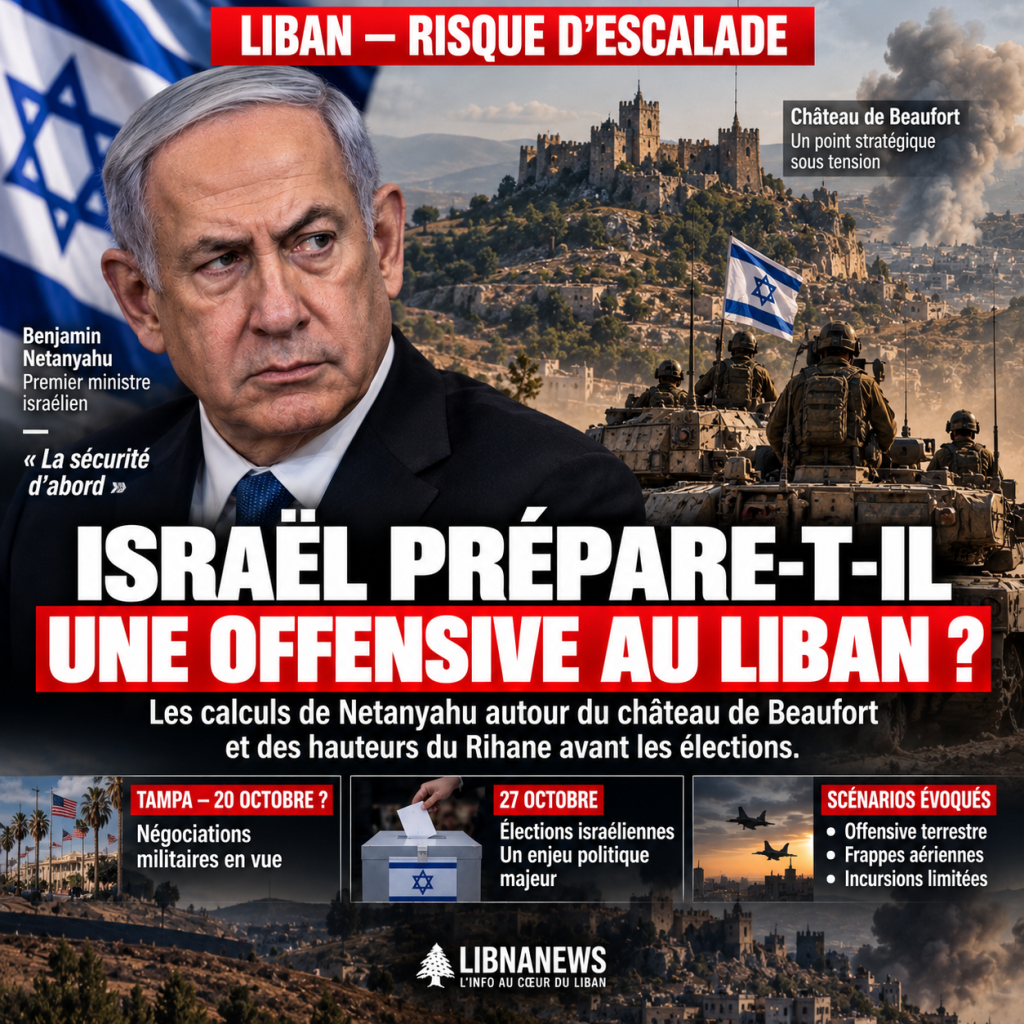
A military operation envisaged in the weeks preceding the Israeli election
Benjamin Netanyahu would consider a new major military operation in Lebanon prior to the Israeli legislative elections of 27 October 2026. The hypothesis appears in information attributed to European diplomatic sources. According to them, the Israeli Prime Minister would seek to use a demonstration of force against Hezbollah to restore its popularity and enhance the chances of its party, the Likud. The timetable places this possibility at the centre of Lebanese concerns. The election is to take place seven days after a planned Lebanese-Israeli military meeting in Tampa, Florida, around October 20th.
However, the information reported does not mention any official order announcing a general offensive. They describe a scenario studied in Israeli political and military circles. This distinction is essential. The available information makes it possible to identify preparations, military objectives and electoral calculations. They do not make it clear that a final decision to launch a major operation has been taken.
The scenario presented by European sources is based on an additional constraint. Donald Trump would seek to avoid a new direct confrontation with Iran. This would limit the possibility of an Israeli escalation against Tehran. Lebanon could then be a more accessible military theatre for Netanyahu, particularly as a result of continued tensions with Hezbollah.
The same sources link this hypothesis to the electoral difficulties of the Israeli Prime Minister. Likud would face increased competition in voting intentions. An operation against Hezbollah could allow Netanyahu to put security issues back at the centre of the campaign.
However, this reading remains an interpretation attributed to diplomatic interlocutors. It does not demonstrate that electoral considerations are the sole driving force behind Israeli military decisions. Territorial objectives and security concerns also play a role in the scenarios studied.
Rihane, a military objective with considerable political consequences
The heights of the Rihane occupy a special place in the assumptions of climbing. This mountainous region, located in the southern Lebanese hinterland, is of military interest because of its relief and its position in relation to the axes linking several sectors of the South.
An Israeli operation targeting these heights would not be comparable to a mere border incursion. It would involve progress towards positions further away from the border and could significantly change the control lines.
However, the military analyses published on 8 October point out that such an operation would entail high risks. A land offensive towards Rihane would require significant resources. It would expose forces engaged to difficulties related to relief, duration of operations and Hezbollah’s reactions.
The electoral calendar is an additional constraint. A major operation could produce military gains, but also result in human losses that could alter Netanyahu’s political calculations.
This is why another hypothesis is envisaged: to favour intensive air strikes, destruction of infrastructure and limited incursions rather than a general land offensive.
This would enable Israel to maintain high military pressure without immediately initiating an operation with difficult consequences.
The information available does not confirm that the Rihane has been designated as the objective of a decided offensive. However, they show that this region is one of the sectors studied in the analyses of Israeli military options.
Beaufort Castle in the center of a battle for height control
Another major point of tension is the Beaufort Castle area. The fortress dominates part of the South Lebanon and offers views of several axes and localities. The surrounding heights are therefore of strategic interest to forces seeking to monitor military movements in the region.
The Lebanese authorities are seeking Israeli withdrawal from the villages around the castle. That request must be included in the issues raised in the forthcoming military negotiations with Israel.
The withdrawal would allow the Lebanese army to deploy in the areas concerned and gradually restore State authority.
Israel stands for a different approach. Its military officials consider that certain high positions are necessary to prevent the rebuilding of Hezbollah’s offensive capabilities.
This divergence explains the importance of the sector in diplomatic discussions. For Beirut, the issue is the recovery of territories and the return of the inhabitants. For Israel, it addresses the possibility of maintaining an advanced monitoring and response mechanism.
The reported destruction in several locations further complicates the situation. Military withdrawal would not be sufficient to allow immediate return of populations if homes, roads and critical infrastructure remained damaged.
The control of the heights could therefore determine not only the evolution of military positions, but also the conditions for the reconstruction of the villages.
Israel seeks lasting change in the military geography of the South
The available military analyses describe an evolution of Israeli doctrine after the 7 October 2023 attack. Israeli officials consider that border surveillance is no longer sufficient to prevent a planned attack from neighbouring territories.
This reflection directly concerns Hezbollah. Israel claims that the Radwan force had plans to conduct operations towards Galilee. This alleged threat is used to justify the creation of advanced positions and the destruction of infrastructure close to the border.
The Israeli objective would therefore not only be to repel Hezbollah fighters. It would be to prevent materially the reconstruction of conditions for an attack.
This approach explains the importance attached to reliefs, roads and areas near Israeli localities.
In particular, the information published refers to a willingness to control land that could be used as observation, preparation or start-up positions.
This strategy has direct implications for the people of South Lebanon. The destruction of buildings and restrictions imposed in certain areas can make the return of populations difficult, even in the absence of permanent confrontations.
The question then becomes that of the duration of these measures. A temporary arrangement can permanently change living conditions if it prevents the reconstruction and return of the inhabitants.
The Lebanese authorities are precisely trying to prevent an Israeli security logic from turning into prolonged territorial control.
27 October elections complicate military decisions
The Israeli electoral calendar is a central element of the analysis. The general elections were announced for 27 October 2026. Tampa’s military negotiations are planned around 20 October.
This proximity creates a period of high uncertainty.
A pre-election military operation could allow Netanyahu to present security results. It could also expose its Government to criticism if the losses were significant or if the stated objectives were not achieved.
The available analyses highlight this contradiction. A major offensive could be politically advantageous in the event of rapid success. But it would pose a considerable risk if the fighting continued.
The choice of limited military pressure therefore appears to be a possibility. Air strikes, targeted destruction or short-term incursions could allow the Israeli government to maintain an offensive posture without immediately launching an extensive land campaign.
However, such a strategy would not guarantee the absence of escalation. Hezbollah could respond to Israeli operations, resulting in a series of strikes and counter-attacks.
The electoral calendar therefore makes it impossible to predict with certainty the decisions of Netanyahu. It is an additional factor in calculations already influenced by military and diplomatic constraints.
Washington tries to maintain negotiations while demanding the disarmament of Hezbollah
The American position has several dimensions. Washington wants to strengthen the authority of the Lebanese state and obtain concrete measures regarding Hezbollah’s military infrastructure.
American officials advocate a gradual approach. It would begin with the implementation of security arrangements and would continue to strengthen the control of the Lebanese army over the territories concerned.
This could promote Israeli withdrawals with verification mechanisms.
But Israeli demands complicate discussions. Israel wishes to retain the possibility of intervening when it considers that a threat appears.
The Lebanese government, for its part, refuses to allow a security mechanism to allow a foreign army to maintain a lasting freedom of action in its territory.
The Tampa negotiations must therefore address issues that go beyond mere military redeployment.
These include arms control arrangements, withdrawal guarantees and the possibility for the Lebanese Armed Forces to provide security in evacuated areas.
The information available does not confirm that agreement has been reached on these points.
A cargo of explosives discovered at the Syrian border
Military tensions are accompanied by concerns about Lebanese internal security.
The information published on 8 October relates to the discovery by the Lebanese army of a shipment of explosives which was allegedly destined to enter the territory from Syria.
The load consisted of 245 kilograms of trinitrotoluene, four ready-to-use explosive devices, eight detonators and electrical cables.
The persons involved in the transport reportedly fled from the Syrian side on the arrival of a Lebanese patrol.
There is no information available to identify the consignees of this cargo. It would therefore be unjustified to establish a link with Hezbollah or with Israeli military scenarios without any additional elements.
However, this discovery highlights the difficulties that Lebanese security forces face in a period of regional tensions.
The army must monitor borders, fight arms trafficking and prepare for its deployment in the South.
Such simultaneous responsibilities may affect its operational capabilities.
Hezbollah at the risk of a new confrontation
Hezbollah remains a central player in Israeli calculations. Under Naim Kassem’s leadership, the party defends the maintenance of its military capabilities as long as Israeli forces occupy positions in the South Lebanon.
This position is based on a different national security reading from that advocated by the government of Nawaf Salam.
The Prime Minister wishes to strengthen the state monopoly of force and to reserve to constitutional institutions decisions concerning war and peace.
Hezbollah believes that its weapons remain necessary in the face of Israeli threats.
A new military operation could exacerbate this discrepancy.
Disarmament advocates could see confirmation of the risks associated with the existence of an armed force independent of the State. On the contrary, Hezbollah could invoke the offensive to defend the need to maintain its capabilities.
The political consequences would depend in particular on the scale of the operations and the reactions of the different parties.
The information available does not allow for the establishment of Hezbollah’s operational intentions in the event of a new offensive.
However, they show that the party refuses to separate the debate on its weapons from Israeli withdrawal and security assurances.
Three military scenarios envisaged before the elections
The information published on 8 October makes it possible to distinguish three main hypotheses.
The first is a large-scale land offensive, which could target strategic areas such as the Rihane heights. This option would involve significant military and political risks. It could change the lines of control, but would expose Israel to prolonged confrontation.
The second is based on increased air strikes and limited incursions. It would maintain pressure on Hezbollah while reducing Earth’s commitment. It could also be presented as a demonstration of force before the election.
The third is to focus on the Tampa negotiations and seek security guarantees without launching a major new operation.
These scenarios are not officially announced plans. They correspond to the options discussed in the available political and military analyses.
Their implementation will depend on Israeli decisions, Hezbollah’s reactions and the evolution of diplomatic discussions.
Lebanon faces an uncertain diplomatic and military deadline
On 8 October 2026, the Lebanese authorities sought guarantees to avoid further escalation. The Tampa negotiations are one of the main diplomatic possibilities.
In particular, the Government wishes to secure Israeli withdrawal from the occupied territories and to allow the deployment of the army in the sectors concerned.
But Israeli positions remain far removed from Lebanese demands. Israel seeks to maintain military safeguards to prevent the rebuilding of Hezbollah infrastructure.
The proximity of the Israeli elections adds additional uncertainty.
The information available does not indicate that Benjamin Netanyahu decided to launch a general offensive before 27 October. However, they show that this assumption is taken seriously by several diplomatic interlocutors.
The Rihane and Beaufort areas occupy an important place in military risk analysis. Their monitoring could make a lasting difference in the security situation and the return possibilities of the inhabitants.
The period between the negotiations envisaged on 20 October and the election on 27 October thus seems particularly sensitive.
Lebanon will have to deal with Israeli decisions, American demands and Hezbollah positions, while no final agreement yet guarantees a complete Israeli withdrawal or lasting stabilization of the border.





Comments