

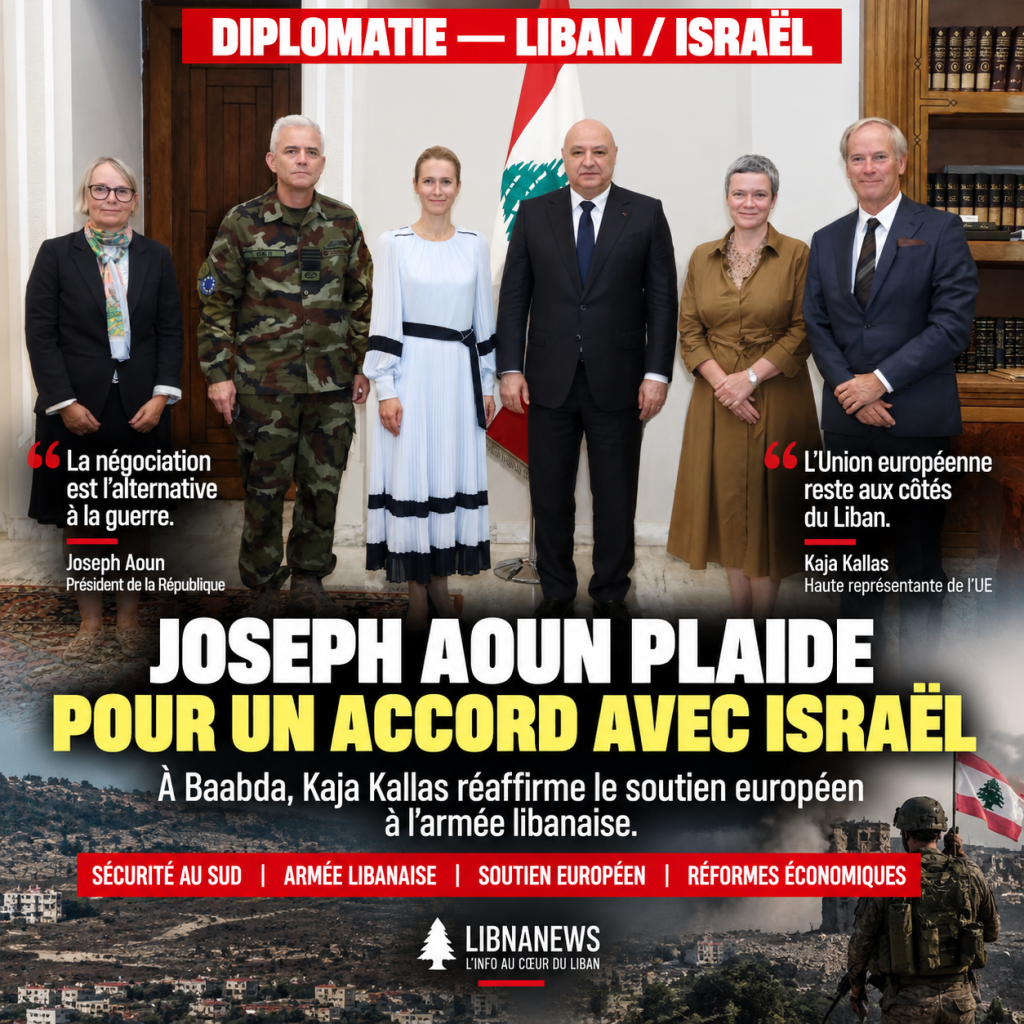
On Thursday 8 October, Lebanese President Joseph Aoun received the Head of European Diplomacy, Kaja Kallas, at the Baabda Presidential Palace. He defended negotiation as the only alternative to war with Israel, while denouncing the non-compliance with Israeli commitments in southern Lebanon. The European Union reaffirmed its commitment to support the Lebanese army, security forces and humanitarian sectors.
President Joseph Aoun placed Lebanon’s stability at the heart of his discussions with Kaja Kallas, High Representative of the European Union for Foreign Affairs and Security Policy, Thursday 8 October 2026, at the Baabda Palace. The meeting focused on the security situation in the south of the country, relations with Israel, European support for Lebanese institutions and expected economic reforms.
The Head of State stressed the link between the security of Lebanon and its regional and European environment. « There is a close link between Lebanon’s stability and that of Europe and the region, » he said.
This position comes as Beirut seeks to consolidate its institutions and gain international support in the face of persistent tensions with Israel. Joseph Aoun stressed the need for a negotiated solution, considering that an agreement is the only way to put an end to the state of hostility between the two countries.
Joseph Aoun defends negotiations with Israel
In his meeting with Kaja Kallas, Joseph Aoun presented the negotiation as a necessity to avoid a new military confrontation.
» Negotiation is the alternative to war, and an agreement is the only way to end the state of hostility between Lebanon and Israel, » the Lebanese President said.
This statement clarifies Baabda’s position: the lasting reduction of tensions must involve a political and security arrangement, rather than the continuation of confrontations.
Lebanon and Israel have no diplomatic relations and remain officially in a state of war. Their border has been an area of military and political tension for decades.
In this context, the Lebanese President’s remarks do not constitute the announcement of an imminent agreement. They reaffirm a diplomatic orientation that favours negotiation in order to secure commitments that can provide lasting stability to the border.
Joseph Aoun, however, announced neither a timetable for discussions nor a new negotiating mechanism. The arrangements for a possible agreement therefore remain to be defined.
Lebanese Army continues its deployment south of Litani
The Lebanese President also discussed the implementation of security arrangements in the south of the country.
He assured him that the Lebanese army was fully fulfilling its missions in the areas where it deployed south of the Litani River, in accordance with the framework agreement referred to at the meeting.
» The Lebanese army is fully fulfilling its duty in areas where it has deployed south of the Litani River, » said Joseph Aoun.
However, the Head of State accused Israel of not complying with the provisions of the agreement.
This distinction is central to the presidential discourse. Joseph Aoun puts forward the responsibilities assumed by the Lebanese military institution while denouncing the commitments which, according to him, remain unfulfilled on the Israeli side.
The southern Litani represents a strategic sector for Lebanon ‘ s security. The deployment of the army in this region is an essential element of arrangements to reduce the risk of confrontation with Israel.
The President did not provide, in the statements reported at the end of the meeting, a detailed list of the number of staff deployed or a detailed list of the provisions which he accused Israel of not applying.
His statements nevertheless underline the importance attached by the Lebanese authorities to the presence of the national army in border areas.
Kaja Kallas confirms European Union availability
The Baabda meeting also addressed the forms of assistance that the European Union could provide to Lebanon.
Kaja Kallas stated that the European Union was willing to provide the necessary assistance to the country, particularly in the security, social and humanitarian fields.
Such assistance could be given priority to the Lebanese Army and the Internal Security Forces.
The European official also mentioned the agencies involved in the social and humanitarian sectors.
This declaration reflects the European will to maintain support for the institutions responsible for internal security and stability in the country.
The Lebanese army occupies a special place in this cooperation. Its role in southern Lebanon, directly mentioned by Joseph Aoun, makes its strengthening an important challenge for Beirut’s international partners.
Another potential beneficiary of this assistance is the Internal Security Forces. They carry out tasks separate from those of the army, including law enforcement and public security.
The social and humanitarian dimension of European support responds to the difficulties that Lebanon continues to face.
However, Kaja Kallas did not announce any specific amounts or new assistance programmes in the statements submitted after the interview.
The financial and operational scope of European commitments should therefore be clarified at a later stage.
Lebanon’s stability as a European issue
Joseph Aoun stressed the regional and international consequences of the Lebanese situation.
By establishing a direct link between Lebanon’s stability, that of Europe and that of the Middle East, the President sought to place Lebanese security issues in a broader framework.
This approach underlines the importance that Beirut attaches to European engagement in stabilization efforts.
The situation in Lebanon concerns several issues followed by the European institutions, including regional security, displacement and humanitarian aid.
Support for Lebanese institutions thus appears to be an instrument for contributing to the stability of the country.
Kaja Kallas’ statements echo this concern by focusing on the capacities of security institutions and social needs.
However, the meeting did not lead to the announcement of a new European diplomatic initiative between Lebanon and Israel in the public information.
The European Union confirmed above all its readiness to accompany the Lebanese authorities in the areas mentioned during the interview.
Joseph Aoun reaffirms his commitment to economic reforms
Beyond security issues, the Lebanese President addressed the economic reforms necessary for the country’s recovery.
Joseph Aoun assured that Lebanon remained committed to their implementation.
In particular, he referred to the adoption of the Financial Deficit Act, generally referred to as the Financial Loss Allocation Act (financial gap law).
This text is one of the sensitive issues of the Lebanese financial sector restructuring process.
It should help to define the treatment of accumulated losses in the financial system and the responsibilities associated with their allocation.
The President presented its adoption as a step towards signing an agreement with the International Monetary Fund (IMF).
This statement confirms that the Lebanese authorities still regard a programme with the IMF as a major objective of their economic policy.
The issue remains particularly important since the financial collapse that began in 2019, which has profoundly affected banks, public finances and depositors’ access to their economies.
The distribution of losses remains one of the main obstacles to a complete restructuring of the banking system.
The final content of the legislation and its application will determine some of the consequences for financial institutions, depositors and public finances.
Joseph Aoun did not specify a date for the adoption of the text or for a possible agreement with the IMF.
Two priorities for relations between Beirut and Brussels
The interview between Joseph Aoun and Kaja Kallas thus revealed two immediate priorities in relations between Lebanon and the European Union.
The first concerns security, with support for the Lebanese armed forces and the search for a negotiated solution to tensions with Israel.
The second concerns economic and institutional recovery, whose financial reforms are a central element.
These two files have separate schedules.
On the security front, the Lebanese authorities highlight the missions carried out by the army south of the Litani, while demanding the implementation of Israeli commitments.
Economic progress depends, inter alia, on the adoption of legislation on financial losses and discussions with the IMF.
For the European Union, the continuation of the announced assistance will have to be translated into concrete measures, the details of which remain to be clarified.
At the end of the Baabda meeting, no new amounts of European aid, negotiation schedule with Israel or legislative timetable for the Financial Loss Law had been communicated.





Comments