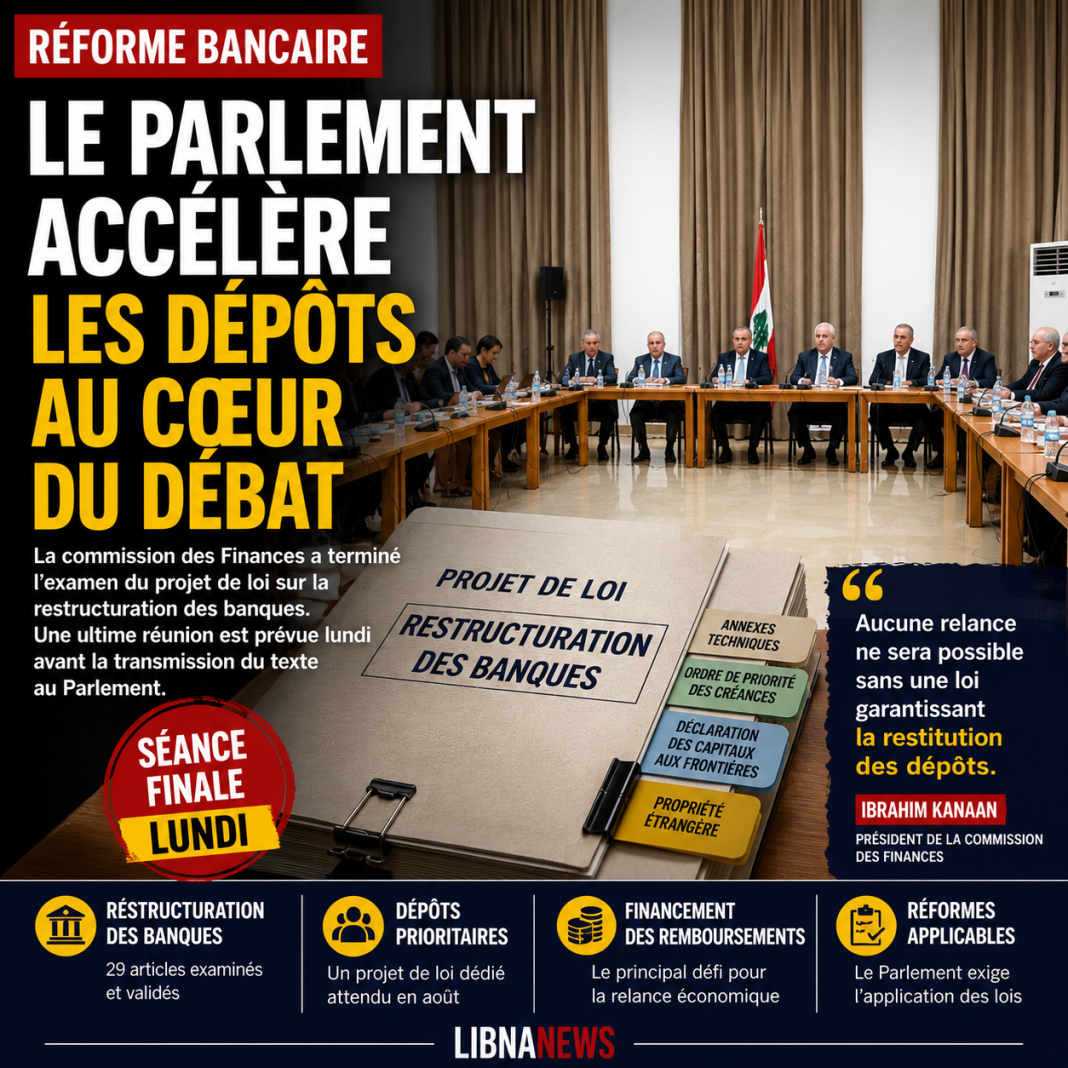






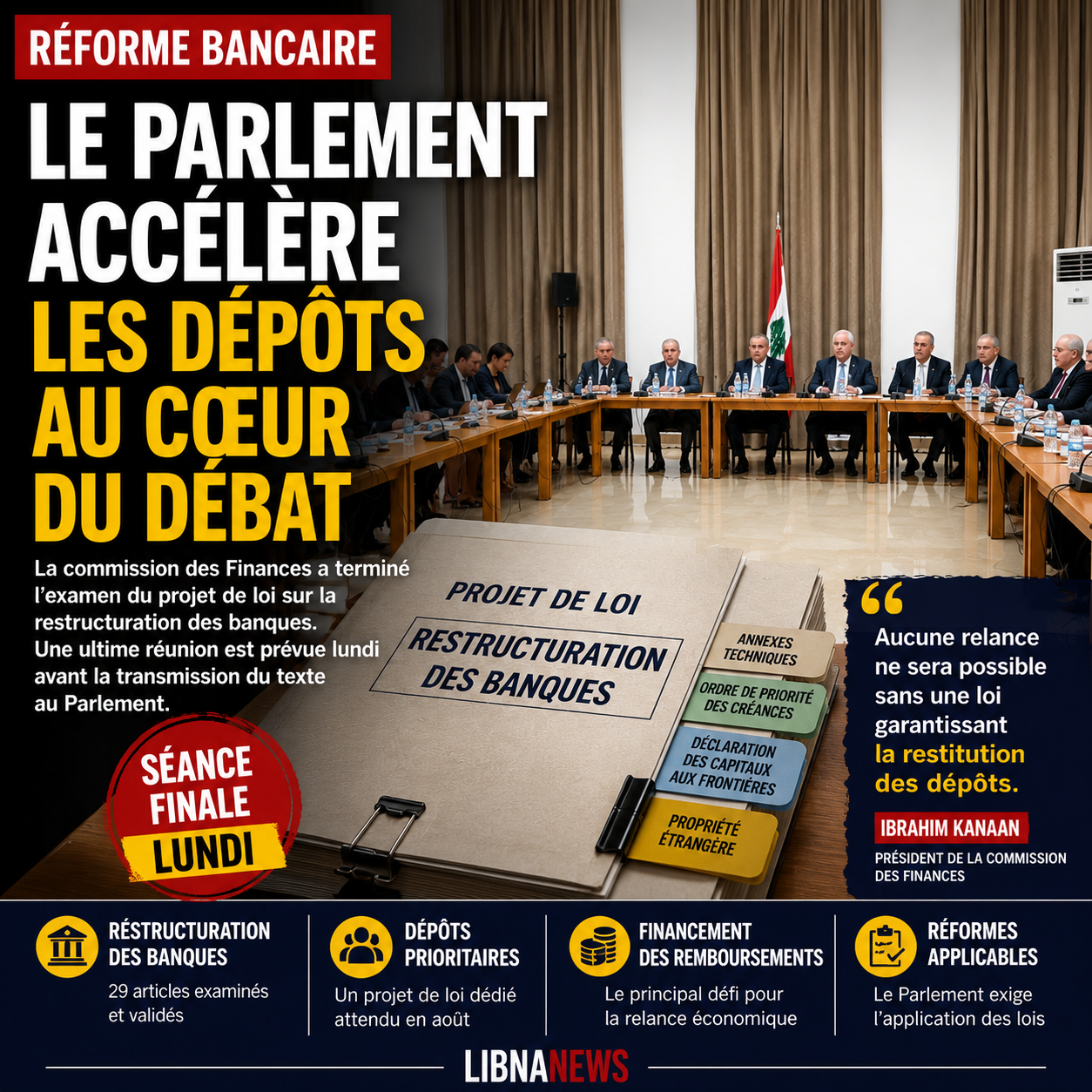
The Parliamentary Finance and Budget Committee has completed its consideration of the bank restructuring bill. A final meeting is scheduled on Monday to finalize the technical annexes before the text is forwarded to Parliament’s Presidency. For his president, MP Ibrahim Kanaan, however, the banking reform cannot have any effect without a law guaranteeing the return of deposits, which he considers to be the cornerstone of economic recovery.
Banking reform enters its final straight line
After more than a month of discussion, the Finance and Budget Committee announced that it had completed its consideration of the 29 articles of the bill on restructuring the banking sector. The text has yet to be supplemented by an annex on the order of priority of claims, as well as two separate drafts relating to the declaration of capital transported across borders and the extension of the deadline for foreign ownership.
A final meeting is scheduled on Monday to validate all arrangements before they are officially forwarded to the General Secretariat of the Chamber of Deputies. This step marks an important step forward in a case considered as one of the pillars of the reforms expected for several years by Lebanon’s international partners.
Parliamentary work brought together representatives of the government, several ministers, MEPs from different political groups and representatives of the legal sector, illustrating the institutional dimension of this reform.
Adjustments to strengthen protection of applicants
The most recent discussions focused on the competences of the liquidator in charge of establishments in difficulty, the functioning of a provisional administration and the judicial remedies available to the parties concerned. Several amendments were introduced to strengthen the legal safeguards available to applicants.
In particular, parliamentarians have established a direct link between bank restructuring and the future legal framework for deposit return. The aim of this coordination is to prevent restructuring of financial institutions from being implemented without first defining how savers should be reimbursed.
Since the financial crisis began in 2019, the issue of bank deposits has been the main concern of hundreds of thousands of clients. The absence of a legal mechanism setting out the responsibilities and arrangements for repayment remains one of the main obstacles to confidence-building.
The deposit project becomes the priority
For Ibrahim Kanaan, bank reform cannot be separated from the future law on deposit restitution. In his view, both texts were legally and economically complementary. Without a clear mechanism defining the rights of depositors and the sources of financing of repayments, bank restructuring could remain largely theoretical.
A governmental commission is currently continuing its work on the second text. The authorities hope to reach a final version in August. Otherwise, the Chairman of the Parliamentary Finance Committee indicated that he could present his own initiative to avoid further delay.
This position reflects growing impatience in Parliament, while several reform projects have been blocked for many months despite their priority.
Repayment financing remains the main unknown
Beyond the legal framework, the main challenge remains financing. The authorities will have to determine the resources to progressively return deposits without further compromising the country’s financial stability.
Lebanon faces a particularly high level of debt after several decades of financing largely based on borrowing and capital inflows. This economic model collapsed with the banking crisis, leaving banks unable to honour all their commitments to depositors.
For Ibrahim Kanaan, a sustainable recovery now requires the reconstruction of a more productive and less debt-dependent economic model. He believes that simply returning to the financial mechanisms that existed before 2019 could replicate the imbalances that led to the current collapse.
Restoring confidence before seeking new funding
The Chairman of the Finance Committee also believes that the confidence of investors and international partners can only be restored if the authorities settle the bank deposits as a matter of priority.
For several years, the international financial institutions have been conditional on the adoption of structural reforms affecting the banking sector, public finances and governance. However, several policy makers point out that the adoption of new laws is not enough if their implementation remains incomplete.
This distinction between the adoption of the texts and their implementation is regularly reflected in the Lebanese political debate. A number of important reforms, including transparency, the fight against illicit enrichment or the lifting of bank secrecy, have already been adopted without producing all the expected effects due to lack of effective implementation.
Parliament now calls for applicable reforms
Through his statements, Ibrahim Kanaan insists on the need to go beyond legislative logic alone. According to him, the credibility of the State now depends on its ability to enforce the laws adopted, enforce judicial decisions and incur responsibilities when the laws are not enforced.
This approach reflects a change in the Lebanese economic debate. After several years of discussions on reform projects, a part of the political class now places more emphasis on their practical implementation.
The next meeting of the Finance Committee should thus complete the parliamentary process on banking restructuring. Attention will then be paid to the draft law on the return of deposits, which is considered one of the most sensitive cases of the economic reconstruction of Lebanon, while the Government is still pursuing its arbitrations on its content and on the financing mechanisms that can guarantee its implementation.