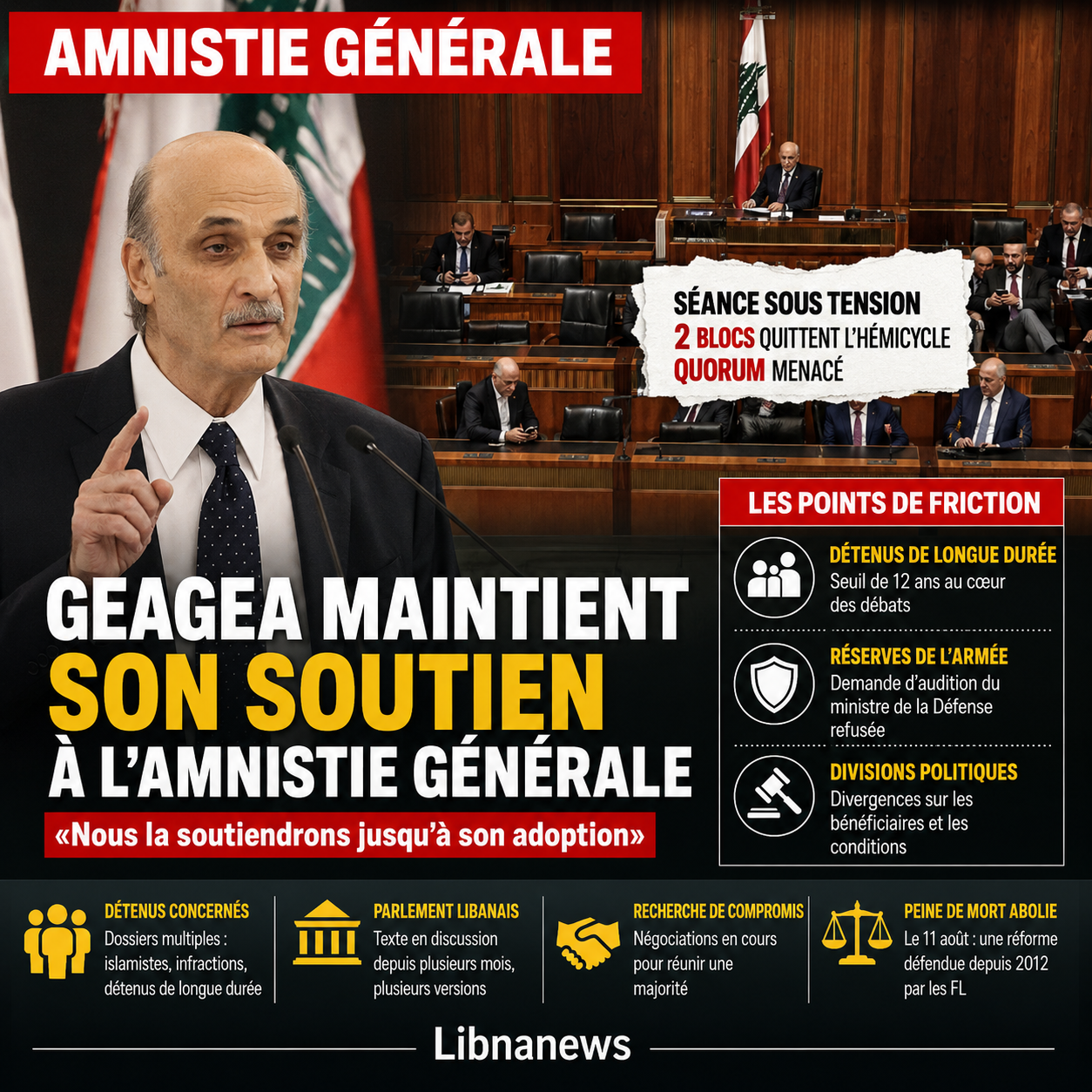






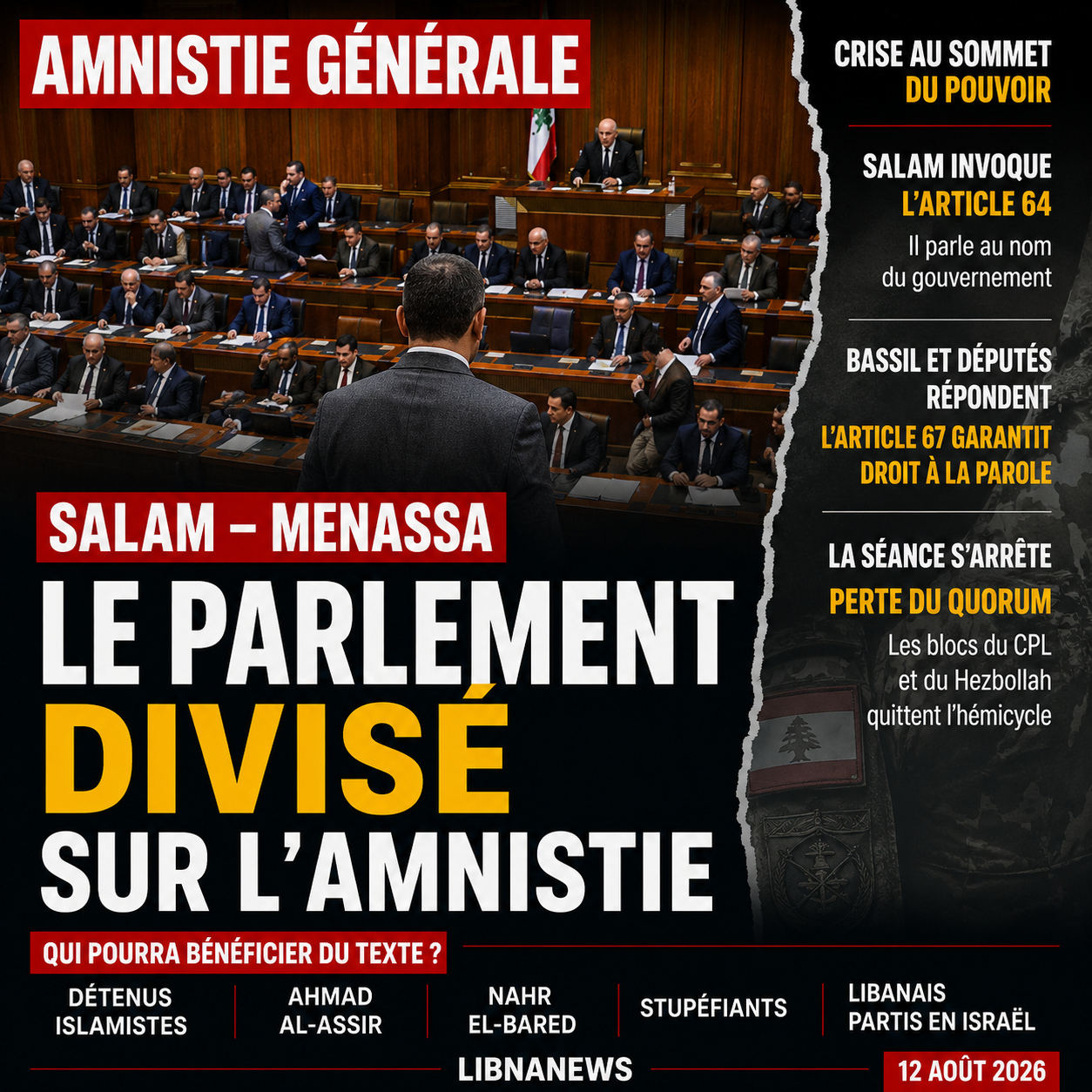
The debate on the general amnesty should focus on prisons, convictions and limitations on sentencing. He finally opened a crisis between the government, the army and Parliament on Tuesday, August 11, 2026. Everything started from a disagreement between Prime Minister Nawaf Salam and Defence Minister Michel Menassa. The latter wanted to present the army’s observations to the deputies on a text that could alter the fate of convicted persons in cases where military personnel were killed. A few hours later, two articles of the Constitution were opposed in the Chamber, several blocks left the sitting and Nabih Berri tried to save a quorum that had become fragile.
The disagreement between Salam and Menassa broke out before the sitting
Tension appears even before the examination of the general amnesty. Michel Menassa wants to speak in front of the assembly when the deputies discuss the text. The Minister of Defence intends to convey to them the remarks of the army, in particular on the provisions concerning heavy convictions and the cases in which military or members of the security forces were targeted.
The military institution had already made its reserves known during the preparatory work. Menassa had participated in the discussions in committee and sent a written note. On 10 August, on the eve of the sitting, he had again provided the Vice-President of Parliament, Elias Bou Saab, with the military’s comments on the changes made to the draft.
The problem is precisely those changes. The text has evolved over negotiations between the blocs. Some new provisions may change the effective length of sentences and conditions of release from prison. Menassa therefore considers it necessary for the army to clarify its position before the deputies to vote.
Nawaf Salam adopts another reading. The Head of Government informs the Minister of Defence that he himself will speak on the amnesty. He intended to present a common position of the executive and refused to allow the government to appear before Parliament with several contradictory votes.
The dispute is not settled until the evening session. Michel Menassa does not participate. His absence quickly turned a divergence within the government into a parliamentary problem. Several MPs want to know why the Minister of Defence is not here to answer questions about army reserves.
Salam will dispute having forbidden Menassa to come to Parliament. He admits, however, that he told him that he would speak on behalf of the government on the amnesty. This nuance will not be enough to extinguish the controversy.
Nawaf Salam invokes article 64
Before the deputies, Nawaf Salam chose to defend his decision on the constitutional ground. He invokes Article 64, which defines the President of the Council as the Head of Government and entrusts him with the task of representing him and speaking on his behalf.
The Prime Minister therefore presents the dispute as an issue of executive functioning. Lebanon has a Council of Ministers, it claims in substance, not 24 governments. Government solidarity implies a coordinated position before Parliament.
Salam also recalls that the army has already been consulted. Michel Menassa presented his remarks during the work of the committees and submitted a written note. The Prime Minister thus seeks to rule out the accusation that he wishes to prevent the military institution from making its opinion known.
His argument is also political. Salam does not want to place the army in a situation of confrontation with a part of the population on such a sensitive issue. A significant part of the demands for amnesty are for detainees whose fate has been mobilising Sunni leaders and families for years.
The Prime Minister refuses that this issue will turn the army into a protagonist of a community conflict. It recalls its support for the military institution and the families of killed soldiers. As for the principle that should guide the treatment of amnesty, he summed it up before the deputies with a formula: « justice, then justice, then justice ». The last word, he stressed, belongs to Parliament.
This defence, however, opens a new controversy. The question is no longer just what the army thinks of the law. It becomes constitutional: can the Prime Minister decide that another member of the government does not have to intervene before the House?
Bassil opposes Article 67 to Salam
Gebran Bassil immediately responded to Nawaf Salam. The President of the Free Patriotic Movement shall not contest the role of the Head of Government provided for in Article 64. He claims, however, that this provision does not remove the rights that the Constitution grants individual ministers before Parliament.
Basil invokes article 67. It allows ministers to attend parliamentary meetings and provides that they must be heard when they request the floor. For the head of the CPL, therefore, a Prime Minister cannot prevent a minister from responding to MPs in an area of his or her responsibility.
He directly calls Nabih Berri. If the Speaker of the Chamber gives the floor to Michel Menassa or asks him to answer a question, can Nawaf Salam forbid him to speak? Basil considers that a positive response would reduce Parliament’s ability to monitor the action of ministers.
He insists on the nature of the case. Menassa not only wants to give a political opinion on the amnesty. He wants to transmit the reservations of an institution directly concerned by certain provisions, since convicted persons who could benefit from the new mechanisms have been involved in cases involving soldiers.
Hussein Hajj Hassan intervenes in his turn. The member of the Resistance Loyalty bloc denounces a situation which he presents as unprecedented: that of a minister who could not present his point of view to the deputies. Ibrahim Kanaan also called for Menassa to be heard before the vote.
Other parliamentarians defend the opposite position. They believe that Nawaf Salam must be able to maintain the coherence of the government and coordinate the interventions of its ministers. But the dispute over the powers of the executive now occupies a central place in a session that was originally to discuss the fate of prisoners.
Who can really benefit from the general amnesty?
The violence of the debate cannot be understood without examining the content of the text. The term « general amnesty » gives the impression of a single measure. The negotiated project is based in fact on several mechanisms: amnesty for certain offences, exceptional reduction of sentences, treatment of long detentions and modification of the actual duration of certain heavy sentences.
The first case concerns persons detained for many years. Negotiations have sought a solution for prisoners whose judicial proceedings have been extended for an exceptional period, especially when no final judgement has yet been rendered.
A previous version had adopted a threshold of fourteen years of detention. The most recent discussions focused on twelve years and the notion of irrevocable judgment. This change is important. It could extend the mechanism to prisoners who have already been convicted but whose decisions remain subject to appeal.
This is one of the main sources of concern. A provision designed to end endless detention without trial should not, according to its critics, automatically become a means of releasing convicted persons in serious criminal or security cases.
A second aspect concerns life sentences. Negotiations have envisaged reducing some of them to 17 years in prison. For a prisoner who has spent a long time in prison, the effect could be rapid.
The abolition of the death penalty, voted on 11 August, also intervenes in this equation. The combination of the death penalty and the reduction mechanisms discussed in the amnesty can profoundly change the length of detention of those sentenced to the most severe sanctions.
The « Islamic detainees » at the centre of the controversy
This is where the most politically explosive file appears: that of the detainees commonly referred to in Lebanon as « Islamics ».
This term covers very different judicial situations. Some detainees have spent many years behind bars waiting for a final judgement. Others were convicted of belonging to armed organizations or security offences. A third category relates to cases in which military personnel were killed.
Consolidating these situations is precisely one of the risks of the debate. Amnesty advocates highlight the considerable judicial delays and long periods of detention. They consider that some prisoners have already spent a disproportionate period behind bars in view of their situation.
The army and the opponents of too wide a text raise another question: can a person who has been detained for 12 or 14 years on a case without a victim be placed in the same situation as a convicted person convicted of having participated in an attack that cost soldiers their lives?
The difficulty is therefore not only to determine a period of detention. It involves defining the crimes that must remain excluded from reduction mechanisms.
In previous negotiations, 39 detainees qualified as Islamists and sentenced to death had been one of the main obstacles. The search for a solution for those convicted had been directly linked to the debate on the abolition of the death penalty.
These 39 people, however, do not represent the entire dossier of Islamist detainees. Their legal situations are not necessarily identical. Their case illustrates, above all, the difficulty of bringing the heaviest convictions into a compromise originally presented as a response to lengthy detentions.
Ahmad al-Assir and the bloody precedent of Abra
A name concentrates much of the concerns: Ahmad al-Assir. The former Salafist Sheikh of Saida was convicted in several proceedings related to the June 2013 Abra clashes between his armed supporters and the Lebanese army.
The fighting of 23 and 24 June 2013 had resulted in numerous casualties among the military. The case then resulted in heavy convictions against al-Assir and several members of his group.
His name therefore returns regularly when the possible consequences of amnesty are discussed. For the families of the soldiers killed in Abra, a reduction in the sentence for those responsible or involved in the clashes would directly affect the court decisions handed down after the death of their relatives.
Conversely, al-Assir’s supporters and some defenders of Islamist detainees have long challenged the judicial and political conditions in which Abra’s case was dealt with. They ask that his situation and those of other detainees be allowed to reflect on the amnesty.
However, this political claim must be distinguished from the actual legal effect of the text. The adoption of amnesty would not necessarily mean automatic release of Ahmad al-Assir. It would depend on the final drafting of the law, the exclusions adopted and the precise situation of its various convictions.
However, his file shows why the definition of « irrevocable judgment » has become so sensitive. While the 12-year mechanism can benefit already convicted persons whose proceedings have not been definitively completed, its scope is much wider than that of a measure reserved for detainees who have never been tried.
The question put to Members then becomes very concrete: do they only want to remedy the consequences of abnormally long procedures, or also allow a reduction in detention for convicted persons in some of the most serious security cases in recent decades?
Nahr al-Bared and other military-related files
Abra is not the only precedent that weighs on the discussions. The dossier of Islamist detainees also includes cases dating back to the years of confrontation between the Lebanese state and jihadist organizations.
The fighting in Nahr el-Bared in 2007 has a special place. For several months, the Lebanese army had faced Fatah al-Islam in the Palestinian camp in the north of the country. The fighting had resulted in numerous casualties in the military ranks and in multiple judicial proceedings.
Not all Nahr al-Bared-related detainees or convicted prisoners are in the same situation and it would be incorrect to state that they would benefit collectively from the law currently under discussion. But these files explain the army’s desire to obtain precise guarantees of the crimes that will remain excluded.
Michel Menassa had already stressed this issue during the preparatory work. Terrorism-related crimes, attacks on the military and attacks on the security forces must, according to this approach, be distinguished from offences that may benefit from leniency.
This is also why military observations cannot be reduced to a principled opposition to amnesty. The dispute begins with its limits. The military institution wants to prevent a general sentencing mechanism from producing unintended consequences in cases where soldiers have been killed.
Astounding and Lebanese left in Israel
Islamic detainees are only part of the desired compromise. For several years, the general amnesty projects in Lebanon have been based on an attempt to gather claims from different communities and political forces.
Drug-related convictions are another important aspect, particularly for Bekaa. Policy makers have long called for the treatment of certain offences in a region where many families are affected by prosecutions or convictions related to drug production and trafficking.
Another case concerns the Lebanese who left for Israel after the Israeli withdrawal from South Lebanon in May 2000. Thousands of people had left the country, including members of the former South Lebanon Army and their families.
Their situation has long been the subject of requests for settlement, particularly in some Christian political circles. Again, individual situations differ greatly. A person who was a minor is not in the same position as an individual convicted of co-operation or acts committed during the occupation.
The political balance sought thus becomes clear. Part of the Sunni MPs defend the settlement of the case of Islamist detainees. Other forces want to deal with drug-related convictions. Christian parties want to resolve the case of Lebanese settled in Israel.
The amnesty therefore works as a compromise between several cases which have almost nothing in common legally. It’s also his weakness. Removing a category can result in loss of support from the block that defends it. Extending a provision may, on the other hand, lead to the departure of Members who consider that certain red lines have been crossed.
Army reserves rock the session
When the debate resumes on Tuesday evening, the question of content joins that of institutional prerogatives. Michel Menassa is absent and several MPs refuse to continue the examination as if the army’s observations had already been definitively settled.
The Free Patriotic Current calls for the minister to be heard. Members of the Resistance Loyalty bloc take a similar position. For them, the changes in the text justify a new presentation of military reserves.
Elected representatives then began to leave the Chamber. The departure of MPs from the CPL and the Resistance Loyalty bloc gradually weakens the quorum. Further absences are added and the possibility of a vote becomes uncertain.
Menassa’s presence therefore takes on an importance which goes beyond his initial planned intervention. His return could help to respond to objections and convince some parliamentarians to return to their seats.
Nabih Berri is trying to find a way out. The Speaker of the Chamber said he was ready to wait for the Minister of Defence to continue the examination. But this solution requires resolving the conflict with Nawaf Salam.
The Prime Minister responded by asking Parliament not to intervene in the functioning of the government. He pointed out that the executive did not interfere in the way Nabih Berri conducted the proceedings of the Chamber and requested the same restraint in return.
At that moment, the debate on prisoners turned into a confrontation between institutions. The head of government defends his authority over the executive, the parliament claims his right to hear from the ministers and the army seeks to preserve his reservations about the consequences of a law that affects convicts involved in attacks against its members.
Nabih Berri fails to save quorum
Nevertheless, the Speaker of the House is trying to continue. Elias Bou Saab participates in contacts to bring MPs back to the room. The present are counted and discussions continue on the conditions for resuming the examination of the amnesty.
But the tension accumulated since the beginning of the day makes compromise difficult. The problem is no longer simply whether a majority will vote in favour or against the text. The first step is to bring together enough Members so that the sitting can legally continue.
The quorum eventually falls. Nabih Berri is to adjourn the meeting and postpone further work until Wednesday, 12 August.
This failure gives a new dimension to the initial dispute between Salam and Menassa. A divergence in the presentation of the army’s observations helped to mobilize several blocks and then make it impossible to continue parliamentary scrutiny.
It would, however, be less likely to attribute the loss of quorum to this dispute alone. Disagreements over the content of the amnesty were already deep. The incident around the Minister of Defence has mainly provided a point of crystallization to concerns that have for several weeks concerned the actual beneficiaries of the law.
Hezbollah and the CPL make the army a red line
The bloc of Fidelity to the Resistance and the Free Patriotic Current did not defend exactly the same political reading of the amnesty, but they found themselves on one point: the text should not be voted without the army’s remarks being examined.
For Hussein Hajj Hassan, the issue concerns the constitutional functioning of the institutions as well as the substance of the dossier. Hezbollah MP insists on the right of a minister to intervene before the Chamber and refuses to allow Michel Menassa to be silenced while his ministry is directly affected by certain provisions.
The CPL develops a comparable reasoning, but Gebran Bassil insists more on Article 67 and on Parliament’s control over ministers. The departure of deputies from these two blocs gives concrete weight to their opposition: without them, the sitting may no longer be possible.
The question of the army thus becomes a genuine parliamentary red line. Even those elected in favour of the principle of amnesty do not want to give the impression that a political compromise is being built at the expense of the soldiers killed in the clashes between Abra, Nahr al-Bared and other security operations.
This caution also allows us to understand why the proposal can no longer be read as a simple measure of prison congestion. As soon as it deals with convictions for terrorism or murder of military personnel, it enters a space where judicial, security and community considerations intertwine.
Amnesty as a Community compromise
The negotiations also show that each major political component seeks a response to a particular issue. Sunni MPs have long insisted on Islamist detainees and on those whose judicial procedures have lasted for years. In Bekaa, other officials highlight drug-related offences. Christian forces want to settle the fate of Lebanese who left for Israel after 2000.
This architecture explains why discussions are so difficult. The text is not based on a single criminal logic. It aggregates several claims whose foundations and beneficiaries are very different.
The risk is that the political compromise will lead to too broad a law. A reduction in sentence for prisoners who have been subjected to excessively lengthy procedures may, if poorly drafted, benefit convicts in much more serious cases. Conversely, multiple exclusions can empty the text of part of its scope and lose the support of the blocks that defended it.
The army intervenes precisely on this fracture line. Its reservations do not concern all the categories concerned, but provisions that may reduce the penalties of persons convicted of crimes committed against its members or against the security forces.
This makes Nawaf Salam’s position politically sensitive. The Prime Minister wants to preserve the army from direct confrontation with the supporters of the amnesty, but this protection can be interpreted as an attempt to prevent the military institution from expressing its objections at the decisive moment.
The Constitution does not resolve the conflict alone
The confrontation around Articles 64 and 67 does not provide an obvious solution. Article 64 affirms the role of the President of the Council as representative of the Government. At the same time, rule 67 provides that ministers may participate in the sittings of the House and must be heard when they request the floor.
The conflict stems from the superimposition of these two principles. Nawaf Salam believes that government solidarity allows him to prevent several contradictory positions being presented on behalf of the executive. Gebran Bassil and Hussein Hajj Hassan reply that a minister retains his own right before Parliament and that he can be questioned in his area of competence.
The issue becomes even more complex when it is not simply a personal opinion of a minister. Michel Menassa wants to convey the remarks of an institution under his political authority and concerned with the effects of the law. The army is not a legislative actor, but it is directly involved in several cases whose convictions could be changed.
Neither of the two readings is sufficient to extinguish the crisis. The Constitution determines the powers, but it does not remove the need for a political compromise on how institutions must dialogue before the vote.
The army has no veto, but its opinion weighs on the vote
In law, the decision lies with Parliament. The army has no power to block an amnesty law. Nor can the Minister of Defence replace MPs.
In practice, the situation is more difficult. When a law is likely to reduce the penalties for people involved in the death of military personnel, ignoring army reserves would have a high political cost.
It is this difference between legal power and institutional influence that lies at the heart of the crisis. Nawaf Salam wants to avoid giving the army the role of arbiter of political debate. His opponents, however, refused that this precaution was used to rule out his observations.
For the families of the soldiers killed, the question is even more direct. They fear that a parliamentary compromise will turn heavy sentences into sentences for much faster release. Their opposition makes any drafting that does not clearly distinguish files involving deaths in the army even more difficult.
The case of Ahmad al-Assir illustrates this difficulty. Although his release does not automatically result from the adoption of the text, the only possibility that he may benefit from certain provisions is sufficient to fuel the challenge.
Berri facing a text that has become institutionally explosive
For Nabih Berri, the difficulty is twofold. It must first gather a majority around a text that sufficiently satisfies the different groups. It must then preserve the functioning of the assembly when disagreements over the army cause departures.
His choice to be ready to wait for Michel Menassa reflects this priority. The Speaker of the House seeks less to arbitrate the conflict between the Minister and the Prime Minister than to prevent the sitting from collapsing.
But this attempt places him himself in the arm. When Berri conditioned the continuation of the session on the possibility of bringing Menassa back, Nawaf Salam saw it as an intervention in the internal organization of the government.
The Speaker of the House finds himself among three constraints: to respect the prerogatives of the executive, to hear requests from Members and to retain the quorum necessary to vote.
The meeting on 11 August shows that these three objectives are no longer compatible without prior compromise.
Judicial law becomes institutional crisis
Initially, Parliament had to answer very concrete questions. What about prisoners who have been in prison for too long without final trial? How far can some sentences be reduced? What offences exclude? How can life sentences be treated after the abolition of the death penalty?
During the course of the session, these questions revealed another set of problems. Who speaks on behalf of the government? Can a minister be heard against the Prime Minister’s will? What is the place for military observations when convictions for killing soldiers are involved? And how far can Parliament take this opinion into account without turning the military institution into an actor in the political compromise?
The crisis was born because all these issues are found in the same text.
General amnesty is no longer just a law designed to correct certain judicial situations. It concerns relations between communities, the memory of deadly clashes and the place of the army in the state. It also tests the functioning of government and the relations between the executive and the legislature.
Nawaf Salam claims to want to protect both government and army coherence. Gebran Bassil and Hussein Hajj Hassan consider that Parliament must be able to hear Michel Menassa. The main aim of Nabih Berri is to put enough Members in the Chamber to allow a vote.
In the aftermath of the loss of quorum, none of these issues is actually resolved. Parliament can still amend the criteria for amnesty, clarify exclusions and respond to objections to crimes against the military. It must also determine how the military’s observations will be heard without giving it a role that does not belong to it constitutionally.
The resumption of the meeting must now show whether the blocks can dissociate the two problems. An agreement on 12 years of detention, life sentences or categories of beneficiaries could lead to substantive progress. But after the arm of iron between Nawaf Salam and Michel Menassa, one question remains: can amnesty still be adopted without a prior political agreement defining the place of the army in its application and in the debate preceding the vote?