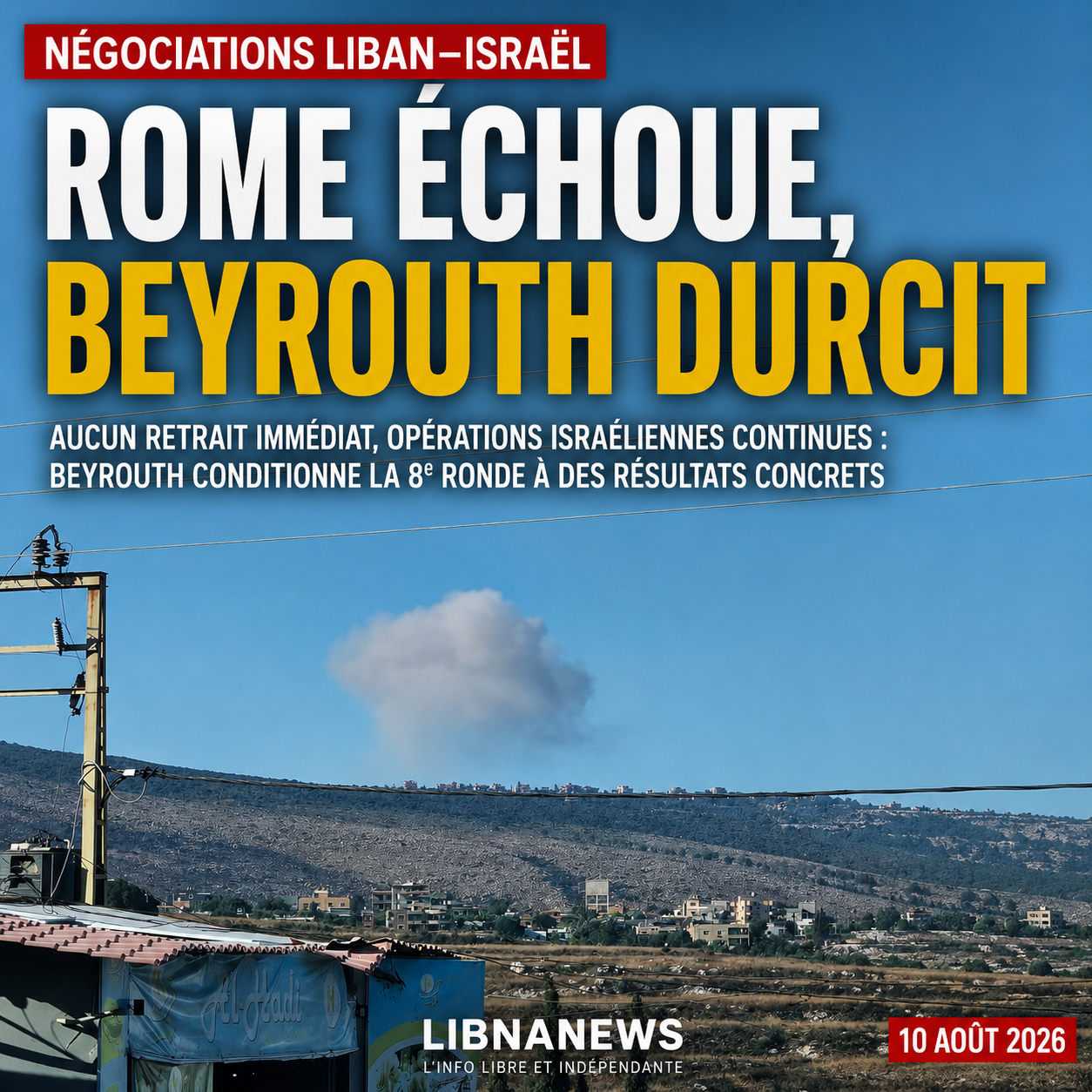
The seventh round of negotiations between Lebanon and Israel, held in Rome from 4 to 6 August 2026 under American mediation, ended without the new Israeli withdrawal that Beirut was seeking in the South. The Lebanese delegation had proposed that Bint Jbeil or Khiam should serve as the next « pilot zone », following the framework agreement signed in Washington on 26 June. Israel did not accept either at this stage, while continuing discussions on the disarmament of Hezbollah and its third-party control. For President Joseph Aoun and the government of Nawaf Salam, this result changes the conditions of the eighth round, announced in early September. Beirut must now obtain a visible Israeli counterpart after several stages in which it has agreed to extend the negotiations to arms, international control and a method of gradual withdrawal. This demand also becomes political, as Lebanese negotiators are challenged and the controversy surrounding Antoun Sehnaoui has revived the accusations of proximity to the networks that accompanied the discussions in Washington.
In Rome, guarantees advance but not withdrawal
Rome was meant to move from method to execution. Three weeks earlier, the sixth round had set out the general lines of the « pilot zones »: Israel was to evacuate a specific area, the Lebanese army took a stand there and a verification mechanism confirmed the absence of Hezbollah’s military infrastructure. The mechanism was then to be replicated in other sectors. For Beirut, the interest of the scheme was based on this succession. Every additional guarantee granted to Israel should lead to a parallel reduction in its military presence. The meeting in August, however, mainly advanced the aspect called for by Israel. Both parties have established a limited list of countries that may participate in the verification, while no new evacuation zone has been established.
Lebanon also refused to allow private security companies to carry out the verification. Beirut wants it to be a State or a clearly identified international structure. This point allowed negotiators to move forward on the architecture of future control, but it did not resolve the main disagreement. Israel wants guarantees before every withdrawal. Lebanon considers that it cannot continue to increase guarantees if evacuations become conditional, slow or indefinitely postponed. The seventh round of discussions revealed a problem that was less visible at the beginning of the discussions: the obligations requested in Beirut were gradually clarified, while the Israeli withdrawal schedule remained largely dependent on Israel’s security appreciation.
This difference is found in the field. Israel maintains a military zone inside southern Lebanon and continues to conduct operations there when it claims to detect a threat from Hezbollah. During the Rome talks, the situation became more tense after the death of two Israeli soldiers in Majdal Zoun. The Israeli army responded with strikes in several sectors of the South. The exact circumstances of the explosion that killed the soldiers were checked, but the episode recalled that the negotiations are under pressure from military operations that are still active. For the Lebanese authorities, asking for more guarantees while maintaining positions and freedom to strike reduces the scope of the principle of reciprocity on which they justified the process.
The gap is particularly marked because Beirut had come to Rome with limited public demand. He did not call for the immediate resolution of all the disputed issues in this round. He wanted to designate a new area where the mechanism already negotiated could be implemented. Bint Jbeil and Khiam were among the options. The Israeli refusal to move to this stage has therefore prevented a comprehensive negotiation less than an experimental arrangement already agreed in principle. In Beirut, this result feeds the idea that the pilot zone system may become a means of delaying withdrawals rather than a means of organizing them.
From Washington to Rome, Beirut expanded its concessions
However, the first direct discussions had been initiated with a different logic. On 14 April, the ambassador of Lebanon to the United States, Nada Hamadé Muawad, met in Washington with his Israeli counterpart Yechiel Leiter under American sponsorship. These contacts, the first of their kind in decades, had considerable political significance for Lebanon. Beirut then demanded a ceasefire, respect for its sovereignty and an Israeli withdrawal, while Israel already placed the disarmament of Hezbollah at the centre of its objectives. His delegation had agreed to continue the dialogue despite that initial divergence, relying on Washington’s ability to transform the discussions into reciprocal measures.
Over the rounds, the perimeter expanded. Lebanon agreed that the issue of Hezbollah’s weapons should be directly linked to the territorial settlement. It then accepted the idea of external verification, followed by gradual implementation by zones. On 26 June, Nada Hamadé Mouawad signed a framework agreement in Washington with Yechiel Leiter under the aegis of US Secretary of State Marco Rubio. This text formalized a sequence combining disarmament, the deployment of the Lebanese army and the Israeli progressive withdrawal. For the Lebanese Presidency, the agreement could be defended because it promised the return of the State to the South at the same time as the reduction of the Israeli presence.
The difficulty appeared quickly. On the eve of the June round, Israeli officials already indicated that their forces could remain in southern Lebanon for a long time. In July, the discussions in Rome then focused on the technical modalities of the pilot areas. The United States described these meetings as positive and productive. At the beginning of August, however, the Lebanese side was still negotiating the choice of the second zone. Progress is being made on procedures, but it remains slower on the ground. After seven rounds, Beirut can no longer present the only continuity of the dialogue as a sufficient result.
This accumulation explains the change of position before September. During the first rounds, Lebanon had an interest in keeping the negotiations open. The state was emerging from a new war, its army had to redeploy and Washington was linking its support to a takeover of the security issue. Refusing the discussions would have exposed Beirut to the accusation of blocking an exit from the crisis. The delegation therefore agreed to deal with difficult issues, sometimes before having obtained all the actions demanded of Israel. This flexibility had one objective: to create a dynamic of withdrawals. The failure of Rome makes the pursuit of the same method more costly.
Joseph Aoun must now show results
The Presidency and the Government are now facing a question of credibility. Joseph Aoun made the monopoly of arms and the return of state authority the focus of his mandate. Nawaf Salam also defends the exclusive competence of Lebanese institutions to decide war and peace. These positions politically reduce Hezbollah’s space, but they assume in return that the state is capable of achieving the end of Israeli occupation. If weapons are withdrawn from an area without the Israeli army evacuating the planned areas, the equation becomes much more difficult to defend before an already divided opinion on the negotiations.
Hezbollah exploits this contradiction. The movement claims that the Israeli presence and the strikes justify the continuation of its weapons. The government replied that the army and diplomacy must gradually replace this logic. But this response depends on measurable results. Each Israeli withdrawal reinforces the State’s argument. Every delay allows Hezbollah to affirm that the negotiations impose constraints on Lebanon without removing the threat that serves as justification for its arsenal. By making withdrawal subject to ever more detailed safeguards, Israel therefore helps to preserve one of the political arguments used by its Lebanese opponent.
Pressure is not just from Hezbollah. The delegation responsible for the talks itself has become a subject of debate. The first rounds were conducted in Washington by Nada Hamadé Muawad, before Simon Karam took a central place in the Lebanese apparatus. The unprecedented nature of the discussions and their proximity to the US administration has fuelled questions about the networks surrounding the process. These questions took on a new dimension with the controversy aimed at banker Antoun Sehnaoui at the end of July.
Antoun Sehnaoui, a polemic that reaches the negotiations
On July 27, Antoun Sehnaoui attended a dinner in Washington, D.C., in memory of American Senator Lindsey Graham, attended by Israeli Prime Minister Benjamin Netanyahu. According to an international news agency, Sehnaoui and former US official Morgan Ortagus co-organized the evening. Twenty Lebanese lawyers then seized the Attorney General by accusing the banker of prohibited contacts with Israel. A magistrate gave the security services 30 days to locate him and interrogate him. The presence of Sehnaoui at dinner was verified by the Lebanese authorities, although a particular image then broadcast on social networks was identified as artificially generated montage.
This case joins an earlier controversy about Sehnaoui’s influence in Washington. On 29 June, an Arab publication claimed that the banker had played a central role in the appointment of Nada Hamadé Muawad as Lebanon’s ambassador to the United States, as well as Karim Suaid as head of the Bank of Lebanon. This statement was then repeated in the political debate and on social networks. However, no official document made public establishes the procedure by which Sehnaoui would have imposed or obtained this appointment. The verifiable fact is that Nada Hamadé Muawad was then one of Lebanon’s main representatives in the first negotiations with Israel and the Lebanese signatory to the framework agreement of 26 June.
The distinction is important, but it does not remove the political effect of controversy. For opponents of the line followed since April, the chain feeds the suspicion of a process too dependent on networks established in Washington: an ambassador presented by a publication as having received the support of Sehnaoui leads the first rounds, then signs the framework agreement; A few weeks later, the same Sehnaoui found himself at the heart of legal proceedings after dinner with Netanyahu. Those facts did not prove that the Lebanese delegation had negotiated in the interest of the banker. On the other hand, they are sufficient to make any new concession that is not accompanied by a visible Israeli result more politically risky.
It is in this context that the hardening of Beirut takes its coherence. The eighth round can no longer be considered as a new technical step in which Lebanon would further detail the conditions for disarmament and control without obtaining a date for a further evacuation. The presidency must protect the legitimacy of its approach, the government must retain a political majority around the arms monopoly and negotiators must be able to show that their discussions produce something other than additional obligations. A withdrawal from Bint Jbeil, Khiam or another clearly designated area would then become less an Israeli concession than a test of the scheme concluded in June.
Israel retains control over withdrawal schedule
However, the Israeli strategy remains unchanged in principle. Israel claims that it does not want to abandon positions until it is certain that Hezbollah will not be able to resettle there. It therefore calls for verifiable guarantees and a third party capable of confirming their application. This requirement has now received a partial response as Lebanon has agreed to discuss an international mission and a list of countries likely to participate. The question raised in Round 8 is therefore more specific: if the verification mechanism responds to Israeli concerns, what further justification will remain for further delaying the withdrawal of a pilot zone?
The risk for Beirut is that Israeli conditions will become cumulative. At each stage, new demands could be added on the nature of the verification force, its prerogatives, weapons seized, infrastructure destroyed or how people return. Meanwhile, Israeli positions would remain in place. A temporary arrangement could then establish a lasting military presence under the guise of negotiation. This is precisely what Lebanon wants to avoid by now demanding a clearer timetable and parallel obligations.
Washington is also facing this contradiction. Since April, the US administration has obtained from Beirut that it accepts direct discussions, formalizes the disarmament issue and considers international control. The United States has a decisive influence on the Lebanese army and the political process. Their ability to obtain comparable withdrawals from Israel now becomes the main test of their mediation. While US pressure is mainly on Lebanon, the eighth round may be seen in Beirut as unbalanced negotiations rather than as an exchange of guarantees.
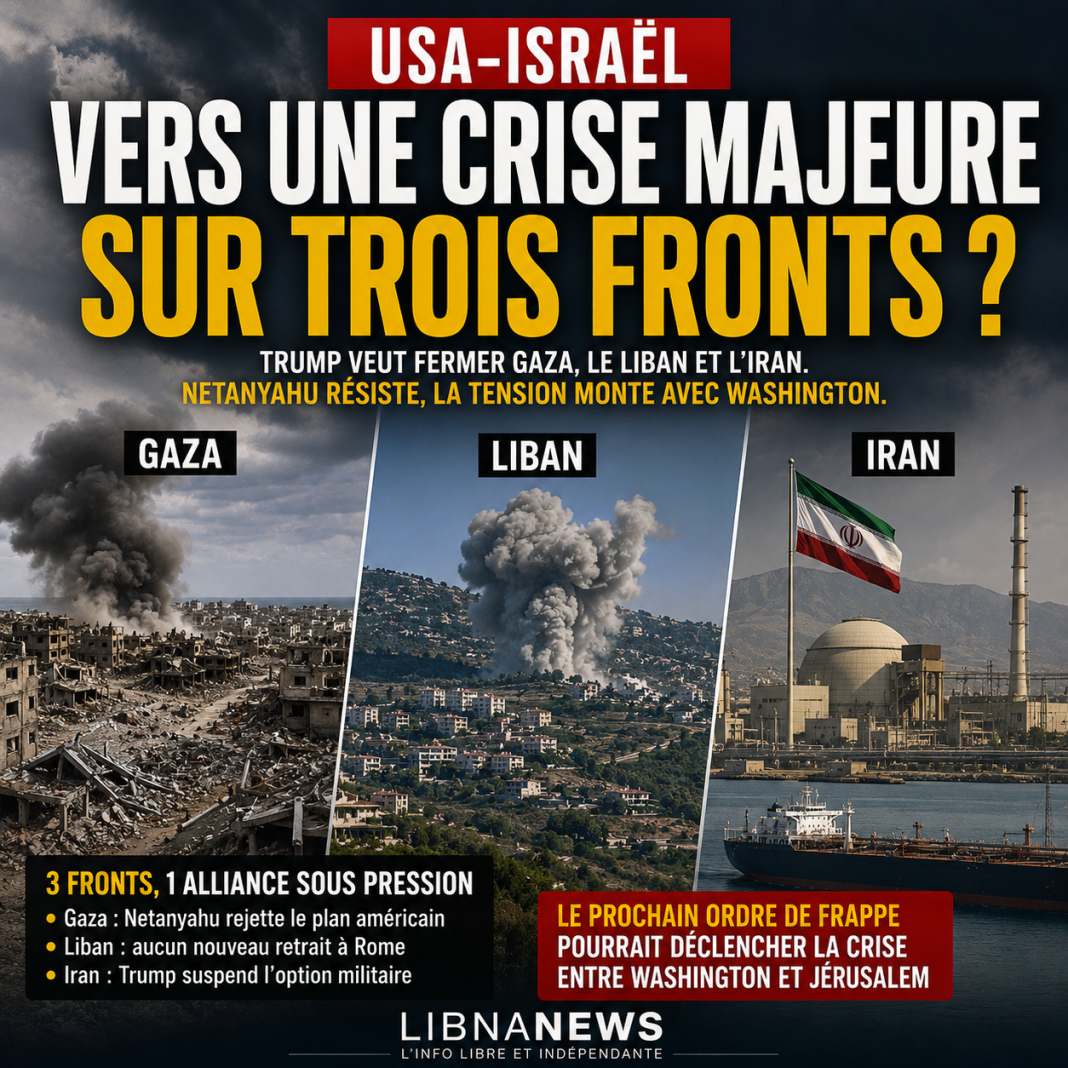
The issue becomes all the more pressing as the regional situation evolves. Israel maintains several open fronts and Benjamin Netanyahu’s government is preparing for domestic political deadlines. In this context, postponing a decision on southern Lebanon may be less costly for Jerusalem than taking the risk of a withdrawal contested by some Israeli opinion. For Lebanon, however, each carryover increases the political cost of negotiations. The internally displaced are awaiting conditions for their return, the army must justify the extension of its responsibilities and the authorities must respond to criticisms of concessions already accepted.
Round 8 opens under new conditions
Beirut has few means to change this balance of forces alone. However, it may raise the threshold for concessions it is prepared to grant. The eighth round should therefore be preceded by more precise demands on the next zone, the evacuation schedule and the cessation of Israeli operations in the sectors concerned. Lebanon may also require that international verification be strictly linked to a corresponding evacuation, so that it does not become an autonomous mechanism imposing obligations without territorial counterpart.
This new line responds as much to the failure of Rome as to the weaknesses accumulated since April. The first negotiations were presented as a historic opportunity to get out of the military cycle. Four months later, they produced a framework agreement and technical mechanisms, but not yet the additional withdrawal Beirut wanted in round seven. The continued Israeli strikes, the lack of a firm timetable and the possibility for Israel to condition each evacuation with new guarantees make the process more difficult to defend in Lebanon.
The Sehnaoui controversy adds an additional constraint. It does not conclude that the Lebanese negotiators would have acted on its behalf, and no public evidence establishes such an operational relationship. But the statement published about his role in the appointment of Nada Hamadé Mouawad, combined with the judicial proceedings opened after his dinner with Netanyahu, has placed the issue of the influences surrounding the negotiations at the centre of the debate. In order to prevent this suspicion from further weakening the process, Baabda and the Great Serail have an interest in imposing a simple rule on the next round: any new Lebanese guarantee must correspond to an identifiable Israeli measure.
The beginning of September will therefore be a more political than a technical deadline. The list of States that could participate in the verification process could be further refined, but it would no longer be sufficient to present the meeting as a success. Beirut is now awaiting a response on the ground. Bint Jbeil and Khiam remain among the advanced options for the next pilot zone. After the failure of Rome, the eighth round will tell whether the 26 June mechanism actually reduces the Israeli presence or whether it serves primarily to organize new conditions before each withdrawal.