

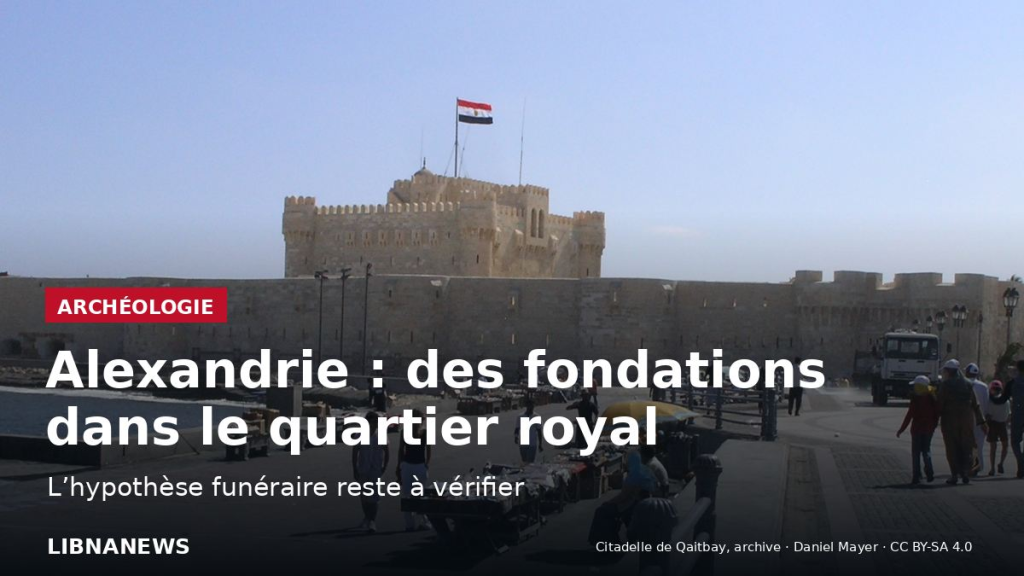
A Greek team discovered the foundations of an important limestone building and a tunnel in the Shallalat gardens in Alexandria. The Egyptian Ministry of Tourism and Antiquities places the remains in the royal quarter of the ancient city. A funeral function is envisaged; The identity of the building remains unknown.
The mission, led by archaeologist Calliope Limneos-Papakosta for the Hellenic Institute for Research on Alexandrian Civilization, has been working in this sector for nearly twenty years. The report published on 24 November by the Egyptian State Information Service describes the foundations of a building surrounded by walls. A tunnel passes under construction heading north. The authorities did not specify where it was or did it belong to the same state of construction as the walls.
The shape of the building guides research
Following the mission’s report, Minister Sherif Fathy appointed a committee to review the site. The group, chaired by archaeologist Ayman Ashmawy, included specialists from the universities of Alexandria and Tanta. According to its initial findings, the square plan and the size of the foundations indicated that they had a large building. The location counts as much as the dimensions: it brings a material landmark to reconstruct an area where ancient texts locate several buildings of the courtyard.
What Strabon allows to search, not identify
The committee does not rule out a funeral function. If confirmed, a trail would be that of royal tombs associated with the reign of Ptolemy IV Philopator, between 221 and 204 B.C.E. The geographer Strabon described in hisGeographythe Sema, an enclosure of the palace complex which housed the tombs of kings and that of Alexander. This testimony places the funeral complex in the Royal Quarter; It alone does not allow the foundations discovered to be attributed to this complex.
The ministry did not announce any identified burial chamber, nor did it name a sovereign, nor did it discover Alexander’s grave. The works must now specify the dating of the building, the function of the tunnel and the links between the exposed walls and neighbouring structures. It is these clues that will allow the funeral hypothesis to be separated from the other possible uses of the building.





Comments