

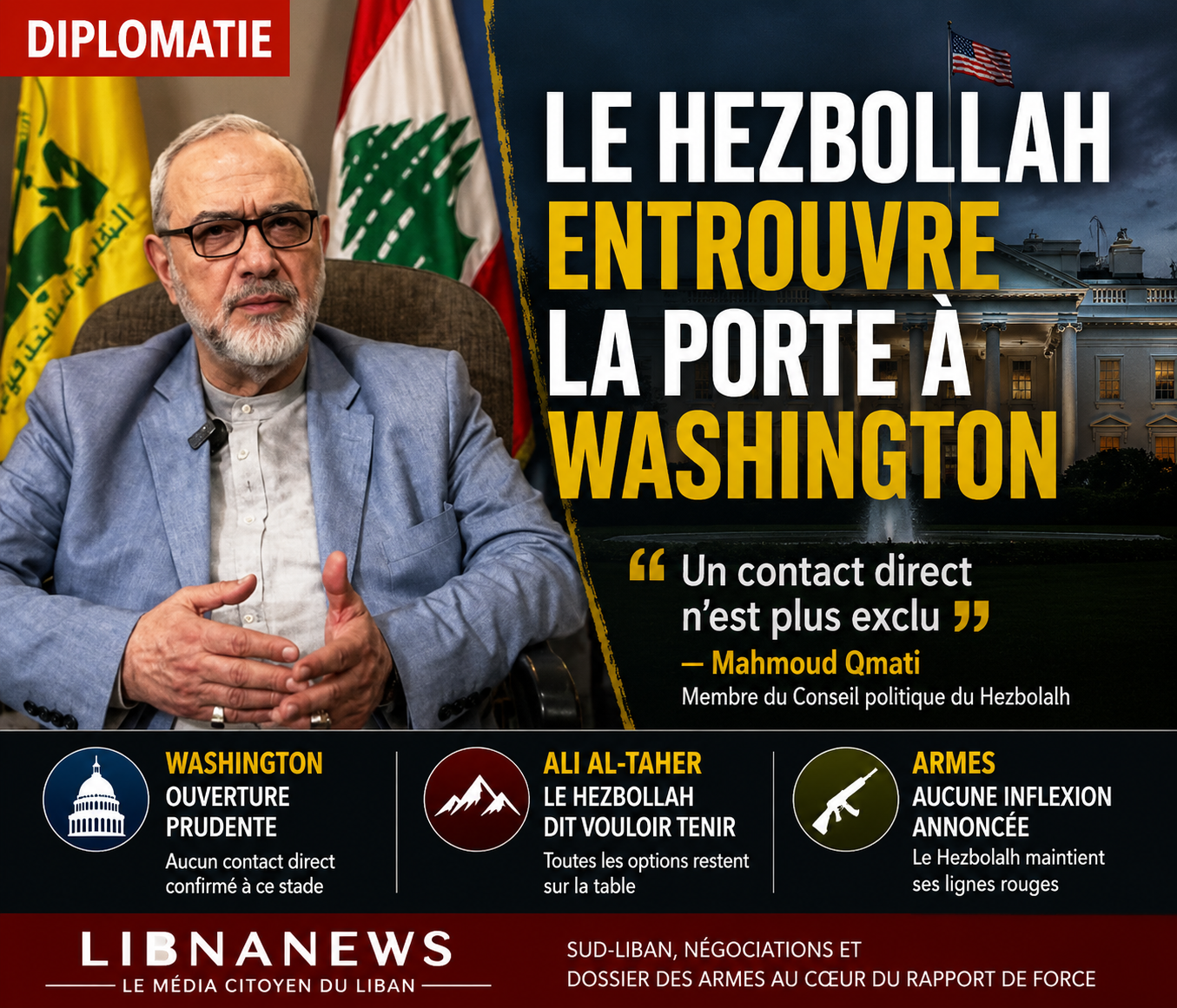
Hezbollah has opened the door to possible direct contact with Washington, without announcing any decision or timetable. Mahmoud Qmati, a member of the political council of the party, said on the night of 23-24 August that this option was not completely excluded and that it would depend on the interest of the movement and the circumstances. This inflection comes as the United States remains at the centre of diplomatic efforts around Lebanon, Israeli strikes continue in the South and the issue of Hezbollah weapons remains at the heart of the balance of power between the party, the Lebanese state and Israel.
In a television interview, Mahmoud Qmati presented this opening with caution. He did not announce the existence of an official channel with the US administration or confirm direct discussions. He only indicated that Hezbollah did not permanently close the door to this possibility and that the decision would be made according to the party’s interest and context. The nuance is important: the statement does not constitute a rapprochement with Washington, but it breaks with a public posture long marked by the refusal of a direct exchange with the United States.
At the same time, the Hizbullah leader stressed the movement’s willingness to give a chance to the ongoing political process. According to him, « resistance » has decided to show patience in order to allow diplomatic efforts to reach what he sees as the priority objective: the Israeli withdrawal from all Lebanese territory. This position is intended to explain the lack of a systematic response to Israeli operations, while strikes and fire continue in several areas of southern Lebanon.
However, Qmati wanted to separate this restraint from a military weakening. He claimed that Hezbollah remained able to act and that its failure to respond to each attack did not mean weakness or disability. He mainly set a red line: any Israeli attempt to move towards new territories or take new positions would, in his view, lead to a response adapted to the nature of developments on the ground. The message thus combines political patience with the explicit maintenance of a response capacity.
Hezbollah opens a door without changing lines
The declaration on the United States is the most new element of Mahmoud Qmati’s intervention. It intervenes in a context where Washington plays a direct role in the discussions on Lebanon’s security, Israeli withdrawal, the deployment of the Lebanese army and the Hezbollah weapons file. United States officials have also argued in recent weeks for actors able to influence the situation to be integrated, directly or indirectly, in efforts to avoid further expansion of the conflict.
The opening mentioned by Qmati does not mean that Hezbollah is changing its strategic position towards the United States. The party continues to accuse Washington of supporting Israel politically and militarily and remains subject to US sanctions. Qmati said that the sanctions and the « financial blockade » would not lead Hezbollah to abandon what it calls its resistance project. The possibility of direct contact would therefore be, in the party’s current discourse, a possible political tool rather than a change of alliance or doctrine.
The Lebanese press noted that Hezbollah had not denied the passage concerning possible direct communication with the Americans. On the other hand, an update attributed to its media relations focused on another element of the interview, relating to the diplomatic framework referred to in order to achieve Israeli withdrawal. This distinction has reinforced questions about the real scope of Qmati’s words, without allowing at this stage to establish that a direct channel already exists.
The subject is all the more sensitive as Hezbollah has historically favoured intermediaries in its relations with Washington. The President of Parliament, Nabih Berri, has played a role on several occasions in the indirect negotiations with American mediators. In the current context, a possible direct exchange would therefore constitute an evolution of methodology, even if its content, form and objectives remained to be defined.
Ali al-Taher, another central point of Qmati’s message
Mahmoud Qmati’s interview was not limited to Washington. He also approached the heights of Ali al-Taher, east of Nabatiyah, which in recent days became one of the main points of military tension in southern Lebanon. The area has been repeatedly targeted by Israeli strikes, while its control and future are subject to conflicting information and increasing attention in security discussions.
Qmati said that Hezbollah’s current decision was to « hold on » and deal with the situation, while noting that all options for the site were being explored. This formulation leaves open the way in which the movement intends to manage the position if military or diplomatic pressure increases. It intervened after the dissemination of information that a transfer from the sector to the Lebanese army had been envisaged, a version contested by sources close to the ground.
Ali al-Taher is of particular importance because the area is north of the Litani, in an area where the issue of the deployment of the State and the future of Hezbollah military infrastructure is becoming increasingly sensitive. Repeated Israeli strikes on these heights have helped to transform a limited geographical point into political and security issues. The question no longer concerns only the presence of Hezbollah on strategic terrain, but also the ability of the Lebanese army and State to impose a formula that would avoid an extension of Israeli operations.
In this context, Qmati also categorically denied the presence of Iranian fighters in the Hezbollah ranks in southern Lebanon. This statement responds to repeated accusations and speculations about the direct involvement of Iranian personnel alongside the movement. The official wanted to maintain the distinction between Iranian political and military support for Hezbollah and the physical presence of Iranian fighters on the Lebanese front, which he denies.
Weapons remain at the heart of the arm
The question of possible contact with Washington cannot be separated from the weapons file. For the Lebanese Government and its international partners, the extension of State control and the role of the army in the South are central elements of the settlement sought. Israel, for its part, regularly links the cessation of certain operations with guarantees concerning Hezbollah’s military capabilities.
Qmati rejects this sequence. It considers that the issue of Hezbollah’s weapons would, in its terms, create an infringement of Lebanon’s sovereignty and rights as a condition for Israeli liberation or withdrawal. The party contends that the Israeli withdrawal must take place independently of the internal debate on its arsenal and refuses that it should be used as a prerequisite for the evacuation of positions that Beirut considers Lebanese.
This divergence is one of the main obstacles to the political process. The Government is seeking to strengthen State authority while demanding an end to Israeli operations and the withdrawal of the remaining occupied territories. Hezbollah asserts that it cannot accept disarmament as the Israeli army maintains positions in Lebanon and continues its strikes. On the contrary, Israel considers that the movement’s military capabilities constitute a threat that justifies its continued operations.
The possibility of a dialogue with Washington thus appears in an environment where substantive positions remain distant. While the United States has a significant influence on Israel and plays a mediation role, it also maintains a policy of sanctions against Hezbollah. For the party, any possible exchange should thus meet a concrete objective without being presented as political normalization.
A patience claimed under military pressure
Qmati’s speech finally seeks to explain the current conduct of Hezbollah in the face of Israeli strikes. By saying that the party chose patience to give the political process a chance, the leader tries to present the military restraint as a voluntary and temporary decision. This justification comes at a time when the absence of a response to certain attacks is fuelling a debate in Lebanon on the real capabilities of the movement after the losses suffered during successive conflicts.
Hezbollah refuses this reading. Qmati states that military capability remains and that the response depends on the nature of each event. The threat of an Israeli response to new positions is used to publicly set the threshold beyond which the movement considers restraint no longer possible. However, this line remains exposed to the daily evolution of the terrain, particularly around Ali al-Taher and areas subjected to repeated strikes.
The choice not to completely close the door in Washington now adds a diplomatic dimension to this strategy. Hezbollah seeks to maintain its discourse of confrontation with Israel and refusal of disarmament under pressure, while leaving open the possibility of a channel with the power that has the greatest leverage on the Israeli government. At this point, there is no indication that a direct dialogue has started or that a decision has been taken.
The scope of Mahmoud Qmati’s remarks will therefore depend on his concrete follow-up. A formal contact with Washington would be a notable development in the Hezbollah method, while a lack of follow-up would bring the declaration back to the status of a political signal sent in a phase of strong military and diplomatic pressure. In the immediate future, the party maintains at the same time three positions: giving the political process a chance, retaining its weapons and its ability to respond, and no longer completely excluding a direct exchange with the United States if the circumstances seem favourable.




