

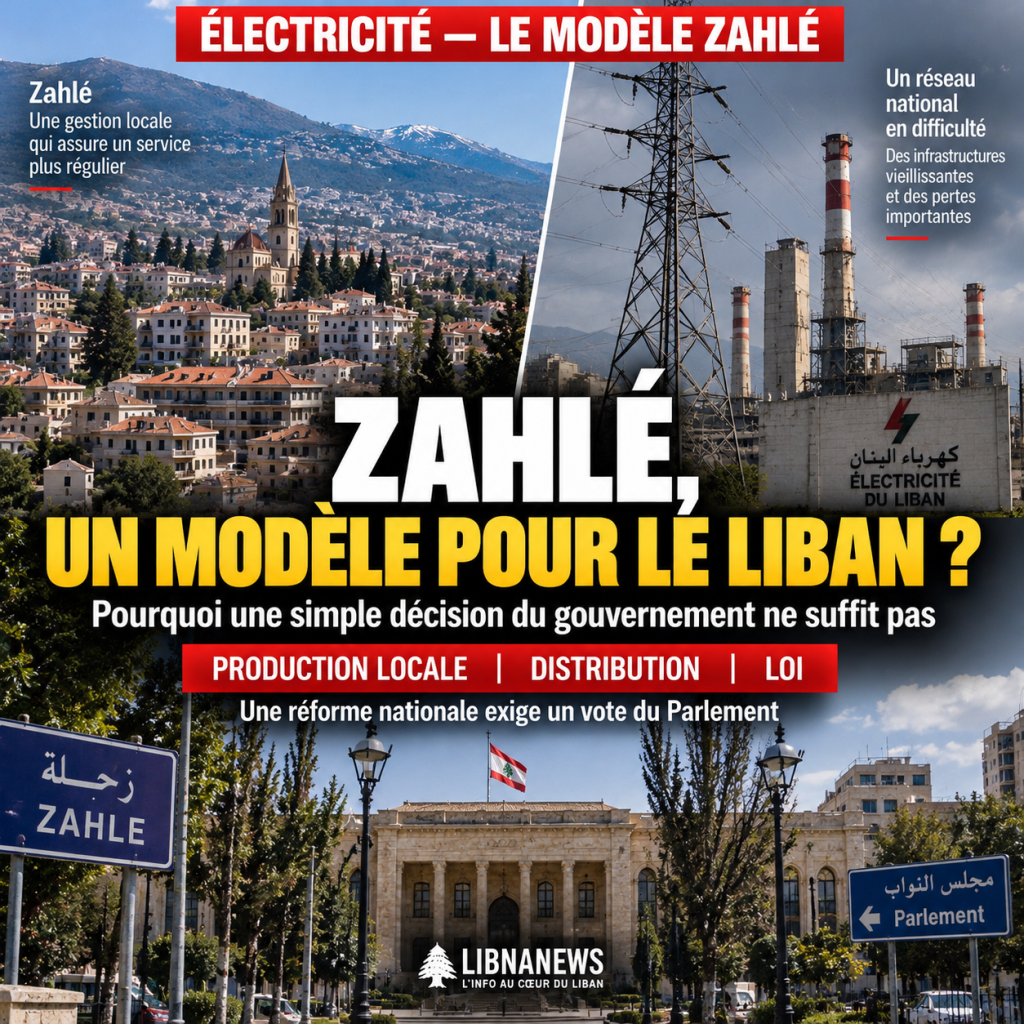
Decentralization in the crisis between Salam and the Lebanese Forces
The debate on Lebanon’s electricity future took an institutional turn in the midst of the conflict between Prime Minister Nawaf Salam and the Lebanese Forces. A political analysis published on 8 October 2026 defends a precise thesis: the immediate solutions demanded around the Ministry of Energy are not enough to correct the sector. It proposes to move part of production and distribution to local structures, taking Zahlé’s experience as a reference. Above all, she says that such a change requires a law passed in Parliament. The problem, therefore, is not just to convince a minister or to release funds. It is to define who can produce, sell and distribute electricity, under what authority and with what obligations to users.
This proposal appears as Joe Saddi suspends his participation in the meetings of the Council of Ministers. The Lebanese Forces blamed the executive for not taking measures that could alleviate the invoices. Parliamentary circles reply that these responses relate to cash or pricing adjustments, not structural reform. The reference to Zahlé is thus used to shift the controversy: instead of wondering just how much the State should pay to its electrical establishment, it invites us to examine the organization of the service itself. However, the publication does not provide a draft law, a national contractual model or a numerical study showing that a reproduction of the scheme would be possible in all regions.
Three hundred million dollars: a debt is not a new plant
The $300 million figure is the first test of this opposition between urgency and reform. It corresponds to the arrears that public administrations and institutions should have at Electricity in Lebanon, according to the political information reported. Their payment would potentially strengthen the institution’s cash flow. But a cashed recipe does not create additional production capacity on its own. An installation stopped due to a lack of maintenance, a saturated network or technical losses does not disappear when invoices are paid. This is the criticism expressed in the analysis: under the conditions described, the sum could above all be used to buy additional fuel without lasting transformation of the system.
However, the two effects should not be confused. An improvement in cash flow may be useful to avoid service interruptions or to fund one-time supplies. It does not prove that structural reform is unnecessary. Conversely, announcing decentralization without explaining how initial investments will be financed does not solve the short-term cash flow problem. The documents examined do not disaggregate the $300 million by debtor administration, seniority of invoice or likelihood of recovery. They also do not detail the cost of a local power plant, network link or counting system. Without these elements, comparing the repayment of arrears with decentralized reform remains a debate of principles, not yet a verifiable budget arbitration.
What Zahlé’s model really asks as questions
The reference to Zahlé refers to a local electrical supply organisation. But the term « model » covers several functions that must be separated: producing energy, buying from a producer, transporting it, distributing it, raising meters, billing and recovering payments. A region can better organize distribution without having all its own production. Conversely, installing a production unit does not guarantee the quality of the network or the payment of invoices. In order to know what could be replicated, it would therefore be necessary to identify exactly what functions are performed locally and how they relate to the national network.
Transposition is then a problem of scale. A relatively concentrated city does not have the same constraints as a mountainous region, a set of scattered villages or a large agglomeration. Line length, customer density, business needs, network losses and payment capacity vary greatly. Identical pricing could generate very different revenues across jurisdictions. A decentralised mechanism must therefore specify how the areas that are costly to serve would continue to benefit from an acceptable service. Without a mechanism of solidarity, reform could increase the gap between communities rather than ensure national improvement.
Why a law is at the centre of the debate
The assertion that the reform requires a parliamentary vote is one of the most concrete elements of the analysis of 8 October. It refers to a question of competence: a decision by the Council of Ministers can guide energy policy, but it is not necessarily enough to redefine production, distribution and billing rights in a sustainable manner. The future framework should determine the conditions for authorisation of operators, obligations for continuity of service, charging rules and control mechanisms. It should also clarify the financial relationship between local structures and electricity in Lebanon.
A credible text should include which invests, bears losses and intervenes when a local operator no longer fulfils its obligations. The rights of subscribers, the procedures for challenging invoices and penalties for default should be defined. Access to the national network, technical coordination and continuity of service in the event of failure must also be addressed. None of these provisions are detailed in the proposal. It would therefore be incorrect to present decentralization as a legislative plan that has already been finalized: it appears here as a policy pursued in a political debate.
Tariff and generators: an incomplete comparison
The government dispute also concerns a fixed charge of 300,000 Lebanese pounds mentioned in the bill reduction proposals, as well as the idea of an evolutionary pricing. These measures may reduce certain subscriptions, but they alone do not say anything about the full cost of production and distribution. An invoice contains different components: the energy actually consumed, the power subscribed and the operating costs of the service. Changing a component without measuring its weight in revenue can create a shortfall that will have to be offset elsewhere.
The use of private generators further complicates comparison. Households sometimes carry several bills to cover their needs. A more reliable public network could reduce this accumulation, but the economy would depend on the actual hours provided, the cost of energy and the conditions of private subscription. The available sources do not present homogeneous series comparing, territory by territory, the final price paid by households. They therefore do not make it clear that the Zahlé model would lead everywhere to a definite reduction in expenditure. This promise should be tested using actual invoices and separate consumption profiles.
The conditions for controllable experimentation
A Zahlé-inspired reform could be evaluated without assuming its success. The first step would be to publish an inventory by area: hours of service, consumption, technical and commercial losses, maintenance costs, amounts invoiced and actually cashed. It would then be necessary to define an experimental scope and sufficient time to observe the results, including during periods of high demand. The comparison should cover identical indicators before and after the change in organization. Otherwise, any improvement could be wrongly attributed to decentralization, whereas it would result, for example, from a temporarily more abundant supply.
The second would be an explicit allocation of risks. If the local operator invests, how does it recover its capital? If the State guarantees the revenue, what is the charge on its account? If tariffs are capped, who pays the difference with the actual costs? These questions affect the viability of the system much more than its name. They also explain why the file goes beyond the prerogatives of the Minister of Energy. Parliament, public finances, communities and supervisory authorities should intervene within a coherent framework.
A political proposal, not yet a reform ready to implement
On 8 October 2026, the available documentary evidence established the existence of a debate on the decentralization of production and distribution, with Zahlé as an example cited. They also establish the presence of immediate claims on arrears and tariffs. On the other hand, they do not provide the content of a bill, a timetable for implementation, an investment budget or an independent assessment of the performance of the local model. These shortcomings do not render the track irrelevant; They simply prevent the announcement of results as acquired.
The disagreement between Nawaf Salam and the Lebanese Forces finally reveals two distinct levels of decision-making. The government can look for quick solutions to improve supply and reduce certain burdens. A territorial restructuring of the sector requires sustainable rules on the skills, financing and protection of users. Consolidating these two horizons would lead to a request for a tariff measure to repair the entire system, or to presenting an institutional reform still indefinite as an immediate response to the cuts.





Comments