

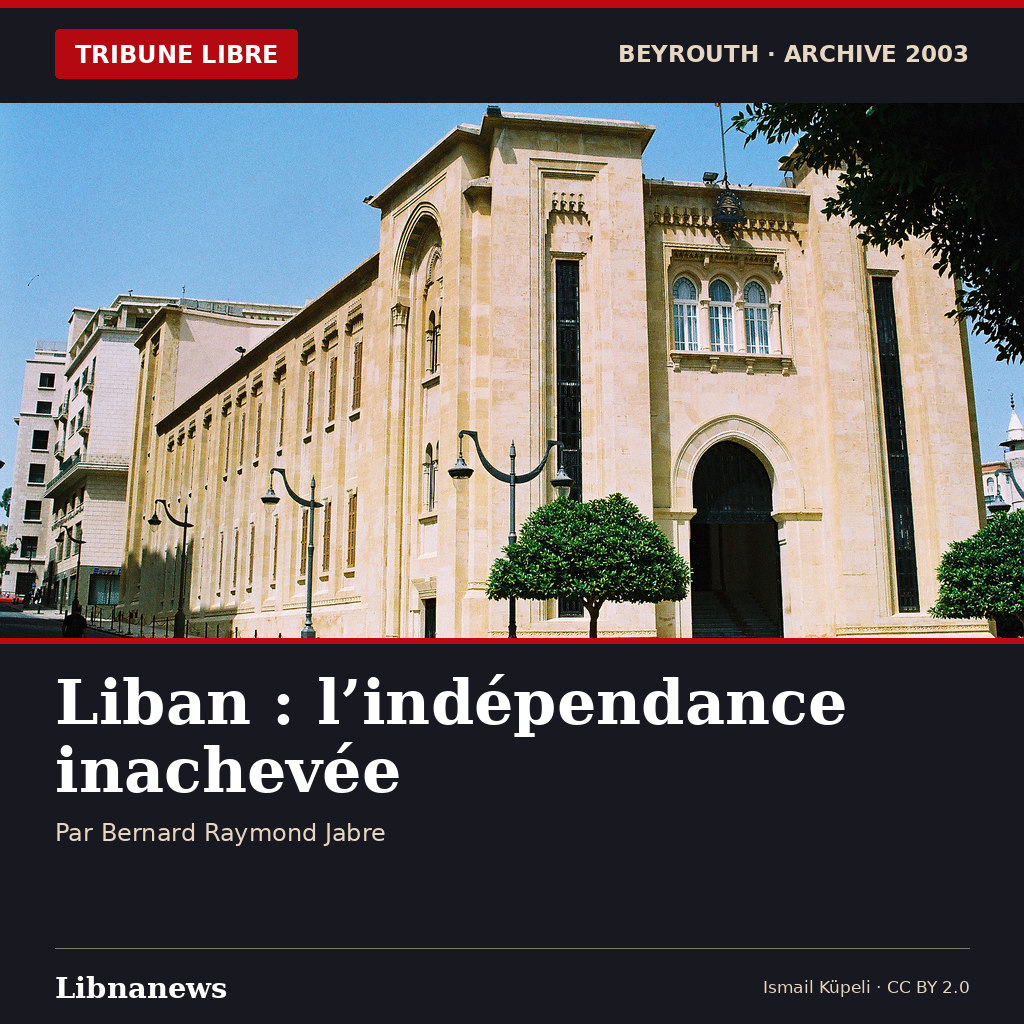
When the Homeland passes before the Ummas
« We can have several belongings. We can only have one sovereignty. »
On 22 November, Lebanon celebrates its independence. But one question remains, more than eight decades after 1943: have we become independent, or have we only achieved independence?
The difference is huge. Legal independence can be proclaimed in one day. Political independence requires a people to decide its own destiny.
A State is sovereign when no one can decide war or peace in its place; where no foreign power has an autonomous military relay in its territory; when no community considers that external fidelity is greater than the fidelity due to the homeland.
And especially when there is only one sovereignty, one legitimacy and one national armed force in its territory. Perhaps this is where the whole Lebanese question begins and ends.
« We can have several belongings. We can only have one sovereignty. »
I. LEBAN IS NOT ONLY A TERRITORY
A homeland is not just a border drawn on a map. It is a will: a will to continue together.
The Lebanese Patria exists precisely because, despite wars, invasions, occupations, economic crises, community clashes and foreign intervention, the Lebanese continue stubbornly to want to live on this land. They rebuild, invest, educate their children, leave and come back, create and start over.
There is an extraordinary will for life in Lebanon. It crosses communities. It belongs to the Christian as to the Muslim, the Sunni as to the Shiite, the Druze as to all who make up this singular society.
In particular, we must stop confusing the Shiite citizens of Lebanon with a foreign organization, ideology or power. The Shiite citizen who wants to live safely in Nabatiyah, Tyre, Baalbek or in the southern suburbs of Beirut is no less Lebanese than the one who lives in Tripoli, Zahlé, Ashrafieh, Aley or Becharre.
The Homeland begins when the life of a Lebanese child has exactly the same value, regardless of the community in which he was born.
II. HERITAGE AND UMMMA: TWO ORDERS THAT MUST BE DISTINGED
Religion is not the enemy of the homeland. Faith belongs to consciousness. The community belongs to history. Culture belongs to memory. All this can enrich Lebanon.
The problem begins when religious, ideological or geopolitical affiliation becomes a supranational political allegiance. It is in this precise sense that I use the word Umma here: not to refer to a particular religion, but to any supranational affiliation that purports to impose political fidelity superior to that due to the homeland.
So there may be Sunni or Shiite Ummas, but also Jewish, Christian, nationalist, revolutionary, ideological, imperial or military. The problem is never what they believe. The problem begins when they claim to command.
One can be Christian and Lebanese, Shiite and Lebanese, Sunni and Lebanese, Druze and Lebanese. We can love France, Iran, the Arab world, America or any other civilization. But when it is necessary to decide on war, peace, borders, diplomacy or the use of weapons, only one question must remain: what serves Lebanon?
« We can have several belongings. We can only have one sovereignty. »
III. LIBANAIS HERITAGE: WHAT DATA SAY
It would be tempting to say that 95% of Lebanese believe in this Patria. No serious survey now makes it possible to establish such a figure scientifically. It is stronger to rely on what is verifiable.
A Gallup survey published in December 2025, based on interviews conducted in June and July, indicated that 79 per cent of respondents wanted only the Lebanese Army to hold weapons. Support was 92% among Christians, 89% among Druze and 87% among Sunnis. Gallup also noted very high confidence in the army at the national level.
These data do not suggest that 95 per cent of Lebanese share exactly the same political doctrine. They nevertheless show a very broad national aspiration for the State, its authority and the monopoly of legitimate force.
IV. A QUESTION OF SOVEREIGNTY IS CENTRAL
After the considerable destruction suffered by the South and many Shia families, the question is no longer abstract: who should decide, tomorrow, war and peace for their children?
A September 2026 Statistics Lebanon survey of 800 Shiite citizens, the results of which were reported in October 2026, indicates that 71.1% want the decisions on war and peace to be made exclusively by the Lebanese State; 66.4% believe that Hezbollah weapons should be handed over to the State in some form; 78.5 per cent say they trust the Lebanese Army.
These figures do not mean that more than 75 per cent of Shiites would simply be « against Hezbollah ». Such an assertion would exceed the available data. They say something deeper: one can preserve an identity, memory or even political sympathy, while considering that weapons, war and peace must return to the state.
« We can have several belongings. We can only have one sovereignty. »
V. IT IS TIME FOR ALL EXTERNAL ALLEGANCE TO BE A MILITARY ALLEGANCE
Relations with Iran may exist. Religious affinities may exist. Cultural, diplomatic and economic ties may exist. But no foreign power should have, directly or indirectly, an autonomous military capability on Lebanese territory.
This is not just Iran. It must be universal. No foreign power – Iranian, Israeli, Syrian, Arab, Western or other – should be able to have in Lebanon any men armed with an authority outside the State.
After so many deaths and destructions, it is legitimate to say: enough of the wars decided elsewhere; enough Lebanese villages transformed into regional battlefields; the military decisions to which the people and institutions of the Republic have not consented.
VI. A SINGLE ARMED ON ALL THE TERRITORIES
The issue of arms is not a community issue. The real question is, who has the right to use force on behalf of the community? In a sovereign State, the answer can only be the State, within the framework of the Constitution and the law.
There can therefore be only one legitimate military power in Lebanon: the Lebanese Army. This principle should apply to all militias, armed organizations, mafia and autonomous military structures, without exception.
It must also apply to Palestinian camps. The inhabitants of the camps must maintain their dignity and human rights; But the camps are under Lebanese sovereignty and cannot constitute military enclaves escaping the State.
This movement has already begun: in 2025, several phases of the handing over of Palestinian weapons were held in the custody of the Lebanese Army, including Rashidieh, Al-Bass, Burj al-Shimali, Baddawi and Ain al-Hilweh, including heavy weapons lots. In November 2026, the Lebanese-Palestinian Dialogue Committee reaffirmed that the camps were under Lebanese sovereignty and that the process should continue.
VII. DISARMAMENT WITHOUT HUMILIER
The return of all weapons under state authority must never be seen as the victory of one community over another. It would be preparing for the next conflict.
To Shia citizens, the state must be able to say: we do not want to weaken you; We want to build a state strong enough that you no longer need a particular organisation to protect your families and villages.
And other communities must accept exactly the same rule. No Christian militia. No Sunni militia. No Druze militia. No Shiite militia. No private army. No state in the state.
A Republic. An army. Sovereignty.
VIII. AN ARMED STRESS TO PROTECT ALL LIBANAIS
If citizens are asked to return their security to the State, that State must be able to protect them. The Lebanese Army must have the human, technological, military and financial means to effectively defend the territory and the people.
The Southern citizen must be able to look at his army and think: it protects my house, my village, my family and my border; I don’t need any other army. The same must be true in the Bekaa, the North, Beirut and the mountains.
Sovereignty is not decreed. She makes herself credible.
IX. INDEPENDENCE IS THE CAPACITY TO SAY NO
Being independent does not mean being hostile to the world. A sovereign country can be friends of all because it is nobody’s vassal.
Lebanon must be able to cooperate with Iran, the Arab countries, Europe, the United States, Turkey, China and all those with whom its interest commands to work, while refusing to have one decide in its place.
And if the conditions for a just, secure and lasting peace are met with its neighbours, Lebanon must be able to examine and build them according to its national interest, security and international law – not because an external power imposes its will.
Being the enemy of no one. Being friends with those we choose. Being nobody’s vassal.
X. THE REAL LIBANAIS COVENANT
Perhaps we have been looking too long for the Lebanese pact in the division of presidencies, the number of Members or the balance of administrations. These mechanisms are important, but none can replace a deeper pact: an internal pact.
I can have a religion. I can belong to a community. I can keep a memory. I can love a foreign civilization. I can defend my convictions. But when collective destiny is at stake, my first political loyalty goes to Lebanon.
The Patria does not suppress communities: it protects them. When the state is weak, each community seeks a sponsor; Each sponsor gradually transforms his protégé into an instrument. Fear produces external allegiance; external allegiance weakens the state; The weakening of the state produces more fear. We have to break this circle.
XI. BEYROUTH WESTPHALIA: THE NEW COVENANT
The Patria answers the question of sovereignty. The Westphalia of Beirut must respond to that of coexistence: how can different beliefs, different memories and also the right not to believe in one state be brought to life, without one of these belongings being able to seize the state or fear being crushed by others?
The idea is that of a new Lebanese pact: not abolish religions, but clearly separate the belief from the political decision. Faith remains free, protected and respected. The Republic belongs to all its citizens and does not receive its political mandate from any religious authority, foreign power or supranational Umma.
The Westphalia of Beirut would therefore not be a war against the communities. It would be the pact that finally allows them to stop being afraid of each other. It would constitutionally guarantee the political, civil, cultural and religious rights of all minorities – Christian, Muslim, Druze or others – but also citizens without religious affiliation or who choose not to claim any.
The majority governs; She doesn’t own the country. The minority is protected; It has no permanent veto power over the nation. Between the two must be the Constitution: strong enough to prevent the domination of the number, but common enough to prevent the fragmentation of the country.
Such a pact requires common political citizenship, independent justice and effective constitutional guarantees. Issues relating to fundamental freedoms, identity and the rights of communities or minorities should benefit from strengthened protection mechanisms, so that no group can be politically erased by a mere ratio of population forces.
Thus, separating belief and politics does not mean driving God out of society. This means preventing a man from speaking in the name of God to command politically all others. The Republic protects believers precisely because it does not politically favour any belief; It also protects those who do not believe.
This Beirut Westphalia would be both Lebanese and universal: an agreement whereby each community renounces its search for security in an external power in exchange for the guarantee, by the State and the Constitution, of its existence, freedom and rights.
From this moment on, the central sentence of our independence makes sense:
« We can have several belongings. We can only have one sovereignty. »
Several beliefs, but a citizenship. Several communities, but a Republic. Several memories, but a common future. Several belongings, but only one sovereignty: Lebanon.
XII. PEACE COMMENCE IN THE INTERNAL
The first peace to be built is inner. It begins when one Lebanese is more afraid than another Lebanese is more loyal to a foreign power than to him.
When the Christian knows that the Shia will not be ordered to drag him into a war; when the Shiite knows that the Christian will not ask a foreign power to come to protect him from him; When Sunni and Druze know that their security depends on the same national institutions, something huge becomes possible: trust.
And without trust, there is no nation.
XIII. THE LEBAN D’ABORD
We have been looking for a solution to the Lebanese question for almost a century. Perhaps it finally stands in a hierarchy: Lebanon first.
This does not mean Lebanon against the world. This means Lebanon master of its choices in the world. Not Iran first. Neither Israel first. Not Syria first. Not Arabia first. Neither France. Not America. Neither the West. Or the East. Lebanon.
Foreign powers can only exploit the fractures of a country for a long time if its inhabitants allow them to become entry gates. Let us close these fractures, not by removing our differences, but by placing above them something we all have together: the Homeland.
XIV. INDEPENDENCE
We have obtained our flag, our institutions, our Constitution and our place in the concert of nations. We have yet to achieve the most difficult part of independence: building it within ourselves.
True independence will happen on the day when no Lebanese will accept that a foreign power decides for it simply because it shares its religion, ideology or interests; the day when no weapon is stronger than the law; the day when no community will need an outside protector; the day on which the decision on war and peace will belong exclusively to the institutions of the Republic.
« We can have several belongings. We can only have one sovereignty. »
CONCLUSION — PATRY BEFORE THE UMMAS
The Westphalia of Beirut can be the name of this new pact: to protect all beliefs and minorities, to separate faith from political power, and to unite all citizens under a single sovereignty.
Before our communities, Lebanon. Before our parties, Lebanon. Before our protectors, Lebanon. Before our Ummas, Lebanon.
The Republic before the militias. The Lebanese Army before all special armies. Peace before the wars of others.
LEBAN.
Because we can have many belongings, several cultures, several memories and several friendships. But politically, we cannot belong to two sovereigns. When this evidence becomes a common principle, sovereignty will cease to be only an article of the Constitution: it will become a collective will, a will for peace, a will for independence, a will for life. The Lebanese Patria.
FEATURES AND SOURCES
Gallup, 4 December 2025 — . National survey conducted in June-July 2025: 79 per cent in favour of holding arms only by the Lebanese Army; 92% of Christians, 89% of Druzes, 87% of Sunnis. Gallup states that the areas excluded due to lack of access accounted for about 10% of the population.
Statistics Lebanon, September 2026 survey of 800 adult Lebanese Shia citizens — results reported in October. 66.4% favouring the handing over of Hezbollah weapons to the State in some form; 71.1% for war and peace to be exclusively State-owned; 78.5% confidence in the Lebanese Army.
Lebanon-Palestinian Dialogue Committee (LPDC), 28 August and 13 September 2025; 30 December 2025; November 2026. Successive handover of Palestinian weapons to the Lebanese Army and reaffirm the principle of State sovereignty over the camps and the exclusivity of arms in the hands of legitimate institutions.
Editorial Note: figures are presented as results of dated surveys and not as absolute truths. The text deliberately distinguishes the author’s political thesis from the empirical data available.
Clarification of drafting: In the 2025 Gallup survey, 27% of Shia respondents said they were in favour of only the army being allowed to hold weapons. The question, period and sample differ from the 2026 survey. The two surveys therefore do not measure a trend at constant scope.





Comments