

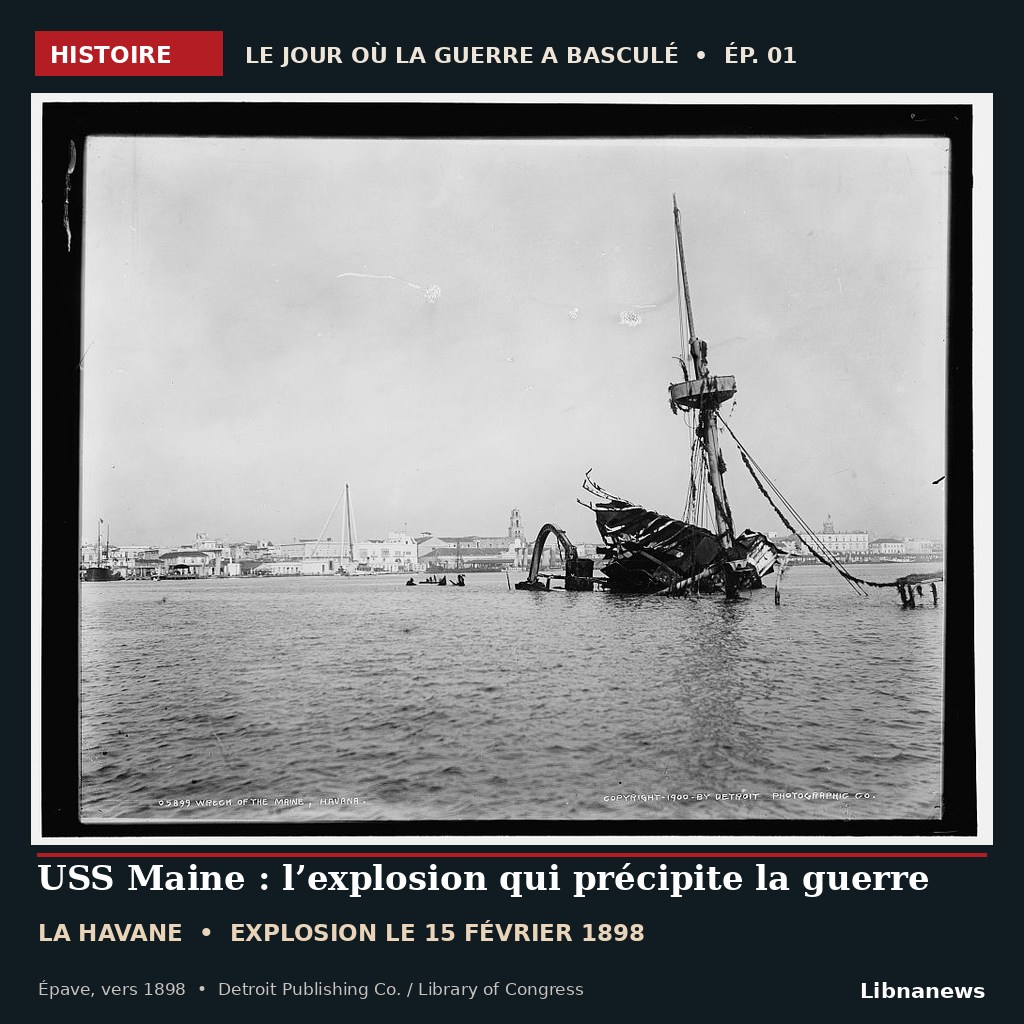
On 15 February 1898, the American battleship USS Maine exploded in the port of Havana. The cause of the USS Maine explosion remains under discussion. In a Cuba that was already at war for its independence, the disaster accelerated the confrontation between Washington and Madrid. Two months later, the United States entered into a conflict from the Caribbean Sea to the Pacific.
The Day War Changed, Episode 1.
On the night of February 15, 1898, Commander Charles Sigsbee telegraphed in Washington. The Maine exploded at 2140 hours in the port of Havana. Survivors are aboard a Spanish warship and an American steamer. There are many wounded. Sigsbee still ignores the fate of two officers. On the point that will soon occupy the first pages, he makes no accusation. On the contrary, he asks that the opinion suspend its judgment.
The first dispatch thus leaves side by side two facts that the rest of the story often separate: an American war building has just been destroyed in a Spanish port, and Spanish sailors are helping its crew. In Washington, shipwreck becomes a foreign policy issue. In Havana, survivors and the dead must first be counted. The shipwreck cost 266 men their lives.
Before the USS Maine, Cuba is already at war
When the USS Maine entered Havana Bay on 25 January, the Cuban independenceist insurrection lasted for almost three years. It resumed in 1895. The insurgents want to end Spanish domination; Madrid is looking to keep the island. So there is already a war, with its own fighters and goals, before the American battleship becomes another symbol.
The policy of reconcentration under General Valeriano Weyler had forced part of the rural population to retreat to localities controlled by the Spanish army. She contributed to a hunger and disease crisis. The offer of autonomy that Madrid expects a calming does not meet the central demand of the independents. For the insurgent Cuban government, it is not a matter of reorganizing the Spanish government, but of freeing itself.
The United States has its own reasons for following the conflict. Cuba is close to Florida, American citizens live on the island and war disrupts trade to which Washington attaches importance. The sending of the ship, which Washington presents as a friendly visit, must signal that the United States intends to protect its nationals and property. In February, Sigsbee can still write that his official relations with the Spaniards are good. This assessment does not say what happened on the 15th; It recalls that the arrival of the building was not a declaration of war.
Two commissions and no established responsibility
The wreck offers traces, but not a story that everyone would read in the same way. An American naval commission, chaired by Captain William T. Sampson, heard the survivors and exploited the findings on the vessel. It concluded in March that an external mine triggered an explosion on board. Then it sets a clear limit to its verdict: the evidence collected does not allow for the attribution of destruction to anyone.
In the report, the mine is therefore a conclusion on the alleged physical origin of the disaster, not evidence against the Spanish Government. Difference is essential. Even if the first proposal is accepted, it does not establish who would have acted, for what reason, or by whom. The commission is not taking that step.
The Spanish authorities are continuing their own investigation. Their commission dismisses the hypothesis of an explosion coming from outside and leans towards an internal cause. However, it concedes that its limited access inside the wreckage prevents it from determining this cause. Washington refused a joint investigation. Both approaches thus produce opposite interpretations of shipwreck, with unequal possibilities for examination. Nor do they demonstrate identifiable human responsibility.
Disagreement survives the war. In 1911, a second U.S. commission took advantage of the clearing of the building to resume the examination. It maintains the hypothesis of a mine, but goes back to part of the 1898 reasoning. In 1976, Admiral Hyman Rickover published a new study based, inter alia, on records and photographs of previous investigations. His team favored an internal accident and considered a coal fire plausible. Investigators are working on old tracks and cannot observe the moment of the disaster. The accident hypothesis remains an interpretation of the traces, not a definitive verdict.
From headlines to Congress votes
The caution of Sigsbee does not last two days in part of the American press. On 17 February New York Journal already presents the disaster as a hostile act attributable to Spain. His one promises a $50,000 reward to help identify leaders. The Sampson Commission did not then return its report. The page reveals nothing about the cause: it shows at what speed the idea of an attack is imposed in a newspaper that campaigns for an American reaction.
It would be tempting to conclude that a press campaign is enough to wage war. The dates tell something else. Between Sigsbee’s telegram and the American declaration, more than two months passed. Meanwhile, diplomats, elected officials and government discuss the future of Cuba. The explosion the press to cut; it does not terminate negotiations. Most importantly, it gives a debate about a nearby war an American event to be put at the forefront.
On 11 April, President William McKinley asked Congress to be able to intervene by force in Cuba. He invokes the plight of the population, the protection of US citizens, the damage to trade and the risk of a permanent crisis near the United States. He also quotes Maine. His argument is not that Spain was found guilty: he uses the destruction of the ship to portray the situation on the island as untenable.
The resolution signed on 20 April calls on Madrid to renounce its authority over Cuba and withdraw its forces. The text also contains a commitment: the United States states that it does not want to retain Cuba’s sovereignty or control after its pacification. The next day Madrid broke diplomatic relations. On 25 April, the U.S. Congress officially observed the state of war, giving effect to it from 21 April. It is this vote, not the night of the shipwreck, that sets the date chosen by Washington.
In Paris, peace far exceeds Cuba
On 1 May, George Dewey’s fleet defeated the Spanish squadron in Manila Bay. The declared war against the Cuban crisis thus reached the Pacific in its first weeks. But the Philippines, too, does not enter history with the arrival of the Americans: Philippine independenceists are already fighting Spanish domination. They do not fight for the archipelago to change its colonial power.
The text signed in Paris on December 10, 1898 clearly states how the issues differ. Spain renounces its sovereignty over Cuba, where the treaty organizes the obligations of the United States during its occupation of the island. On the other hand, it ceded Puerto Rico and Guam to the United States. It also ceded the Philippines, against a treaty payment of $20 million. Renunciation of Cuba and disposals of other territories are included in different articles: the island is not transferred to the United States in the same way as the other three.
In Cuba, the American occupation continued until 1902. The establishment of the Republic does not put an end to the asymmetry created by the war: the Platt amendment frames the new relationship and gives Washington a right of intervention. In the Philippines, the shift is more immediate. On February 4, 1899, American forces and those of the Philippine independenceists clashed. The United States Senate only agreed to the treaty two days later. The war against Spain was settled in Paris. In Manila, fighting resumed, this time between American soldiers and Filipino independenceists.





Comments