

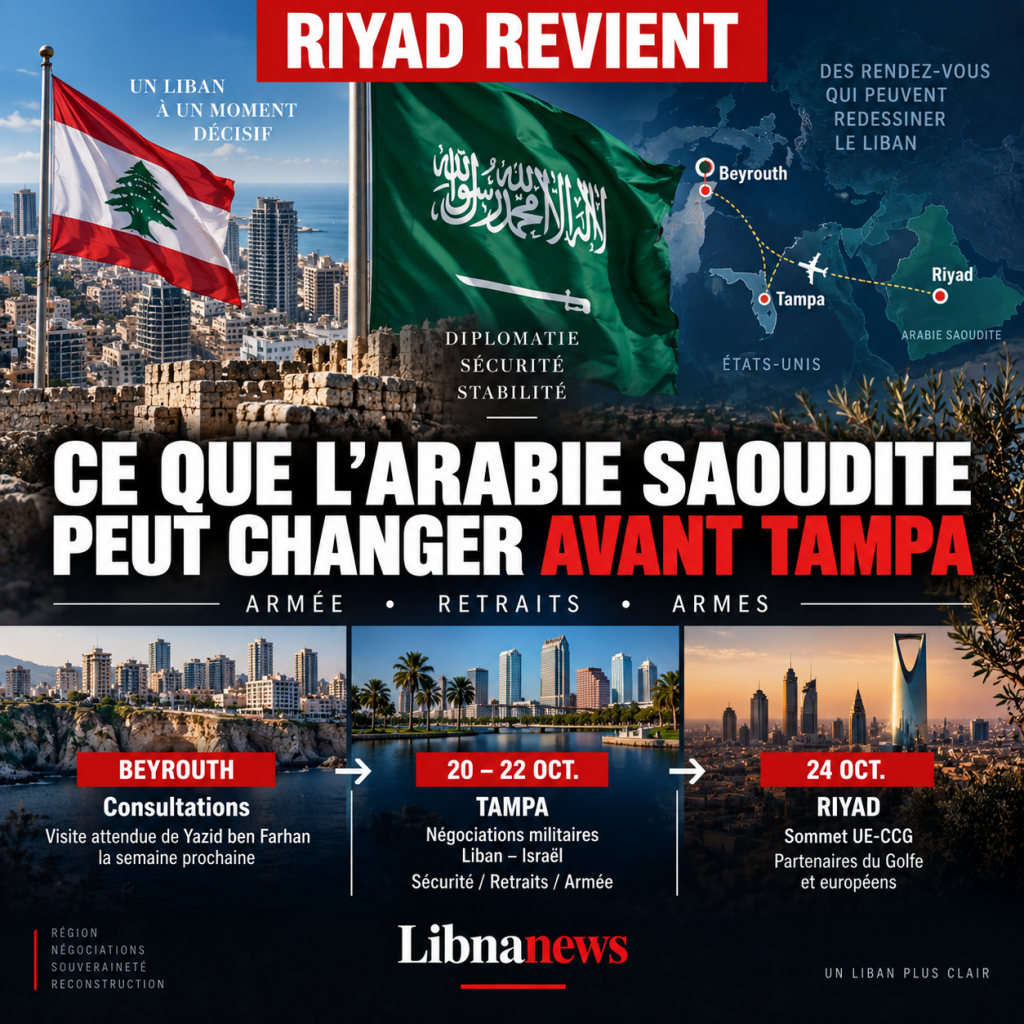
A visit between two decisive appointments
The possible arrival in Beirut of Saudi emissary Yazid bin Farhan comes at a time when the Lebanese file is changing. Military negotiations between Lebanon and Israel are scheduled to resume in Tampa, Florida, between 20 and 22 October 2026. Two days later, on 24 October, Riyadh was to host a summit between the Gulf countries and their European partners. Between these two meetings, Saudi Arabia seeks to retain a capacity to act on a Lebanese issue that has become inseparable from regional upheavals. Ben Farhan’s visit is announced next week, but its definitive confirmation remains linked to developments in the region.
This still conditional character is important. This is not a visit whose detailed agenda has been officially made public. The information available indicates that it should enable the Saudi envoy to discuss the situation of the country with Lebanese officials in the context of regional transformations. On the other hand, they do not allow Riyadh to be given a secret plan or list of applications which would not have been made public. The scope of the visit is mainly reflected in its calendar. It would come as Beirut prepares a difficult negotiation with Israel, the South remains subject to strikes and destruction, and the issue of Hezbollah weapons remains at the centre of American pressure.
The sequence is all the more significant as Saudi Arabia is itself going through an exceptional phase of regional mobilization. Riyadh has just activated with Turkey and Pakistan the military commitments of their defence alliance. The three countries announced the transition to practical implementation of their common obligations, with the deployment of planned forces and capabilities to Saudi Arabia. This decision is based on the resumption of the war in Yemen and the Huthi attacks on Saudi territory. The return of Saudi emissary to Lebanon is therefore not taking place in a diplomatic vacuum. It intervenes at a time when Riyadh simultaneously reorganizes its security, alliances and regional action.
Tampa puts Beirut ahead of an almost impossible equation
The Lebanese delegation will arrive in Tampa with a known difficulty. Washington wants concrete answers on Hezbollah’s weapons. At the same time, Beirut is seeking Israeli withdrawals, advancing the deployment of the army and preventing the establishment of an Israel-controlled, sustainable security zone in the South. These objectives do not necessarily follow the same timetable. That is precisely what makes negotiation complex.
A progressive formula is studied in the circles of power. It would identify areas where the Lebanese army can deploy immediately. Israel would make a limited withdrawal. An army unit would then enter the area, with some form of international supervision. The process could be replicated elsewhere if the first experiment worked. This method aims to break out of the face between two maximalist requirements: a complete settlement of the weapons file before any Israeli withdrawal, or a total withdrawal before any further progress on the Lebanese side.
But the system only works if Washington accepts simultaneity. If the United States considers that a prior and complete commitment to Hezbollah’s weapons is a condition for any Israeli withdrawal, the Lebanese margin is greatly reduced. The risk would then be that the Tampa meeting would produce a limited text or simply maintain the open negotiating channel, without major change on the ground.
In this context, the Saudi presence can have political weight, even if there is no available document to say that Riyadh will enter directly into military negotiations. Saudi Arabia has a close relationship with Washington and a network of Arab and international alliances. It also has a long history of involvement in Lebanese political crises. His interest in the case a few days before Tampa means at least that she does not want to let the future of Lebanon decide exclusively between Washington, Israel, Tehran and Lebanese actors.
The South has become the centre of Lebanese policy
The situation in the South gives the visit an additional dimension. The Lebanese authorities seek to prevent the provisional arrangements from becoming a permanent reality. The destruction of villages, the difficulty of returning the inhabitants and the maintenance of Israeli positions make the territorial issue immediately concrete. Beirut is also preparing a technical dossier on Israeli operations. Maps and images must show the extent of destruction and its consequences for living conditions.
President Joseph Aoun has multiplied the meetings devoted to the South. It stresses support for the inhabitants remaining in their villages and the needs of the displaced. It also links diplomatic efforts to Israeli withdrawal and the principle of State monopoly of arms. Prime Minister Nawaf Salam adopts a similar line on the role of the State. He claims that the people of the South should not feel abandoned and that institutions should be present in all regions, whether they are the South, Akkar or Bekaa.
Salam also wants to make the effects of government action visible. After his visit to Nabatiyah, he discussed the restoration of water and electricity, the renovation of schools and the implementation of the announced projects. He explained that a new visit to Nabatiyah or Tyre should take place when concrete results can be found. This approach is politically important. The government tries to respond to Hezbollah on its own social and territorial terrain, not through direct confrontation with its base, but through an increased state presence.
The displacement of Yazid ben Farhan would thus arrive in a Lebanon where the question of sovereignty is no longer discussed solely from the angle of arms. It also concerns the capacity of the State to provide services, rebuild villages, protect the inhabitants and physically occupy areas evacuated by Israel. For Beirut’s Arab partners, this dimension is essential. A strengthening of State authority cannot be based solely on political decisions if institutions are unable to act on the ground.
Riyadh finds a different Lebanon
The Lebanon that the Saudi emissary would find is no longer that of the previous phases of crisis. Joseph Aoun is President of the Republic. Nawaf Salam runs the government. Karim Suaid is Governor of the Bank of Lebanon. At the same time, discussions focused on sovereignty, reconstruction, electricity, public finances and the banking system. This configuration offers Riyadh several entry doors that do not necessarily go through the traditional relations between parties.
In particular, the Government is seeking to revive an institutional relationship with the Arab countries. Salam defends state-to-state diplomacy, a principle he also applies to his relationship with Iran. He explained that he wanted to open a new page with Tehran on the basis of mutual respect and non-interference. He also called for the appointment of a new Iranian ambassador to Beirut. In its logic, normalization of relations with Iran must go through institutions and not through privileged relations with Lebanese formation.
This doctrine is of direct interest to Saudi Arabia. It offers an opportunity to reinvest Lebanon without rebuilding the old partisan sponsorship formulas. Riyadh can support institutions, the army, reconstruction and reform while avoiding internal rivalries. Ben Farhan’s visit can thus be read as a test of this new relationship. It will measure whether political convergence can be transformed into more structured cooperation.
However, we must avoid giving this perspective a scope that is not yet documented. No new and precise Saudi funding for the reconstruction of the South is announced in the available information. No financial package related to the visit is detailed. No agreement on electricity or infrastructure is attributed to the emissary. The documented core of displacement remains political: to discuss the Lebanese situation in the context of regional transformations.
The weapons file will be impossible to circumvent
Even without a detailed public agenda, there is a question of any high-level discussion on Lebanon: the state monopoly on arms. It is at the centre of negotiations with Washington. It passes through the speeches of Lebanese officials. It also structures the relationship between the state and Hezbollah.
Joseph Aoun reaffirms the principle of arms monopoly. Nawaf Salam believes that the commitments already made must be implemented and refuses the idea of continuing the debate from its starting point. Other officials go further. Samy Gemayel asks the State to make decisions in principle to enforce and considers that Lebanon must leave what he describes as Iranian guardianship. On the other hand, Hizbullah-like figures argue that the concentration of weapons cannot be aimed at satisfying Israel and that any strategy must first guarantee the defence of the territory.
The Saudi visit will therefore take place in the middle of a Lebanese debate that remains open. Riyadh does not need to publish a new doctrine for the subject to be present. It is enough for Tampa to put this issue at the centre of the negotiations a few days later.
The real challenge will be the method. Brutal pressure on the Lebanese authorities could reduce their ability to achieve internal compromises. A gradual approach, linked to the strengthening of the army and Israeli withdrawal, would provide more political space. The available information does not yet indicate which method ben Farhan will prefer. They show, however, that the issue will be difficult to avoid.
Electricity and the economy can enter the political equation
The return of Saudi Arabia also comes at a time when Lebanese leaders are seeking solutions outside of several structural crises. The meeting between Nabih Berri and Nawaf Salam placed electricity at the top of the agenda. There are two avenues: a system of construction, operation and transfer, or a libano-international agreement that could lead to a lasting solution.
The energy situation gives this issue a special urgency. The price of private generators reached 52,840 pounds per kilowatt hour in September. It has increased by 9.5 per cent in one month and about 75 per cent since February. At the same time, the cost of business inputs has been at its highest in three and a half years. Fuel, power, construction materials, shipping and insurance weigh on margins. Companies reduce their recruitment and purchases despite an activity that shows some signs of growth.
Saudi Arabia therefore has a potential space beyond pure diplomacy. Infrastructure, energy, reconstruction and investment can accompany a strategy of state consolidation. But again, it would be premature to assign these files to Ben Farhan’s visit without official announcement. Their importance lies in the context in which it would occur. The leaders he will meet are precisely looking for partners who can turn political decisions into funded projects.
The same logic applies to the South. The South Council follows the plans announced during Nawaf Salam’s visit to Nabatiyah. Public institutions must respond to the needs of damaged villages and displaced populations. The challenge is to ensure that reconstruction is not delayed to the point of leaving other actors alone in the social field.
Yemen also changes Riyadh’s regional weight
Finally, the announced visit takes place in a Saudi context marked by the resumption of the war in Yemen. Operation « Fajr Al Yaman » opened a new military phase. Yemeni government forces claim progress on the western coast and around Bab Al Mandab. The Houthis contest some of these announcements and at the same time threaten Saudi territory.
Faced with this situation, Riyadh, Ankara and Islamabad announced the immediate implementation of their joint defence commitments. Military forces and capabilities must be deployed in Saudi Arabia in accordance with the provisions of their alliance. Saudi Defense Minister Khaled bin Salman presented this activation as a collective response to attacks against the kingdom and holy places.
Washington also reaffirmed its security commitments to Riyadh. Marco Rubio defended Saudi Arabia’s right to protect himself from the Huthi attacks. These developments temporarily reinforce the strategic centrality of the kingdom. They also give it a stronger relationship with Washington as the United States leads much of the diplomatic sequence concerning Lebanon.
This simultaneity explains the interest of Ben Farhan’s visit. Lebanon is not an isolated case on the Saudi desk. It belongs to a much broader regional architecture that includes Yemen, Iran, Gulf security, relations with Turkey and Pakistan and relations with the United States.
A mission whose content will be played as much after as before Tampa
The timetable could ultimately be the main political message. If Yazid ben Farhan arrives before the Florida negotiations, his talks will allow Riyadh to collect directly the positions of Joseph Aoun, Nawaf Salam and other relevant officials. The Kingdom will then be able to follow the negotiations with an updated reading of the Lebanese political limits.
Tampa will then measure the real margin left in Beirut. If Washington accepts a gradual formula combining Israeli withdrawals and army deployment, Lebanon will have space to build a broader process. If the United States first demands a definitive answer on Hezbollah’s weapons, the government will face a much more difficult challenge.
Two days after the planned Tampa window, the Riyadh summit will give Saudi Arabia a new opportunity to put Lebanon in its consultations with its European partners. This reconciliation of schedules does not prove the existence of a pre-established plan. He nevertheless created a coherent diplomatic sequence: consultations in Beirut, negotiations under American sponsorship in Florida, and then an international meeting in Riyadh.
Yazid bin Farhan’s announced visit is therefore worth less, for the time being, by the decisions it would bring than by the time chosen. Riyadh returns to direct contact with Lebanese leaders as the fate of the South, the role of the army, the verification mechanism and the place of arms outside the State are simultaneously negotiated. Saudi Arabia does not have the answers to these files alone. But her return before Tampa shows that she intends to be present when the new rules of the Lebanese game begin to be set.





Comments