

The real stake lies behind the military negotiations
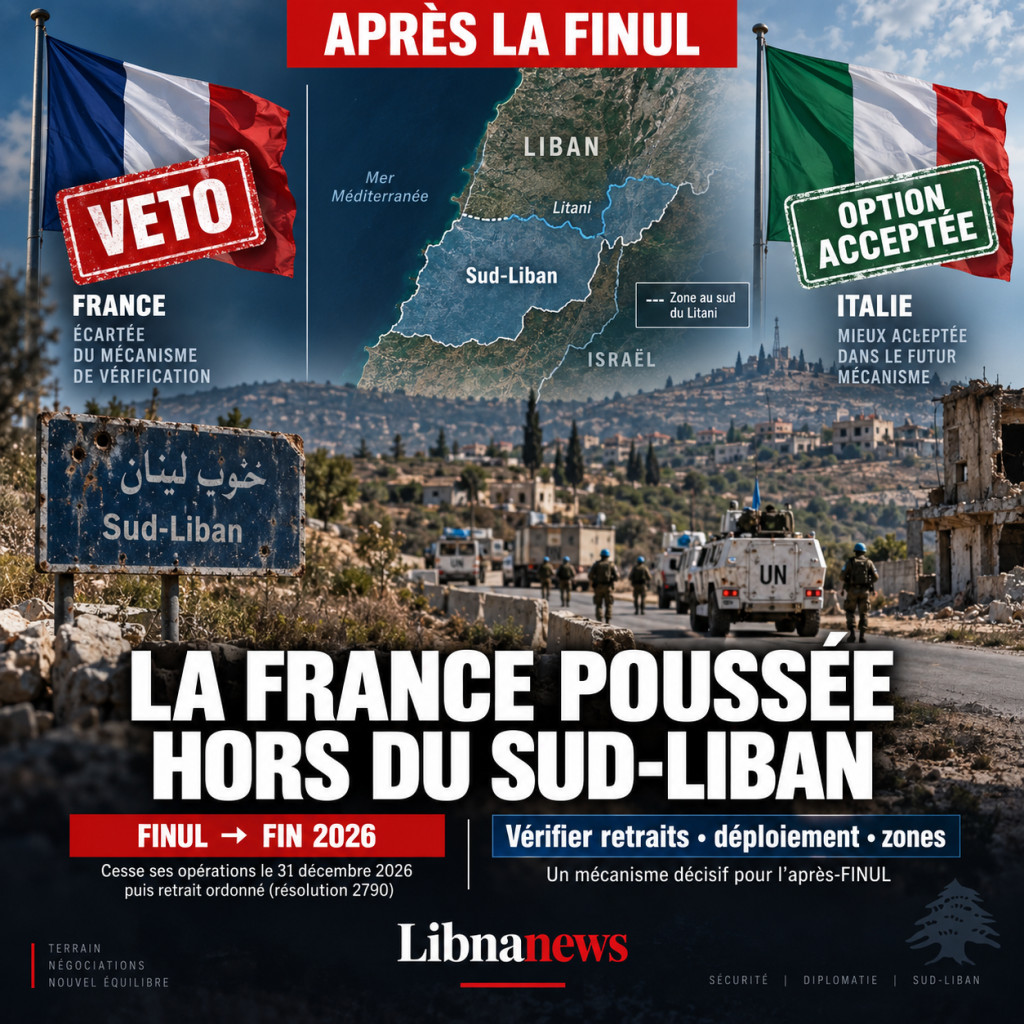
A discreet diplomatic battle is taking place around the future security arrangements in southern Lebanon. It no longer concerns only the withdrawal of Israeli forces, the deployment of the Lebanese army or the fate of Hezbollah weapons. It now deals with a more technical issue that is apparently, but with far-reaching consequences: which countries will have the right to verify the application of future military arrangements? In this negotiation, France faces Israeli opposition. Italy appears better placed. Several other countries have been proposed, while Washington retains a central role in finding an acceptable formula.
The problem has taken on a particular dimension in the recent direct negotiations between Lebanon and Israel. The seventh session, held in Rome, did not resolve the composition of the verification mechanism. Lebanon had proposed several States: France, Italy, Switzerland, Austria and Jordan. The idea was to establish a diversified international presence, capable of verifying commitments made on the ground without placing the whole process under the authority of a single actor. This proposal did not obtain the necessary agreement. French participation is opposed by Israel, while Italy enjoys a more favourable attitude.
Azerbaijan was also mentioned as one of the opportunities that emerged during the discussions. However, this option raises other difficulties. The close military and strategic ties between Baku and Israel feed reserves in Lebanon, especially in the Hezbollah environment. The problem then becomes almost circular. A country acceptable to Israel can be challenged on the Lebanese side. An actor considered natural by Beirut may, on the other hand, run into the Israeli veto. Finding observers capable of being accepted by all parties thus becomes one of the most delicate negotiations of the United Nations Interim Force in Lebanon.
The question is far from protocol. States participating in the mechanism could be called upon to observe the military situation in certain areas, verify the deployment of the Lebanese army, monitor Israeli withdrawals and assess the possible presence of armed installations or positions. Their assessment could condition the transition from one stage to the next. Behind the choice of flags is therefore a question of power: who can certify that a commitment has been fulfilled, that an area meets the agreed conditions and that a new withdrawal can begin?
Paris is gradually losing its place in the system
The French problem did not appear to have arisen abruptly at the last meeting in Rome. Several signs indicate a gradual decline of Paris in the security architecture of the South. France had long held a special position thanks to its political commitment to Lebanon, its participation in international arrangements and its military presence in the Interim Force. This seniority could have made it a natural candidate for the future mechanism. It is precisely this continuity that is now being questioned.
The cooling was demonstrated even before the start of direct negotiations between Lebanon and Israel in mid-April 2026. Paris had already lost part of its role in some military meetings. Its influence on the ceasefire monitoring mechanism concluded in 2024 was also reduced. The current refusal of French participation in the verification mechanism is therefore part of a broader development. This is not just a disagreement over the composition of a delegation to carry out a few inspections.
This distance becomes more sensitive as the prospect of a new international architecture in the South approaches. If the Interim Force effectively leaves the field, States participating in the partial successor mechanism could gain privileged access to military information and operational discussions. They would monitor deployments, withdrawals and incidents. They could also play a role in fact-finding when one party accuses the other of failing to comply with its commitments.
France risks losing more than one seat. It could lose part of its ability to intervene directly in the day-to-day management of the Southern case. This development would be all the more significant as Paris long considered Lebanon a privileged ground for its diplomatic action in the Middle East. Its decline would open up more space in the US, but also to other European partners.
Italy benefits from a more favourable context
Rome is in almost the opposite situation. Italian participation in the future mechanism does not meet the same opposition at this stage. Italy also has an ancient experience of Lebanon. His forces had participated in the international arrangements deployed in the country, and his relations with the various Lebanese actors did not currently bear the same political weight as those in Paris in relations with Israel.
Rome’s choice to host the sixth and seventh sessions of direct negotiations reinforced this position. It does not conclude that Italy will take the lead in the future mechanism. No such decision appears in the available information. However, it reveals a significant difference. France must overcome a refusal. Italy remains in the game without encountering an equivalent obstacle.
This distinction can gradually change the European balance around the Lebanese issue. For years, Paris has sought to preserve a specific political and military role. If Rome becomes one of the main European players accepted by all parties, it could recover part of this space. This would not necessarily mean a complete substitution of Italy with France. The proposed mechanism could include several States. But in a negotiation where each participant must be accepted, not being vetoed is already a major advantage.
Lebanon is seeking to retain a plural formula. His initial proposal involving five countries met this logic. Switzerland and Austria could offer a less direct profile of regional rivalries. Jordan was an Arab presence with official relations with Israel. France and Italy brought their experience of Lebanese terrain. The failure of this first formula shows, however, that the search for a theoretical balance is hampered by real power ratios.
« Experimental zones » give international control its full weight
The battle around the mechanism cannot be understood without the « experimental zones » file. The principle discussed is based on step-by-step progress. In a given area, the Lebanese army must be able to strengthen or establish its presence. Israel must make a corresponding withdrawal. An international verification must then see the new situation. If experience is considered satisfactory, the same model could be applied elsewhere.
Lebanon wants to move towards new areas. Israel and the United States previously requested verification of the results achieved in the first sector. This difference seems limited, but it gives the control mechanism considerable power. If verification is a prerequisite for any extension, the body responsible for this mission becomes the guardian of the calendar.
The first experiment concerns sectors around Frun and Srifa. Some parts of Zawtar Al Gharbiya are also involved in the discussions. The presence of the Lebanese army in a large part of these areas is one of Beirut’s arguments for the continuation of the process. However, the Israeli side wants to obtain further validation before proceeding to the next stage.
The logic of a progressive mechanism is also studied at the top of the Lebanese state. The army could identify points where it has an immediate deployment capability. Israel would then make a limited withdrawal, possibly from a specific locality or perimeter. A Lebanese unit would immediately enter the area, with international supervision. The process could then be replicated. This formula aims to prevent the creation of a security vacuum between an Israeli withdrawal and the arrival of Lebanese forces.
This method responds to a major political difficulty. Beirut seeks withdrawals without waiting for a comprehensive settlement of all the contentious issues. Instead, Israel links its decisions to broader security guarantees. International verification becomes the bridge between the two approaches. But it can also become a lock if the evaluation criteria remain contested.
A temporary structure that could become permanent
Another formula is circulating to accompany this transition. It would be to create a temporary security and negotiating structure bringing together Lebanon, Israel and the United States Central Command, with the participation of international liaison officers. The objective would be to maintain an operational channel after the withdrawal of the Interim Force and to prevent Israel from finding itself alone in front of the Lebanese army on a still unstable border.
However, the temporary nature of the arrangement does not completely reassure Beirut. One of the main concerns is precisely to see a mechanism created to manage a transition transformed into a sustainable architecture. Lebanon is concerned that verification functions will gradually absorb some of the missions currently carried out by the International Force. An evolution of this nature would profoundly change the nature of the foreign presence in the South.
The Interim Force is based on a United Nations mandate. It has multilateral legitimacy and international composition. A smaller mechanism, heavily dependent on the United States and subject to Israeli acceptance by its participants, would operate according to a different logic. The question is therefore not only one of its effectiveness. It affects the political balance of the scheme and the framework within which disagreements would be arbitrated.
It is also for this reason that the French question becomes emblematic. A French presence in a classical multilateral system does not have the same meaning as a presence subject to Israel’s approval in a smaller mechanism. The current veto materializes this transformation. The debate no longer focuses solely on Paris’ contribution to the security of the South. It focuses on its ability to participate in the new decision-making system.
86 meps try to prevent the vacuum
In the face of this development, a parliamentary mobilization took place in Lebanon. An initiative supported by 86 MPs calls for a review of the conditions and timetable for the withdrawal of the Interim Force. The reasoning is simple: the international mission should not disappear as long as the Israeli occupation persists and the Lebanese State is not in a position to effectively exercise its exclusive authority throughout the territory concerned.
Melhem Khalaf, Firas Hamdan, Najat Saliba and Adnan Trabulsi are among the deputies involved. A legal note was given to the Greek consul Ignatios Panteleimon Papadimitriou. The approach to Athens is not accidental. Greece holds the presidency of the Security Council during the month of October. In this way, parliamentarians want to bring the issue of the security vacuum directly to the forum that could affect the international mandate.
Kassem Hashem defends a close position. It considers that an international presence in its present form or in a new configuration is still necessary. The objective is to maintain an international framework accompanying the implementation of resolution 1701 and to avoid a situation where the Lebanese army should manage a confrontational line with Israel alone.
The debate therefore goes beyond the usual divisions on the International Force. The immediate issue is the timetable. Even those in favour of the rise of the Lebanese army must take into account the time it takes to assume all responsibilities in the South alone. Between the departure of international forces and the consolidation of state authority, a few weeks of vacuum could be enough to create a new military reality.
Washington holds the key to the device
In this negotiation, the United States occupies a central position. Washington is involved in the search for the verification formula and plays a key role in discussions with Israel. The choice of States to participate in the mechanism therefore largely depends on the balance that the Americans want to establish between Israeli demands and Lebanese demands.
This American position partly explains the French difficulty. If the refusal came only from Israel, Paris could seek American support to bypass it. However, the information available shows a wider convergence against a French role in the mechanism as currently envisaged. This situation considerably reduces Beirut’s room for manoeuvre.
However, Lebanon retains several levers. It can stress the international character of the mechanism, multiply proposals from participating countries and continue the battle in the Security Council to maintain a United Nations presence. It can also use the advance deployment of its army to demand additional Israeli withdrawals. But each of these levers depends, at some point, on international validation.
The future of the South could thus be decided as much in the definition of procedures as in the discussions on principles. A determining rule that inspects an area may have as much effect as an agreement on the withdrawal of that area. A list of countries allowed to participate may redraw diplomatic influences. An interim mission can become sustainable if no alternative is found.
The Israeli calendar further complicates the equation
The negotiations are finally taking place in a particularly sensitive Israeli context. Elections are announced for 27 October. At the same time, Benjamin Netanyahu claimed that Israel would continue to hit Hezbollah in Lebanon. Continued military operations make it more difficult to build a mechanism based on confidence and simultaneous measures.
Beirut intends to document the destruction in the South. Maps and images of Israeli operations could be presented as part of the discussions. The Lebanese argument is that a security mechanism cannot be stabilized if the destruction continues, if the inhabitants remain prevented from returning and if normal living conditions are not restored.
The military meeting must therefore simultaneously manage withdrawals, the deployment of the army, weapons, experimental zones, verification and the future of the international presence. The French question lies at the heart of this architecture. Above all, it reveals that the interim post-Force is already being negotiated before all parties agree on what should really succeed it.
Paris is not yet permanently excluded from any future role. Rome was not designated as its replacement. Azerbaijan has not been formally integrated into the mechanism. The final composition remains open. But a trend is emerging: France now encounters an obstacle where its presence once seemed natural. If the verification mechanism remains a limited tool, this will remain limited. If it becomes the operational centre of the system to manage the South after the Interim Force, the veto against Paris will mark a much deeper redistribution of influences around Lebanon.





Comments