

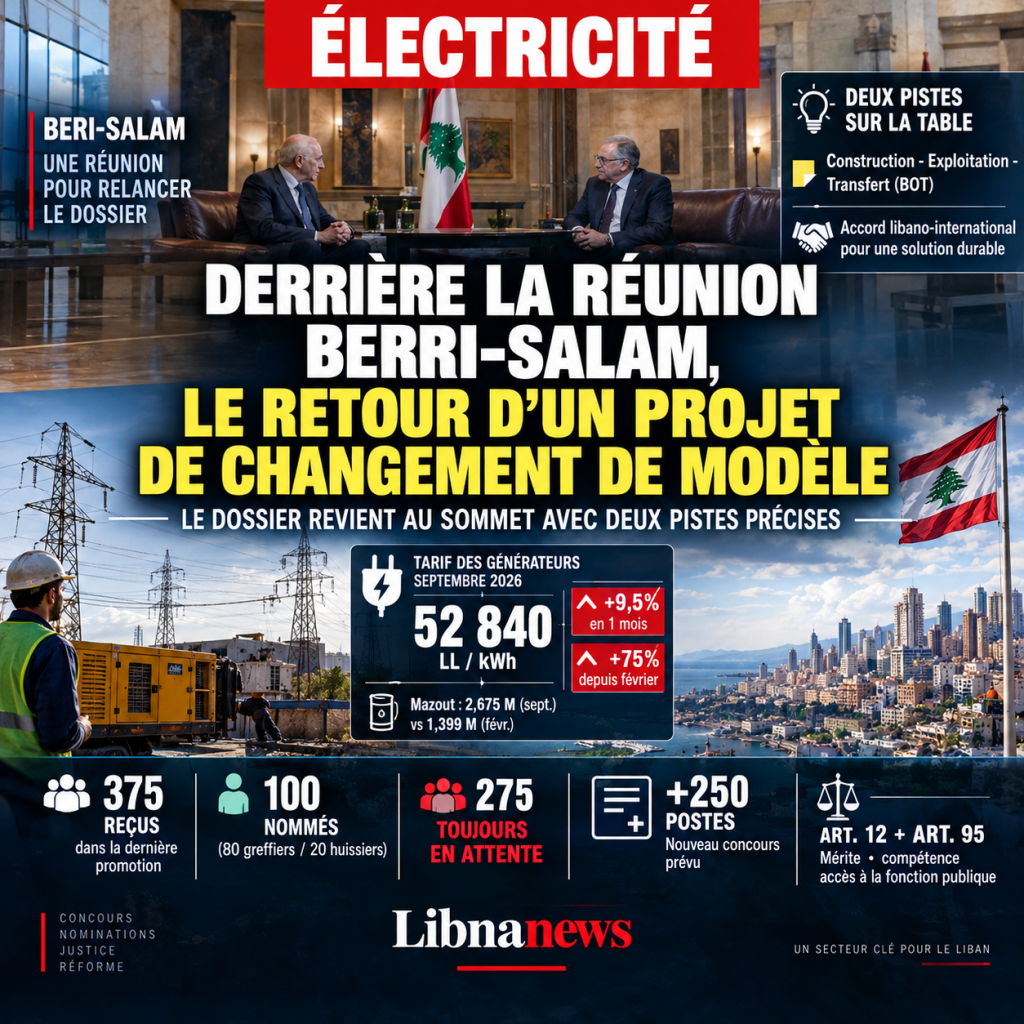
The file returns to the top with two specific tracks
The electricity issue has returned to the forefront of political priorities with the meeting between the Speaker of Parliament Nabih Berri and Prime Minister Nawaf Salam in Ain al-Tiné. In the middle of the discussions on the South, the diplomatic movements of the Head of Government and the economic situation, the two officials devoted part of their interview to the search for a « radical » solution to the electrical crisis. Two tracks were placed on the table: using a system of construction, operation and transfer, or concluding a Lebanese-international agreement capable of achieving a lasting settlement.
The choice of terms is important. It is no longer just a matter of increasing power hours on a timely basis or finding fuel for power plants. The discussion focused on a mechanism that could change the way investments are financed, infrastructure developed and product service. The use of a system of construction, operation and transfer would, in principle, enable an operator to finance and construct an infrastructure and then operate it for a specified period before it is transferred to the State. The other option mentioned remains less detailed: an agreement between Lebanon and international partners that would build a comprehensive solution.
However, no final decision was announced at the end of the meeting. No foreign partner has been publicly designated. No amount of investment, tender schedule or list of plants concerned appears in the available information. The meeting therefore marks a political orientation rather than an operational launch. This is precisely where the issue lies: whether the return of the dossier to the state summit really opens a new phase or whether it will remain at the stage of a new formula search.
The urgency is perfectly measurable. Lebanon continues to pay a broken energy bill between insufficient public electricity, private generators and individual solutions. The recent increase in costs shows that this organization is not only technically deficient. It is becoming increasingly burdensome for households and businesses.
52 840 pounds per kilowatt hour in generators
The price of private generators fixed for September has reachedlebanese pounds 52,840 per kilowatt hour. The increase is 9.5% in one month. The comparison with February is even more spectacular: the price was 30,244 pounds. In seven months, the increase is approaching 75%.
Oil accounts for a significant part of this increase. The average price of the fuel oil plate used in the pricing calculation reached about£2.675 millionagainst 1.399 million in March. This development directly affects generator owners, but the charge is then transferred to subscribers. The regional energy crisis thus becomes an additional monthly expenditure for Lebanese households.
The peculiarity of the Lebanese system amplifies the shock. In a normal power grid, an increase in fuel prices can be spread over a diversified production structure, supply contracts and a national grid. In Lebanon, a significant portion of consumption is based on a multitude of fuel-fired generators. When the fuel oil increases, the transfer to the invoice is quick.
This situation also produces strong inequality. A household able to invest in solar panels, batteries or other solutions gradually reduces its dependence on generators. A home with fewer means remains a prisoner of the monthly bill. The individual energy transition can therefore alleviate the burden on some consumers while leaving others exposed to rising fuel.
The discussion between Berri and Salam comes at this very moment. The structural nature of the solution is evident: even a temporary reduction in fuel oil prices would not solve the problem. It would temporarily reduce the bill without changing the dependency on a costly and fragmented system.
Enterprises are increasingly absorbing the shock
The pressure is not just about individuals. The economic indicators of September show a paradoxical situation. The index of purchasing managers in Lebanon has gone from50.1 points in august to 50.5 in september. Thus, for a fourth consecutive month, it remains above the threshold of 50 which traditionally separates the contraction from the growth of activity.
This could give the image of an economy that is slowly starting to move forward. However, detailed data tell a much more fragile story. Enterprises have seen the largest increase in input costs in about three and a half years. Energy is part of this, along with food, building materials, shipping and insurance.
The difference between growth in activity and improvement in the situation of enterprises becomes essential. A company can receive more orders while seeing its margin decrease. If the cost of electricity, transport and raw materials increases faster than its income, the recovery becomes difficult to transform into investment or employment.
Business behaviour is beginning to reflect this caution. Recruitment has decreased. Procurement has also been reduced. Export orders remain weak in an unstable regional environment. Companies therefore seek to protect their cash flow even though the general indicator of activity remains slightly in positive territory.
Electricity is involved in almost all these decisions. It does not simply represent one line of expenditure among others. It conditions production costs, the preservation of goods, the operation of equipment, air conditioning, computer science and part of logistics. A company that cannot predict its energy cost has less visibility to set prices and program its investments.
The construction, operation and transfer model goes back to the centre
It is in this context that the track of the system of construction, operation and transfer acquires its interest. The aim would be to raise capital and expertise without asking the State to immediately finance all infrastructure. The selected operator would construct the project, operate it under a specific contract and then transfer it to the public authority.
On paper, the mechanism addresses one of Lebanon’s most obvious problems: the State has limited financial margins while the investment needs are considerable. Electricity requires capital for production, but also for transport, postal services, networks and loss reduction. Waiting for public finances to be able to finance all these investments alone could prolong the crisis for years.
However, the mechanism is not an automatic solution. It depends on the contract. It is necessary to determine who finances, who bears the risks, how the operator is remunerated, what pricing is applied, what guarantees the State grants and under what conditions the infrastructure belongs to it. A bad contract can transfer part of the risk to the public sector while guaranteeing the operator’s income. A well-built contract can, on the contrary, speed up an investment that the State would not be able to carry out alone.
The available information does not yet specify which part of the sector would be concerned. It is therefore not possible to state that the government is considering entrusting all the electricity production to this model. The discussion covered a possible way to find a definitive solution. Technical details remain to be built.
This lack of precision is precisely the next test. Political will becomes credible when it is transformed into specifications, timetable, funding mechanism and selection procedure. Until these elements are published, the system remains an option and not an executable project.
Another avenue: a Lebanese-international agreement still to be defined
The second possibility mentioned by Berri and Salam is that of a Lebanese-international agreement. The formula is wider and much less precise. It could cover different types of cooperation, but the information available does not identify a country, institution or consortium already chosen. It would therefore be premature to assign the project to a specific partner.
The political interest of this track is nevertheless clear. A solution supported by international partners could simultaneously provide funding, expertise and guarantees. In a sector long characterized by deficits and controversies, the presence of an external player could also help shape implementation.
But this path also imposes conditions. An international partner will seek information on the financial situation of the sector, pricing mechanisms, recovery capacity and government responsibilities. It will also wish to have visibility on the regulatory framework. The search for external financing cannot therefore be completely separated from internal reforms.
This is where the electricity issue joins that of public finances. Nabih Berri received the Governor of the Bank of Lebanon,Karim Suaid, in the same political sequence. Nawaf Salam also met at the Grand Sérail to discuss the financial and banking situation. No operational link between these interviews and electricity financing was announced. Their combination, however, shows that government and key institutions work in an environment where every major investment depends on restoring larger financial capacities.
Lebanon cannot therefore treat electricity as an isolated sector. Its reform depends on trust, financing, the State’s ability to sign credible contracts and the existence of institutions capable of enforcing them.
Industrialists are also asking for a response on energy
The issue also appears in discussions with the productive sector. Business representatives from the southern suburbs presented their priorities to the Economic, Social and Environmental Council. In particular, they call for a structured approach to support the establishments affected by the destruction, re-launch the companies arrested and preserve jobs.
The energy issue is one of their concerns. For an industrial enterprise, dependency on generators is an even greater handicap than for a business or an office. Machines consume more. Disruptions can disrupt production cycles. Individual solutions require significant investment.
The problem becomes particularly acute for companies damaged by the war. They must simultaneously finance the repair of their premises, the possible replacement of their equipment and their energy needs. Without a more stable electrical solution, material reconstruction does not guarantee the resumption of production.
Industrialists in the southern suburbs are also asking for a detailed database of enterprises, their activity, size, number of employees, production capacity, needs and damage. They hope that the affected settlements will be given priority in recovery and reconstruction plans.
This demand shows why the electricity reform now has an economic reconstruction dimension. Restoring buildings without guaranteeing the energy necessary for their operation is not enough. The same reasoning applies to the South, where the authorities seek to restore essential services to enable the return of the inhabitants.
The South turns electricity into a question of sovereignty
Nawaf Salam made the return of public services a central element of his speech on the South. After his visit to Nabatiyah, he insisted on the need to see concretely the restoration of water and electricity, the progress of projects, the renovation of schools and the return of the inhabitants.
This approach gives electricity an additional political dimension. In areas affected by military operations, providing power is not only improving daily life. It’s allowing people to stay or come back. It’s helping businesses reopen. It’s re-starting public services. It is therefore involved in restoring the effective presence of the State.
President Joseph Aoun developed a similar logic when he insisted on supporting the inhabitants who remained in their villages in the South. The ability of the State to meet their needs becomes a component of sovereignty. The authority is not only measured at the deployment of the army. It is also measured by water, roads, schools and electricity.
This dimension explains why the energy issue can hardly be postponed to the return of perfect regional stability. Tensions in the Middle East make energy more expensive and investment more risky. Waiting for them to disappear would mean letting households and businesses continue to finance the status quo.
The most vulnerable households pay proportionally the heaviest price
The increase in the electricity bill is finally coming in a country where a large proportion of households are already reducing their essential expenditure. Available social data show that many families reduce their health and education expenditures. Some are no longer able to provide proper medication or feeding to children. Others sell household goods or income-generating assets.
In this context, the increase in electricity is not absorbed by simply reducing leisure time. It competes directly with essential expenses. A household must arbitrate between generator, food, medicine, transportation and school. The increase in the kilowatt hour thus becomes an additional factor of impoverishment.
Individual solutions can themselves reinforce inequalities. A family with capital can install a solar solution and reduce its exposure to generators. A family without savings continues to buy expensive energy every month. The least able household to invest then becomes the most dependent on the most expensive system.
This reality should affect the design of any reform. A purely technical solution can improve production without necessarily solving the question of the price paid by consumers. The future model will therefore have to meet two simultaneous requirements: to produce sufficiently and to produce at a bearable cost.
The next test will no longer be a meeting but a calendar
The meeting between Nabih Berri and Nawaf Salam brought electricity back to the highest political level. It also introduced two identifiable leads. This is more than just a repetition of a finding of the sector’s failure. But the information available still stops before the elements that would make it possible to talk about a real plan: partners, projects concerned, amounts, calls for tenders, guarantees, pricing and deadlines.
The next step will therefore be easy to measure. If the construction, operation and transfer track is selected, it will have to produce a specific procedure. If the option of an international agreement progresses, the partner and the modalities will have to be identified. In both cases, the issue of funding should be made public.
The economic urgency no longer allows these decisions to be separated from their cost to the Lebanese. At £52,840 per kilowatt hour for generators in September, the electrical crisis is no longer just the historical symbol of bad public management. It is a direct drain on household incomes and business margins.
The change of model referred to in Ain al-Tiné cannot therefore be judged on the chosen formula. It will be on its ability to gradually replace expensive, fragmented and unpredictable energy with a stable service. After years of temporary solutions, the difference between a new announcement and a reform will now have some very concrete elements: a contract, a financing, a timetable and kilowatt hours actually delivered.





Comments