

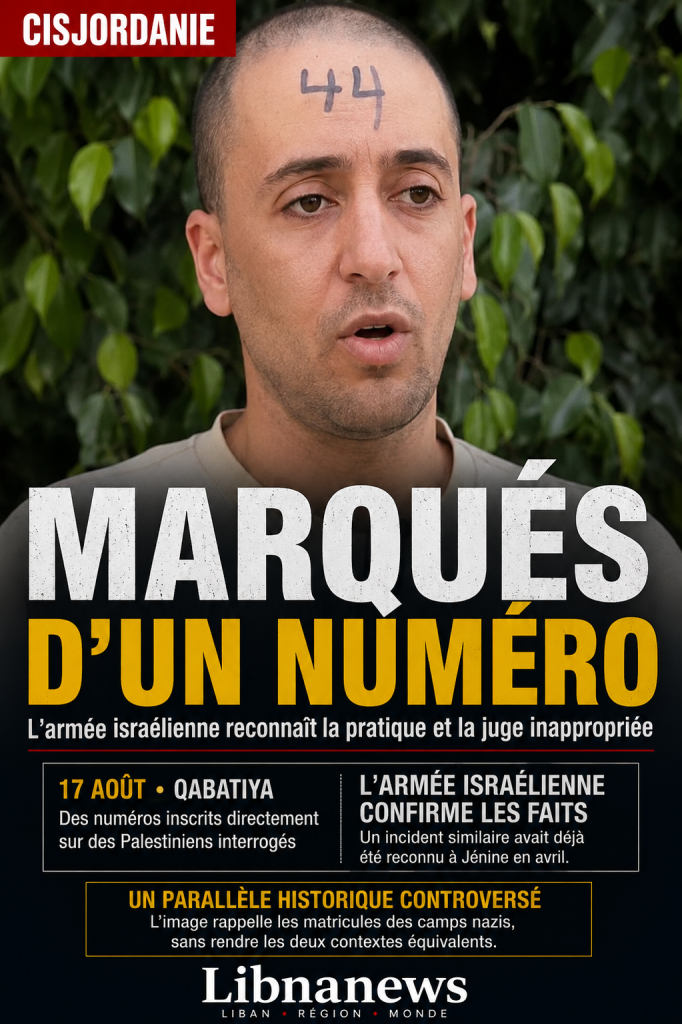
The Israeli army acknowledged that soldiers had placed numbers directly on the body of Palestinians arrested during an operation conducted on 17 August 2026 in Qabatiya, in the northern occupied West Bank. Images show a man with the number « 44 » on his forehead. The army claims that this practice was inappropriate and ensures that it reminded the military members concerned of the rules. In Israel and abroad, the images immediately led to a parallel with the numbering of detainees in Nazi concentration camps. The comparison is based on a particularly busy historical image, but requires an essential distinction: Israeli inscription is a contemporary act of identification and presumed humiliation, while Auschwitz’s matrix belonged to the Nazi concentrationary and genocidal system.
The number « 44 » occupies almost its entire forehead. The Palestinian man appears before local media after being interrogated by Israeli soldiers in Qabatiyah. According to his testimony, he was not the only one who was so identified. Other Palestinians arrested during the operation reportedly received numbers on various parts of the body.
The Israeli army confirmed on 18 August that its forces had actually marked Palestinian numbers interviewed during the operation. It therefore did not contest the general authenticity of the practice shown by the images.
Instead, she distanced herself from the soldiers’ behaviour. The command indicated that it had highlighted the seriousness of the incident to the military and that lessons had been learned from the incident.
This recognition is important because the debate is no longer based solely on Palestinian images or accusations of militants.The existence of the numbering was admitted by the army itself.
In Qabatiya, numbers on the forehead and body
The incident occurred during an extensive Israeli operation in Qabatiyah, south of Jenin, on 17 August. The army claims to have searched about 100 buildings and interrogated or arrested several people. Two Palestinians suspected of planning attacks were also reportedly arrested as part of the operation.
It was during this sequence that soldiers used numbers to identify some of the Palestinians being interrogated.
The evidence gathered indicates that the marks were not only affixed to clothing or administrative records. Figures were written directly on the skin, especially on the forehead, hands and, according to some testimonies, other parts of the body.
This difference is at the heart of the controversy.
Assigning an administrative number to an inmate is a common practice in many prison systems. A file, card, bracelet or register may use a number to enable the internal identification of a person.
Writing this number on the inmate’s body, and especially on his face, is of another nature.
The process makes the identifier visible before personal identity. It temporarily transforms the person into physical support of the control device to which he is subjected.
It was this dimension that caused the strongest reactions.
Ahmad Tibi denounces « dehumanization »
Israeli Arab MP Ahmad Tibi was one of the first politicians to react publicly to the images.
He denounced a « shocky » practice and described replacing a person’s identity with a number as a process of dehumanization. He also referred to « dark periods », a transparent allusion to European history and Nazi persecution.
This reference has a particular power in Israel.
The memory of the Shoah occupies a central place in Israeli national history, in education and in the family memory of a part of the population. The number on the skin is itself one of the most recognizable symbols of the Nazi concentration world.
A French Muslim organization also reacted on 19 August by expressing its « horror » after the dissemination of the images and also establishing a rapprochement with the marking practices imposed on the victims of Nazism.
But using this comparison needs to specify exactly what happened in the Nazi camps.
In Auschwitz, the number replaced the prisoner’s identity
In the Nazi concentration system, detainees received registration numbers used for their administrative identification in the camps.
At Auschwitz, this practice took a particular form. From autumn 1941 the SS began totattoo the matrix directly on the body of some prisoners, first on Soviet prisoners of war. The system was then extended and, from 1942, Jewish prisoners registered in Auschwitz were also systematically tattooed.
The number was usually entered on the forearm.
More400,000 numbers of prisonerswere assigned to the Auschwitz complex according to the historical archives kept on the concentration system.
The detail is important: not everyone who arrived in Auschwitz received a number. Persons sent directly to the gas chambers were usually neither registered as prisoners nor tattooed. The number concerned those registered by the SS in the concentration system, particularly for forced labour.
This number was part of a much larger device.
Prisoners were also classified by category, marked by triangles of different colours on their uniforms and subjected to a system that reduced their identity to a bureaucratic classification in the service of persecution, exploitation and, for the Jews of Europe, a project of extermination.
So tattooing was not a simple practical process.
It became one of the symbols of the Nazi process ofdepersonalisation of victims.
Why the image of Qabatiya reminds Auschwitz without being Auschwitz
It is precisely here that the parallel must be limited.
Palestinians in Qabatiya were not tattooed. The numbers were written to the marker and the Israeli army claims that this practice was not consistent with the expected behaviour of its soldiers.
Thus, on the basis of this incident, there is no Israeli system equivalent to the institutionalized tattoo procedure in Auschwitz.
Above all, the Nazi concentrationary universe cannot be reduced to its numbering system. It was part of an apparatus of persecution, forced labour, famine, torture and extermination whose historical purpose and scale are specific.
To claim that both situations are identical would therefore be historically inaccurate.
But this does not make the image insignificant.
The parallel concerns the gesture of marking a human being with a number, not the equivalence of the two political and historical systems.
It is this distinction that makes it possible to understand why images cause a particular shock even in Israeli society. The act uses, even temporarily and with a marker rather than a tattoo, a visual representation that refers to one of the most sensitive historical experiences in Jewish history.
This is not the first time in 2026
The Israeli army’s response also raises an additional difficulty: a similar incident had already been recognized a few months earlier.
In April 2026, Palestinian women allowed to temporarily enter Jenin refugee camp to collect personal effects had been photographed with numbers on their hands.
At the time, the army explained that the camp had been divided into areas identified by numbers and letters in order to organize the movements. According to his version, the idea of putting sector references on the hands was proposed by Palestinians themselves.
However, the army had recognized a« bad judgment »and indicated that the appropriate rules had been reminded of the soldiers.
Four months later, the formula used after Qabatiya closely resembles that used in April: behaviour is considered serious and the army assures that « lessons have been learned ».
This repetition transforms the question.
The problem is no longer just why a soldier wrote a number on a person. It becomes necessary to understand why a practice already considered inappropriate a few months ago could have been repeated.
A broader question about Palestinian detention
The incident occurs in a context where the conditions of detention of Palestinians are already under significant international surveillance.
More than 9,000 Palestinians were detained in Israeli prisons at the end of 2025 for security reasons described by the Israeli authorities. Several thousand were placed in administrative detention or under other regimes allowing prolonged detention without a formal criminal conviction.
Israeli and international organizations have documented since 7 October 2023 accusations of violence, food deprivation, lack of access to care, degrading treatment and, in some cases, torture.
The Israeli prison administration contests the systematic nature of these accusations and claims to act in accordance with the law. The army has also opened investigations in some cases.
In June 2026, the Israeli Supreme Court also annulled the general ban on visits by the International Committee of the Red Cross to Palestinian prisoners, considering that this restriction no longer had sufficient legal justification.
The Qabatiya case is therefore associated with an already much broader debate on the treatment of Palestinian detainees.
From name to number, the question of dignity
The stakes finally go beyond the historical comparison itself.
In any institution that deprives a person of liberty, a number may have a legitimate administrative function. Penitentiaries, courts, hospitals and many jurisdictions use digital identifiers.
The question changes when the number is entered on the body.
A file identifies a person for administration. A figure inscribed on his forehead identifies for all who look at her.
This difference explains the reaction of the Palestinian photograph number « 44 ».
It also explains why the parallel with Auschwitz comes almost automatically, even when it must be handled with great historical rigour. The concentration number has become one of the universal symbols of reducing a person to a category and number.
The most rigorous comparison is therefore not to say that Qabatiya reproduces Auschwitz. It consists of finding thatthe use of an inmate’s body as support for a reactive number is an image historically associated with dehumanizationto the extent that the israeli army itself considered it necessary to disavow the practice.
The question that remains open is now internal to the Israeli military system: after a first incident recognised in April and then a second in August, will the reminder of the rules suffice to prevent a Palestinian interrogated during a next operation from going out again with his identity replaced, in the eyes of all, by a figure written on the skin?




