

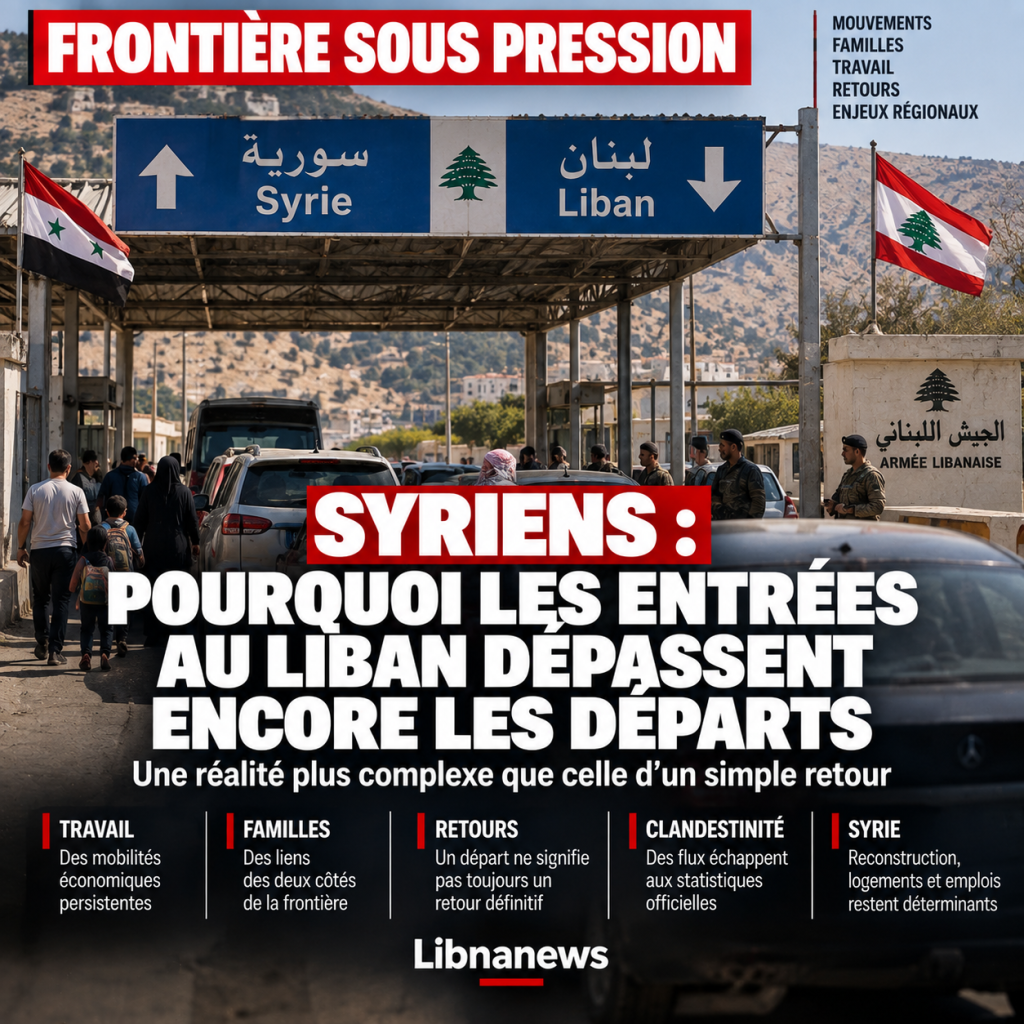
The Syrian movement on the Lebanese border gives a more complex picture than the continuous return to Syria. The data and testimonies gathered in the sources of October 2, 2026 show that the passages take place in both directions and that the entrances to Lebanon remain important. In some observed periods, they even exceed exits. This reality does not automatically mean that a new wave of permanent installation is underway. A recorded border crossing does not amount to a sustainable installation, nor does an exit from Lebanon prove a definitive return to Syria. It shows, however, that the Syrian political transformation was not enough to bring about a simple and irreversible return movement.
The border remains an economic, family and social space. Syrians pass through Lebanon to work, join their families, access services or pursue steps before leaving. Others leave Lebanon but may return. To these regular movements are added the clandestine passages, which make any statistical reading more difficult. So the question is no longer just counting departures. It is important to understand why Lebanon continues to attract Syrians as the political discourse focuses on their return.
Border figures that do not tell a single-way migration
The data presented in the corpus first question a widespread idea: the evolution of the situation in Syria would have mechanically reversed all flows. On the contrary, the recorded passages show a persistent circulation. Syrians leave Lebanese territory, while others enter or return. Depending on the periods considered, there may be more entries than departures.
However, these figures should be handled with caution. Pass statistics measure movements and not unique people. The same person may cross the border several times during a given period. She may leave Lebanon, return a few days later, and then return. Each of these movements is recorded separately. Using the number of entries as a direct measure of the number of new residents would therefore lead to an erroneous conclusion.
The same precaution applies to exits. A Syrian crossing the border to his country is not necessarily a refugee who makes a definitive return. This can be a temporary trip, family visit, administrative or work-related return. In order to measure a genuine return, it would be necessary to distinguish those who left Lebanon for a long time from those who continued to travel between the two countries.
This distinction is essential for public policy. A government that only reasoned on the basis of the number of exits may overestimate the decline in the Syrian population in Lebanon. Conversely, interpreting each entry as a new installation would lead to exaggeration of the opposite phenomenon.
Work continues to fuel movements to Lebanon
The economy is one of the major explanations for this movement. Despite the Lebanese crisis, some sectors continue to employ Syrian labour. Needs do not disappear simply because the political situation in Damascus is changing. The economic differential between the two countries, the professional networks established for years and the geographical proximity maintain movements of workers.
This reality creates a paradox. Lebanon has been in a deep economic crisis for several years, but it continues to offer certain income opportunities that can remain attractive for workers from Syrian regions where the economy itself is very fragile. The comparison is therefore not made between a prosperous Lebanese economy and a troubled Syrian economy. It takes place between two deeply affected labour markets, but with different levels of pay, opportunities and networks.
Seasonal movements further complicate reading. In agriculture, construction and other activities, labour requirements may vary depending on the period. Thus, a person can come to work in Lebanon without seeking to settle permanently. It can maintain its main residence in Syria and regularly cross the border.
The regulation of these movements represents a different challenge than that of refugees. A return policy alone cannot address cross-border work. It is also necessary to determine the conditions of entry, residence permits, work permits and mechanisms for distinguishing occupational mobility from installation.
Family ties prevent a clear separation between the two territories
More than a decade of significant Syrian presence in Lebanon has created or strengthened family networks that cross the border. Members of the same family can live in both countries. Some children can attend school in Lebanon while others are living in Syria. Marriages, economic activities and family obligations support displacement.
This dimension makes the idea of a return considered a unique event particularly fragile. A family can start returning to Syria without immediately cutting off all its ties with Lebanon. A member may return before others to check the accommodation or working conditions. Others may stay in Lebanon until the end of a school year. Some may then return temporarily.
The movements observed at the border therefore also reflect family strategies. After years of instability, households seek to limit risk. They may avoid immediately transferring their entire lives from one country to another as long as they do not have sufficient guarantees of housing, income, education and services.
This caution is rational. A definitive return involves much more than the physical crossing of the border. It implies the possibility of living in the place of destination in a sustainable manner. The availability of housing, employment, school and care is as important as immediate security.
Political change in Syria does not solve material problems
The transformation of Syrian power has changed some of the political obstacles to return. However, it did not repair infrastructure, recreate jobs or rebuild destroyed housing. This is probably one of the main reasons why the movement remains less linear than expected.
A Syrian can no longer fear the same political risks as before while not having the necessary material conditions to return permanently. The family home can be destroyed or uninhabitable. The local labour market may be insufficient. Schools and services can be difficult to operate. Some regions may experience a more stable situation than others.
The sources also show that Syria itself is still going through episodes of violence and security fragility. The situation cannot therefore be described uniformly for the whole territory. Conditions of return vary greatly depending on the region of origin.
This diversity is essential to understand why global figures are not enough. Two Syrians leaving Lebanon on the same day may have completely different prospects depending on whether they return to a relatively stable region or to an area where infrastructure remains severely degraded.
Sustainable return depends less on a general political announcement than on very concrete local conditions.
Illegal passages further blur statistics
The Lebanese-Syrian border is not limited to official posts. Illegal routes continue to be part of the problem. The reliefs, border villages and smuggling networks have long favoured passages beyond the normal control of the authorities.
This reality means that no official statistics on inputs and outputs can be expected to represent all movements. It measures what is recorded at controlled crossing points. Illegal movements must be assessed separately and are, by definition, much more difficult to quantify.
The problem has a migration dimension, but also a security dimension. The same routes can be used for people, goods or different forms of smuggling. Border control has therefore become a major issue in relations between Beirut and the new Syrian authorities.
Improved cooperation could help to distinguish the different flows. It could also reduce the number of people dependent on illegal networks to move from one country to another. But this cooperation requires the exchange of information and regular coordination between two States whose relations are still under reconstruction.
The migration issue thus directly joins that of normalization between Lebanon and Syria.
Voluntary return and expulsion do not respond to the same logic
The Lebanese debate on Syrians often mixes several categories of movements. However, voluntary return, administrative exit, expulsion and temporary displacement are different phenomena. Adding them without distinction produces figures difficult to interpret.
A voluntary return implies that a person decides to resettle his life in Syria. An expulsion is the result of a decision of the Lebanese State. A round trip can simply be a family or economic mobility. These movements have very different consequences for the people actually present in Lebanon.
This distinction is also important in assessing the effectiveness of public policies. While the objective is to reduce the number of Syrians residing in Lebanon in a sustainable manner, the number of passages to Syria alone is not a sufficient indicator. It is necessary to determine how many people then return and how many actually cease to reside in Lebanon.
Monitoring becomes particularly difficult when not all people have the same administrative status. Some are registered with international bodies. Others are not. Some work. Others live in more precarious situations. A uniform policy cannot produce the same results for all these categories.
Lebanese authorities want to regain control of mobility
For the Lebanese State, the issue now exceeds the only question of the number of refugees. It is a matter of regaining control over a border whose flows have long been difficult to control. This implies knowing the persons who enter, the reason for their stay and its duration.
A more precise migration policy should be able to distinguish between temporary workers, visitors, persons with legal status and those who cross the border illegally. This distinction would also help to emerge from a debate where all Syrian entries are often presented as identical.
It would also facilitate the work of the Syrian authorities. A sustainable return often requires documents, administrative procedures and the reactivation of rights or services in Syria. Organized cooperation can reduce obstacles and limit the use of illegal intermediaries.
But this development requires significant administrative capacity. Controlling a border is not just about deploying more security forces. There is also a need for reliable information systems, consistent rules and coordination between administrations.
Lebanon still faces demographic and social pressure
Even when the passages do not correspond to new installations, the continued high traffic has consequences for Lebanon. Public services, municipalities, the labour market and infrastructure continue to operate in a context of significant Syrian presence.
The Lebanese economic crisis makes this situation particularly sensitive. Public resources remain limited. Municipalities must finance basic services with insufficient resources. Tensions on employment and housing also fuel the political debate.
These difficulties, however, do not lead to the conclusion that every entry to the border automatically increases demographic pressure in a sustainable manner. It is precisely for this reason that better knowledge of flows is indispensable.
The difference between mobility and residence becomes central. A country may experience a high number of border crossings without increasing its resident population to the same extent. Conversely, a reduction in the number of admissions does not necessarily guarantee a rapid decline in the population already settled.
Public policies must therefore be based on several indicators rather than a single spectacular figure.
Syrian reconstruction will be the real engine of return
In the medium term, the most important variable is probably on the other side of the border. As long as Syria cannot provide sufficient housing, employment, schools and services, some Syrians will retain reasons to maintain an economic or family relationship with Lebanon.
Reconstruction could gradually change that balance. The development of economic activities in Syria would create jobs and reduce the interest of certain business trips to Lebanon. The rehabilitation of housing would allow more families to return. The operation of schools and health services would also reduce barriers.
Regional economic projects can play a role in this development. Discussions on transport, trade and energy between Syria, Turkey and Lebanon show that the new Syrian authorities are seeking to reintegrate the country into regional economic channels. If these projects produce jobs, they can have indirect migration consequences.
But this transformation will take time. It cannot be replaced by a simple administrative decision at the border.
Figures must now measure people, not just passages
The main statistical challenge is finally how many Syrians actually live in Lebanon and how that number is changing. Daily inputs and outputs provide useful information on mobility. They do not fully answer this question.
Sustainable returns, resettlements, departures to third countries and people who continue to travel between Lebanon and Syria should be monitored. Without this distinction, the same figures can be used to defend opposing conclusions.
A large number of exits can be presented as evidence of a massive return, while a portion of the persons concerned then return. A large number of entrances can be presented as a new wave of migration, while one part corresponds to workers or visitors making round trips.
The reality that appears on 2 October 2026 is therefore more nuanced. The border does not function as a door through which a Syrian population would gradually leave Lebanon without returning. It remains an intense traffic space between two closely linked societies.
Syria’s political transformation has created new opportunities for return. It has not removed the economic, family and material reasons for continuing displacement to Lebanon. As long as Syrian reconstruction remains incomplete and the two economies continue to be highly interdependent, movements should remain complex. For Beirut, the real challenge is no longer simply to increase the number of exits. Finally, it is necessary to distinguish a lasting departure from a simple border crossing.





Comments