

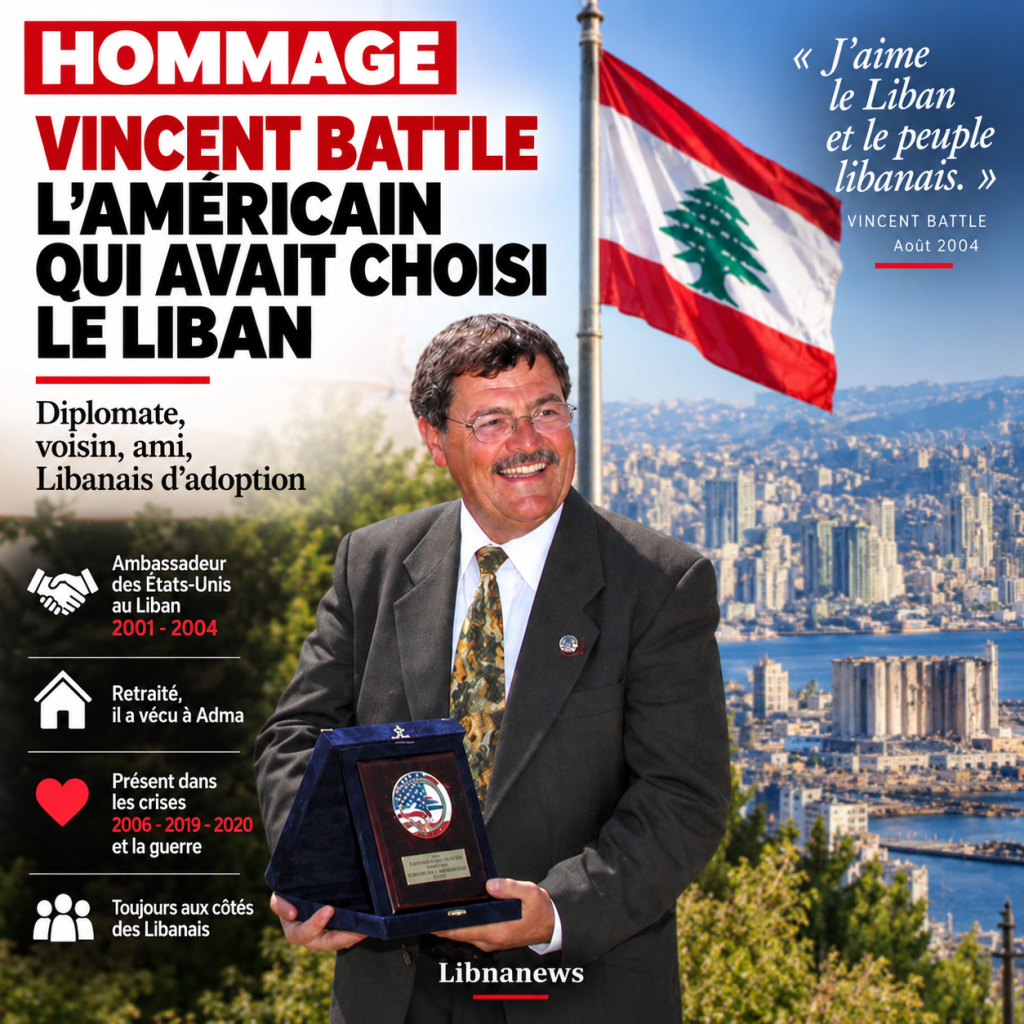
Vincent Battle died in Beirut. The former US Ambassador to Lebanon could have ended his life in Washington, New York or elsewhere, as so many diplomats after a long career spent traveling the world. He chose Lebanon. Not only the comfortable Lebanon of diplomatic receptions and happy years. It remained when the country started to collapse again, when banks had closed their doors to depositors, when the book had lost most of its value, when Beirut had been devastated by the explosion of 4 August 2020 and when the war had returned. He was still there.
Maybe that’s what tells Vincent Battle best. He had represented the United States in Lebanon, but Lebanon had eventually become part of its own life. After leaving the embassy, he had purchased an apartment north of Beirut in the Adma area and had established his residence there. He was no longer an ambassador. He no longer had a professional obligation to stay here. He had simply become one of those foreigners whom Lebanon had eventually adopted and who, in turn, had adopted Lebanon.
A story with Lebanon long before its embassy
His Lebanese history had actually begun long before his appointment as ambassador. Vincent Battle had already served in Beirut as the number two American embassy between 1991 and 1994, in the strange years immediately following the civil war. He had even briefly led the US diplomatic mission as a businessman.
He knew the country intimately when he returned as ambassador in 2001. Its mission was to be completed in August 2004. It began under circumstances that now seem almost symbolic of the next period: Vincent Battle was on his way to Beirut on 11 September 2001 when the attacks against the United States took place. Upon his arrival in Lebanon, Lebanese protocol officials accompanied him to the airport VIP lounge, where he discovered on the screens the images of the World Trade Center towers.
The next three years were after 11 September, the war in Afghanistan, and then the American invasion of Iraq in 2003. Being American ambassador to the Arab world at that time was obviously nothing of a protocol function. Relations between Washington and part of the Lebanese political class were difficult and Vincent Battle defended his country’s politics, sometimes in particularly harsh confrontations.
But it also belonged to a generation of American diplomats who still considered that knowing a country required knowledge of its inhabitants.
A real ambassador in Lebanon
At that time, Vincent Battle could be met on AUB or LAU campuses, accompanying Lebanese officials, meeting with students, attending ceremonies or following programs supported by the United States. It was not among these ambassadors that one could see only at the presidential palace, in the Grand Sérail, in the political salons or behind the walls of a chancery. He was going to the field.
Universities occupied an important place in this American presence. In March 2003, he gave US$594,000 in funding to the President of Lebanon American University, Riyad Nassar. One part was intended to provide full scholarships to 200 students, the other to fund research on the health consequences of air pollution in cities and industrial regions. At the AUB, it was also found in agricultural and development programmes, particularly in Bekaa, where the United States was funding training for farmers.
But Vincent Battle did not limit Lebanon to Beirut and its major universities. He travelled through Chouf, Bekaa, Kesrouan, South or North to visit municipalities, associations, agricultural projects and development programmes. In March 2003, he was also involved in the delivery of more than $127,000 to five NGOs working in rural and disadvantaged areas.
It was obviously not his money: he represented the United States and USAID. But the way he exercised that function was important. He was there. He met people. Above all, he seemed to take a sincere pleasure in discovering this country beyond the appointments imposed by his diplomatic agenda.
Former colleagues said that he accepted virtually all the invitations addressed to him, even in the villages. Cherry festivals, olive festivals, municipal meetings: he traveled the country. Jeffrey Feltman, who succeeded him in Beirut, even remembered a rather telling advice that Battle had given him: never accept more than three invitations to dinner the same evening. Battle could have a drink at the first, dinner at the second and then finish the evening around a white coffee at the third.
You had to know people. It was also that, for him, diplomacy.
« I love Lebanon and the Lebanese »
When he officially left office in August 2004, Vincent Battle delivered a sentence at Beirut airport that was almost banal for a diplomat at the end of his mission: « I love Lebanon and the Lebanese people. »
At home, however, it was not a formula.
Because Vincent Battle came back.
And most of all, he stayed.
He bought an apartment in Adma and chose to retire there. He spoke Arabic, mastered French even better, and possessed this knowledge of the Middle East, which was not acquired in notes prepared by a chancery. Even before joining the US Foreign Service in 1977, he had lived and worked for a decade in Uganda, Pakistan and Libya. His diplomatic career then led him to Bahrain, Syria, Oman, Haiti, Egypt and Washington.
It belonged to this former school of diplomats which could almost be described as « orientalist » in the historical sense: women and men who learned languages, knew the societies in which they were sent and could devote part of their existence to trying to understand a country before pretending to explain it.
In her case, however, something had exceeded that professional knowledge. Lebanon was no longer only a country studied, observed or analysed. It had become home.
In 2006, he was still there
Two years after the end of his term, the war broke out between Israel and Hezbollah.
Vincent Battle was then retired. He no longer had any official office or obligation to the United States Embassy.
He could have left the country.
He did exactly the opposite.
While tens of thousands of foreigners were seeking to leave and the United States was organizing the evacuation of their nationals, the former ambassador came to the American embassy to offer his help. He volunteered for operations that allowed the evacuation of more than 15,000 American citizens.
Jeffrey Feltman will later tell that his predecessor had just arrived, rolled up his sleeves and got to work.
The anecdote says a lot of man. But she also says something about her report to Lebanon. When a war broke out, roads were bombed and military ships evacuated foreigners, the natural reaction of a retired diplomat would probably have been to leave too.
Vincent Battle chose to help those who were leaving, then stay.
He also remained when Lebanon collapsed
The following years were not much more lenient with his country of adoption.
Vincent Battle saw the political crises, the clashes of 2008, the repercussions of the war in Syria, and then the economic collapse from 2019. He saw the book collapse, banks holding the money from their depositors and a large part of the Lebanese middle class switch. He was still there when the explosion of 4 August 2020 destroyed part of Beirut.
Then he saw Lebanon sink back into the war.
Many Lebanese themselves left during these years. Tens of thousands of foreigners too. He was still here.
That’s why reducing Vincent Battle today as former US ambassador would probably miss out on the essentials.
Ambassadors pass. They arrive in Beirut, present their credentials, meet with presidents, ministers and party leaders, take part in receptions and then return to another assignment or to Washington. Their relationship with the country often ends with their function.
For Vincent Battle, she continued.
The diplomat had become a resident. The representative of the United States had become a neighbour. And the former ambassador had become, in a way, a Lebanese adopted.
There was something at home from another time of diplomacy. A time when his country was represented did not prevent him from loving deeply the one in which one had been sent, where to know a society was not merely to meet his politicians, and where an ambassador could still be seen on a university campus, in a municipality or in a village because he considered that his profession was also to be there.
Perhaps this made him a rather different personality from many diplomats today. Vincent Battle had not only acquired expertise from the Middle East. He was imbued with this region, its languages, its habits and its contradictions. And in Lebanon, this relationship had become deep enough to survive the function that had brought it back.
Vincent Battle died in Beirut.
He will also be buried in Lebanon, in the Latin church of Fanar.
This is finally a fairly consistent conclusion for the one who, by officially leaving the country as ambassador in August 2004, had simply said: « I love Lebanon and the Lebanese people. »
He still had more than twenty years to prove that it was not a diplomatic formula.





Comments