





Lebanese-Israeli negotiation caught up with the ballot box
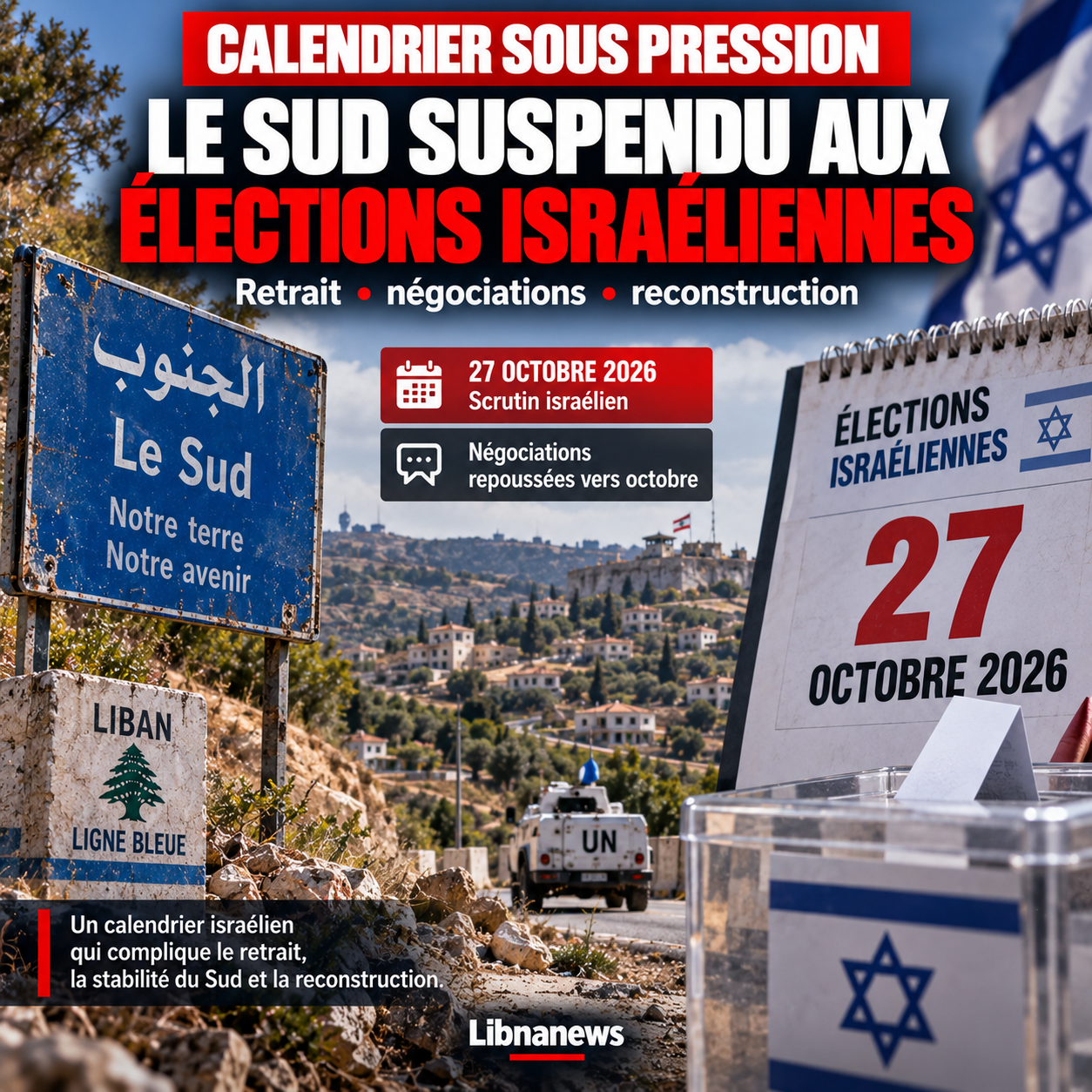
The Lebanese South calendar no longer depends solely on the commitments contained in the framework agreement, the deployment of the army or discussions between Beirut and Washington. Another deadline is now set in the calculations: the Israeli elections scheduled for 27 October 2026. Within a month of the election, the Israeli election campaign interferes with negotiations on the withdrawal of forces present in Lebanon, future security arrangements and the resumption of direct discussions. For Beirut, this situation creates a major difficulty. The government is seeking quick results on the ground, while Israeli leaders have fewer and fewer political reasons for making decisions that could be presented as concessions before the vote.
The information gathered in the corpus reveals two contradictory dynamics. On the one hand, official Lebanese sources indicate that an eighth session of direct negotiations could take place in the second half of October. The meeting would initially have been considered earlier. On the other hand, several points suggest that Washington still has to deal with Israeli constraints and that the proximity of the elections weighs on the timetable. This contradiction does not necessarily mean that one of the information is wrong. Rather, it shows that a negotiation date can be envisaged without the political conditions for substantial progress.
The problem therefore goes beyond holding a meeting. Beirut can get a new session without getting a withdrawal. A delegation may negotiate without the necessary margin to conclude. Washington can push for the resumption of dialogue while avoiding exerting maximum pressure a few weeks from an Israeli election. The diplomatic calendar and the political calendar no longer merge.
Netanyahu turns security into an electoral argument
Benyamin Netanyahu approaches the election in a campaign where security occupies a central place. As the elections approached, he presented himself as the leader capable of protecting Israel in a regional environment marked by confrontations with Iran, Gaza and other fronts. This strategy is not new. But the context of 2026 gives it a special scope.
Military operations, targeted assassinations and demonstrations of firmness enable the Israeli Government to keep security issues at the centre of the campaign. The Lebanese South is included in this table. Any decision on occupied positions, monitoring mechanisms or withdrawal can be assessed immediately through its electoral cost.
A territorial withdrawal is thus more difficult to present politically than an additional security requirement. An evacuation can be attacked by opponents to the right of the government as an abandonment of a security guarantee. Conversely, maintaining positions can be presented as a precautionary measure pending stronger Lebanese guarantees.
This asymmetry complicates Beirut’s efforts. Lebanon calls for simultaneous progress in the Israeli withdrawal and extension of State authority. But as the vote approaches, the Israeli government may need to demand more results from the Lebanese side before changing its own presence.
The electoral campaign thus turns a question of diplomatic sequencing into an Israeli internal issue.
Beirut’s « fait accompli »
Lebanese political sources expressed greater concern. In their view, Israel would not prepare, in the short term, for a full withdrawal from the South. Instead, it would seek to consolidate a safe area within a space described as the « yellow route ». These same sources fear that the settlement will be postponed until early 2027, after the Israeli and American elections.
This information must remain attributed to these sources. It does not in itself constitute evidence of an official Israeli decision to change the border on a lasting basis or annex part of Lebanese territory. However, it reveals Beirut’s main fear: that a situation presented as provisional gradually acquires de facto permanence.
Time then becomes a strategic variable. The longer a military position is maintained, the more justified it can be by new requirements. Infrastructure can be installed. Operational procedures may be established. A temporary line can eventually become a reference in the discussions.
For Lebanon, therefore, the risk is twofold. A delay blocks the return of the inhabitants and reconstruction. But it can also change the starting point for future negotiations. Instead of discussing the application of an already agreed withdrawal, the parties could eventually negotiate on the conditions for abandoning a presence that has become sustainable.
That is why Joseph Aoun insists on the need to put an end to the destruction and earth-moving operations in the southern villages affected by the Israeli presence. It also calls for the return of Lebanese prisoners, the settlement of disputed issues along the Blue Line, the gradual withdrawal of Israeli forces and the deployment of the army to internationally recognized borders. For the Presidency, the delay is not neutral: it maintains tension and prevents the State from fully extending its authority.
The Litani emerges in the countryside
The statement by Israeli Finance Minister Bezalel Smotrich on an Israeli presence that could reach the Litani adds a particularly sensitive dimension. The point comes at a time when the discussions are supposed to involve arrangements for withdrawal and restoration of the authority of the Lebanese State.
However, this declaration must be distinguished from an official decision of the Israeli Government. There is no evidence that Israel has adopted the Litani as a new border or as an official territorial objective. This distinction is fundamental. A political official may set a maximumist objective without immediately becoming a governmental or military doctrine.
But the timetable gives the declaration particular importance. In an election period, politicians have an interest in speaking to their electorates. Maximumist positions can be used to move the debate and force competitors to demonstrate their own firmness.
For Beirut, the danger begins when what comes under the electoral discourse approaches the military reality. As long as the idea of a presence until the Litani remains a declaration, it can be fought diplomatically. If it is accompanied by a concrete enlargement of the controlled areas or a long-term refusal to withdraw, the problem changes in nature.
The negotiations would no longer focus solely on the modalities for implementing the Framework Agreement. It would cover the extent of the territory that Israel would seek to retain under its control.
An eighth session became a test
In this context, the possible eighth session of negotiations takes on greater importance than the previous one. According to available information, it could be held in the second half of October. Its timetable would therefore place it only a few days before the Israeli elections.
A meeting at that particular time can perform several functions. It can enable the United States to preserve the diplomatic process and avoid its rupture. It may also allow parties to prepare decisions that would only be carried out after the election.
But the proximity of the vote reduces the likelihood of a politically costly concession. An Israeli government in the field may agree to discuss a verification mechanism or technical procedure more easily than announcing the immediate abandonment of a military position.
Lebanon is then faced with a delicate choice. Refusing to negotiate because the chances of progress are low would lose a diplomatic channel. Agreeing to negotiate without results could turn meetings into a status quo management mechanism.
Nawaf Salam expressed precisely this concern. He refused that the framework agreement should become a process for simply administering the conflict. For him, it must produce measurable changes on the ground.
The Lebanese position is based on three requests. The first is a clear timetable for Israeli withdrawal and the implementation of arms exclusivity in the hands of the State. The second is a parallel progression of these two processes. The third is the creation of a verification mechanism capable of identifying commitments on both sides.
This last point is essential. Without a control mechanism, each party can justify its inaction by the other.
Washington caught between pressure and arbitration
Lebanese officials place much of their hopes in the United States. Joseph Aoun considers that Washington has the necessary means to push Israel to implement the agreement. Nabih Berri makes a similar speech and believes that the US administration and Donald Trump are able to exert the pressure necessary to put an end to Israeli operations.
This convergence is remarkable. Lebanese officials of very different sensitivities recognize the decisive nature of the American lever.
But having a lever does not necessarily mean wanting to use it immediately at its maximum. Washington pursues several simultaneous objectives. He wants to consolidate the authority of the Lebanese State. It requires measures concerning Hezbollah’s weapons and its financial networks. It supports the strengthening of the army. It also seeks to preserve its relations with Israel in a period of strong regional tensions.
The Israeli election therefore adds a constraint. Too much American pressure could itself become a campaign argument. The Israeli government could make some claims such as externally imposed concessions.
Conversely, the absence of pressure can weaken the Lebanese government. If Beirut takes difficult domestic measures without Israeli counterpart, its opponents can argue that the diplomatic strategy does nothing.
Washington must therefore arbitrate between two risks: push too hard before the Israeli elections or wait so long as to compromise the credibility of the Lebanese process.
Hezbollah observes the relationship between concessions and results
The Israeli electoral calendar also has a Lebanese internal dimension. The government wants to move towards arms exclusivity and strengthen the army. Hezbollah contends that the issue of its weapons cannot be separated from the Israeli occupation and operations.
The later the withdrawal, the more this argument can be echoed. A prolonged Israeli presence allows the party to argue that the security conditions justifying the resistance have not disappeared.
Conversely, a verifiable withdrawal with credible military deployment would change the debate. The discussion would focus more on the need for an autonomous armed structure when the State effectively exercises its authority in the territory.
This is why sequencing is crucial. An international strategy that would call on Lebanon to settle the arms issue fully before any Israeli withdrawal may encounter much stronger political resistance. Israel is concerned that a withdrawal may be followed by the restoration of Hezbollah’s military capabilities in the evacuated areas.
Beirut’s principle of simultaneity seeks precisely to break this impasse.
Reconstruction also suspended on schedule
Delay directly affects reconstruction. Some areas cannot be rehabilitated normally as long as their security situation remains uncertain. Residents are reluctant to return when military operations continue. Donors themselves can expect more guarantees before committing large sums.
This situation has an immediate social effect. The debate on borders, elections and negotiations seems diplomatic. For the inhabitants of the South, however, it determines the possibility of returning to a village, rebuilding a house or resuming economic activity.
Each additional month of status quo also increases the cost of the adjustment. Damaged buildings continue to deteriorate. Infrastructure remains unused. Displaced populations must be supported elsewhere.
The Israeli electoral calendar therefore has consequences far beyond Israeli policy.
After October 27, the problems will not disappear
However, it would be misleading to consider elections as the only obstacle. The election may explain part of Israeli prudence, but the differences over the South are structural.
Israel calls for guarantees of Hezbollah’s military presence, weapons and control mechanisms. Lebanon calls for withdrawal, termination of operations and respect for its sovereignty. The United States wants the Lebanese State to assume more security responsibilities. The debate on the future of Finul adds an additional unknown.
On 27 October, therefore, certain decisions can be released without resolving disagreements. The Israeli government that emerged from the election, whatever its composition, will still have to determine what it considers to be a sufficient guarantee to withdraw. Lebanon should continue to clarify how it intends to ensure the exclusivity of arms and deploy its army.
The danger would be to turn the election into a new justification for waiting. After October could come another deadline, then another technical or security condition.
For Beirut, the challenge is therefore to use the current period to set principles that will survive the electoral calendar: withdrawal from Lebanese territory, parallel deployment of the army, verification mechanism, treatment of disputed issues and reconstruction of evacuated areas.
The real battle of the calendar is there. Lebanon does not control the Israeli campaign or its results. On the other hand, it may seek to prevent the elections from transforming a supposed interim arrangement in the South into a new military normal. Between an eighth session of negotiations envisaged a few days before the election, the maximalist statements on the Litani and concerns about the sustainability of a safe area, the question is no longer just when the negotiations resume. She is to knowin what state will the land be when Israel emerges from its electoral campaign.