

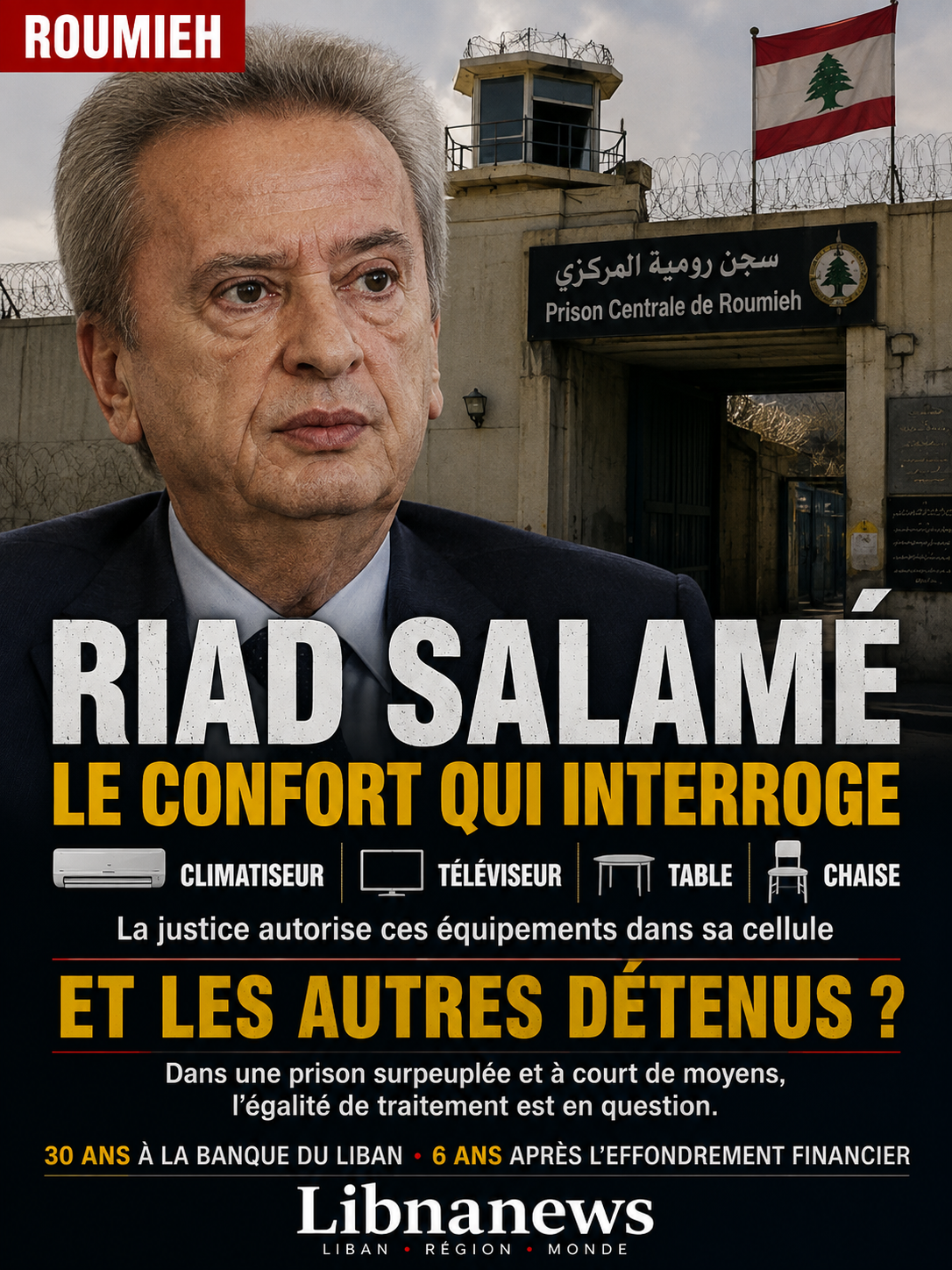
Air conditioning, TV, table and chair: Lebanese justice allowed Riad Salamé to equip his cell in Rumieh prison, according to information published Wednesday 19 August 2026. Taken in isolation, the layout may seem anecdotal. It is much less so when it concerns the former governor of the Bank of Lebanon, pursued in major financial cases after leading for thirty years the institution at the heart of the system that collapsed in 2019. In a prison marked by overcrowding and chronic lack of resources, the case mainly raises a question of equality before detention: are the conditions granted to one of the country’s most powerful former men accessible to ordinary prisoners?
It took the prison for Riad Salamé to officially request an air conditioner, a television, a table and a chair from the court. The request was accepted, according to the information published on Wednesday, and the former governor will therefore be able to dispose of these equipment in his cell in Roumieh subject to the practical arrangements for their installation.
None of these four pieces of equipment obviously changes the judicial situation of the former governor. They do not reduce the charges against him, do not constitute release and do not prejudge the outcome of proceedings. Riad Salamé remains presumed innocent until a final decision has established his guilt in the relevant cases.
But information has a political and social dimension that is difficult to evacuate. It concerns the man who led the Bank of Lebanon from 1993 to 2023, during the construction and then the collapse of a financial model that left hundreds of thousands of depositors unable to access their savings normally.
The question therefore is not to demand that Riad Salamé be detained in unworthy conditions. It is much simpler:why would an ordinary inmate in Roumieh not benefit from the same conditions?
Air conditioning, TV, table and chair in Roumieh
The list reported on 19 August is precise. Riad Salamé asked for permission to equip his cell with an air conditioner, a TV, a table and a chair, and justice agreed.
There are, however, several elements to be established before talking about public administration. The available information does not specify who will buy the equipment, who will pay for their installation or how the electric consumption of the air conditioner will be financed. There is therefore no basis at this stage for stating that these expenses will be borne by the prison administration or the taxpayer.
What is acquired is different: the former governor obtained permission to dispose of these facilities in the prison compound.
The table and chair can hardly be considered extravagant objects. In the case of a defendant engaged in complex judicial proceedings, having a space for reading and working can meet a concrete need, including preparing his defence with his lawyers.
The TV and, above all, the air conditioner report more of a material improvement in detention. This is where information takes its full bearing in the context of Roumieh.
Roumieh prison is not known for its comfort
Roumieh concentrates a significant part of the dysfunctions of the Lebanese prison system. Overpopulation, ageing buildings, inadequate health facilities, pressure on medical services and a high number of remand prisoners are recurrent problems.
The economic crisis opened in 2019 further exacerbated this situation. The collapse of the pound reduced the financial capacity of the state at the same time as food, medicine, fuel, spare parts and maintenance became more expensive.
The detainees suffered this degradation directly.
Families have had to take on an increasing part of the needs of their imprisoned relatives. Humanitarian organizations have had to intervene to support certain services. The prison management forces themselves suffered the collapse of their purchasing power.
It is in this environment that the authorization granted to Riad Salamé must be replaced.
The contrast, therefore, is not only between a cell with an air conditioner and a cell without an air conditioner. He opposedthe ability of an inmate with resources and lawyers to request individual accommodation for prisoners almost entirely dependent on the limited means of administration and their families.
The former strongman of the Bank of Lebanon is not an anonymous detainee
This difference would be less politically sensitive if the detainee concerned were not Riad Salamé.
For three decades, the former governor held one of the most powerful positions in the Republic. Arrived at the head of the Bank of Lebanon in 1993, he crossed governments, presidencies, political crises, wars and changes of majority without losing his post.
For a long time, its balance sheet was presented as a guardian of monetary stability. The parity of the pound with the dollar, the growth of the banking sector and Lebanon’s ability to attract capital have built its international reputation.
This image collapsed with the system itself.
Starting in 2019, banks imposed drastic restrictions on depositors. The book lost most of its value. The savings accumulated for years were found to be inaccessible or deeply depreciated, while the state was lacking on its debt in March 2020.
The World Bank described the Lebanese crisis as one of the most serious global economic crises since the mid-19th century.
Riad Salamé cannot, of course, be held legally responsible for all of this collapse simply by association with his function. Economic and political responsibilities include governments, banks, political leaders and fiscal choices accumulated for decades.
But it is equally impossible to treat his thirty years at the Central Bank as a peripheral element of this history.
Financial engineering at the heart of the system
Under Riad Salamé, the Bank of Lebanon has developed increasingly complex financial operations in order to attract currencies and preserve the parity of the pound.
Beginning in 2016, operations commonly referred to as « financial engineering » became more widespread. They provided banks with significant returns in exchange for foreign currency contributions to the system.
The immediate objective was to strengthen reserves and maintain financial stability.
The problem was structural: the system needed continuous inflows of dollars to finance the accumulated imbalances. When the flows slowed down and then reversed, the architecture became impossible to maintain.
The losses then broke out in the open.
The international financial institutions subsequently stressed the need to recognize and distribute these losses among the State, the Central Bank, banks and other stakeholders. This issue remains at the heart of the political conflict over Lebanese financial restructuring.
For depositors, the result has been much more concrete: bank accounts sometimes showing lifetime savings without the possibility of freely withdrawing the corresponding sums.
It is this past that today makes the image of the politically explosive air conditioner.
Procedures that go far beyond the management of the Central Bank
However, the former governor is not in Roumieh because the book collapsed under his mandate.
This essential distinction must be maintained.
The legal proceedings against Riad Salamé concern specific financial transactions and specific charges that must be examined by the court. In both Lebanon and Europe, investigations have focused on the movement of funds, its assets and financial relations involving, inter alia, Forry Associates, linked to its brother Raja Salamé.
European magistrates have been investigating hundreds of millions of dollars in financial flows and assets suspected of being linked to these operations for several years. Seizures and freezing of assets were ordered in several countries.
Riad Salamé rejected the charges against him. He argued that his fortune came from his previous professional activity in finance and investments made during his career.
These denials must be reported with the same precision as the accusations.
Criticism of its record at the Bank of Lebanon cannot be used as a substitute for a judicial conviction. But the presumption of innocence does not mean that his public action for 30 years must escape critical examination.
For applicants, the contrast is brutal
The authorisation granted to Roumieh comes at a time when the banking crisis is still not fully resolved.
Years after the collapse began, the fate of deposits remains linked to financial reforms, bank restructuring and the distribution of accumulated losses in the system.
This slowness gives the case of the cell a particular dimension.
The former governor may apply to a judge for permission to materially improve his detention space and obtain a response. Depositors have been waiting for years for a definitive framework to determine the conditions under which they will recover their money.
The two situations obviously do not fall within the same institution or procedure. Legally opposing them would make no sense.
Politically, however, the image is powerful.
It recalls the gap that characterized the entire Lebanese crisis: those with privileged access to institutions, information, currencies or power networks did not experience collapse in the same way as ordinary households.
It is precisely for this reason that each particular treatment given to a former senior official is observed with suspicion.
A VIP cell? We still have to prove it
This suspicion does not exempt the verification of the facts.
The authorization of an air conditioner and a TV is not sufficient to demonstrate that Riad Salamé enjoys an illegal prison regime or a « VIP cell ». To assert this, it would be necessary to know precisely the rules applied in Roumieh and compare them with those imposed on other detainees.
Can other prisoners install a television set? Can they get a fan or air conditioner? Who authorizes this equipment? Are there any medical or equipment criteria? Are the devices funded by families? Is electricity billed or supported by the establishment?
Without these answers, the charge of privilege remains to be demonstrated.
But this lack of information is itself a problem.
In a transparent prison system, the rules on authorized equipment should be known and identical for prisoners in comparable situations. The opinion should not have to guess whether a former governor enjoys a favour or a right accessible to all.
Air conditioner asks the most embarrassing question
Of the four equipments, the air conditioner logically concentrates attention.
It requires an electrical installation and consumes much more energy than a table, chair or even a TV. In the Lebanon of 2026, this question is not trivial.
The country continues to live with a fragile electrical system, marked by years of rationing and the massive use of private solutions. Public administrations themselves have suffered from this shortage.
In Roumieh, operating an air conditioner therefore requires sufficient power.
Who provides it? How long? At what cost? Will the device operate on the prison network or will it require a specific device?
As long as these questions remain unanswered, we must avoid saying that the state will pay Riad Salamé for air conditioning. But they deserve to be laid down precisely because the authorization does not concern a passive object: it involves the continuous consumption of a resource which the prison system does not necessarily have in abundance.
The problem is not that Salamé is treated with dignity
It would be easy to turn the case into a request for additional punishment.
That would be missing the real stake.
A defendant, even when one of the country’s most powerful public officials, retains rights. The presumption of innocence remains. Conditions of detention must respect human dignity and cannot constitute an early sentence.
Riad Salamé therefore did not have to be subjected to degrading conditions because some of the population attributed him political or moral responsibility in the financial collapse.
The question is exactly the opposite:if certain conditions are necessary for Riad Salamé’s dignity, why would they not be necessary for all the detainees in Roumieh?
This is where authorization becomes a subject of prison policy.
Equal justice does not involve removing a chair from the rich prisoner. It consists of ensuring that the poor prisoner can also sit properly. It is not a matter of making a former governor suffer from heat, but of determining what temperatures and ventilation conditions are acceptable to the entire prison population.
Does Roumieh reproduce the inequalities of Lebanon?
Prisons are supposed to withdraw liberty, not redistribute conditions of detention according to heritage.
In Lebanese reality, however, personal and family means play an important role. A prisoner whose family can provide food, medicine, clothing or other property is not in the same situation as a prisoner who has no external support.
The prison state weakened by the crisis thus leaves some of its own shortcomings to be compensated by private resources.
The Salamé case pushes this logic to its most visible point.
The former Governor has the financial means, the lawyers and the procedural capacity to request a precise layout. Justice allows it. So the system works for him.
The journalistic question then becomes that of the prisoner placed a few cells further: is he aware of this procedure, can he formulate the same request and, above all, does he have the material means to benefit from the same authorization?
If the answer is no, the problem goes beyond Riad Salamé.
It would mean that the inequalities that structure Lebanese society are crossing the prison doors without difficulty.
A small case that refers to a huge bankruptcy
Of course, an air conditioner does not constitute the Riad Salamé dossier.
The main thing remains elsewhere: the legal proceedings, the financial transactions examined, the responsibilities that can be established or ruled out and the fate of the funds under investigation.
But this small material case has a strength that the financial records of several thousand pages do not have.
It is immediately understandable.
For three decades, Riad Salamé held the summit of the institution responsible for preserving currency and financial stability. After the collapse, Lebanese people saw their incomes evaporate, their economies become inaccessible and public services deteriorate. The former governor, now detained and still presumed innocent, obtains judicial authorization to install an air conditioner and television in his cell.
It would not be accurate or fair to automatically deduce an illegal privilege.
But after thirty years of power and six years of crisis, Riad Salamé remains a case wheretransparency must be greater, not weaker. The judiciary and the prison administration can therefore quickly dispel the suspicion: publish the applicable rules, specify who finances the equipment and indicate whether any prisoner placed under the same conditions can obtain the same authorization.
Otherwise, the Roumieh air conditioner will remain what the Lebanese financial file has been producing regularly since 2019: a small material issue behind which immediately reappears the much broader question of whether the same rules really apply to everyone.




