

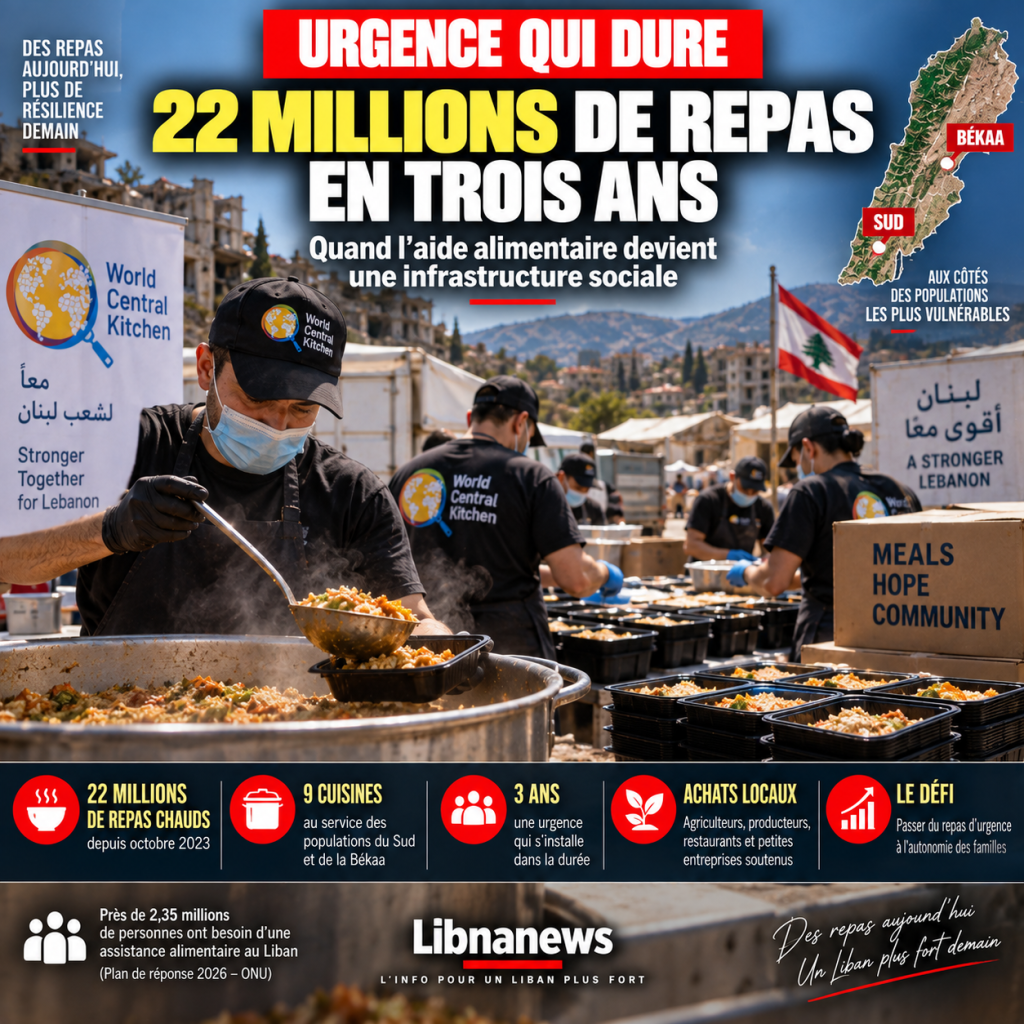
Nine kitchens to respond to a crisis that refuses to stay temporary
Approximately 22 million hot meals distributed over three years: the figure gives an unusual measure of the depth of needs that have emerged in Lebanon since October 2023. During a meeting with President Joseph Aoun, an international humanitarian organisation specializing in food aid presented the development of its operations in the country. Its structure includes nine kitchens and local partnerships. It works with the most vulnerable populations and displaced persons, particularly in the South and the Bekaa. Behind the impressive volume of meals served is however a more important question than the logistical performance. A mechanism designed to respond to the emergency is becoming a sustainable social infrastructure. The difference is fundamental. Humanitarian cooking normally occurs when a shock temporarily prevents a population from feeding normally: war, displacement, disaster or destruction of a supply network. When the device works for several years and produces millions of meals, it no longer responds only at the time of the disaster. It is beginning to fill the gaps in an economic and social system that does not allow all households to regain their autonomy quickly.
However, the figure of 22 million must be interpreted with caution. This is a cumulative number of meals and not the number of different people receiving assistance. The same family may have benefited from the device for several days or months. It would therefore be incorrect to convert this volume directly into a number of single beneficiaries. However, it reveals the scale of the operation. Over three years, 22 million meals correspond to several tens of thousands of servings on average each day, although activity has necessarily varied with periods of conflict and displacement. The presence of nine kitchens also shows that the model is not that of a one-time distribution of imported packages. It is based on a daily preparation capacity, with supply, personnel, cooking, packaging, transport and identification of priority areas. Such a humanitarian cuisine must be able to rapidly increase its production when massive displacement occurs and then reduce it when the inhabitants return home. It must also operate despite power cuts, fuel problems and road disturbances. Food aid thus becomes a real logistics network. Its persistence since 2023 indicates that needs do not disappear with the end of an acute phase of fighting. They transform and move.
In the South, food accompanies travel and returns
The South is one of the main territories concerned. Confrontations, destruction and displacement have disrupted normal feeding conditions. A family leaving their village does not necessarily lose its housing. She may lose access to her kitchen, garden, usual business, or an agricultural activity that provided part of her income. When she arrives at a school, a collective centre, with relatives or in temporary accommodation, daily meal preparation becomes an immediate problem. Food aid then responds to a basic need: to allow an displaced population to eat while other forms of assistance are in place. But returning to the village does not automatically end if necessary. A house can be damaged. Water or electricity systems can be difficult to operate. A trade may not have reopened. A farm may have been abandoned for several months. Geographical return does not necessarily mean a return to economic autonomy.
This reality explains why food must be thought of with reconstruction. Distributing a meal meets the need of the day. Repairing a home, reopening a road, allowing a farmer to resume his activity or a trade to restart gradually reduces the need to distribute this meal. Both policies should therefore move forward together. If reconstruction is slow, food aid continues. If income does not return, the household may have a functional kitchen but cannot afford to buy enough products. The social issue then joins the humanitarian issue. Lebanon has markets and shops. He is not confronted with a general disappearance of food. The problem for many households is economic access to products, aggravated in some areas by war and displacement. This distinction is important. It means that the answer cannot rely indefinitely on free meal production. As local conditions normalize, monetary support, income support programmes or purchases from local producers can become more appropriate. The emergency kitchen must be able to transform itself into a gateway to a local economy that is functioning again.
Bekaa reveals another dimension of food vulnerability
The large presence of the device in the Bekaa recalls that the needs are not exclusively related to the destruction of the South. The region has a long history of concentrated populations with fragile incomes, agricultural workers and displaced persons. Successive economic crises have reduced household capacity to absorb unforeseen expenditure. In this context, food becomes one of the first variables to adjust the family budget. A household cannot remove its rent or certain health costs. On the other hand, it can buy less meat, replace certain products with cheaper foods, reduce servings or reduce the diversity of its diet. Food insecurity does not always appear in the spectacular form of hunger. It can take the form of a gradual degradation of nutritional quality.
Hot meals have a particular advantage here. They provide a complete portion without forcing the household to have the fuel, electricity, utensils or time to cook. They are particularly suitable for travel and emergency situations. But they also have a limit: they create a daily dependence on the distribution network. A food package or financial aid leaves more choice to the household. A prepared meal meets a specific need at a specific time. Humanitarian programmes must therefore adapt their tools to the situation of beneficiaries. A family that has been displaced for a few days does not have the same needs as a family that has been living in temporary housing for several months. In the first case, collective cooking can be the most effective solution. In the latter, allowing the household to make its own purchases can contribute more to its autonomy. The volume of 22 million meals shows the power of the device. It also raises the question of its ability to change its methods as crises change in nature.
Behind each meal, a local economy can be sustained or bypassed
One of the most important aspects of the model is local partnerships. An operation of this magnitude buys considerable amounts of food. The choice of suppliers therefore has an economic effect. Locally buying vegetables, bread, agricultural products or services makes it possible to turn part of humanitarian aid into activity for producers and businesses in the region. Conversely, massive import of already prepared products can respond quickly to the emergency but reduce this multiplier effect. The use of kitchens in the country offers the possibility of linking assistance with the local economy. A meal can simultaneously feed a displaced person and create an order for a farmer, baker, transporter or cook.
This logic is particularly interesting in Lebanon because some beneficiary regions are also agricultural regions. Bekaa and Akkar produce a significant portion of the country’s fruits, vegetables and other commodities. The South also has agricultural sectors affected by the clashes. A local supply policy can therefore support producers at a time when their markets are weakened. However, it requires a rigorous organization. The necessary volumes must be available. Products must meet health standards. Prices must be sufficiently competitive for the program to serve a large number of meals. Finally, purchases should not themselves cause tension in local markets in areas where supply is limited. Food aid then becomes a miniature economic policy. It must decide where to buy, at what price and from whom. The longer it lasts, the more these choices affect the territories concerned. This is an additional reason for making the operation of the scheme transparent and for assessing its impact not only on beneficiaries but also on local economies.
When the emergency lasts three years, the border with social protection disappears
Perhaps the main teaching of 22 million meals is in the long term. An intervention launched or strongly strengthened after October 2023 continues to occupy an important place in September 2026. However, three years represent a long period for a qualified emergency device. The persistence of needs means that the crisis has produced structural vulnerabilities or has overtaken existing ones. The risk is that humanitarian aid will become a parallel form of social protection. Non-State organizations identify beneficiaries, finance meals, manage kitchens and organize distribution. They perform an essential function. But they can also end up assuming a mission that public institutions should gradually resume or integrate into a national policy.
The problem is not whether humanitarian organizations should leave. A brutal exit would leave the most fragile households without a solution. The challenge is to organise the transition from emergency to social protection. This implies knowing who still depends on free meals because he is displaced, who depends on it because his income is insufficient and who could regain his autonomy with another form of help. These situations require different answers. A single elderly person may need a long-term meal service. A family whose main support has lost its job can benefit more from temporary income and work support. A family whose house was destroyed needs reconstruction. Treating these three cases with the same daily meal is effective in an emergency, but insufficient as a social policy. The challenge for the next few years will therefore be to transform the data accumulated by humanitarian programmes into tools for a more targeted response, while protecting the personal information of beneficiaries.
The state cannot rebuild its presence by leaving food entirely to NGOs
The file joins a broader issue that crosses Lebanon in 2026: the return of the State to territories and services. The government seeks to strengthen the army, rebuild the South, reform banks and modernize administrations. Social protection is part of the same problem. A citizen who is permanently dependent on an external organisation for an essential meal has a different relationship with the State than a citizen with a predictable public mechanism. This does not mean that the administration itself has to cook millions of portions. It can work with specialized organizations, municipalities and local businesses. But it must be able to define criteria, coordinate programmes and know the needs.
Coordination is also necessary to avoid duplication. In a prolonged crisis, several organizations can intervene in the same territory. Some families receive several forms of assistance, while others are left out for lack of information or documentation. A stronger national social protection system would help to better identify vulnerabilities. But its construction faces well-known difficulties: administrative fragmentation, weak resources and distrust of institutions. Humanitarian organizations sometimes have a faster operational capacity than ministries. The risk is then to transform this efficiency into a permanent solution. An NGO may change its priorities or lose funding. A State cannot sustainably base food security on the annual availability of external funding.
Twenty-two million meals also raise the question of future financing
Such an operation requires considerable resources. Food is only part of the cost. Kitchens, staff, equipment, storage, packaging, transport and sanitary facilities must be financed. When the urgency attracts international attention, donors can quickly mobilize funds. The longer the crisis lasts, the more difficult it becomes. New disasters are emerging elsewhere. Priorities change. Humanitarian budgets are distributed among an increasing number of needs.
Lebanon must therefore anticipate the risk of donor fatigue. An infrastructure of nine kitchens can meet peaks of demand, but its maintenance depends on stable funding. If resources decline while needs persist, the organization will have to reduce the number of meals, change its criteria or close some points. Populations that have become accustomed to the device will then undergo a further rupture. The best way to reduce this risk is to gradually reduce the number of people in need of daily food aid. This again refers to income, reconstruction and employment. The success of a food programme should not be measured solely by the increase in the number of meals served. In the long term, it should also be measured by the number of families that do not need it anymore.
From the emergency to a resilience strategy
However, the network established since 2023 has a value that could survive the crisis. Nine kitchens capable of producing large quantities of meals quickly represent a useful infrastructure for a country exposed to conflict, displacement and disasters. Rather than completely dismantle this capacity when needs decrease, a part could be integrated into a national emergency preparedness system. Stockpiles, suppliers and trained teams could be mobilized quickly during a new massive displacement or natural disaster. The difference would be that this capacity would stay on standby rather than feeding tens of thousands of people daily for lack of social solution.
The network can also transfer skills to local actors. Municipalities, associations and small businesses involved in operations now have a large-scale logistics experience. This skill can be used for other social or disaster preparedness programmes. The challenge is therefore to preserve capacity without preserving dependency. Lebanon needs to be able to produce hundreds of thousands of meals quickly when an emergency demands it. It should not need to do so on an ongoing basis to compensate for insufficient income and services.
The figure of 22 million meals sums up two opposite realities. It demonstrates a remarkable ability to mobilize food aid under difficult conditions. At the same time, it reveals the extent of a vulnerability that has lasted for three years. As long as the kitchens have to operate at a massive level to meet ordinary needs, the emergency will not really be over. The transition will begin when the hot meal becomes what it should be in a humanitarian policy: an immediate response to a shock, before housing, income, work and public services allow families to take over control of their food themselves.





Comments